
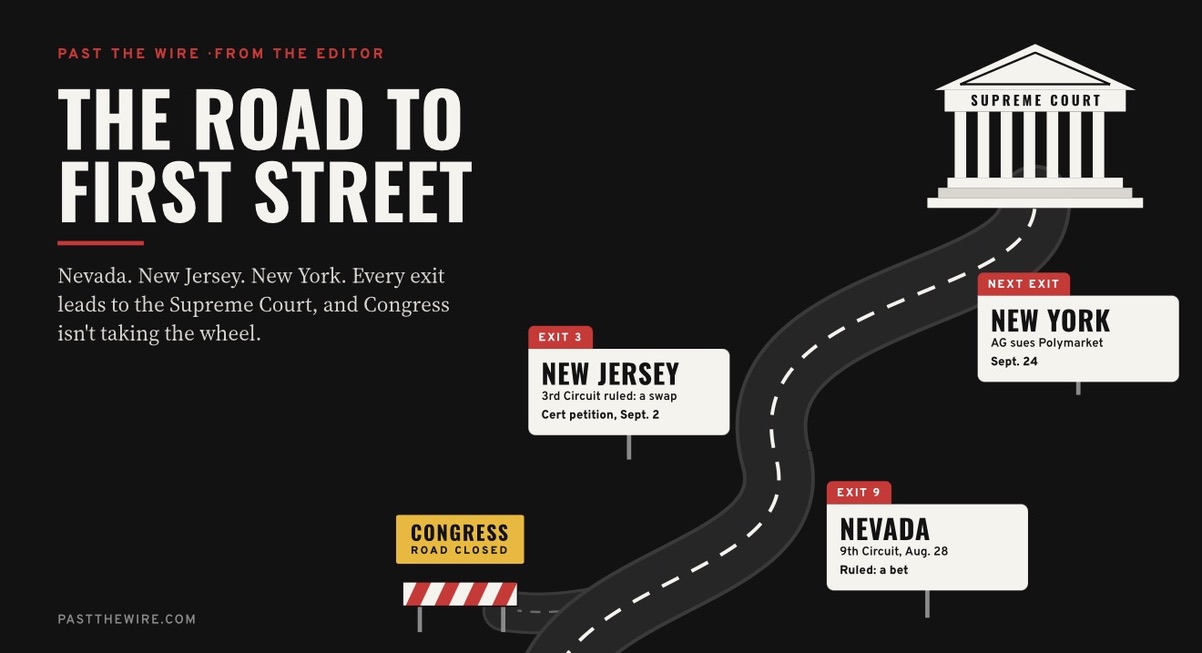

The fight over prediction markets did not slow down after the Ninth Circuit ruled against Kalshi on August 28. It sped up. On Thursday, New York Attorney General Letitia James sued Polymarket US, accusing it of running an unlicensed gambling business. It was her fourth enforcement action against a prediction market operator, following Coinbase and Gemini in April and Kalshi in July. Polymarket did not wait long to answer. The same day, it removed the case to federal court and filed its own lawsuit against James and the New York Gaming Commission, arguing that federal commodities law preempts New York’s gambling laws. That is the pattern now. A state says gambling. A platform says federal preemption. Both sides head to court, and the courts keep disagreeing.
I have written twice about the Ninth Circuit’s decision. First on what it meant, and then on whether the court asked the right question when it compared what a customer owns on Kalshi with what a customer owns at a sportsbook. I am not going to relitigate either column here. The question now is a different one. Who ultimately decides this? Congress wrote the Commodity Exchange Act, so the obvious answer is Congress. I don’t think that is how it plays out. I think this goes to the Supreme Court, and I think the Supreme Court’s answer will stand for a long time, because Congress is unlikely to step in before or after. I could be wrong. Here is why I don’t think I am.
The Road to the Court Is Already Paved
The Supreme Court rejects roughly 99 percent of the petitions it receives. The cases it does take tend to share a common feature, and this one has it. When two federal appeals courts read the same federal statute and reach opposite answers, the law means one thing in Newark and something else in Las Vegas. The justices generally do not let that stand.
That is exactly where we are. In April, the Third Circuit ruled 2-1 that Kalshi’s sports contracts are likely swaps under the Commodity Exchange Act and that New Jersey’s gambling laws are preempted. In August, a unanimous Ninth Circuit panel ruled the same contracts are likely sports bets and that Nevada may enforce its gaming laws. Same company. Same instruments. Same statute. Opposite results.
New Jersey moved quickly. On September 2, one day before its extended deadline, the state filed a 332-page petition asking the Supreme Court to hear the case. The question it presented is whether Dodd-Frank preempts states from regulating sports bets offered on CFTC-registered markets. Robinhood, a party to the Nevada litigation, has filed its own petition asking the Court to review the Ninth Circuit’s decision. Kalshi went a different route and asked the full Ninth Circuit to rehear the case en banc. If that succeeds, the panel’s opinion could be vacated and the split could disappear, at least for a while. Kalshi’s strategy makes sense, but full-court rehearings are rarely granted. The Fourth Circuit, which heard arguments on Maryland’s case in May, still has not ruled. One judge on that panel said from the bench that if it quacks, it is a duck. Whatever the Fourth Circuit decides, it will add another data point to a split that is already there.
None of this happens quickly. People who follow the docket closely expect arguments no earlier than the fall of 2027, with a decision around the summer of 2028. That is two more football seasons, two more March Madness tournaments and billions more in volume while everyone waits. But the path is clear.
Why Not Congress?
In fairness to Congress, it has not ignored the issue. Bills have been introduced. Nevada Representatives Steven Horsford, a Democrat, and Mark Amodei, a Republican, introduced the Prediction Markets Are Gambling Act this summer. It would prohibit sports and casino-style contracts on federally registered exchanges while leaving weather, economic and other legitimate hedging contracts alone. Senators Adam Schiff, John Curtis and Catherine Cortez Masto filed a companion bill in March. Other bills target insider trading, election contracts, war and assassination markets, and trading by members of Congress themselves. This is not purely a partisan issue. Forty-four states told the CFTC this summer that it has no authority over sports prediction markets, and that coalition spans the political map. Opposition to these markets comes from red states and blue states alike.
That is the argument for Congress. Here is the problem.
Groucho Marx, playing a college president in Horse Feathers, sang a song called “Whatever It Is, I’m Against It.” Nearly a century later, that could serve as the operating manual on Capitol Hill. Congress in recent years has not been known for passing laws. It has been known for not passing them. Bills get introduced, press releases go out, hearings are held, and then the bill dies in committee, where most bills end up. A bipartisan list of sponsors is a start. It is not a law. For a bill to become law, it has to get floor time in both chambers, survive leadership that has other priorities, and avoid becoming a bargaining chip in a fight about something else entirely. This Congress does not do that often, and it does even less of it in an election year.
There is a second problem, and it may be bigger than gridlock. The federal regulator is on the other side. The current CFTC has been openly receptive to prediction markets. It dropped the government’s appeal in the original Kalshi litigation, withdrew the prior administration’s proposed rule, and has gone to court itself arguing that federal law preempts state regulation of sports contracts. A bill that strips sports contracts out of the CFTC’s jurisdiction is not just a bill that needs votes. It is a bill that runs against the position of the administration’s own regulator. Even a bipartisan majority has to reckon with that.
Put it together and the likely outcome is not a clean statute from Congress. It is nine justices reading a statute Congress wrote in 2010, after a financial crisis, without prediction markets in mind.
The CFTC Is Rewriting the Rulebook Mid-Race
The agency is not sitting still. In June, the CFTC proposed changes to Regulation 40.11, the rule covering event contracts involving gaming and other enumerated activities. That matters because the Ninth Circuit leaned on the current version of that rule as an independent reason Kalshi’s sports contracts cannot claim federal protection. I wrote earlier that the Special Rule and Regulation 40.11 might be Kalshi’s greatest legal problem. The CFTC now appears to be working on that problem for Kalshi.
That does not change what I said on August 30. The CFTC can write regulations. It cannot rewrite an Act of Congress. A revised rule could remove one leg of the Ninth Circuit’s reasoning. It cannot turn a sports bet into a swap if the Supreme Court decides the statute does not allow it. So the agency’s rulemaking does not replace the Court. It raises the stakes of what the Court eventually says. If the justices find these contracts are swaps, a friendly CFTC gets to decide which sports markets survive, and states lose the fight. If the justices find they are not, no amount of rulemaking fixes that. At that point, as I said before, only Congress could fix it.
The Answer Will Last Because Congress Won’t Change It
This is the part people should think hardest about. When the Supreme Court interprets a statute and Congress disagrees, Congress can simply amend the statute. That is the design. It assumes a Congress that acts. When Congress does not act, a statutory ruling from the Court effectively becomes permanent.
We have seen this before. When the Court decided Murphy v. NCAA in 2018, it left sports betting to the states, and Congress never followed up with a federal framework. States built their own systems in the space the Court opened, and those systems are now at the center of this fight. Whoever loses in the Supreme Court will run straight to Capitol Hill asking for a fix. If Congress stays true to form, they will be asking for a long time.
That is why this case matters so much more than one company’s business model. The Supreme Court is not just going to referee a dispute between Kalshi and Nevada. In the absence of Congress, it is likely going to decide who controls sports wagering in America for the foreseeable future: fifty state gaming regimes built after Murphy, or a single federal regulator applying a financial statute to the Super Bowl.
For horseplayers, the stakes are not abstract. Racing has its own federal law, the Interstate Horseracing Act, which is one of the few places where Congress clearly addressed interstate wagering. Every other form of sports wagering is now waiting to find out whether a law written for derivatives covers it too. Pari-mutuel handle competes every day with products that carry no state license, no racing takeout and no contribution to purses. How the Court answers this question will shape the racing industry’s competitive landscape as much as that of any sportsbook.
Congress created this problem with broad language in 2010. Congress could fix it with clear language tomorrow. Based on everything we have seen, I would not bet on it. There is even a prediction market on whether Congress will pass a ban this year. The irony is hard to miss.
Nine justices will likely end up answering the question gamblers settled a long time ago. When I put money down because I think one team will beat another, did I make a trade, or did I make a bet?
Are you watching closely?


Comments