


Bill Finley wrote an interesting piece in the Thoroughbred Daily News about Tripadvisor’s decision to place an animal-welfare warning on pages for racetracks around the world. Saratoga, Keeneland, Del Mar, Churchill Downs, Santa Anita, Monmouth Park and others now carry essentially the same message: the business does not currently meet Tripadvisor’s Animal Welfare Policy. Tripadvisor’s policy goes further, saying it will not facilitate ticket sales for experiences where domesticated animals are placed at heightened risk of injury or death for sport or entertainment, specifically identifying most horse, dog and camel racing.
Predictably, racing isn’t happy. The British Horseracing Authority called the decision surprising and troubling, and other racing organizations have pointed toward decades of investment, veterinary science and welfare improvements. I understand the reaction. Nobody who loves this game enjoys seeing horse racing characterized as an activity that doesn’t meet someone’s animal-welfare standards. Before racing gets too angry with Tripadvisor, however, perhaps we should ask a more uncomfortable question. Why did Tripadvisor believe it could say this in the first place, and why will plenty of people outside horse racing read that warning and think they have a point?
If racing in the United States thinks PETA and Horse Racing Wrongs are the only people who feel this way, newsflash: they aren’t. This isn’t PETA putting a warning on Saratoga’s page. It isn’t Horse Racing Wrongs doing it. It is Tripadvisor, one of the largest travel platforms in the world. Racing can call that unfair. Racing can cite its safety improvements. Racing can explain everything it does for horses. Some of those arguments are legitimate and some deserve to be heard. What racing cannot afford to do is dismiss every outside criticism as coming from people who don’t understand the game. Eventually enough people who don’t understand your game can determine whether your game maintains its social license to exist.
I have personally struggled with this issue since I was a kid. I saw my first catastrophic breakdown more than half a century ago and I remember it. I remember plenty of others since. I have spent most of my life around horse racing. I made my living betting on horses. I love the game. When I sit down to watch the races or walk into a racetrack, however, my first “ask” isn’t that I win. My first ask is for safe racing. Bring every horse and every rider back safely. Then we can worry about cashing tickets. I don’t believe that makes me anti-racing. I think it makes me somebody who understands what we owe the animal without whom none of us has a game.
We have all heard that horses love to run and compete. Some absolutely do. Anyone who has spent enough time around good racehorses has seen it. They know when it is race day. Some thrive on competition. But let’s stop pretending every horse loves everything we ask it to do every day. They don’t. Horses can be sore. They can have issues better served by rest. They can be frightened. They can have physical problems that aren’t obvious to somebody standing along the rail. And there is an uncomfortable economic reality we shouldn’t be afraid to acknowledge. Resting a racehorse costs money. Racing one provides an opportunity to make money. That doesn’t make owners or trainers bad people. Most care deeply about their horses. It does mean the system contains an economic incentive that should never be allowed to influence a medical decision about whether a horse should race.
We also need to give credit where it is due. HISA has made racing safer. That isn’t an opinion. In 2025, tracks operating under HISA rules recorded 1.04 racing-related fatalities per 1,000 starts, nearly a 50 percent decline from the 2.00-per-1,000 rate when national reporting began through The Jockey Club’s Equine Injury Database in 2009. HISA also reported that tracks outside its jurisdiction had a higher rate in 2025. California, after the horrific period at Santa Anita in 2019, instituted sweeping changes involving veterinary practices, training methods and racetrack operations and has experienced a dramatic decline in fatalities. Those numbers matter, and HISA and California deserve credit for them. More importantly, those numbers prove something racing should never forget: intervention works.
That is also why “breakdowns are inherent to racing” is not good enough anymore. Yes, there will always be risk when 1,100-pound animals run at roughly 40 miles an hour. There is risk to horses. There is risk to jockeys. There is risk in virtually every athletic competition. But if regulatory changes, veterinary scrutiny, medication controls, diagnostics and improved racetrack practices have already reduced fatalities, then clearly at least some of what we once shrugged off as inherent wasn’t inherent at all. It was preventable. The only intellectually honest response to that discovery is to ask how much more is preventable.
We should also consider how racing handles a catastrophic injury when one happens in front of the public. A horse goes down. The screen goes up. The horse ambulance arrives. Sometimes the horse walks into it. Sometimes the outcome is far worse. The announcer appropriately becomes solemn, there is an uncomfortable period of silence, and before long racing produces its own rendition of “the show must go on.” The horses for the next race come onto the track, the betting pools open and everybody moves forward. There are logistical reasons for that. There are humane reasons for putting up the screen. Nobody needs to turn a catastrophic injury into a spectacle. But put yourself in the shoes of somebody seeing it for the first time. A horse may just have died in front of them, and minutes later we’re discussing the Pick 4. Then imagine telling that person breakdowns are simply inherent to the game. Is it really difficult to understand why that answer doesn’t work outside our walls?
Maybe the language itself needs to change because the philosophy behind it needs to change. There is risk in racing. Our obligation should be to identify every risk we can identify, eliminate every risk we can eliminate and never accept a preventable death as the cost of doing business. That isn’t promising zero fatalities. Nobody can honestly promise that. It is refusing to use the impossibility of reaching zero as an excuse for not getting closer to it.
That brings us to questions racing should be asking, and I am asking them as a horseplayer, not pretending to be a veterinarian. Should certain injuries automatically trigger mandatory stand-down and return-to-racing protocols similar in concept to medication stand-down periods? Not simply thirty or sixty days because somebody picked a number, but a medically designed protocol requiring treatment, rehabilitation, progressive conditioning and objective veterinary clearance before the horse returns. Should specific warning signs trigger advanced diagnostic imaging before another start? Should horses returning from certain injuries be required to satisfy defined medical benchmarks rather than simply appearing on an entry sheet when connections believe they are ready?
Should we develop something resembling the concussion protocols used in other sports, adapted obviously for the horse? A horse displaying particular risk factors—lameness, repeated veterinary scratches, abnormal gait, concerning diagnostic findings, significant treatment history or other defined indicators—would enter an equine return-to-racing protocol. Clearance wouldn’t depend upon optimism, economics, field size or the calendar. It would depend upon objective veterinary standards. And perhaps the veterinarian responsible for making that decision should be institutionally insulated from anyone concerned about whether Saturday’s fifth race has six horses or ten.
Should racing look seriously at workload? Is an offseason appropriate, or is that too simplistic? Horses aren’t machines and neither rest nor exercise can be reduced to a number on a calendar. Bone adapts to workload. Conditioning matters. Too much high-speed work can be dangerous, but bringing a horse back improperly after prolonged inactivity can create different risks. Perhaps the better question isn’t whether every racehorse needs the same offseason. Perhaps every horse needs an individualized recovery and conditioning cycle based upon what that horse has actually done and what its body is telling us.
Technology should be part of this discussion. Standing PET scans, MRI, CT, nuclear scintigraphy and other diagnostic tools have advanced enormously. HISA’s newest safety reporting is beginning to break fatality data into more granular categories, including racing surface and race type, specifically so patterns can be identified and opportunities for intervention targeted. Good. Follow the data wherever it goes, including places the industry may not particularly enjoy going. If certain surfaces, conditions, workloads, injury histories, treatment patterns or combinations thereof consistently precede catastrophic injuries, those aren’t inconvenient statistics. They are warnings.
I would go another step. Aviation doesn’t learn only from airplanes that crash. It learns from incidents that almost became crashes. Why shouldn’t racing build the same mentality around near misses? A horse is pulled up but survives. A veterinarian scratches a horse at the gate. A horse warms up poorly and is taken out. Imaging discovers a lesion before catastrophe. A horse is placed on a veterinary list because somebody saw something that didn’t look right. Those aren’t merely scratches and inconveniences. They are potentially some of the most valuable safety data racing possesses. Study the horses we saved as aggressively as we study the horses we lost. They may tell us what intervention actually works before another horse has to die to prove it.
Then there is what happens after racing, an issue this industry still prefers to compartmentalize. We have documented the slaughter pipeline on these pages before. We have also documented how The Jockey Club’s own Rule Book could be changed to require far greater transfer-of-ownership accountability after horses leave racing. Instead, we get announcements about optional traceability initiatives and they are heralded as progress. Any progress is better than none, but let’s not confuse an optional program with closing the pipeline. If the mechanism remains optional, the horse still has the option of disappearing. That isn’t closing the pipeline. It is a card trick.
The Thoroughbred Aftercare Alliance and legitimate aftercare organizations do important work. People throughout racing spend their own money and enormous amounts of time finding horses homes and giving them second careers. They deserve recognition. But the existence of good aftercare does not erase the horses that wind up in kill pens. Racing likes organizational boxes. HISA handles one thing. The Jockey Club handles another. TAA handles another. State commissions handle something else. The racetrack has its responsibilities, the owner has theirs and the trainer has theirs. The public doesn’t see our organizational chart. The public sees one horse. They see it bred, trained, raced, injured or retired and, sometimes, they see where it ultimately ends up. They aren’t going to care which organization’s jurisdiction ended at which point in that horse’s life.
This is where racing should pay attention to what happened in other animal-entertainment industries. SeaWorld spent decades selling families an experience presented as wholesome entertainment. Then came Tilikum, the captive orca whose involvement in human deaths became central to a much larger public examination of the treatment of captive killer whales, followed by the enormous cultural impact of Blackfish. Public perception changed. The business changed with it. The point isn’t that horse racing is SeaWorld or that racehorses are captive orcas. They aren’t. The point is that an industry doesn’t get to decide forever how the public perceives its treatment of animals. Sometimes public perception changes gradually. Sometimes one horrific event accelerates everything. Racing would be foolish to wait for its own cultural tipping point before taking that lesson seriously.
Horse racing already begins this fight with another stigma attached to it: gambling. The industry hasn’t helped itself there either. For generations it has failed to consistently promote and recognize its customer and handicapping for what they can be—the intellectual competition and skill game that many of us have spent lifetimes trying to master. Almost everything in life is a bet in one form or another. We have discussed that on these pages before. Racing instead too often allows the public image to stop at gambling, and cheating and drugging only reinforce the worst version of that perception. Baseball survived the steroid era. Basketball has survived officiating and gambling scandals. Sports have survived point-shaving scandals. Even prediction markets, relatively new to the mainstream, are already discovering that integrity questions arrive wherever money and outcomes meet. Horse racing has something those scandals don’t. When our integrity and safety systems fail badly enough, an animal can die. That puts us on an entirely different playing field.
That is why I don’t think the answer to Bill Finley’s article is to attack Tripadvisor. I don’t know whether Bill intended his piece as a criticism of Tripadvisor for singling out racing, and if that wasn’t his intention, apologies. But if we’re looking for somebody to call out, perhaps Tripadvisor isn’t first in line. Tripadvisor didn’t invent breakdowns. Tripadvisor didn’t create kill pens. Tripadvisor didn’t create medication violations, sore horses, economic pressures or racing’s historic tendency to circle the wagons when outsiders criticize us. Tripadvisor put a warning label on something racing has been struggling with since long before Tripadvisor existed.
That warning should bother everyone who loves racing. It bothers me. But it should bother us for a different reason than simply being offended by it. We should want that warning gone because racing has earned its removal, not because somebody in public relations successfully convinced a travel company to take it down.
I don’t have every answer. Nobody does. Some of the ideas raised here may prove impractical. Veterinarians, equine surgeons, epidemiologists, researchers, trainers, regulators and people far more qualified than I am may have better ones. Great. Let’s hear them. Maybe mandatory injury protocols work. Maybe workload monitoring works. Maybe expanded diagnostics work. Maybe studying near misses reveals something we haven’t seen. Maybe there are technologies sitting in veterinary hospitals today that should be sitting at every major racetrack tomorrow. The answer to an imperfect idea shouldn’t be silence. It should be a better idea.
Racing has already demonstrated that it can change. HISA’s numbers demonstrate it. California demonstrates it. Fatalities have come down because people stopped accepting the status quo and changed rules, medicine, oversight and racetrack practices. That deserves acknowledgement. It also creates an obligation. If we learned enough to get from where we were to where we are, what can we learn that gets us from where we are to somewhere considerably better?
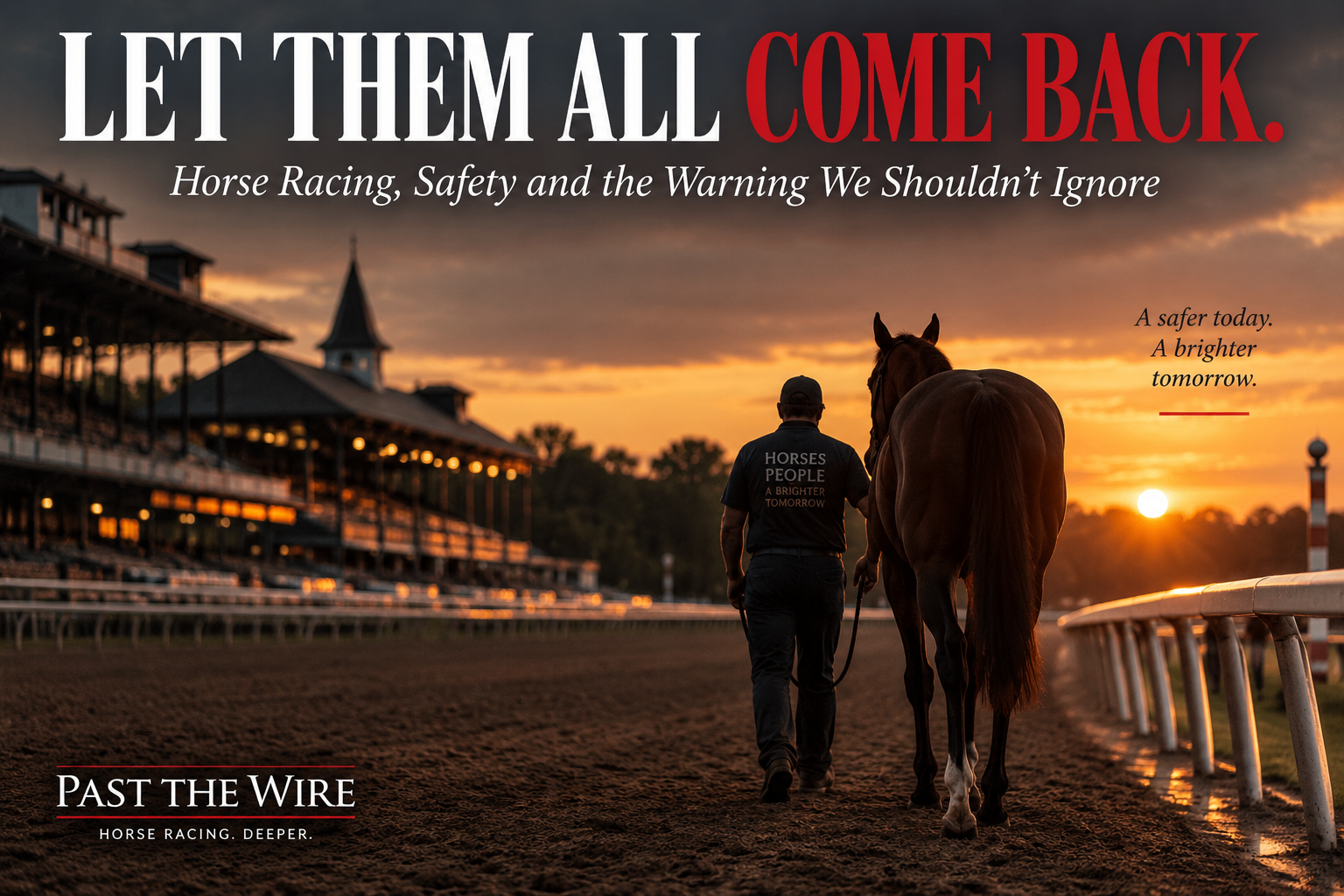
I love this game. I have loved it for more than half a century. I can remember the horses that made me money and the horses that cost me money, but unfortunately I can also remember horses going down. Some images don’t leave you. Maybe that is why my first ask remains the same every time they load into the gate. Let them all come back.
There is some irony here racing might want to think about. Two of the people who have taken more criticism than most in this industry are Belinda Stronach and HISA CEO Lisa Lazarus. Stronach has made little secret of the fact that racing is no longer where she wants much of her business future concentrated, and Lazarus has been attacked almost from the moment HISA became the law of the land. Interestingly, two women who have become lightning rods in a sport still largely run by men are also closely associated with two of the most significant safety improvements we can actually measure. You don’t have to like either of them, agree with everything they have done or endorse every decision made under their watch to acknowledge the numbers. California got safer. Racing under HISA got safer. Sometimes the people an industry is most comfortable criticizing are the same people forcing it to confront something it was too comfortable accepting. That doesn’t settle the debate over either of them. It should settle the debate over whether meaningful intervention can make a difference.
TDN opened the door. Racing can walk through it angry at Tripadvisor, or we can walk through it asking why that warning exists and what we can do so nobody has a legitimate reason to put it there again. That is the harder conversation. It is also the one worth having.



Comments