A Bet Is Locked. A Position Is Traded. Did the Ninth Circuit Ask the Wrong Question?
By Jonathan Stettin•September 2, 2026•16 min readSave Article
The latest appellate blow to Kalshi was significant. There is no reason to minimize it, spin it or pretend otherwise. On August 28, 2026, the United States Court of Appeals for the Ninth Circuit ruled that Kalshi had not shown it was likely to succeed in preventing Nevada from applying its gaming laws to Kalshi’s sports-event contracts. The court concluded those contracts were likely sports bets, not swaps protected by the exclusive federal jurisdiction of the Commodity Futures Trading Commission. Nevada won. Kalshi lost. At least for now and within the reach of that decision.
That is the headline. It is not necessarily the end of the story.
The Ninth Circuit’s decision directly conflicts with an April ruling from the Third Circuit, which found that the same type of Kalshi sports contracts likely are swaps under the Commodity Exchange Act and that New Jersey’s gambling laws are preempted. One federal appellate court says the contracts belong inside a federally regulated derivatives market. Another says they remain sports betting subject to state gaming laws. The identical instrument cannot logically change its essential legal character when it crosses from New Jersey into Nevada, but that is effectively where we are.
This may eventually land before the United States Supreme Court. Before it does, there is a basic question nobody seems willing to examine closely enough.
What does the customer actually own?
I am not a lawyer. I completed the eighth grade and went into gambling. That is not false modesty. It is simply the life I chose. I have, however, played professionally at a high level, dealt with legal bookmakers, illegal bookmakers, racetracks, pari-mutuel pools, betting markets and people who understood how to move risk long before anyone put a friendly trading interface on a phone. I have also spent enough time inside serious litigation to know that the label placed on a transaction is not always the transaction itself.
Years ago, my adjusting work and affidavits became part of litigation that produced two published Florida appellate decisions involving the crime-fraud exception, privileged documents and attorney disqualification. Ervin Gonzalez, one of the appellate lawyers in that litigation and a longtime University of Miami litigation professor, later told me that if I ever attended law school, he would give me an A in his class without having to attend a day based on how I handled myself pro se. Another of my attorneys, in a different case altogether, Myles Malman, was one of the lead federal prosecutors who successfully prosecuted Manuel Noriega. He later went into private practice and represented me. He told me I had missed my calling and should have been a lawyer.
None of that makes me one. It does provide context. I learned to look beyond what something is called and examine how it actually works. The Ninth Circuit looked at what Kalshi’s contracts are about. It may not have looked closely enough at what they are.
What Happens When You Make a Bet?
When a sportsbook offers a point spread, total or moneyline, the book controls the initial transaction. It can change the odds, lower the limit, reject the wager or refuse a customer’s action altogether. If the sportsbook believes it has taken too much money on one side, it can move the line to attract money in the other direction. It can also lay off some of its exposure elsewhere.
Illegal bookmakers historically did the same thing. A bookmaker with more action than he wanted on one team might lay part of it off with another bookmaker. He could also move the number, refuse additional wagers or reduce a customer’s limit. None of that made the bookmaking legal, and none of it changed the nature of the customer’s transaction. It merely changed how the bookmaker managed his own risk.
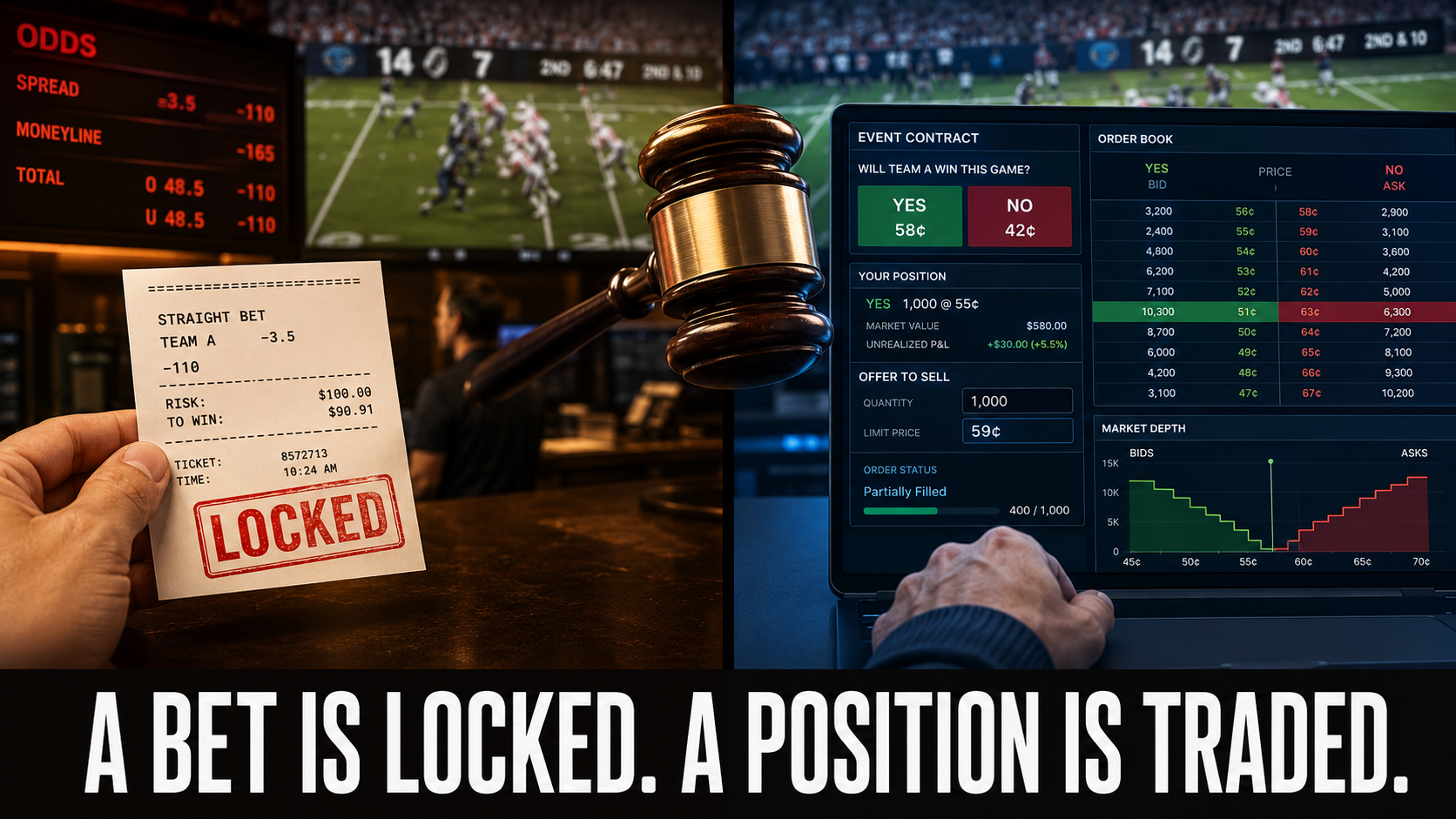
Once the customer’s wager is accepted, however, the customer has a locked contractual bet at the accepted terms. If I wager $110 to win $100 on a team at minus three, my bet does not become minus three and a half because the market later moves. My sportsbook can offer me a cash-out, but that is a new offer made at the sportsbook’s discretion. The ability to accept that offer is not an inherent ownership right contained in my original bet. The house decides whether to offer it, when to offer it and at what price.
The sportsbook’s ability to hedge or lay off its liability is also irrelevant to what I own. That transaction occurs on the book’s side of the counter. It does not make my wager transferable. I cannot take my existing ticket, put it into an open marketplace and ask another participant to purchase it at my price.
My wager is locked. The book can manage its exposure, but I cannot trade my position.
What Happens When You Make a Trade?
A market functions differently. Buyers and sellers enter orders. They compete on price. An order may be completely filled, partially filled or never filled at all. A participant may want to exit at a particular price but be unable to do so because the market does not provide sufficient liquidity. The operator establishes rules, maintains the venue, matches orders and clears transactions, but the market determines whether another participant will take the opposite side at the requested price.
That is not a minor cosmetic difference. It changes the rights attached to the instrument.
A Kalshi participant can acquire a position and subsequently offer that position into the market without asking Kalshi to provide a discretionary cash-out. The participant’s ability to exit is inherent to the market structure, although the price and liquidity necessary to complete that exit are never guaranteed. The position can appreciate or depreciate before the underlying event is decided. Its value changes with information, time, probability and available liquidity.
That looks and behaves like trading because it is trading. Whether it can also fall within a state’s broad definition of wagering is a separate question.
A sportsbook customer owns a wager against a counterparty. A market participant owns a position that can be offered for sale. The fact that both transactions may reference the winner of a football game does not erase that distinction any more than two contracts involving the price of oil become identical merely because they refer to the same barrel. The Ninth Circuit compared Kalshi with a Caesars sportsbook wager and found essentially the same economic purpose. In both transactions, someone risks money based on an uncertain sporting result. That is true. It is also incomplete. Two transactions can share a purpose without being the same legal instrument. A homeowner can speculate on rising real-estate prices by buying a house, purchasing shares in a homebuilder, trading a real-estate investment trust or entering a derivative tied to housing prices. The common economic expectation does not make the instruments legally interchangeable.
The subject of the contract does not necessarily determine the legal character of the contract.
The State Definitions Do Not Settle It
Nevada defines a sports pool broadly as the business of accepting wagers on sporting or other events by “any system or method of wagering.” Kentucky defines a sports wager as money or something of value risked on a sporting event whose outcome is uncertain. New Jersey goes further and expressly includes “exchange wagering” within its definition of a sports pool.
Those definitions are important, and they present a legitimate problem for anyone arguing that exchange mechanics can never constitute wagering. New Jersey has legally authorized exchange wagering, including the matching of opposing wagers and the ability to back or lay an outcome. Betfair operated a horse-racing wagering exchange there before closing it in 2020. Prophet Exchange later launched a peer-to-peer sports exchange before leaving New Jersey in 2024. Sporttrade offered a state-regulated sports trading marketplace in several jurisdictions before ceasing all wagering operations on May 25, 2026.
So it would be inaccurate to claim that America has never authorized betting exchanges. It has. What I could not find is a conventional, state-licensed peer-to-peer sports betting exchange still operating today, and none of those prior exchanges operated as a federally regulated designated contract market under the Commodity Exchange Act.
New Jersey’s definition may actually expose the deeper flaw in allowing state labels to decide this case. New Jersey expressly calls exchange wagering a form of gambling, yet the Third Circuit still held that Kalshi’s sports contracts likely qualify as federally regulated swaps and that New Jersey probably cannot apply its gambling laws to them. That tells us something critical. A state’s decision to call an activity wagering cannot answer whether the instrument also fits Congress’s federal definition of a swap. The same transaction can conceivably satisfy a broad state definition while also falling within an exclusive federal regulatory structure. That is when the Supremacy Clause and preemption become relevant. Otherwise, every state could defeat the CFTC’s exclusive jurisdiction by writing a sufficiently broad definition of “wager.” Congress could create a national derivatives market on Monday, and Nevada could take it back on Tuesday by adding the words “by any system or method” to a gaming statute. Nevada unquestionably has the power to regulate bets. The disputed question is whether Nevada first must establish that the instrument is legally a bet rather than a federally protected swap. It cannot answer that question merely by pointing to its own definition.
The Circular Problem
The Ninth Circuit’s official summary states that Kalshi’s sports contracts were not swaps under the Commodity Exchange Act “because they were sports bets.” That is a powerful conclusion. It may also be circular. The entire dispute is whether they are sports bets or swaps. If a court begins by calling them sports bets and then uses that label to conclude they cannot be swaps, the disputed premise has decided the legal question.
The statutory definition of a swap includes a contract providing for a payment dependent upon the occurrence or nonoccurrence of an event or contingency associated with a potential financial, economic or commercial consequence. The Third Circuit found that sports outcomes can plainly have such consequences for teams, leagues, television networks, advertisers, sponsors, local economies and countless other stakeholders. The Ninth Circuit took a narrower approach. It found that a sporting event does not inherently possess the type of financial or commercial consequence contemplated by the Commodity Exchange Act. It also worried that Kalshi’s interpretation lacked a limiting principle and could pull practically every sports wager into the CFTC’s jurisdiction.
That concern is legitimate. Nobody should pretend it is not. If every payment tied to any uncertain event automatically becomes a swap, federal derivatives law could consume a remarkable portion of traditional state-regulated gambling. Congress does not normally eliminate a historic state police power through vague language buried in a financial reform statute. But the opposite interpretation has no obvious limiting principle either. If every contract tied to a sporting outcome is automatically a bet, regardless of how it is structured, traded, transferred, cleared or regulated, then a state can remove an entire class of instruments from federal jurisdiction simply by examining the subject matter and ignoring the market.
One interpretation risks turning every bet into a swap. The other risks turning every event contract into a bet. That is the line the courts must locate. It cannot be found by comparing only the final payoff.
Trading Does Not Require a Hedge
The Ninth Circuit also emphasized that derivatives traditionally allow people or businesses to hedge an existing economic risk, while Kalshi’s sports contracts create a risk that did not previously exist for the participant. That distinction sounds persuasive until it encounters the real market. Futures, options and swaps are routinely used for speculation. A trader does not ordinarily have to prove that he owns wheat before trading wheat futures, owns an airline before trading oil or has a commercial exposure to interest rates before taking a position in an interest-rate product. Hedging helps explain the economic utility of derivatives markets, but the absence of a hedge does not automatically transform a trade into a wager. A person can speculate in a trade. A person can hedge with a wager. Neither motivation conclusively defines the instrument.
That is another place where someone who actually operates in both worlds sees a difference that may be less obvious from a courtroom. The gambler and the trader can possess identical opinions about an outcome while owning fundamentally different contractual rights.
Kalshi Has Hurt Its Own Argument
A credible argument must confront its worst facts, and Kalshi has supplied several. Kalshi reportedly advertised itself as the first app offering legal sports betting in all 50 states. That may have been clever marketing, but it was reckless legal positioning. A company cannot spend its marketing budget telling customers it offers sports betting and then act surprised when a court quotes those words while determining whether it offers sports betting.
Kalshi also should not be portrayed as an immaculate peer-to-peer marketplace that never has an economic interest on either side. The Ninth Circuit noted that a Kalshi affiliate has served as a significant market maker. That does not necessarily convert the entire market into a conventional sportsbook, but it weakens any simplistic argument based entirely on the absence of a house position.
There is also Congress’s “Special Rule” for event contracts and the corresponding CFTC regulation, 17 C.F.R. § 40.11. The statutory provision gives the CFTC authority to review contracts involving gaming and other enumerated activities and determine whether they are contrary to the public interest. The Ninth Circuit concluded that Kalshi’s listing of these contracts was unlawful under the applicable regulation.
That is not a footnote to be waved away. It may ultimately be one of Kalshi’s greatest legal problems.
It also creates an interesting statutory question. If a gaming-related contract can never be a swap or federally regulated event contract in the first place, why did Congress specifically give the CFTC authority to evaluate contracts involving gaming? Judge Kenneth Lee’s concurrence acknowledged that this point gave him pause. The existence of the Special Rule arguably suggests that at least some gaming-related contracts can enter the CFTC’s domain, where the agency then decides whether they serve the public interest. The majority effectively found that the regulation currently closes that door. Judge Lee saw at least the outline of an argument that Congress placed the doorman at the CFTC, not in 50 separate state gaming commissions. That’s important.
Nevada Has More Than Police Power at Stake
Nevada has a legitimate and important interest in regulating gambling. It licenses operators, tests their integrity, imposes financial requirements, protects consumers, collects taxes and addresses problem gambling. Those responsibilities should not be dismissed as mere protectionism. Nevada also has an undeniable financial and institutional interest in ensuring that activity connected to sports outcomes flows through its licensed gaming system. Southern Nevada tourism generated approximately $50.8 billion in direct visitor spending and an estimated $80.9 billion in total economic impact during 2025. Las Vegas visitation declined 7.5 percent that year. The picture has improved somewhat in 2026: through July, visitation was slightly higher, Strip gaming revenue was up and hotel performance had improved. At the same time, airport passenger traffic remained down, downtown performance was weaker and the recovery was uneven.
The fair statement is not that Nevada attacked Kalshi because Las Vegas is desperate for money. There is no evidence establishing that motive, and Nevada does not need an improper motive to defend its regulatory system. The important point is structural. Nevada regulates, licenses and taxes an enormous gaming industry. A federally regulated platform offering sports contracts nationwide threatens the state’s control of that industry, the competitive position of its licensed operators and potentially the revenue attached to both. That does not make Nevada wrong. It does mean Nevada is hardly a disinterested observer.
Nevada’s financial dependence on gaming explains why it will defend the boundary aggressively. It cannot determine where federal law places that boundary.
If Kalshi’s contracts are not swaps, Nevada should prevail. If they are swaps traded on a federally designated contract market, Nevada’s economic reliance on gambling does not diminish federal supremacy. Motive provides context. Statutory classification decides the case.
The Court Watched the Game, Not the Market
This is not an argument that putting the word “trade” on a sportsbook makes it a financial exchange. It does not. A bookmaker cannot evade gaming laws by redesigning its screen, calling wagers contracts and changing “bet” to “buy.” It is an argument that courts must examine the complete transaction before concluding that nothing meaningful has changed.
Who sets the price? Who takes the other side? What does the customer own after the transaction? Can that position be transferred as a matter of right? Who controls the exit? Is the exit a discretionary offer from the house or a sale into an independent market? Does the operator profit directly from the customer’s losing position, or does it collect transaction fees for operating the venue? Is the transaction cleared under a federal market structure? Is liquidity an inherent risk? Can the participant enter a limit order that never trades because the market will not support the requested price? Those are not distinctions without differences. They are the mechanics that define a market.
The Ninth Circuit saw money placed on the outcome of a sporting event and recognized something that looked like gambling. Anyone being honest can see why. What it may not have adequately considered is whether an instrument can involve speculation on sports and still possess the legal and operational characteristics of a trade.
New Jersey says exchange wagering is gambling. The Third Circuit says Kalshi’s exchange-traded contracts are swaps. The Ninth Circuit says they are sports bets and therefore not swaps. Kentucky concentrates on whether value is risked on an uncertain sporting result. Nevada covers practically any system or method of wagering. That patchwork is exactly why the final answer cannot depend on what each state chooses to call the instrument.
I spent a considerable portion of my life gambling. I know a bet when I make one. I also know the difference between having a locked wager and owning a position whose value, execution and exit depend upon a market. The two can involve the same opinion. They can produce the same ultimate payoff. They can even feel the same to someone staring only at the scoreboard. They are not necessarily the same transaction. JS
Nevada can regulate a bet. Before it does, someone still has to prove this is one. The Ninth Circuit watched the game. I am not convinced it watched the trade.