


Why U.S.S. Valor Won’t Run in the Breeders’ Cup Juvenile
Barry Irwin told me before the Champagne that even a victory wouldn’t change the plan. Every move with U.S.S. Valor is being made with one race in mind: the Kentucky Derby.
There are horses who win races and there are horses who make you start thinking about races six and seven months away. U.S.S. Valor looks like he may be one of the latter.
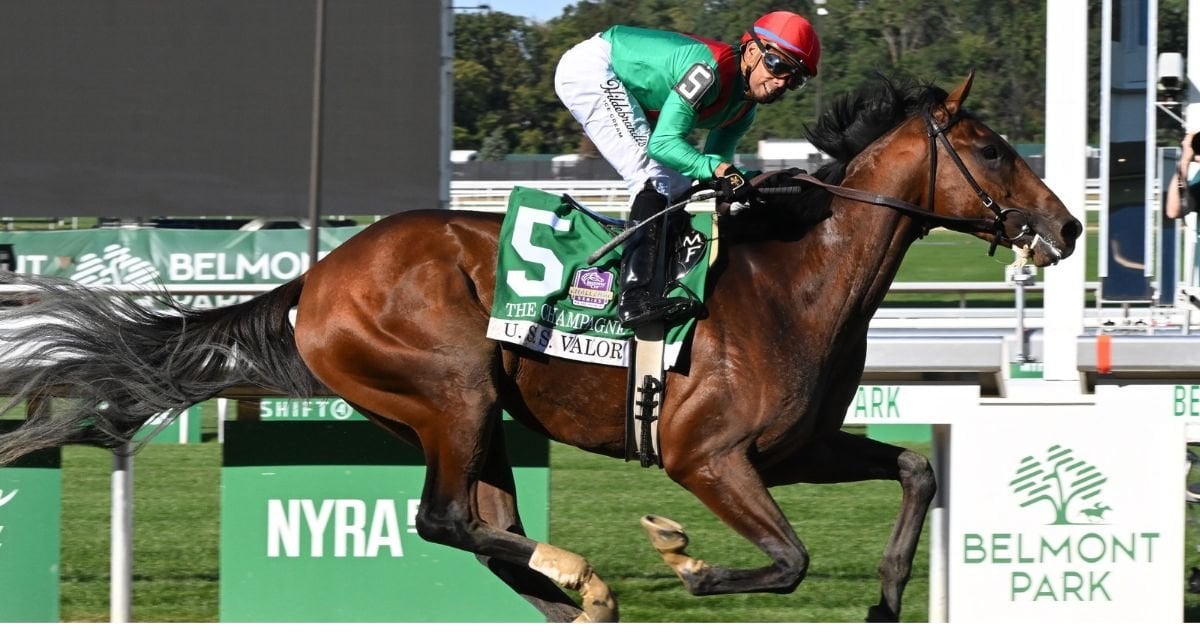
On Saturday at Belmont Park, U.S.S. Valor won the Grade 1 Champagne Stakes by 6 1/2 lengths. The margin was impressive enough. The way he did it was better. He did not have everything his own way, had to negotiate some traffic and wait for his opportunity, and when Manny Franco finally asked him the response was immediate. Good horses win when things go right. The really good ones start getting your attention when things don’t go perfectly and they solve the problem anyway.
I spoke with Team Valor’s Barry Irwin before the Champagne, not after it. That matters. It is easy to map out the future after your horse has just won a Grade 1 by daylight. Barry already had his map drawn.
He told me before U.S.S. Valor ever went into the gate Saturday that even if he won the Champagne, a Win and You’re In race for the Breeders’ Cup Juvenile, he did not intend to run him in the Juvenile. Barry’s reasoning was simple. He believes asking a young horse to peak and run that hard in late October or early November, then unwind, regroup and be asked to peak again on the first Saturday in May is asking a lot. Maybe too much. He has one objective with this horse and he made no attempt to disguise it.
Every move he makes and every step he takes with U.S.S. Valor is being made with the Kentucky Derby in mind.
Barry Irwin has earned the right to think that way. He has already stood in the Kentucky Derby winner’s circle with Animal Kingdom in 2011. I remember that Derby particularly well because Animal Kingdom was very good to me at the windows that afternoon. Barry knows firsthand what it takes to get a horse there, and more importantly what it takes to get one there ready to deliver his best race on the day when everyone wants their best race.
There is also some history supporting the argument Barry is making. Since the Breeders’ Cup began in 1984, only two winners of the Breeders’ Cup Juvenile have come back the following spring and won the Kentucky Derby: Street Sense and Nyquist. That’s it. Two. The Juvenile has produced plenty of outstanding horses and plenty of horses who later ran well in the Derby, but as a breeding ground for Kentucky Derby winners, it hasn’t exactly been Claiborne Farm. Pun intended.
That doesn’t mean running in the Juvenile prevents a horse from winning the Derby. It obviously doesn’t. Street Sense and Nyquist proved that. It doesn’t mean skipping it provides some magic formula either. There is no magic formula for getting a Thoroughbred to the Kentucky Derby healthy, sound, improving and at his absolute best. If there were, everyone would use it. What it does mean is there is a legitimate argument to be made that sometimes the best way to win the next race isn’t necessarily to run in the next race.
Barry isn’t chasing an Eclipse Award in November. He is trying to win a Kentucky Derby in May. He may get it anyway. U.S.S. Valor has been impressive enough that he will merit consideration for champion juvenile without running in The Breeders’ Cup. Those chances increase if the juvenile is won in ordinary fashion.
There is something else about U.S.S. Valor that makes the story a little more interesting. Team Valor didn’t go to a sale and buy him after somebody else did the planning. He is a homebred, and Barry and his wife Kathleen were directly involved in creating the mating.
Team Valor bought his dam, Spangled Banner, a daughter of Tiz Wonderful, for $225,000 in 2022. Barry and Kathleen then planned the mating to War of Will. There is plenty to like there if you are thinking beyond a brilliant two-year-old performance at a mile. War of Will won the Preakness and was good enough and versatile enough to also win a Grade 1 on the grass. Spangled Banner has already produced Grade 1-placed Expressman, and further back in the female family you find multiple Grade 1 winner Curalina and Canadian Horse of the Year Uncaptured. This isn’t a pedigree that screams get what you can get at two and hope it lasts. There are legitimate reasons to wonder what might still be there as the distances get longer and the calendar turns.
There is also Shug McGaughey.
If you were going to hand a talented two-year-old to someone and tell him the objective is not October, not November, but Louisville in May, you could do a lot worse than handing him to Shug. A Hall of Famer, a horseman from a different school and a different era, McGaughey has never been confused with someone desperate to get to the bottom of a horse before he has to. He won the Kentucky Derby with Orb in 2013 and the Belmont Stakes with Easy Goer long before that. He has trained champions, Breeders’ Cup winners and some exceptionally good horses during a career that has already spanned half a century.
At 75, Shug may or may not get many more horses that make people start talking seriously about the Kentucky Derby before the leaves have even finished changing. Nobody knows that, including Shug. U.S.S. Valor, though, may be giving him another legitimate shot at one.
There is something fitting about that. An owner who has already won the Derby deciding he doesn’t have to dance every dance along the way, and a Hall of Fame trainer who has spent a lifetime understanding that horses don’t read calendars and don’t care about marketing departments. Between them sits a two-year-old who has now done enough to make the rest of us pay attention.
Barry also has a new novel out called A Knight Errant. During our conversation before the Champagne he asked me if I had ever written anything about it. I hadn’t. After U.S.S. Valor won Saturday, Barry sent me a promotional piece for the book in which he described U.S.S. Valor as looking like the real-life version of the equine hero he created for the novel.
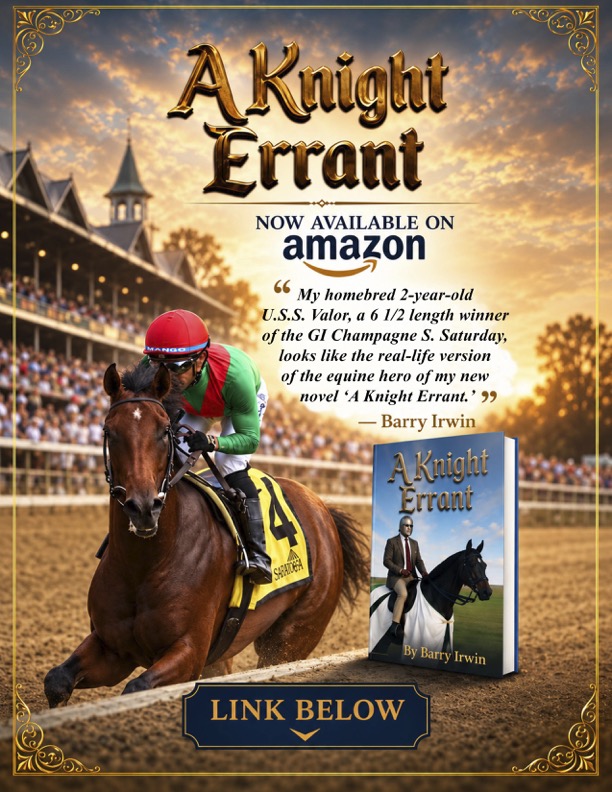
I haven’t read the book, so I am not going to pretend to review it. Barry Irwin has known me long enough to know I don’t work that way. What I can say is that writing a fictional racehorse is considerably easier than breeding a real one that can do what U.S.S. Valor did Saturday. Barry and Kathleen appear to have done pretty well with the latter.
Now comes the hard part.
There are roughly seven months between the Champagne and the Kentucky Derby, and seven months is an eternity with a Thoroughbred. Horses improve. Horses regress. Horses get hurt. Horses surprise you. The horse everyone is talking about in October is often not the horse everyone is talking about in May. That is the game.
Barry Irwin knows that better than most.
Which is precisely why what he told me before the Champagne was more interesting than anything he could have told me afterward. Before U.S.S. Valor became a Grade 1 winner, before the impressive stretch run, before people began penciling him into the Breeders’ Cup Juvenile and before anyone knew whether Saturday would confirm the promise he had shown at Saratoga, the plan was already in place.
The Champagne didn’t change it. If anything, it gave Barry Irwin one more reason to stick to it. There is only one race he is trying to win. That is run the first Saturday in May.

Comments