


Transparency. Integrity. Accountability.
Those might be three of the most frequently used words in horse racing today. We hear them from racetracks, regulators, breed organizations, sales companies, owners and industry leaders. We hear about growing the game, attracting new owners, retaining the owners we already have and creating confidence in an industry that asks people to invest substantial amounts of money in Thoroughbred horses. We hear them, we don’t see them.
Those words have to mean something when questions arise.
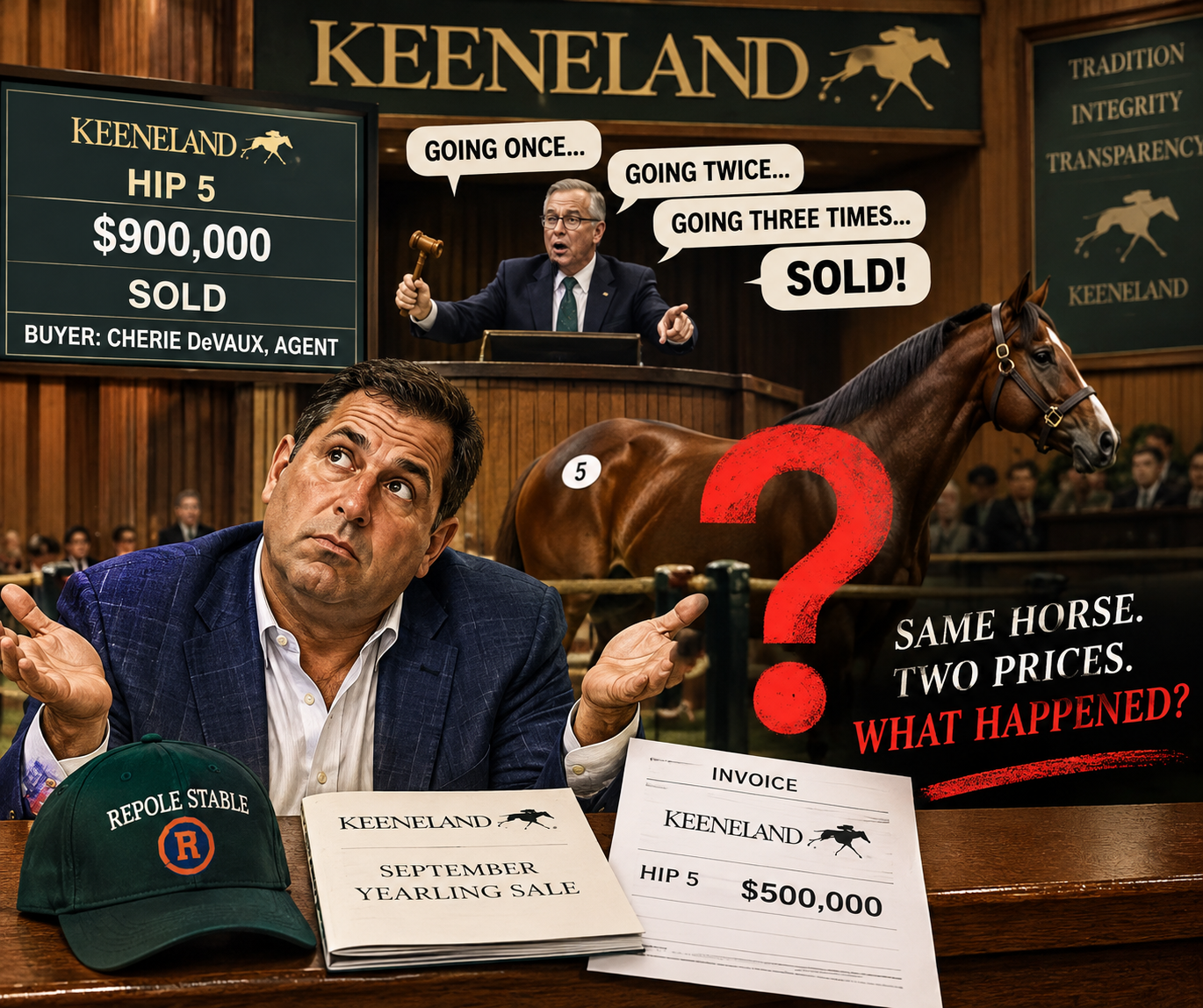
Mike Repole raised some very specific questions Friday concerning Hip 5 at the 2025 Keeneland September Yearling Sale. Unlike some of the broader battles Repole has waged with The Jockey Club and others in the industry, this one involves a particular horse, a particular sale, two very different dollar amounts and a public sales record that remains available for anyone to see.
According to Keeneland’s own current online record, Hip 5, an Uncle Mo filly out of Knarsdale, consigned by Scott Mallory as agent for Determined Stud, is listed as SOLD for $900,000 to Cherie DeVaux, Agent. Repole says that is not where the story ended.
“Last year, Hip 5, an Uncle Mo filly and full sister to Seismic Beauty, was reported sold for $900,000 after I stopped bidding around $800,000. The ticket was signed by an agent,” Repole wrote. He then described what he says happened approximately 30 minutes later.
“Thirty minutes later, the consignor offered me the horse for $800,000. I offered $500,000. They declined, then called back and accepted.”
Then comes the part that deserves an explanation. “I own the horse. I paid $500,000. Yet one year later, Keeneland still publicly reports a $900,000 sale, even though Keeneland invoiced me for $500,000,” Repole wrote.
Those are Repole’s assertions. We have not independently reviewed his invoice or documentation of the $500,000 transaction, and we are not going to treat an allegation as an established fact merely because it was posted on social media. We don’t do that when we agree with someone, and we don’t do it when we disagree with them. That said, Mike Repole inaccurately misstating any of this publicly is a longshot, and one to bet against as much as we love betting on them. What we can establish independently is that Keeneland’s own public database currently identifies Hip 5 as a $900,000 sale to Cherie DeVaux, Agent. We can also establish something else that matters. Keeneland’s 2025 September Yearling Sale Conditions of Sale specifically address what happens when a purchaser defaults. The rules state that a purchaser without prior credit approval who fails to pay within 60 minutes or execute the required purchase documents may be considered a defaulter. The consignor then has several options, including “voiding the sale” and requesting that the horse be offered again.
The rules go further. If Keeneland determines that putting the horse back through the ring during the same session is not practical or advisable, the horse may subsequently be resold by Keeneland at “public or private sale.” That is important because the existence of a $900,000 hammer price followed by a $500,000 transaction does not, standing alone, establish that anybody did anything improper. Keeneland’s own Conditions of Sale contemplate circumstances in which an original purchaser can default, an attempted sale can be voided and a horse can subsequently be sold privately. That could provide a perfectly legitimate explanation for what occurred with Hip 5.
But it doesn’t answer the question. What happened?
Was the original $900,000 transaction completed? Did the original purchaser default? Was the sale voided? Was the horse subsequently resold pursuant to the default provisions in Keeneland’s Conditions of Sale? Was there some entirely different contractual circumstance that explains the two transactions? Those are questions. They are not accusations.
There is another question that, from our perspective, is considerably more important to the industry than who won an argument on X.
Why does Keeneland’s public record continue to identify the horse as SOLD for $900,000 if, as Repole states, Keeneland ultimately invoiced him $500,000 for that same horse?
Maybe there is an established accounting or sales-reporting convention that explains it. If there is, tell us. Maybe the public result is intended to reflect the hammer transaction regardless of whether the transaction was subsequently consummated. If so, tell buyers exactly that. Maybe the $500,000 transaction is classified separately as a private or post-sale transaction. Again, explain it. The answer matters because Keeneland doesn’t merely publish individual results. Keeneland publishes gross sales, averages, medians, numbers of horses sold and other statistics that are relied upon throughout the Thoroughbred industry. Keeneland is currently promoting the 2025 September Sale as the highest-grossing Thoroughbred auction in history, reporting more than $531.7 million in sales for 3,078 horses, along with a record average of $172,755 and a record median of $80,000. During the sale itself, Keeneland repeatedly reported cumulative “through-the-ring” gross, numbers sold, averages and medians as measures of the strength of the marketplace.
That brings us to the question we believe deserves a very simple answer. Which price for Hip 5 was included in those statistics?
Was $900,000 included in Keeneland’s official gross? Was $500,000 included? Were both included under different classifications? Was neither included after the original transaction failed? If the $900,000 remains included, what is Keeneland’s policy for counting a sale that was subsequently voided or otherwise not consummated? If Repole’s $500,000 purchase was a private resale following a default, where is that transaction reflected in Keeneland’s records? There is precedent for Keeneland separately identifying post-sale transactions. In its own reporting on other sales, Keeneland has distinguished through-the-ring results from post-sale gross receipts involving horses sold privately afterward. So asking how Hip 5 was classified is hardly an academic exercise.
Repole also asked a much broader question: “How many other reported prices differ from what was actually paid?” We don’t know. And until somebody establishes that this happened with other horses, neither does Mike Repole. That doesn’t make the question illegitimate. It makes it a question worth answering with data instead of insinuation.
There is also the matter of The Jockey Club, which Repole brought into the discussion. He humorously mocked the institutional overlap between The Jockey Club and Keeneland. Strip away the sarcasm and there is a factual point underneath it. Everett Dobson is Chair of The Jockey Club, William S. Farish Jr. is Vice Chair and William M. Lear Jr. is Secretary. Keeneland materials identify Dobson, Farish and Lear as its three trustees. This chain link fence does make calls for transparency particularly appropriate when the organizations and their leadership have repeatedly emphasized transparency themselves. Dobson recently described transparency as one of The Jockey Club’s strategic pillars, promising measurable outcomes and honest reporting and telling the industry to hold the organization to those commitments. Fair enough. We will. But there is an even larger issue here than Mike Repole, The Jockey Club or one $400,000 discrepancy between two numbers associated with one horse.
Horse racing says it needs owners. Not just billionaires. Not just established farms that have been doing business in Lexington for generations. New owners. New money. New participants. People willing to walk into a sales pavilion, raise their hand and put hundreds of thousands of dollars of their own money behind this game. Keeneland itself said last year that “New buyers are stepping in” and described that as a win for the industry. Then those buyers deserve to understand exactly how the marketplace works. If someone bids $800,000 on a horse and another bidder supposedly buys that horse for $900,000, a buyer should be able to rely upon the integrity of that process. If that $900,000 transaction collapses 30 minutes later and the horse becomes available for $500,000, there may be a completely legitimate explanation. The Conditions of Sale demonstrate that there can be. But explain it. A new owner walking into this game shouldn’t have to wonder whether the bidder across the pavilion is actually buying the horse. They shouldn’t have to wonder whether published sale prices represent money actually paid. They shouldn’t have to wonder whether a $900,000 “SOLD” horse was actually sold for $900,000, subsequently sold for $500,000, or somehow represents both transactions depending upon which set of statistics they’re reading.
Most importantly, they shouldn’t have to wonder whether they’re being nurtured or fleeced. That is not an accusation that anyone was fleeced here. It is precisely why transparency matters. Confidence in a marketplace isn’t created by telling buyers to trust the marketplace. It is created by giving them enough information that they don’t have to. So we aren’t calling for anyone’s head. We aren’t declaring the sale corrupt. Not now. We aren’t accusing an agent of bidding without authorization, a consignor of running up a bidder, or Keeneland of inflating its numbers. There isn’t enough public evidence to responsibly say any of those things at this point.
We’re asking Keeneland to tell us what happened.
Was the $900,000 sale completed or voided? If it was voided, why does Hip 5 remain publicly listed as SOLD for $900,000? What was the nature of the subsequent $500,000 transaction Repole describes? Who was the original buyer represented by the agent, assuming Keeneland can disclose that information? Was the $900,000 counted in Keeneland’s official sale gross, average and number sold? Was the $500,000 counted anywhere? What is Keeneland’s written policy for correcting or preserving a public sales result when an original transaction is voided or a purchaser defaults? And finally, how many transactions from the 2025 September Sale, if any, remain recorded as SOLD at a price different from the amount ultimately collected for the horse?
Those answers could put this entire thing to bed. Maybe Keeneland followed its rules exactly. Maybe the statistical treatment is standard, consistent and completely defensible. Maybe there is an explanation that makes the $900,000 and $500,000 numbers perfectly compatible. We would like to hear it.
An industry demanding transparency, integrity and accountability shouldn’t be offended when someone asks for transparency, integrity and accountability. Especially when we’re simultaneously telling the next generation of owners that we’d love to have their money. Come on in. But first, somebody answer the questions.
At least Tommy always seemed to know exactly who was bidding, who was buying, and what the horse actually cost.


Comments