



Then Understand Who Gets to Play by Them
There is a quote often attributed to Albert Einstein about learning the rules of the game and then playing better than anyone else. Whether Einstein actually said it is another matter. The sentiment, however, is one every professional gambler understands. You cannot beat a game you do not understand, and understanding the game means considerably more than knowing how to read the past performances, calculate the odds, or identify the most likely winner. You have to understand the market, the mathematics, the people you are competing against, and perhaps most importantly, the rules under which everyone is playing. That last part is where things get interesting.
I spent a considerable portion of my life playing horses professionally. Not playing at being a professional, not selling selections, and not grinding out a few dollars on weekends. Playing for a living. There is a difference, and it becomes painfully apparent when the mortgage is due, the bills are coming in, and the only thing standing between you and the next payday is your bankroll and your ability to make the right decisions. You learn quickly that being right is not enough. You have to be right when it matters, at a price that makes being right worthwhile, and with enough money behind your opinion to make the exercise meaningful. You also have to survive being wrong.
I was never interested in cashing the most tickets. I wanted to win the most money. If I liked the two horse, I might bet $500 to win and play $100 exactas with the two over the five and seven. I wasn’t boxing them, reversing them, or spreading around trying to manufacture a winning ticket. If I was right, I wanted to get paid. If I was wrong, I wanted to have enough money left to fight another day. Every dollar spent protecting myself against an opinion I didn’t have was a dollar that wasn’t working for me when I was right. Some people called that stubborn. Others had considerably less flattering descriptions. I called it making a living.
The price mattered, of course, but not in the simplistic way people sometimes assume. I could bet a horse at 9-5 or 20-1 if the price justified the opinion. I wasn’t looking for longshots simply because they were longshots, and I wasn’t avoiding favorites because somebody decided there was no value in betting them. Value is a relationship between probability and price. It is not a number on a tote board. That distinction separates handicapping from gambling, and gambling from professional gambling. It also explains why two people can look at the same race, reach the same conclusion about the most likely winner, and make entirely different decisions about whether to bet.
There were days I left the racetrack questioning everything I thought I knew. Anyone who tells you that doesn’t happen when you play for a living either has a remarkably selective memory or wasn’t playing for a living. You don’t survive by chasing, forcing wagers, or deciding the next race owes you something because the last one didn’t work out. You preserve your bankroll. You wait for your opportunities. You never waste a bet. The game doesn’t care what you need, what you deserve, or how good your last opinion was. The game is indifferent. That is part of what makes it beautiful, and part of what makes it brutal.
Now imagine taking that same philosophy and applying it with considerably more capital, sophisticated mathematics, proprietary data, advanced technology, and the ability to execute thousands of decisions at speeds no human being can match. You have moved from the individual professional gambler to the world of quantitative wagering. The tools have changed. The fundamental objective has not. Find an edge, price it correctly, manage the risk, and exploit the opportunity when the expected return justifies the investment.
There is nothing inherently dishonest about that. There is nothing inherently dishonest about being smarter, better prepared, better capitalized, or more disciplined than the person on the other side of your wager. I never apologized for doing my homework, finding something other people missed, or having the conviction to bet accordingly. Why should someone who develops a superior mathematical model apologize for understanding probability better than the competition? Why should a professional gambler apologize for being a professional gambler?
The problem begins when we confuse being better at the game with being permitted to play a different game.
That is the distinction horse racing needs to confront, and it is one the people building the next generation of wagering markets would do well to understand. A mathematical advantage is one thing. A structural advantage created by preferential access, undisclosed arrangements, or rules that differ depending on who is placing the wager is something else entirely. One is competition. The other raises legitimate questions about the integrity of the competition itself.
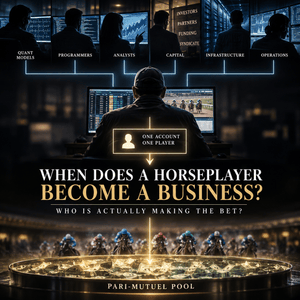
Computer-assisted wagering, or CAW, has brought that distinction into sharp focus. Sophisticated wagering teams use models, data, technology, and capital to identify opportunities in pari-mutuel pools. They also operate under negotiated commercial arrangements that differ from those available to ordinary customers. The existence of those arrangements does not, by itself, establish wrongdoing. Rebates, volume discounts, and commercial agreements are not automatically evidence of misconduct. But when those arrangements materially affect the economics of a wager, and when differences in access or timing can affect the prices other participants receive, the industry owes its customers a clear explanation of how the game actually works.
I have written extensively about CAWs, and my position has never required pretending that sophisticated gamblers are the enemy. I understand why they exist. I understand why they invest in technology. I understand why they seek favorable commercial terms. I also understand that racetracks and wagering operators have their own economic incentives. What I question is whether the structure of the modern pari-mutuel system adequately protects the customers whose money makes the pools possible in the first place. Those are different questions, and treating them as interchangeable allows everyone to avoid answering the difficult ones.
Consider the individual horseplayer studying a race, identifying a horse worth betting at 4-1, and placing a wager based on that price. Now consider a large wagering operation capable of submitting substantial amounts of money very late in the betting cycle. If the final price changes significantly after the individual has committed his money, the economic proposition he accepted has changed. That does not prove manipulation, and it does not mean every late price movement comes from a CAW. It does mean the customer is entitled to ask whether the system provides adequate information and whether the rules governing timing and access are appropriate.
The answer cannot simply be that the sophisticated players are better at the game. Perhaps they are. That is not the question.
The question is whether everyone is playing under rules that are clearly disclosed, consistently enforced, and designed to preserve confidence in the wagering product. If the answer is yes, explain how. If the answer is no, explain why not. If certain commercial arrangements are necessary to maintain liquidity or support the economics of the industry, make that case with evidence. If restrictions on late wagering would reduce handle or create other unintended consequences, show us the numbers. The people who understand these markets should be capable of explaining them without asking everyone else to accept the existing structure on faith.
This is not an argument against mathematics. It is an argument for transparency.
It is also an argument that extends well beyond horse racing. Prediction markets are attracting capital, technology, professional traders, market makers, and people who see opportunities in pricing uncertainty. The terminology changes. The underlying questions remain remarkably familiar. Who provides the liquidity? Who determines the prices? Who has access to what information? How are conflicts managed? What happens when a participant possesses an advantage that comes not from superior analysis but from the structure of the market itself?
A bettor and a trader may enter their respective markets through different legal and contractual frameworks. Their positions may be treated differently, and the rules governing those markets may differ substantially. Those distinctions matter. But the mathematics of evaluating an uncertain outcome, determining a fair price, and deciding whether the available return compensates for the risk do not disappear because somebody changes the terminology.
The professional gambler recognizes the calculation. So does the quantitative trader. So does the market maker.
What interests me is what happens when those worlds begin to overlap. Horse racing has decades of experience operating pari-mutuel markets. Sports betting has developed its own approaches to pricing, risk management, and customer relationships. Prediction markets introduce additional structures, participants, and regulatory questions. Each has something to learn from the others, and each has problems that cannot be solved simply by pointing to the deficiencies of a competing model.
The people developing these markets should welcome scrutiny. Not because every criticism is justified. Some are not. Not because every successful participant owes the public an explanation of his proprietary methods. He doesn’t. A professional gambler should not have to surrender the intellectual property that makes him successful. But there is a meaningful difference between protecting a proprietary model and withholding information about the rules under which the model is permitted to operate.
I don’t need to know how someone calculates his probabilities. I do want to know whether he is receiving access, timing privileges, or commercial treatment that materially changes the game for everyone else. I don’t need to know the contents of his bankroll. I do want to know whether the operator administering the market has established safeguards that apply consistently and protect the integrity of the product. Those questions are not an attack on successful gamblers. They are questions about the market in which those gamblers operate.
There is another distinction worth making. A game can be mathematically beatable and still be commercially unsustainable. It can generate enormous handle while failing to retain the confidence of its customers. It can attract sophisticated capital while discouraging the recreational participation that helps sustain its liquidity. None of those outcomes is inevitable, but none should be dismissed merely because a spreadsheet shows that the current arrangement is profitable.
A successful wagering ecosystem needs more than winners and losers. It needs participants who believe the proposition being offered is legitimate. That does not mean everyone must have the same bankroll, the same information, or the same ability. They never will. It means the rules governing the market should be understandable, the relevant differences in treatment should be appropriately disclosed, and the people responsible for administering the game should be prepared to defend its structure.
Horse racing has a particular responsibility here because its customers are not merely purchasing entertainment. They are supplying the capital that makes the wagering pools function. Every bet contributes to the market. Every participant has an interest in the integrity of the process. When the industry treats legitimate questions about that process as hostility toward sophisticated wagering, it misses the point and avoids an opportunity to strengthen its own product.
I would welcome a serious conversation with the people who build these models, provide liquidity, manage risk, and operate at the highest levels of professional wagering. Not a promotional exercise. Not an exchange of accusations. A conversation about how the markets work, where the economic incentives align, where they conflict, and what can be done to make the system more transparent and sustainable. There are people in those businesses who understand the mathematics far better than I do. There are things they could teach me. There are also things a lifetime spent on the other side of the betting window might teach them.
That is a conversation worth having.
I have no objection to someone beating me because he is smarter, better prepared, or more disciplined. I spent years trying to be that person. I have no objection to someone building a business around a legitimate edge. I understand the work, the risk, and the conviction that requires. What I object to is being told that an advantage created by the structure of the game is indistinguishable from an advantage earned by understanding it.
They are not the same thing.
The future of wagering will not be determined solely by who builds the fastest model, deploys the most capital, or discovers the next profitable market. It will also depend on whether the people building those markets can establish rules that participants understand and trust. That is not an obstacle to innovation. It is part of what makes innovation sustainable.
The professional gambler knows that no edge lasts forever. Markets adjust. Prices change. Competitors learn. The advantage you enjoyed yesterday may be gone tomorrow. You adapt, you improve, or you find another game. That is the nature of competition, and I wouldn’t have it any other way.
Who wrote the rules, who gets to play by them, and how many people don’t even know they’re playing? Somewhere, Raddimus is smiling.

Comments