

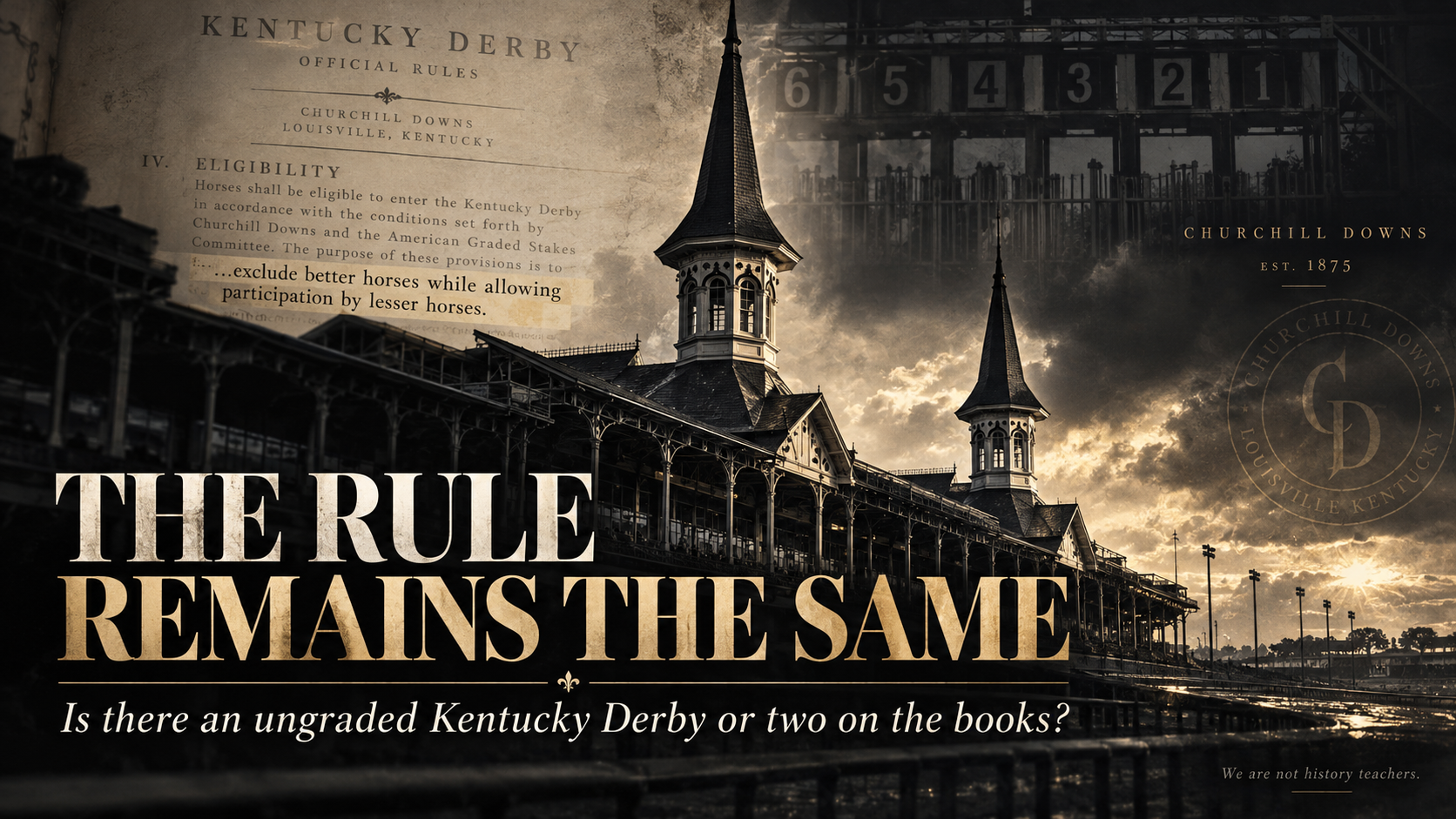

Is there an ungraded Kentucky Derby or two on the books?
In February of 2022, I asked a question that did not make me many friends in Louisville or Lexington: was the Kentucky Derby really a Grade 1 race that year, or the next? I took plenty of heat for asking it. I also heard privately from people close enough to the graded-stakes process to understand exactly what I was asking. They were not lining up to say anything publicly, but I was hardly alone in seeing the problem. I thought the stir might be enough to make somebody clean up the language. Four years later, nothing has been cleaned up. Bill Carstanjen recently told us Churchill Downs is not in the business of teaching history. Fair enough. The rule remains the same, word for word, and it still deserves an answer.
Here is the rule as it appears on TOBA’s own site today: races are ineligible for grading when the conditions for competing contain restrictive provisions concerning which horses may enter, other than sex or age. It goes further. “A race is regarded as a restricted race if any of its conditions for entry would tend to exclude better horses while allowing participation by lesser horses.” There is a limited exception involving non-winners of a sweepstakes and Listed status. There is no Kentucky Derby exception. There is no private-property exception. There is no exception saying the rule disappears when a racetrack does not want the trainer of an otherwise qualified horse. The language says what it says.
Before anybody decides what this is about, let me save them some time. This is not a Bob Baffert defense. Medina Spirit tested positive. The Kentucky Derby disqualification stood. Churchill Downs had every right to be angry over what happened in its signature race, and the courts ultimately upheld Churchill’s ability to exclude Baffert from its property and events. None of that answers this question. This is about the written grading rule, the body charged with administering it and the eligibility system Churchill created for the most important race in America. If that answer creates discomfort for the breeding industry, Churchill Downs or anyone else, I did not write the rule. I just read it.
Start with what Churchill actually did. Effective September 30, 2021, Churchill announced that Road to the Kentucky Derby points would not be awarded to horses trained by an individual suspended from competing in the Derby, or to horses trained by someone directly or indirectly employed, supervised or advised by that suspended trainer. A horse could win a recognized Derby points race and receive no points, while the horses finishing behind it received theirs. That was the situation I wrote about in 2022.
Points are not decoration. They are not an award handed out after the race. They are the preference mechanism that determines who gets into the Kentucky Derby starting gate. If twenty horses can run and more than twenty want to run, points determine preference. When Churchill decides that one horse’s performance counts toward Derby eligibility and another horse’s identical or superior performance does not because of who trains it, Churchill is making a decision about who may compete in the Derby.
That was the question I put to Andy Schweigardt in 2022. Andy, then TOBA’s Senior Director of Industry Relations and Development and secretary of the American Graded Stakes Committee, was gracious enough to engage it. His interpretation was that the restricted-race language was intended for the narrower universe of race conditions as they would appear in the condition book. He also acknowledged that the language had not been written with this particular situation in mind. I appreciated his candor then and I still do. But that answer never resolved the underlying problem. Intent is not language. The rule TOBA publishes does not say “condition-book restrictions.” It says “conditions for competing,” and it says a race is restricted if those conditions tend to exclude better horses while allowing lesser ones.
The issue became even harder to dismiss once Churchill formalized transfer deadlines as part of Derby eligibility. For 2024, Churchill stated that horses in the care of a trainer suspended from the Derby had to be transferred to a non-suspended trainer by January 29 to become eligible, and that after the transfer they could begin earning points on a forward-looking basis. Miss the deadline and the horse was out, regardless of what it went on to accomplish on the racetrack. Then the rule stopped being theoretical.
On March 30, 2024, Muth won the Grade 1 Arkansas Derby by two lengths. Just Steel finished second. Mystik Dan was another 4¼ lengths back in third. Muth was trained by Bob Baffert and therefore could not receive the 100 Kentucky Derby points ordinarily attached to that victory. Five weeks later, Mystik Dan won the Kentucky Derby. Muth was not eligible to be there.
I want to be very precise about what that does and does not mean. It does not mean Muth would have won the Kentucky Derby. It does not diminish Mystik Dan’s victory by one inch. Three-year-olds improve and regress rapidly in the spring, and different tracks, distances, trips and pace scenarios produce different results. Mystik Dan earned his Derby. But that is not what the TOBA rule asks. The rule does not say the excluded horse must prove he would have won, and it does not ask us to rerun the Derby in our heads. It asks whether a condition “would tend to exclude better horses while allowing participation by lesser horses.” Muth and Mystik Dan met five weeks before the Derby in a Grade 1 race, and Muth beat him by more than six lengths. Muth could not run in the Derby. Mystik Dan could. If that does not at least trigger the restricted-race question, somebody needs to explain what possibly could.
The history before Muth shows this was not some isolated quirk. In 2022, Taiba and Messier were transferred from Baffert to Tim Yakteen and became eligible to earn Derby points. Taiba won the Santa Anita Derby, Messier finished second, and both made the Kentucky Derby field. In 2023, Reincarnate followed the same path. He was ineligible for Derby points while in Baffert’s barn, was transferred to Yakteen, became eligible to earn points going forward and made the Derby field. By 2024, several owners simply refused to play the transfer game. Churchill’s deadline required Baffert-trained horses to leave his barn by January 29 to preserve Derby eligibility, and they did not. Among them was Muth. Asked whether he would move his horses, owner Amr Zedan answered, “No move. Mr. Baffert (is) our man.” Whatever anyone thinks of that decision, it demonstrates the point. The condition affected which horses could compete and forced owners to choose between the trainer they selected and access to the Kentucky Derby.
Now let me give Churchill the best argument, because it deserves one. Suspended trainers are excluded from races every day. Horses move barns. Licenses matter. Racetracks and regulators impose conditions of participation all the time, and nobody strips the grade from every stakes race touched by a suspension. That argument has force, and it had even more force in 2022. The Kentucky stewards had imposed a regulatory suspension on Baffert arising from Medina Spirit, so Churchill’s Derby policy at least overlapped a governmental racing sanction during part of that period. If someone wants to tell me the 2022 Derby belongs in a different analytical bucket, I will listen.
That is precisely why 2023 and 2024 are the more interesting years. By then the regulatory suspension was no longer the issue. Baffert was training and winning major races elsewhere. His horses could run in graded stakes, in the Preakness and in the Belmont. The exclusion from the Kentucky Derby existed because Churchill Downs continued its own private suspension and built that suspension into Derby eligibility. Churchill may have had every legal right to do that, and the courts dealt with that question. But whether Churchill had the right to exclude Baffert and whether a Derby run under those eligibility restrictions remained eligible for Grade 1 status under TOBA’s written rule are two different questions. That distinction has been blurred from the beginning. Private-property rights answer who Churchill may exclude from Churchill Downs. They do not automatically answer what the American Graded Stakes Committee must do when a Grade 1 race is conducted under a condition that tends to keep a superior horse out while permitting lesser horses to enter.
There is another important distinction here. Ineligibility is not the same thing as a downgrade. TOBA publishes procedures for upgrading and downgrading graded races through committee votes and statistical review. But the restricted-race language sits in the threshold criteria for consideration for grading. TOBA says restricted races are ineligible. That is different from deciding whether a field was statistically strong enough to deserve Grade 1, Grade 2 or Grade 3 status.
TOBA also says something else that deserves more attention than it receives. Preference conditions, it says, should be written to industry-acceptable standards, such as graded wins and placings, graded earnings and points from graded performances, “with the goal of achieving the highest quality field.” TOBA warns that deviating from standard preference practices may result in fields of less quality and could lead to downgrading. That language fits almost too neatly beside the restricted-race rule. One provision says do not structure entry conditions in a way that tends to exclude better horses while allowing lesser horses. Another says preference conditions should be designed to produce the highest-quality field. Then Churchill created a Derby preference system under which the winner of a Grade 1, 100-point prep could receive zero points because of his trainer. How do those things coexist under the rule as written? That is the question. Not whether Bob Baffert deserved punishment, not whether Churchill had legal authority, not whether Muth would have won the Derby and not whether anyone wants to remove the Grade 1 from the Kentucky Derby.
The American Graded Stakes Committee has no trouble enforcing technical requirements when the race is smaller and the consequences are easier to absorb. TOBA states, for example, that if more than one horse is officially placed in the same win, place or show position without a dead heat, the race will retroactively lose its graded or listed status. That is strict application of a written rule. Rules become considerably more interesting when following them is expensive.
The Kentucky Derby is not merely another Grade 1. Its grade carries enormous breeding and commercial consequences. Grade 1 black type follows horses into sales catalogs and pedigrees for generations, and the Derby winner becomes part of an international breeding market. That is precisely why the American Graded Stakes Committee exists. TOBA says its purpose is to “provide owners and breeders of Thoroughbred horses a reliable guide to the relative quality of Thoroughbred bloodstock.” That is also why the question is so uncomfortable. After my original column, I heard privately from people close to this process who understood the argument and did not dismiss it. I am deliberately leaving it there. I have no interest in dragging anyone into a public fight they never volunteered for, and the point is not who privately agreed with me four years ago. The point is that four years later, the published rule still says the same thing.
Which brings us back to Bill Carstanjen. This week he spoke about the Triple Crown’s enormous historical legacy and then said, “We are not history teachers.” No, Bill. Neither are we. But in 2023 and 2024, Churchill Downs may have rewritten some. The Kentucky Derby is history, and Churchill sells that history every May: the Twin Spires, the roses, the first Saturday in May, an uninterrupted run going back to 1875. The Derby is routinely called the most exciting two minutes in sports, not merely the most exciting two minutes in horse racing, and part of that legacy is an understood promise that the best three-year-olds in America gather in Louisville to determine who is best.
Not every great horse has made every Derby. Horses get hurt. Trainers choose other races. Owners make bad decisions. Qualification systems have always left somebody on the outside. But a Grade 1 Kentucky Derby should not be deliberately structured so that an elite horse’s Grade 1 victory counts for nothing because Churchill has suspended the trainer, while horses he defeated remain eligible. That is not bad luck. That is a condition imposed by the race operator. History explains why the Kentucky Derby matters. History does not exempt the Kentucky Derby from the rules governing Grade 1 races.
And here is the part I still cannot understand. Churchill did not have to create this problem. It could have banned Bob Baffert from its property and from personally participating in the Derby, protecting its claimed private-property rights without making qualifying performances disappear. Horses could have kept earning points based on what they did on the racetrack. If an owner ultimately wanted to enter the Derby, Churchill could have required the horse to be in the care of another trainer before entry or before arriving on the grounds. That would still have kept Baffert out of Churchill Downs, still imposed consequences and still required an owner who wanted the Derby to use another trainer. But it would have separated punishment of the trainer from recognition of the horse’s competitive performance. Instead, Churchill chose a system in which the performance itself could become worthless for Derby qualification. That is the decision that collides with the grading rule.
Could Churchill have handled it more cleanly? I think that is a fair question. Could the American Graded Stakes Committee have clarified its rule after I raised this in 2022? Absolutely. If the committee’s position is that “conditions for competing” really means only restrictions printed in a traditional stakes-book condition, it could have said so, and it still can. Four years have passed, and it has not.
So here are the open questions for TOBA and the American Graded Stakes Committee. Did the committee ever formally review the eligibility of the 2023 or 2024 Kentucky Derby under the restricted-race criterion? Does the phrase “conditions for competing” include a racetrack-created Derby eligibility rule under which horses trained by a particular suspended trainer cannot earn qualifying points? If it does not, where is that exception found in the published rule? Does a transfer deadline imposed solely because of the identity of the trainer constitute a condition that can “tend to exclude better horses while allowing participation by lesser horses”? If Muth winning the Grade 1 Arkansas Derby while receiving zero Kentucky Derby points does not meet that language, what factual scenario would? And if the committee’s interpretation has always been that trainer-based Derby eligibility restrictions fall outside the rule, why has the language never been amended to say so? Those are open questions. TOBA can answer them publicly, or not. The questions do not disappear either way.
That matters because the rule remains the same. If Churchill Downs or any other racetrack creates a similar eligibility system tomorrow, we are right back where we started. The industry still has no publicly stated limiting principle explaining when a condition that excludes a better horse is a prohibited restriction and when it is merely something everyone agrees not to call one.
I wrote about this in February of 2022 knowing it would make me unpopular with portions of the breeding industry, plenty of people in Kentucky and probably a few Churchill Downs shareholders. Nothing has changed there either, and I have not lost a minute of sleep. Rules matter most when following them is inconvenient. Otherwise they are not rules. They are suggestions for everybody else. The Kentucky Derby is the most important race we have, and that is exactly why it should be held to the standard, not placed above it. The horses were real. The races were real. The winners were real. The history is real. The only question is whether the grade was, and four years later, the rule is still sitting there waiting for somebody to answer it.



Comments