


I have been around gambling my entire life. Literally. My Mom was at Belmont Park, the old one, the day before I was born, and she was back a few days later with me in a stroller. I grew up spending summers at Saratoga. Weekends were spent at the track, running around the grounds and learning much more than the average kid my age about racing and the gambling culture that encompassed it.
It went deeper for me. My Mom was also a poker player, and I mean an every-night poker player in the Las Vegas-style nightclubs as they were called back then, right out of the movie Rounders. Some were in the backs of stores, some in restaurants, and there were even games in churches. One was run by “The Bishop.” I don’t know if he was a real Bishop, but he had a church, they had a game, and for a fee he’d baptize anyone.
By the time I was 15 or 16 I could be considered a serious gambler myself. I not only played poker, I dealt at some of those clubs. Back then I could shuffle and cut a deck of cards with one hand, which I later learned was not like riding a bike. You can forget how to do it.
Mornings in my apartment, which was small, were spent with coffee and the Racing Form. The discussions weren’t about what was on television that night. They were about who you liked in the seventh at Aqueduct. I learned early what a good bet was, what a bad bet was, and maybe most importantly, when the best bet was no bet.
There was a common joke back then. Gambling brings families closer together. Eventually you’ll all be sleeping in the same room.
I knew the culture and everything that surrounded it. The ones who lent money, the ones who borrowed money, the ones who collected money, the ones who paid it back, and the ones who couldn’t. I knew the ones who won, the ones who lost, and the ones who lost everything. None of this started with an app.
My Dad was a mutuel clerk for the New York Racing Association at Aqueduct, Belmont and Saratoga. Back then it was considered a good job and one that wasn’t necessarily easy to get. The clerks were members of Local 3 of the International Brotherhood of Electrical Workers. They were paid well, had excellent benefits, needed little or no advanced education, and worked from around 11 or 11:30 in the morning until maybe 5 or 6 in the afternoon.
There was a joke there too. What would the handle look like without the clerks?
I won’t go too deeply into that here except to say every clerk had a money box. It was locked away after the races and the clerks didn’t all balance out every night. Different clerks settled their boxes on different days. There was nothing physically preventing Clerk A, who was short, from borrowing cash from Clerk B to balance his box on Monday and giving it back before Clerk B had to balance his own box on Wednesday.
Not exactly what you would call a gambling deterrent system, and certainly not what anyone would call best practices today.
My point is simple. Gambling problems did not arrive with DraftKings, FanDuel, prediction markets, mobile wagering or the Supreme Court striking down PASPA. They were already there. I saw them. I lived around them.
Gambling has been around forever. I recently wrote about how almost everything we do in life contains some element of a bet. Open a restaurant and you are gambling people will like it, that somebody won’t open a better one across the street, and that your costs won’t bury you before you develop a clientele. Get married and you are betting you picked the right person and that they picked the right one too. Day trade, buy stocks, contribute to a 401(k), buy a horse, buy a house, buy a car or start a business. There is risk inside almost every meaningful decision we make.
People aren’t perfect either. We have vices. Gambling, alcohol, drugs, food, sex and any number of other behaviors can become compulsive or destructive. There have always been people who succumbed to them, people who profited from them and people who could participate without ever losing control.
It is also extraordinarily difficult to take away something people want. Prohibition taught us that. The war on drugs reinforced it. That doesn’t mean laws don’t matter or that regulation can’t reduce harm. It means there is a considerable difference between regulating human behavior and believing you can eliminate human appetite.
Now we are being told there is another crisis, and in some quarters another war, this time over gambling. There is a problem with the premise if we start by pretending the problem itself is new. It isn’t.
Pathological gambling was formally recognized in the American Psychiatric Association’s diagnostic manual in 1980, decades before anybody carried a sportsbook around in his pocket. The descriptions from that era sound remarkably familiar today: chasing losses, increasing wagers, borrowing money, concealing gambling, jeopardizing relationships and needing somebody else to bail you out financially. I knew those people before anyone called it gambling disorder.
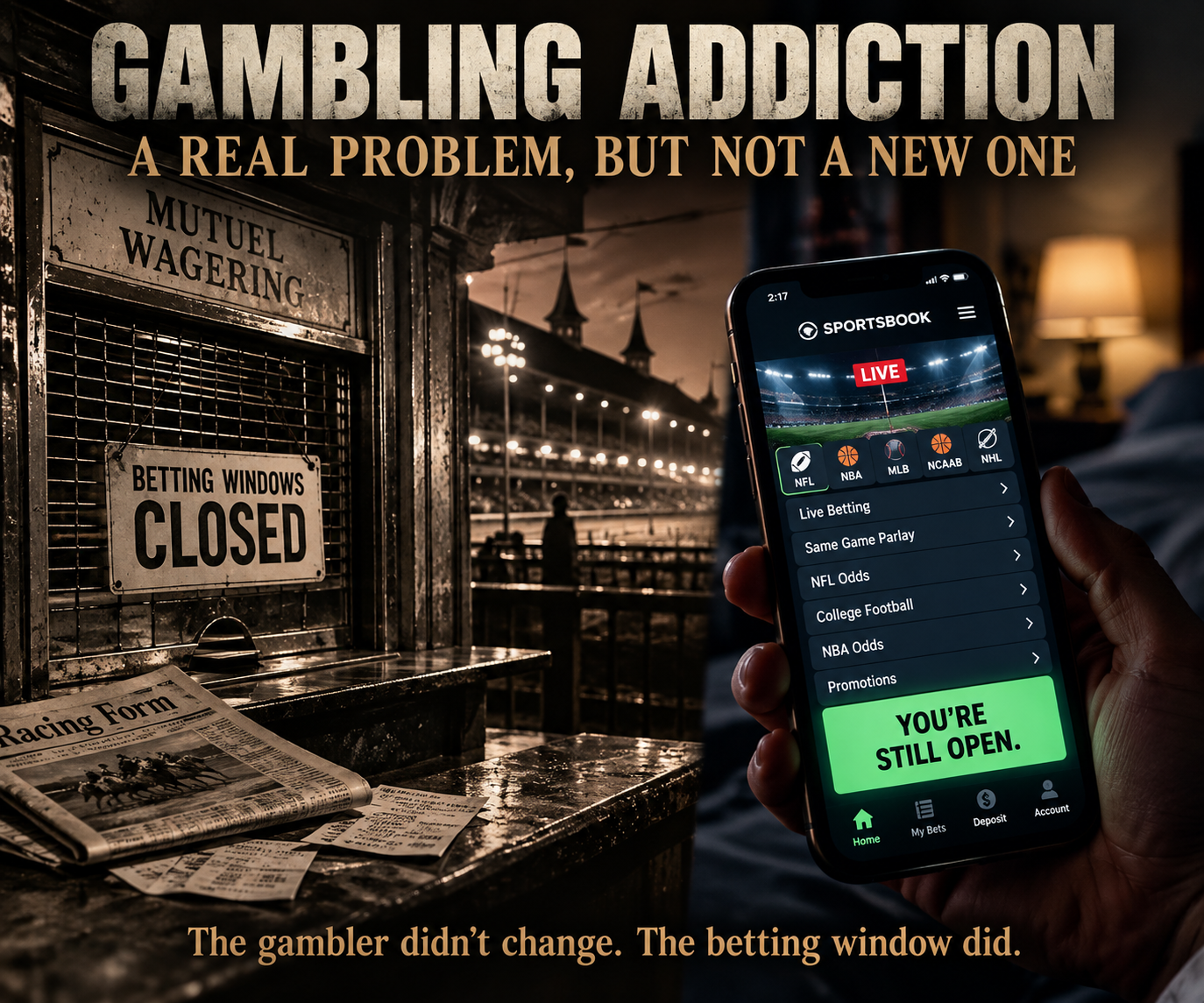
What has changed isn’t necessarily the gambler. What has changed is the betting window.
When I was growing up, Aqueduct eventually closed. Belmont eventually closed. The last race at Saratoga was run. The poker game eventually broke up. Even bookmakers kept hours. If you wanted to gamble, you generally had to go somewhere, call somebody, find somebody, have cash or at least make some conscious effort to put the bet in. There was friction. Today the betting window never closes.
It is on the nightstand. It is in your pocket. It goes to dinner with you. It sits next to you while you watch a game. You can wake up at 2:17 in the morning, roll over, pick up your phone and bet something somewhere without putting your shoes on.
That is different, and pretending it isn’t would be as intellectually dishonest as pretending gambling addiction was invented in 2018.
The research supports that distinction.
After the Supreme Court’s 2018 decision opened the door for states to legalize sports wagering, legal sports betting exploded in the United States. One study published in JAMA Internal Medicine examined internet searches seeking help for gambling addiction following legalization and found significant increases, particularly after online sportsbooks became available. Searches are obviously not the same thing as clinical diagnoses, and the researchers acknowledge that limitation, but they are a legitimate signal that more people are looking for help.
Other research goes beyond Google searches. Studies examining household financial data following the legalization of online sports betting have found increased wagering accompanied by reduced savings, with some of the strongest negative effects falling on financially constrained households. Researchers have also identified increases in credit-card debt, overdrafts and other measures of financial distress following expanded access to sports wagering, with online availability generally producing stronger effects than retail-only betting.
I don’t find any of that particularly surprising. I’ve been gambling most of my life. Of course easier access matters.
Make anything available 24 hours a day, remove almost every obstacle to getting it, advertise it constantly, allow people to consume it privately and make payment nearly effortless, and some percentage of people who are vulnerable to overconsumption are going to overconsume it.
That doesn’t make everyone who places a bet an addict any more than the existence of alcoholism makes everyone who orders a drink an alcoholic. That distinction seems to be getting lost.
There is also research that complicates the simple narrative that America suddenly became a nation of gambling addicts. The National Council on Problem Gambling has itself cautioned that its national surveys should not simply be treated as prevalence studies measuring the number of gambling addicts. Its more recent work found risky and problematic gambling indicators moving back toward approximately 2018 levels after rising during the pandemic, even as online gambling remained considerably more prevalent. The organization correctly says it is too early to declare that problematic gambling has stabilized, but that hardly supports the simplistic argument that legalization automatically created an endlessly rising epidemic.
What the research does consistently identify are groups that deserve attention: younger adults, frequent gamblers, people gambling across multiple products, online gamblers, sports bettors and people who already exhibit risky gambling behavior. That makes sense too.
Two things can be true at the same time. Gambling addiction did not suddenly appear when legal sports betting expanded across America, and modern technology can make an existing vulnerability considerably more dangerous.
There is another change I don’t think the gambling industry should pretend doesn’t exist, and that is advertising. Nobody had to advertise gambling to my family. We knew where Belmont Park was.
Today’s environment is different. Watch a sporting event and gambling can become part of the broadcast itself. Odds, promotions, same-game parlays, sponsorships, commercials, social media and betting content can surround the game. Research into sports-betting advertising has raised legitimate concerns about the volume of that exposure and about whether people who already exhibit problematic gambling behavior are more susceptible to promotional offers and impulse wagering.
That doesn’t mean advertising gambling should disappear. It means the industry shouldn’t insult everyone’s intelligence by claiming saturation can’t possibly have an effect. It can. There is a difference, however, between acknowledging that and declaring gambling itself the enemy.
We have tried prohibition before. We have fought wars against drugs. We have regulated alcohol, cigarettes and countless other things people consume despite knowing they can be harmful. Some of those regulations have absolutely reduced harm. Drunk-driving laws matter. Age restrictions matter. Treatment matters. Education matters.
But drinkers haven’t stopped drinking. Drug users haven’t stopped using drugs. People haven’t stopped smoking, overeating or engaging in any number of behaviors that can become destructive. Some people stop. Some people seek help. Some people never develop a problem in the first place.
The realistic objective should be reducing harm, not pretending government can legislate desire out of human beings. There is something else I learned early that seems almost absent from today’s discussion. Not everybody who gambles gambles the same way. I knew people who could go to the racetrack with $200, lose it and go home. They didn’t chase. They didn’t go to the ATM. They didn’t borrow $500 from somebody walking through the parking lot. They lost their money, complained about the jockey on the drive home, and came back next Saturday. I knew the other guy too. Same racetrack. Same horses. Same betting windows. Different people.
I eventually became a professional gambler. I made my living doing this. I still enjoy going after the kill. There is nothing quite like being right when you’ve done the work, waited for the opportunity and put your money down when you believe you have the advantage. So yes, I’m biased. I’m also probably more familiar with the downside of gambling than many of the people suddenly discovering it. Professional gambling isn’t about betting constantly. At least successful professional gambling isn’t. It is about discipline, bankroll, price, risk, patience and selectivity. One of the first lessons I learned remains one of the most important lessons I know.
Sometimes the best bet is no bet. That creates an interesting conflict in the modern gambling economy. The sportsbook benefits when you bet more. The good gambler benefits when he bets better. Those aren’t always compatible objectives. If we are going to have an intelligent national conversation about gambling, maybe that is a better place to start than deciding everyone who enjoys wagering needs to be saved from himself. Some people absolutely do need help. They should be able to get it.
That is where I think the gambling industry, regulators and government have an obligation that shouldn’t be controversial. Treatment should be accessible. Self-exclusion should be simple and effective. Deposit and wagering limits should be available to anyone who wants them. Minors should be protected. Promotions shouldn’t masquerade as free money when they aren’t. Research should continue into which gambling products and characteristics create disproportionate harm. Clinicians should understand gambling disorder, and funding for treatment should reflect the enormous expansion of legal gambling.
Most importantly, there should be no shame attached to asking for help. I’ve watched people lose everything. There isn’t anything funny about that.
There shouldn’t be a stigma attached to somebody recognizing he can’t control his gambling and saying so. If anything, that is the moment we should make it easier for him, not harder. Give him somewhere to call. Give him somewhere to go. Give his family resources. Give him the ability to lock himself out and make that lock mean something. But helping the person who cannot gamble responsibly doesn’t require treating every person who gambles as though he cannot. That is where I think some of today’s conversation loses its way. Gambling is not going away.
It was here before I was born. It was here when my mother walked into Belmont Park pregnant with me. It was there when she came back carrying me. It was in the poker clubs, in the churches, behind the stores, at Aqueduct, Belmont and Saratoga. It was in those mutuel clerks’ boxes. It was with bookmakers, card players, horseplayers and people making bets long before anyone had heard the words “mobile sportsbook.” Technology didn’t invent the gambler. It removed the closing bell. That deserves attention. It deserves research. It deserves regulation where regulation actually reduces harm. It deserves honesty from an industry making enormous amounts of money from wagering, and it deserves resources for the people who discover they cannot control it. What it doesn’t deserve is historical amnesia.
We shouldn’t pretend gambling addiction suddenly arrived because gambling became legal, visible and convenient. We shouldn’t pretend prohibition will eliminate something human beings have done for thousands of years. And we shouldn’t pretend that because most people can gamble without destroying their lives, the people who can’t don’t matter. I have seen both sides of this for more than six decades. The people haven’t changed very much. The game hasn’t changed very much either.
The biggest difference is that today, the betting window never closes.
If you feel you may have a gambling problem, seek professional help, it is available, 1-800-Gambler
Always gamble responsibly.



Comments