

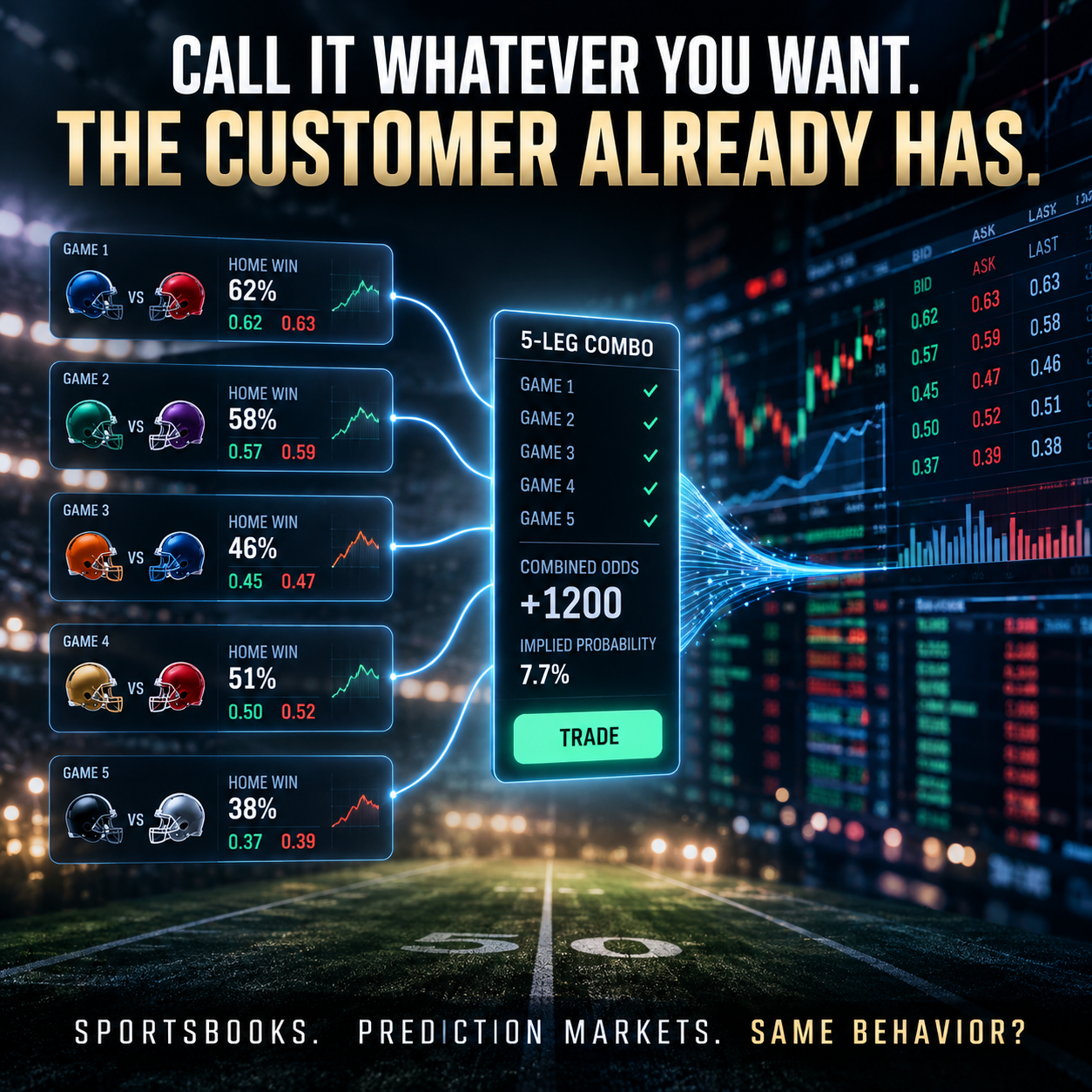

There is an interesting argument taking place in courtrooms across America over prediction markets, sports event contracts, and whether what companies like Kalshi are offering should be treated as federally regulated financial products or gambling subject to state law. Lawyers are arguing about swaps, preemption, the Commodity Exchange Act and the jurisdiction of the CFTC. States are arguing they know a sports bet when they see one. Prediction markets insist there is an important legal and structural distinction between trading an event contract and making a wager with a sportsbook. Maybe there is. I will leave that question to the judges, at least for now. I have been pretty clear what I think and where and how I think thet will ultimately be decided. There is another question I find considerably more interesting. What does the customer think he is doing?
Bernard Marantelli of White Swan Data recently posted some fascinating numbers from Kalshi’s NFL “combo” markets comparing Week 1 with Week 2. Total trades increased 10.70% to 2.95 million. Maker risk jumped 24.65% to $1.77 billion. Average maker risk per ticket increased from $532.76 to $599.90. Most interesting of all, the risk-to-stake multiplier expanded from 8.48x to 11.55x, an increase of more than 36%. Meanwhile, taker stakes actually declined 8.54% to $153.2 million. Those numbers deserve more than a passing glance because they suggest something considerably more interesting than simply growth.
Marantelli’s observation was that takers were not merely adding two or three legs. They were moving deeper into the number of legs and further into the high-volatility end of the market. Anyone who has spent any meaningful amount of time around sports gambling should recognize that behavior immediately. It is the same basic behavior that turned parlays and same-game parlays into one of the most important profit centers in the traditional sportsbook business.
There is a legitimate caveat, and Marantelli pointed it out himself. The NFL schedule changed between the two weeks. Week 1 had four standalone games compared with three in Week 2. Putting another game into the primary Sunday afternoon window creates more simultaneous games, more combinations and more opportunities for customers to stack outcomes together. That matters. Two weeks of data does not establish a long-term behavioral trend, and anyone claiming otherwise would be getting ahead of the evidence. But the question the data raises is far more important than declaring a trend after two Sundays.
Are prediction-market customers beginning to behave like sportsbook customers?
If they are, nobody who understands gambling should be surprised. The appeal of the parlay has never required an economics degree to understand. Risk a relatively small amount of money for the possibility of winning considerably more. Add another team. Add another player. Add another outcome. Turn an ordinary Sunday afternoon into five games you suddenly care about and give yourself something to sweat going into Sunday night. The mathematics may change. The terminology may change. The mechanism facilitating the transaction may change. Human nature doesn’t change nearly as quickly.
That is what makes the timing of these numbers particularly interesting. While customers are experimenting with increasingly complex sports combinations, federal courts are simultaneously trying to decide what these products actually are.
On Friday, October 2, U.S. District Judge Martha Pacold in Illinois handed Kalshi, Coinbase and the CFTC a significant preliminary victory. In considering title-game contracts such as whether the Chicago Cubs will win the World Series, Pacold concluded that the contracts are likely “swaps” under the Commodity Exchange Act and that portions of Illinois’s sports-wagering regulatory regime are likely preempted by federal law. The ruling is preliminary and limited, and questions involving Illinois fees and taxes remain unresolved. It nevertheless gave the prediction-market industry an important win after several significant setbacks.
Only a week earlier, the Sixth Circuit had gone the other way. In cases involving Ohio and Tennessee, the appellate court held that Kalshi had not demonstrated its sports-event contracts qualify as swaps and further held that even if they did, the Commodity Exchange Act would not preempt those states’ gambling laws. The legal battle is far from settled. Different courts are looking at remarkably similar products and reaching fundamentally different conclusions about what they are and who gets to regulate them.
Now put the two stories next to each other.
In one room, lawyers are parsing the statutory definition of a swap and debating federal preemption. In another, traders and market makers are developing increasingly sophisticated technology to price, fund and manage multi-leg sports combinations. And sitting at home on Sunday afternoon is a customer who may not know what the Commodity Exchange Act says, may never have heard the word preemption and almost certainly doesn’t care which federal agency has jurisdiction over the transaction.
He sees football games. He sees combinations. He sees a chance to risk a little to win a lot.
That does not answer the legal question. It shouldn’t. Statutes are not interpreted by asking what a guy sitting on his couch thinks he is doing. Prediction markets also have structural differences from conventional sportsbooks that shouldn’t simply be ignored because the products look similar on a phone screen. Markets have makers and takers. Prices can move through supply and demand. Participants can trade positions rather than simply hand a wager to a bookmaker. Those distinctions are real.
But customer behavior is real too.
That becomes especially important because Marantelli made another observation that should get everyone’s attention. This high-volatility, multi-leg portion of the business is already at the core of sportsbook income, and prediction markets are not merely entering that territory. They may be expanding it as the technology, funding and risk-management infrastructure improves.
That is where this gets much bigger than whether one NFL Sunday happened to produce more combinations than another. If prediction markets can build deeper liquidity around these products, improve the technology used to price them, solve the funding and risk-cycle issues associated with increasingly complicated combinations, and attract market makers capable of efficiently carrying that exposure, then they have potentially recreated one of the sportsbook industry’s most profitable products inside an entirely different market structure. Maybe recreated isn’t even the right word. They may eventually improve upon it.
Traditional sportsbooks spent years learning something gamblers have known forever. People like action, but they especially like action with a story attached to it. One team winning is a bet. Five things having to happen in sequence becomes an afternoon. You don’t need to teach that behavior to the customer. You simply need to give him the opportunity to express it. Prediction markets appear increasingly capable of doing exactly that.
There is also an irony here that should not be lost amid all the litigation. Prediction markets have spent considerable time and money explaining why they are not sportsbooks. From a legal and regulatory standpoint, they may ultimately be proven correct. The Supreme Court may eventually have something to say about that. Congress may eventually have something to say about it. The CFTC certainly will. At the same time, the market may be discovering how profitable it can become when its customers start behaving exactly like sportsbook customers.That does not make an event contract a sports bet as a matter of law. It does, however, make the line increasingly difficult to explain outside a courtroom.
The next several weeks of NFL data will tell us much more. If the depth of these combinations continues increasing after adjusting for scheduling differences, then Marantelli’s numbers may have identified something considerably more important than a Week 1-to-Week 2 statistical curiosity. They may be showing us the early stages of a behavioral migration. Not necessarily gamblers leaving sportsbooks for prediction markets, although some of that undoubtedly occurs, but sportsbook behavior migrating into prediction markets. There is a difference. And there is potentially a fortune in that difference.
For all the complicated legal arguments surrounding this industry, sometimes the market answers a question before the lawyers do. Prediction markets can call them contracts. Sportsbooks can call them parlays. Regulators can call them gambling. The CFTC can call them swaps. Lawyers can spend the next year arguing over which word belongs in which statute.
The customer doesn’t care what you call it. He sees five football games, puts them together, risks a few dollars to win a lot, and sweats the last leg Sunday night. We’ve seen this movie before. The only question now is who gets to sell the tickets.

Comments