


When Churchill Downs CEO Bill Carstanjen called for an independent investigation of HISA, I had no problem with it. I said so before he sat down this week to explain why he believes HISA, Lisa Lazarus, its information security, its handling of the Fair Hill Five and other integrity questions deserve scrutiny. On August 31, I wrote, “Churchill Downs Wants HISA Investigated. Fine. Just Don’t Stop There.” Ten days later, as the noise got louder and more people started choosing sides, I wrote it again, even more plainly: “Investigate HISA. Fine. Just Don’t Stop There. We Meant Everybody.” My position has not changed. Investigate HISA. Investigate HIWU. Investigate the Marshall Gramm matter. Investigate the Fair Hill Five. Investigate the relationship between HISA and The Jockey Club. Follow the money, examine the relationships, look at the enforcement and ask every uncomfortable question that needs to be asked. Just don’t stop there.
That is what makes Carstanjen’s comments this week worth examining. Not because I disagree with everything he said. I don’t. He has every right to question how Marshall Gramm obtained confidential information he was not entitled to have. I have questioned that myself. He has every right to ask how long the vulnerability existed, whether anyone else exploited it, and what HISA knew and when it knew it. We asked those questions before Churchill’s latest interview, and HISA for the most part answered them. If its systems were inadequate, fix them. If its internal controls failed, identify where and why. If somebody else accessed information they should not have had, find them too. None of that changes because Bill Carstanjen said it.
The problem begins when accountability becomes directional. It is easy to demand transparency from the guy sitting across the table. Transparency only becomes a principle when you are willing to live under the same light yourself.
Carstanjen says Churchill has always been concerned about computer-assisted wagering. He says CDI dealt with it by taking the business away from third parties and bringing it in house so Churchill could “monitor and track it.” He says Churchill has raised the rates computer players pay, and believes that has helped balance their share of the pools. He says Churchill has never cut what he called “interesting or creative or weird CAW deals.” He says customers cannot be allowed to perceive that somebody else has an unfair advantage or that the game is rigged. Fine. Show us.
Start with what Carstanjen actually described. Bringing CAW in house did not remove computer players from Churchill’s pools. It made Churchill their host. By his own account, those players often pay the very highest host fees. That means the higher rates he points to as a safeguard are also a revenue stream, and the more CAW volume Churchill hosts, the more Churchill earns. He framed his entire approach around generating “the best overall returns for our company.” I appreciate the candor. It is also exactly why the public deserves to see the numbers rather than take the company’s word for how those two interests balance out.
So here are the questions. What percentage of Churchill Downs wagering pools comes from CAW players? What percentage arrives through Velocity? What effective rates do those players pay compared with retail customers after every rebate and incentive is accounted for? How much of that volume arrives in the final seconds before the race? What percentage of Churchill’s handle is generated by players receiving pricing unavailable to the ordinary bettor? How much does CDI earn from that business? And what has happened to those numbers over time as the rates Carstanjen describes have gone up? Those are not accusations. They are questions.
Carstanjen says Churchill’s approach is working. Maybe it is. He says he believes CAW participation at Churchill is already closer to where NYRA and California are now trying to get through wagering cutoffs. Maybe it is. There is one small problem. In the same answer, he acknowledges he does not actually have their numbers. He has a feeling. A feeling is not data. For years, the wagering customer has been told computer-assisted wagering is too complicated, too proprietary and too sensitive to fully understand. Now one of the largest racing and wagering companies in America is telling that same customer its system is better, based partly on numbers it does not have and partly on numbers of its own it does not disclose. He even defended the privacy of computer players’ transactions. The retail bettor gets no such consideration. He just gets to watch the odds move after the gate opens. That is exactly why executive assurances are no longer enough.
To his credit, Carstanjen acknowledges the problem. He says bettors may look past what racetrack executives say about their computer wagering policies, calls that skepticism troubling, and says, “When there’s a perception of a problem, it’s a problem for everybody.” He is right. So stop asking the wagering customer to rely on perception in either direction. Publish the numbers. If Churchill’s CAW policies are better, show us why. If Velocity players pay materially higher effective rates, show us. If late odds movement is less severe at Churchill tracks, show us. If CAW participation has been reduced to a level Churchill believes is healthy for the ecosystem, tell us what that level is. If the ordinary retail bettor is being protected, demonstrate how. Transparency cannot mean HISA opens its books while Churchill describes its own operation with adjectives.
That was part of the point of our earlier articles. Churchill’s August 28 letter to the FTC raised questions about the Fair Hill Five, wagering integrity, testing timelines, and whether information reached racetracks and the wagering public quickly enough. Those were fair questions then, and they remain fair questions now. But HISA does not regulate the pari-mutuel wagering markets. Churchill operates racetracks. Churchill operates TwinSpires. Churchill operates Velocity. Churchill has direct access to wagering information HISA does not possess. So when Churchill asks who should have identified suspicious wagering connected to the Fair Hill Five, there is another fair question sitting right next to it: what did Churchill’s own wagering operations see, when did they see it, and what did they do with it?
That is not a defense of HISA. It is the opposite. Investigate HISA completely. Determine whether HISA should have acted sooner against Ángel Quiroz based on whatever medication information was available. Determine whether testing took too long, whether disclosure should have come sooner, and whether its systems failed. Then keep walking. If the Fair Hill Five was an international wagering event, examine the wagering. Examine the ADWs, the batch activity, the accounts, and what the host tracks, the tote companies and the offshore markets saw. Examine whether anybody recognized abnormal patterns while they were happening. You do not investigate an international betting event by stopping at the veterinarian.
Consider where that event actually stands. Scotland Yard has yet to determine exactly what happened with the Fair Hill Five, and the latest reports out of the UK indicate the books have not yet paid the wagers. The bookmakers who took the bets are still sorting out what they were looking at. The investigators with jurisdiction over those bets have not reached a conclusion. Yet the story being told in this country too often begins and ends with a trainer, a test and a federal regulator. The wagering is the event. It happened across betting shops, accounts and markets, most of which HISA has no authority over. Placing the full weight of the Fair Hill Five on HISA’s medication timeline is not accountability. It is a very convenient place to stop looking.
This is where the conversation keeps getting lost. HISA can be responsible for one part of a failure without being responsible for every part of it. Churchill can raise legitimate questions about HISA without becoming exempt from questions itself. Two things can be true at once. Apparently that has become a difficult concept in horse racing.
The Triple Crown comments deserve the same examination. Carstanjen says the Triple Crown has a tremendous historical legacy, but “we are not history teachers.” He says racing cannot keep talking about 1945 or 1880, and that today’s customers need reasons to engage. Who exactly is arguing for a history class? The history is the asset. The Kentucky Derby matters because of its history. So do the Preakness and the Belmont Stakes. Churchill understands that better than anyone. It sells the roses, the Twin Spires, the mint juleps and every anniversary it can put on a program. A Derby winner going to Baltimore with the Triple Crown suddenly alive is one of the few storylines horse racing does not have to manufacture, explain, package, workshop, brand or sell to somebody who has never opened a Racing Form. They already understand it. That does not mean the schedule can never change, or that 14 days between races is sacred because somebody did it 100 years ago. It means treating history and engagement as competing ideas misses what made the Triple Crown valuable in the first place. History is why people engage with it.
The chronology surrounding the Preakness makes his comments even more interesting. Churchill attempted to acquire control of the Preakness. Maryland ultimately paid $85 million and prevented that from happening. Carstanjen now says that had Churchill acquired it, the first idea would have been to work it out with NYRA and potentially move the Preakness later in the summer, after the Belmont. Churchill and NYRA have since announced their own series of races to help determine the 3-year-old championship, and the Preakness is not part of it. I am not going to tell you why. I don’t know, and neither does anybody who was not in those rooms. I will simply point out the sequence. Had Churchill controlled the Preakness, Churchill had ideas about where it could fit. Churchill did not obtain control of the Preakness. The Preakness is now outside the championship series Churchill created with NYRA. Readers can decide what they make of that. That is how questions are supposed to work.
If Churchill wants to lead the conversation on integrity, its own record is part of the conversation. When Medina Spirit tested positive for betamethasone, traced to a topical ointment, Churchill moved quickly to assert its private property rights and ban Bob Baffert. That was its right. But the standard has to mean something when it is inconvenient too. In November 2025, a video circulated appearing to show Irad Ortiz Jr. and Jose Ortiz in the ring at a Puerto Rico cockfighting club, collecting cash from the betting crowd. PETA publicly called for action in January. Kentucky stewards looked into it and took no action. Churchill Downs said nothing, and in May the brothers finished first and second in the Kentucky Derby. Cockfighting is not a gray area. It has been a federal felony in Puerto Rico since December 2019, a ban the federal courts have upheld over the island’s objections. It is animal cruelty, and in a sport built on the care of animals, that alone could reasonably be argued as conduct detrimental to racing. And it is a blood sport that exists to be bet on. The Ortiz brothers have not been charged with anything, and they are entitled to that presumption. But Churchill did not need charges to act on Bob Baffert, and it did not need them here to at least say something. A company that invoked its property rights over an ointment, then stayed silent while two riders shown in a cockfighting ring apparently handling the betting money rode in its signature race, does not get to lecture anyone about wagering integrity. Not around here, anyway.
The same standard applies to Lisa Lazarus. Carstanjen says he was disappointed by her response to Churchill’s FTC letter. He says it lacked the humility a regulator should demonstrate, felt a little personal, and amounted to public relations and deflection. He is entitled to that view. I read it differently. When Carstanjen criticized HISA’s digital security, Lazarus pointed out that breaches are a modern reality, and that Churchill should know, because TwinSpires was breached in 2012. That is not a deflection. It is a relevant fact. Sometimes the person being questioned has a legitimate answer, and sometimes that answer creates another question for the person doing the questioning. That is not a failure of transparency. It is what transparency looks like when it runs in both directions. We said exactly that before this interview.
If HISA violated its rules, establish it. If HISA’s security failed, establish how. If its relationship with The Jockey Club created a legal or governance problem, identify the provision and the violation. If Churchill has a more equitable CAW model, establish that too, and show the numbers. Churchill has made its own decisions over the years about who is and is not welcome to race on its property. If it applies a consistent integrity standard in making those calls, explain the standard. If Churchill believes wagering entities should have recognized what happened around the Fair Hill Five, tell us what Churchill saw. Everybody wants accountability until the questions reach their own front door.
That is what “don’t stop there” meant. It did not mean investigate HISA until we find something we can use against HISA. It did not mean investigate Churchill until we find something we can use against Churchill. It did not mean investigate The Jockey Club because you dislike The Jockey Club, or defend Lisa Lazarus because you happen to like Lisa Lazarus. It meant everybody. Ask HISA. Ask Churchill Downs. Ask The Jockey Club. Ask the ADWs, the CAW players and the regulators. Ask the people demanding transparency, and then ask them the same questions they demanded somebody else answer.
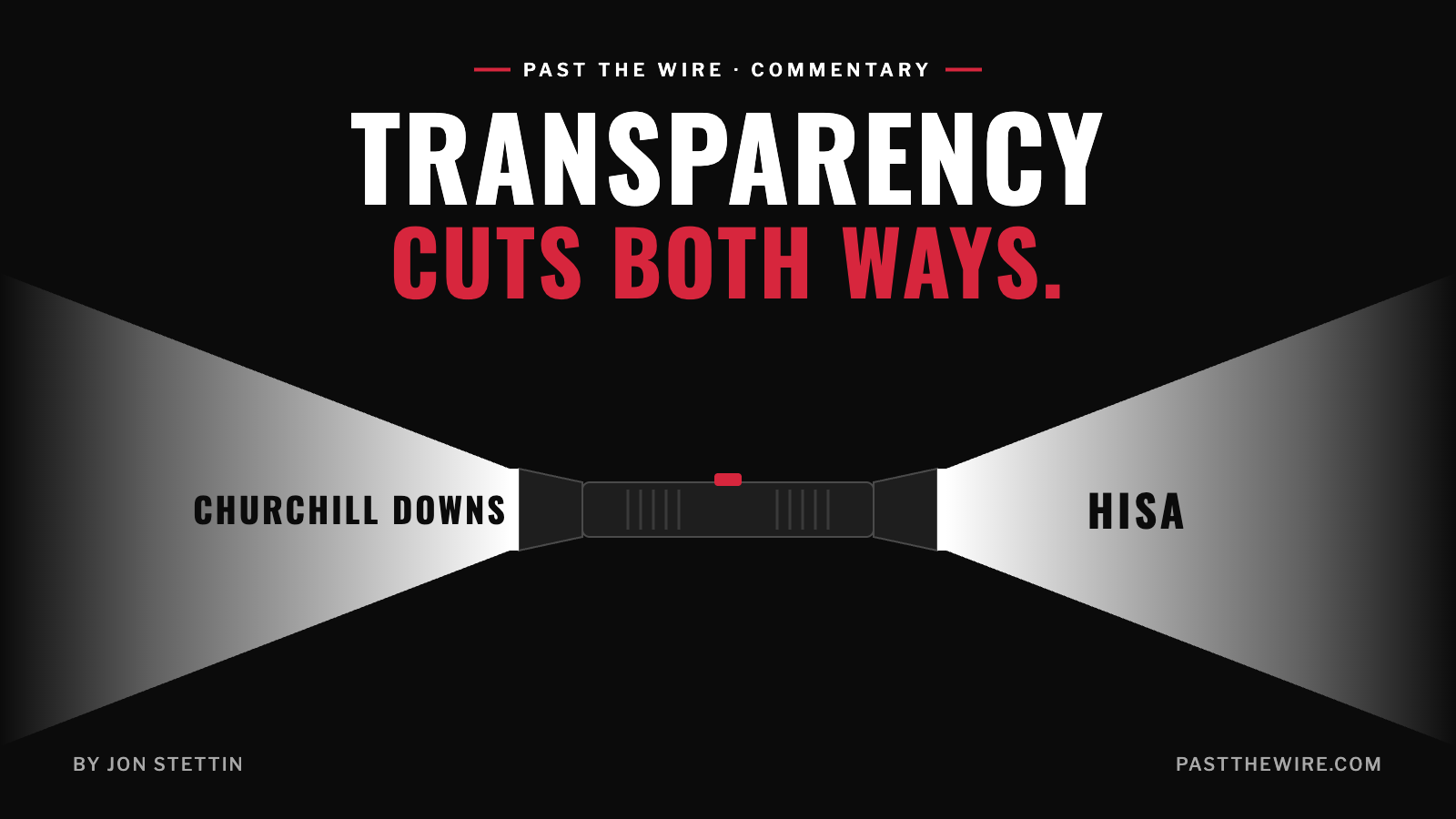
Bill Carstanjen wants the flashlight pointed at HISA. Fine. We pointed it there before he did. We just never agreed to turn it off when it reached Churchill Downs.


Comments