

Keeneland, the numbers behind the numbers, and what happens when people question the system.
For as long as I have been around Thoroughbred sales, there have been rumors and whispers about agents, farms, breeders and consignors running up prices, buying back their own horses, and creating the appearance of demand that may not be what it seems. Some stories may be true. Some may be exaggerated. Some may be bullshit. I cannot prove every tale told around a sales pavilion, and I am not going to pretend I can. What I can do is look at the rules, look at the transactions, and look at what the institutions do when somebody questions either one.
The rules themselves invite questions. Keeneland’s Conditions of Sale permit sellers, including through disclosed or undisclosed agents, to bid on their own horses. There are legitimate reasons to protect a reserve. But there is a world of difference between protecting a minimum acceptable price and allowing a prospective buyer to believe he is competing only against other independent buyers. A permitted practice is not automatically a transparent one.
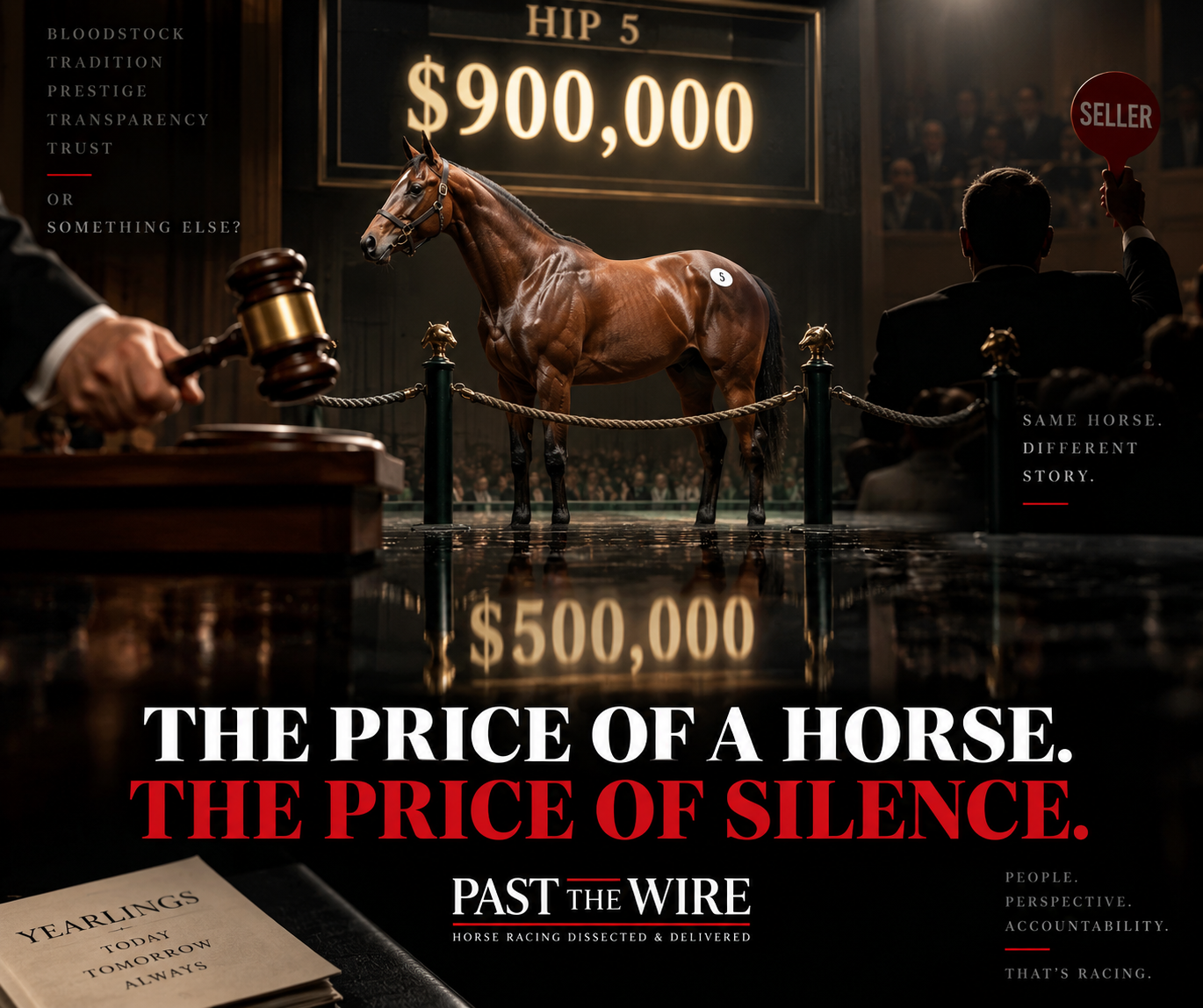
The $900,000 horse and the $500,000 purchase
Consider Hip 5 at the 2025 Keeneland September Yearling Sale, an Uncle Mo filly out of Knarsdale. The published result listed Cherie DeVaux, Agent, as buyer at $900,000. Mike Repole has said he subsequently purchased the filly privately for $500,000 and was invoiced for that amount. Determined Stud’s Matt Dorman acknowledged buying the filly back. Accounts of whether the filly carried a reserve differ. Those disagreements should be reported as disagreements, not magically resolved by the writer.
Keeneland’s explanation is that published results record what happened in the ring, including the hammer price, under its auction reporting convention. That tells us how the number got onto the page. It does not answer the more useful question: what does a reader understand when a horse appears to have sold for $900,000 but is subsequently acquired for $500,000? A hammer price, a completed sale to an independent buyer, a buyback and a later private transaction are different events. A transparent record can preserve each without pretending they are interchangeable.
Start at the reserve
Here is my proposal. If a horse has a reserve, disclose it up front. Better yet, open the bidding at the reserve. If the seller will not accept less than $500,000, start at $500,000. If nobody bids, the horse does not sell. If real buyers want the horse, let them compete. The public should not have to guess whether the next bid comes from someone trying to buy the horse or someone trying to keep it.
I understand the argument for confidential reserves: sellers want flexibility, and auction houses believe familiar procedures facilitate sales. Those are interests, not commandments. They can be weighed against the buyer’s interest in knowing the nature of the competition. Seller bidding is not proof of fraud in any individual sale. It is a structural reason to demand more intelligible disclosure.
When the auction goes sideways: Carrie Brogden explains
Carrie Brogden has supplied a useful example of what transparency can look like when an auction goes wrong. In a September 17 public post, she began: “I was her consignor and this is what happened.” Her account concerns a Tiz the Law filly with a $239,000 reserve, a reserve she says she can document with the slip.
According to Brogden, Starlight bid above $260,000, Mark Stanton’s agent bid $275,000, and a Japanese agent’s $285,000 bid was recognized by the bid spotter. The agent then said he had not intended to bid and withdrew it. The auctioneer attempted to return to Stanton’s agent at $275,000, but the Starlight group had already left the pavilion. The bidding fell below the reserve and the filly was an RNA. Brogden says she subsequently called Jack Wolf and his group, who returned and bought the filly privately for $225,000. Wolf and Tom Ryan are associated with Starlight; this was the same interested group that had participated in the earlier bidding, not an unrelated buyer who appeared afterward.
Brogden says the late bidder may have encountered a language barrier and that she does not believe anyone acted with ill intent. That is her explanation, not proof of wrongdoing by the bidder, the consignor, Starlight or Keeneland. Tom Ryan likewise described the confusion as an example of how messy a live auction can become. Stanton, for his part, publicly praised Brogden for explaining the transaction and expressed the opinion that the bidder who offered $285,000 owed her the $60,000 difference. His view is just that, is not an established debt.
Look at the figures: $239,000 was the reserve; $285,000 was the disputed high bid; $225,000 was the subsequent private purchase price. The eventual sale was $14,000 below the original reserve. A reserve is the seller’s minimum at the time, not an eternal valuation, and the failed bidding may have changed the seller’s options. My proposal to disclose the reserve or open at it would not, by itself, prevent a mistaken bid or a bidder’s withdrawal. It would, however, remove one avoidable mystery from the process.
Brogden’s account does not demonstrate inflated Keeneland statistics or seller bidding. It demonstrates why a bare number cannot always tell the whole story and why an honest, specific public explanation can protect buyers and consignors alike. Transparency is not a promise that nothing will go wrong. It is the willingness to explain what actually happened when something does.
The numbers travel far beyond the ring
Repole’s public post raises the possibility that buybacks and seller bidding could affect reported averages and headline prices, including the figures used to promote stallions. His hypothetical is a question about incentives and the integrity of market statistics, not evidence that any named farm manufactured a particular transaction. But the question matters. Sales figures become marketing material, breeding decisions, valuations and headlines. If a reported price includes a seller buying back his own horse, that fact should be readily identifiable to anyone relying on the number. His own closing line was: “Back in Queens where I come from we call it BULLSHIT!!!!!” In Brooklyn, where I’m from we call it f…ing BULLSHIT or simply GTFOH.
RNA results are not simply absent from the world; sales companies publish RNA information. My point is more fundamental. Why not disclose the reserve before the first bid, or begin at that reserve? And why not make the final disposition unmistakable: sold to an independent buyer, retained by the seller, or sold later in a separate private transaction? The public should not need a detective’s kit to understand a sales result.
The connection and the confrontation
Cherie DeVaux is married to David Ingordo. Her name appears as agent on the published Hip 5 result. That relationship does not establish that Ingordo bid on the filly, directed DeVaux, or participated in any disputed transaction. It would be irresponsible to suggest otherwise without evidence. It is nonetheless relevant background when discussing the subsequent confrontation involving Ingordo and Pat Cummings over criticism of sales practices.
As Past The Wire previously reported, Ingordo confronted Cummings, accused him of posting criticism on Repole’s behalf, and repeatedly poked him in the chest after Cummings told him not to touch him. Our published account also described a witness intervening and security becoming involved. We reported a stern talking-to and an internal warning of some sort. We stand behind our reporting. If Keeneland took additional action, it can say so. I am not going to fill in what I do not know, and I am not going to pretend the publicly known response answers the question of institutional accountability.
Kentucky law is not silent on physical contact
Kentucky Revised Statutes § 525.070(1)(a) addresses harassment through intentionally intimidating, harassing, annoying or alarming another person by striking, shoving, kicking or otherwise subjecting that person to physical contact. Physical-contact harassment under that provision is a Class B misdemeanor. Whether the elements of any offense were met in this incident is a question for the appropriate authorities, not a verdict I am issuing in a column. But repeated unwanted chest poking, as we reported it, is not automatically trivial because no visible injury was alleged. The statute gives readers a concrete reason to take the conduct seriously.
Nor does Keeneland need a criminal conviction to decide what conduct it will tolerate at its own event, subject to its rules and obligations. Ingordo is responsible for his conduct. Keeneland is responsible for its response. Those are different responsibilities. In my opinion, the response publicly known to us does not inspire confidence. That is a judgment about the institution’s actions, not a claim that I know everything that occurred behind closed doors.
The silence after the hammer
Our account circulated among people in the industry. Some have spoken; others have not. I will not pretend silence proves agreement, fear, or a conspiracy. I will say that the absence of a meaningful public reckoning is striking when the same business so readily celebrates its records, averages and commitment to integrity. Other outlets make their own editorial decisions. Their failure to cover a story, where verified, is worth discussing.
We have asked questions before. So have others. Keeneland has explained its reporting convention. An explanation of a convention is not a defense of its wisdom. A warning, if that is the extent of the response, is an action; it is not necessarily an adequate one. I am not interested in sending the same questionnaire until somebody supplies an answer I like. I am interested in what the record shows, what the rules permit, and what changes,if any, follow.
Disclose the reserve. Start the bidding there. Identify seller buybacks clearly. Distinguish the hammer price from a subsequent completed sale. Apply conduct standards consistently, whether the person involved is a newcomer or a powerful agent. None of that requires a conspiracy theory, a criminal conviction or another committee meeting. It requires a willingness to put daylight where the industry has grown accustomed to shadows.
Racing has a difficult enough time attracting owners, especially owners who can participate in this particular sale. One would logically think they’d run it in a way conducive to just that. If someone brought a prospective owner or investor and they observed what occurred, learned the response by Keeneland Sales, heard the stories, what are the odds they want to jump into that pool?
They can call it tradition. They can call it standard practice. They can call it a matter already addressed. I call it a market whose participants deserve to know what they are bidding against, and an institution whose response should mean more than its press releases. The hammer has fallen. The questions remain.

Comments