

The Racing and Gaming Conference debated whether casual bettors, serious horseplayers and computer-assisted wagering operations can coexist. The better question is why one pari-mutuel pool has been divided into three classes of customers in the first place.
A passionate discussion took place at the Racing and Gaming Conference at Saratoga over whether the casual bettor, the consistent bettor and the computer-assisted wagering bettor can coexist in the same pari-mutuel pools. Christian Hellmers argued for meaningful guardrails. Don Johnson, who is part of a CAW wagering operation, argued that each racetrack should decide how much CAW participation works within its particular ecosystem. Steve Kornacki pointed to the damage late odds changes may be doing to existing horseplayers and potential new ones.
It was a worthwhile discussion. It was also a discussion Past the Wire has already had, repeatedly, from both sides of the rail. We have interviewed and authenticated a CAW player. We have corrected false allegations made against CAW operations. We have defended the intellectual advantage earned through research, technology and superior execution. We have also examined the structural advantages provided through rebates, direct or near-direct tote access, high-speed batch wagering and last-second entry into pools ordinary horseplayers are expected to fund.
We have asked the questions. We have studied the answers. We have proposed solutions designed to regulate CAW activity without driving its handle out of the game. Now NYRA has supplied actual numbers from a live racing environment.
Asked and answered.
The framing of the Saratoga panel revealed the problem before anyone attempted to solve it. The discussion divided the wagering market into the casual bettor, the consistent bettor and the CAW bettor. Why does CAW require its own separate classification inside what is supposed to be one pari-mutuel pool? There are highly successful professional horseplayers who are not CAW players. There are sophisticated handicappers using proprietary figures, advanced data and computer models without receiving CAW access or pricing. There are large retail players who wager seven figures annually without operating through a high-volume wagering shop.
CAW is not merely a synonym for intelligent, sophisticated or successful. It is a separate category because its participants receive a different method of access, execution, timing and pricing.
Horse racing held a panel to discuss whether three different classes of customers can coexist in one pari-mutuel pool. The existence of three classes answers the question before the panel begins.
In 2021, I interviewed a legitimate CAW player for “Horseracing’s True Lifeline.” I confirmed through three racetracks that the player had an individual TRA code and did, in fact, wager into their pools. The purpose was not to indict CAW operations. It was to separate fact from fiction at a time when nearly every discussion about computer-assisted wagering was buried beneath rumor, misunderstanding and resentment.
I concluded then that CAW players were not inherently the enemy of horseplayers or racing. I acknowledged that their models represented a substantial investment of time, money and expertise. I rejected the popular claim that they were simply looking at open or uncovered combinations and taking whatever the public had missed. I recognized that eliminating a significant share of racing’s handle overnight could damage tracks and purses. I wrote that serious horseplayers should suit up and compete.
I was not afraid of CAW players then. I am not afraid of them now.
What changed was not my willingness to compete. What changed was the size of their participation, the concentration of their play, the privileges afforded to them and the evidence of what those privileges were doing to everyone else in the pool. A wagering category that may have once supplemented liquidity grew large enough to influence pricing across entire pools while receiving an effective takeout unavailable to the customers on the other side of its bets.
The question has never been whether CAW players are smart. Many of them are exceptionally smart. Intelligence does not confer a right to separately negotiated rules inside a common pool.
Hellmers makes a good point, but not a complete one. He believes CAW wagers should enter by two minutes to post, forcing those players to lock in their liquidity, assume price risk and establish a visible market that everyone else can evaluate. That is unquestionably better than allowing massive high-speed batches to arrive as the horses enter the gate, after ordinary players have committed and no longer have an opportunity to react. If CAW teams receive superior rebates, superior technology and superior execution speed, they should not also receive the right to bet last. No participant should be granted every structural advantage simultaneously. Where Hellmers loses me is in his description of what should happen next. In his version, the CAWs enter first and “set the market.” The data players then build or adjust their models, and the remaining public wagers into the market those sophisticated groups have established. That may sound orderly in a conference room. It sounds considerably less inviting from the other side of the betting window.
I do not need a CAW operation to tell me what a horse is worth. I need the same opportunity it has to determine what that horse is worth—and to receive a price reasonably resembling the one showing when I make the wager.
The public does not wager merely to provide liquidity after the most technologically advanced players have efficiently priced every horse. People wager because they believe their opinion can be right when the market is wrong. That belief is the foundation of handicapping. If racing’s objective is to allow CAW models to remove every meaningful inefficiency before the public participates, then horse racing has converted a competitive skill game into a toll road. Requiring CAWs to wager early attacks the last-mover advantage and the most visible late odds collapses. It does not address rebate disparity, specialized access, data availability, batch-wagering capability, transparency, retail subsidization of CAW economics or the concentration of CAW play in particular exotic pools. It is a meaningful guardrail. It is not a level playing field. Johnson’s response avoids the central issue. He suggests that requiring CAWs to wager early might not help other sharp horseplayers because those players will often identify the same horses the CAW models identify. So what? The objection is not that CAW players find winners. The objection is not that they build better models, conduct more research or manage their bankrolls more effectively. Those things are competition. They are supposed to be part of the game.
Finding the same horse is handicapping. Betting that horse through different pipes, at different speeds, under different pricing arrangements and after everyone else has committed is market structure.
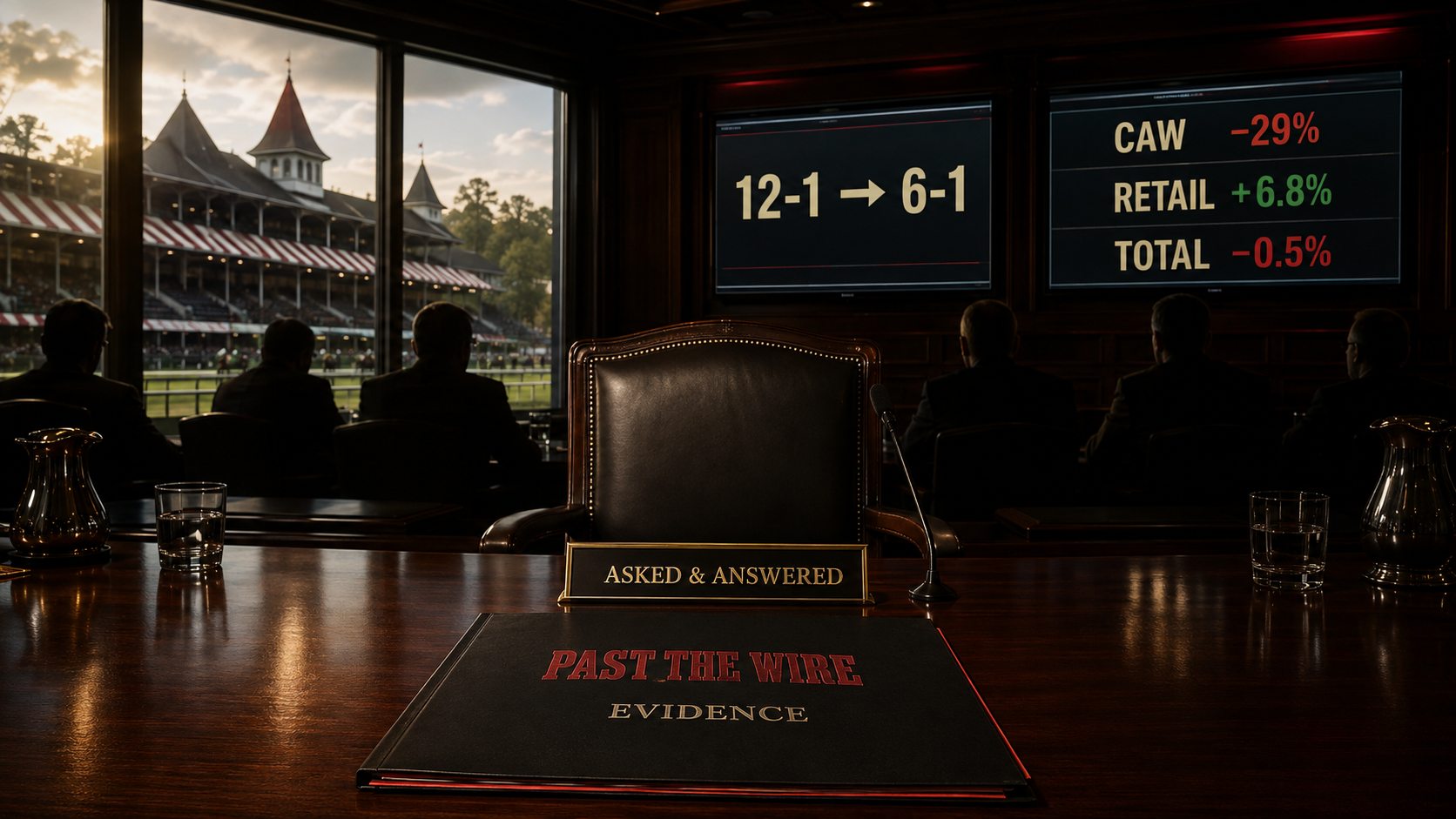
T O Elvis demonstrated the distinction perfectly. I examined that race in “Elvis Did the Work. The Public Didn’t. That’s the CAW Story.” T O Elvis was a 30-1 morning-line Japanese shipper in the Churchill Downs Stakes on Kentucky Derby Day. His form was publicly available. His race replays could be found. His travel and preparation had been reported. The presence of Ryusei Sakai was a tell for anyone willing to recognize it. I looked long and hard at T O Elvis myself. I watched his races, studied the situation and concluded that the American horses were faster and that the layoff would work against him. I was wrong. The players who identified him as an overlay were right. I did not call that cheating. I did not allege hidden information. I wrote that the intellectual edge was earned and that the public was not deceived. The public was outworked. Then approximately $320,000 entered T O Elvis’ win pool in under a minute. His odds collapsed from 12-1 to approximately 6-1, and he returned $13.74. That enormous wager was not placed at that moment by accident. The timing maximized the return while leaving almost no opportunity for the rest of the market to react. The CAW rebate did not discover the horse or create the intellectual edge. It compounded the profit after the edge had already been earned. Those are separate questions, and an honest discussion must be capable of holding both at once. The research was legitimate. The execution occurred within the rules. The structural mechanism was damaging to the customer experience.
Kornacki is correct that the T O Elvis screenshots discouraged more than the people who wagered on that particular race. A potential horseplayer accustomed to sports wagering looks at a ticket purchased when a horse is showing 12-1, watches that horse win at approximately 6-1, and reasonably wonders what kind of market he has entered. Racing can explain pari-mutuel reconciliation, commingled pools, transmission delays and final-cycle wagering until the grandstand lights go dark. The customer already knows what he saw.
In almost every other wagering market, you know the price before you buy. Horse racing has conditioned its customers to discover what they bought after the race begins.
Johnson also argues that every racetrack should decide the CAW mix with which it is comfortable because every geography and wagering ecosystem is different. There is some truth in that. Aqueduct in February is not Saratoga in August. Field sizes, pool sizes, customer composition and signal economics vary. Implementation may require flexibility. Fundamental fairness does not. These are nationally commingled pools. A bettor in Florida, California or Kentucky is directly affected by the CAW rules in place at Saratoga, Churchill Downs, Keeneland or Gulfstream Park. The host track owns its signal, but it is not wagering with only local money.
Geography can determine post time. It should not determine whether two dollars is worth the same two dollars after it enters a pari-mutuel pool.
Johnson’s position leaves every track free to decide how much structural imbalance its customers should tolerate. I am less interested in the CAW mix with which a racetrack is comfortable than I am in the pool its customers are comfortable wagering into. In December 2025, before these Saratoga numbers were available, I offered a broader solution in “Solving the CAW Problem Without Killing the Game.” The premise was simple. CAW players could retain their models, algorithms, bankrolls and businesses, but the pool needed to return to the essential pari-mutuel promise: players competing under equal circumstances, with the same information, timing and effective rules. The proposal called for an end to late batch wagering, no tote access beyond what retail customers could see, real-time publication of CAW wagering without identifying individual bettors, an end to retail players and horsemen subsidizing CAW rebates, and free public access to the basic information necessary to handicap intelligently. I wrote then: “I’m not afraid to play against anyone or anything—not sharks, not syndicates, not supercomputers—as long as the field is level.” That remains the standard.
Be smarter. Build the better model. Conduct more research. Bet more money. Beat me if you can. But when we enter the same pari-mutuel pool, enter through the same door, see the same information, operate under the same timing rules and pay a price that does not require everyone else to subsidize yours. The argument against meaningful CAW restrictions was always that racing could not afford to lose the handle. Touch the rebates, restrict the timing or close certain pools and the money would disappear. Purses would suffer. Liquidity would collapse. The ordinary horseplayer should accept the disadvantages because CAW handle was keeping the game alive.
Then NYRA tried something different. During the five-day Belmont-at-Saratoga festival, CAW handle declined from approximately $40 million in 2025 to $22.1 million in 2026, a decrease of 44.7%. Total handle did not collapse. It increased 1.1%. Handle excluding CAW grew by approximately $20 million, or 12.7%. I examined those figures in “When You Give Horseplayers a Fair Shake, They Bet. Period.” The conclusion was unavoidable: The pool did not crater. It rebalanced. Now, through the first 23 days of the Saratoga meet cited by BloodHorse, CAW handle has declined 29%, retail handle has increased 6.8%, and total handle is down less than one-half of 1%. Once again, a significant reduction in CAW volume has not destroyed the overall market. Retail customers are wagering more.
That does not constitute a controlled laboratory experiment, and I will not pretend it does. Saratoga is a unique product. Weather, field size, race placement and other variables affect year-to-year comparisons. But two separate periods now point in the same direction. Restricting CAW activity has not killed the pools. The customers the industry was told to treat as secondary have responded by increasing their participation.
There is another issue the headline handle number does not capture. CAW handle is generally tied to substantial rebates. Retail handle is not. If a racetrack replaces heavily rebated CAW volume with a comparable amount of retail wagering, nearly flat gross handle may generate more net revenue for the track and purses. That means the industry is asking the wrong questions when it treats total handle as the only scoreboard. How much CAW handle was lost? How much retail handle returned? What was the effective revenue produced by each category? How much did rebate expense decline? How much more money reached purses? Did late-price volatility decrease? Did customer churn improve? Did players who previously stopped betting late return to the pools? Without those figures, “handle is down” is not economic analysis. It is arithmetic without context.
NYRA itself changed the conversation when David O’Rourke acknowledged that some handle could become destructive to the consumer experience. I addressed that admission in “When Handle Becomes Destructive.” For years, horseplayers who complained about odds collapsing after the gates opened were told they did not understand pari-mutuel wagering. They were told the volatility was normal, CAW money represented essential liquidity, and they should be grateful for the larger pools. NYRA measured the volatility, imposed restrictions, absorbed the loss of CAW volume and reported that late exacta-price volatility declined by approximately 45% to 50%.
You do not build a volatility index, restrict a major customer category and knowingly surrender handle to solve a problem that existed only in the customer’s imagination.
NYRA deserves credit for acting, measuring and publishing the results. Its reforms are not complete, but they represent more than a conference discussion. They produced evidence. That evidence now places the burden on every racetrack continuing to permit unrestricted last-second CAW activity. The question is no longer whether meaningful guardrails might work. We have evidence that they do. The question is no longer whether retail horseplayers will respond. They have. The question is no longer whether losing CAW volume automatically means losing total handle dollar for dollar. It does not. The question is whether the rest of the industry is willing to acknowledge what the numbers are saying when those numbers threaten relationships and revenue structures built over decades.
I once wrote that CAW players might be horse racing’s true lifeline. I believed their handle was indispensable and that much of their intellectual advantage was legitimately earned. I was willing to say that when many horseplayers did not want to hear it. I am not embarrassed by it now. Evidence matters. Markets change. The size and influence of CAW wagering changed. We learned more. NYRA acted, and the results supplied information we did not possess five years ago.
A lifeline that begins strangling the patient is no longer a lifeline.
Hellmers believes CAWs should wager first and set the market. That is better than allowing them to wager last and take the market, but why must racing design the entire pool around them at all? Johnson believes every racetrack should choose the CAW mix it finds acceptable. The people funding those pools deserve a vote in that decision. This is not a crusade against intelligent players, technology, models, large bankrolls or winning. It is a defense of the pari-mutuel contract. Fairness. Transparency. Equal footing.
The panel may have been meeting a mile or two from Saratoga Race Course. Past the Wire was not seated at the table. That is all right. Whether they saw us in the room or not, the questions we asked were already there, the solutions we proposed were already on the record, and the numbers have begun answering for us.
Asked and answered.