

T O Elvis Odds Explained
What the T O Elvis wagering data tells us about information asymmetry, late money, and who actually earns an edge in the pari-mutuel system
The numbers sitting in the Churchill Downs Race 10 pool data for Saturday’s Grade I Churchill Downs Stakes tell a story that has nothing to do with the horse’s connections or the competence of the field he beat. They tell a story about homework, timing, and a legal wagering structure that quietly and efficiently rewards both.
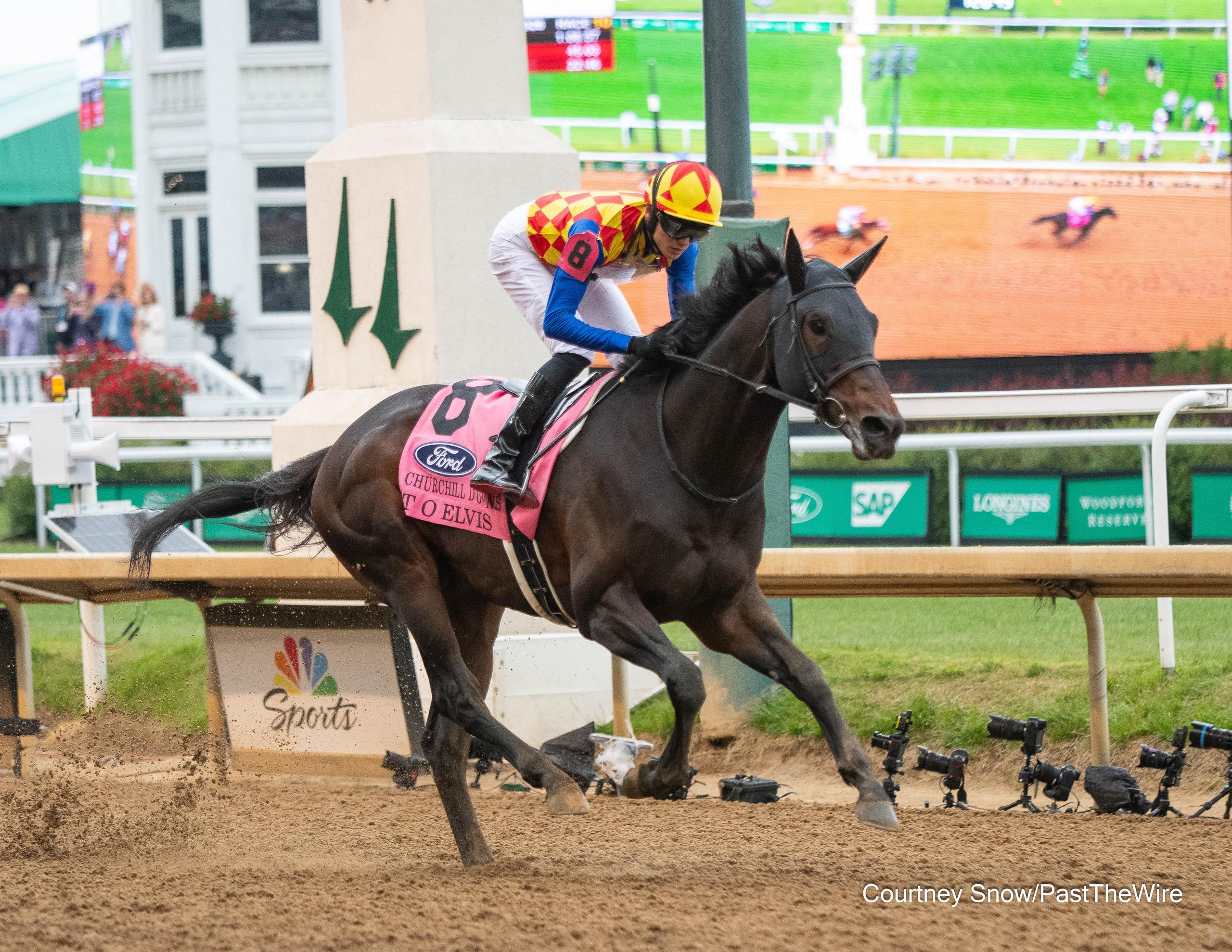
T O Elvis, a 4-year-old Kentucky-bred son of Volatile trained in Japan by Daisuke Takayanagi, went to the post at 12-1 on a morning line of 30-1. He won by approximately three lengths, completed seven furlongs in 1:20.49 on a fast track, and returned $13.74 to win. None of that is the interesting part.
The interesting part is what happened in the final minute of betting.
The information was public. The video was available. The form was real. Nobody made the public look away.
At 11 minutes to post, the win pool on T O Elvis stood at $211,982. His win percentage hovered around 5.93%. Unremarkable. Then, at the -54 MTP mark — the last-minute surge that shows up in pool data as a snapshot of concentrated professional wagering — his win pool exploded to $531,443. His win percentage jumped to 12.11%. His odds collapsed to 5.81. By post time, he was 5.87 odds on the board.
That is roughly $320,000 hitting a single horse’s win pool in under a minute on Kentucky Derby Day — a card when casual money dominates, attention is fragmented, and the average bettor is focused on the main event, not a support sprint with a Japanese shipper nobody had seen outside of Nakayama.
Before we go further, a clarification worth making: this is not offshore book money. Offshore books don’t touch the pari-mutuel pools. They set their own lines and absorb action internally. What you are seeing in this pool data is commingled ADW money, advance deposit wagering accounts flowing through platforms like TwinSpires and TVG, whose customers’ bets are legally and structurally integrated into the host track pool. Additionally it is CAW money: computer-assisted wagering, operating entirely within the legal architecture of American pari-mutuel racing through high volume rebate shops like Elite Turf Club and Velocity.
And here is where the editorial impulse to cast this as something sinister runs into a wall, because the foundation of the edge these players held was not technological. It was not predatory. It was not hidden.
It was research.
The Form Was There. The Public Just Didn’t Look.
T O Elvis entered the Churchill Downs Stakes off a five-length demolition in the Grade III Capella Stakes at Nakayama in December — a performance that earned him an automatic berth in the Grade II Riyadh Dirt Sprint. His connections chose to bypass that race and point toward the Dubai Golden Shaheen before regional hostilities forced a reroute to Louisville. He arrived having not run since December, having endured a transatlantic layover in Alaska, a 42-hour quarantine at O’Hare, and a long van ride south.
None of that information required a source. The Capella replay was not behind a paywall. The travel itinerary was reported in advance by the Thoroughbred Daily News. The trainer — Takayanagi — had already sent horses to American Grade I races, including T O Password’s creditable fifth in the 2024 Kentucky Derby. The jockey — Ryusei Sakai — was not an unknown quantity to anyone paying attention. He rode Forever Young to a Breeders’ Cup Classic victory in 2025. His presence on T O Elvis was a tell, not a mystery.
The morning line of 30-1 told you everything about what the public would likely do. They did, others didn’t. Nick Tammaro, who set that line, was reflecting the market’s outlook: an unraced-in-America shipper, facing Knightsbridge off a four-race win streak, two fast Bob Baffert trained sprinters, entered for his first Grade I. The 30-1 was defensible. It was not, however, accurate and the players who did the work knew it.
The rebate is the structural advantage on top. The edge was earned intellectually first.
By post time, the sharp money had moved T O Elvis from 30-1 to roughly 6-1 on true odds. He paid $13.74. That gap — between what the ticket returned and what the informed money believed the horse was worth — is the definition of an overlay. The CAW players found it, funded it, and collected it. The rebate they receive on handle through their CAW account made a profitable bet even more profitable. Most CAW models are trained to look for precisely that, overlays and exploit them. Additionally, most models flagged Knightsbridge as a vulnerable favorite to bet against. He was racing against faster and classier horses than he had been beating.
In full disclosure I did look long and hard at T O Elvis. I saw the form, watched his races, and thought these horses were just better and faster than he was, and the layoff wouldn’t work to his benefit in this spot. When I saw the money I knew it was one of two things – I was wrong, or there were a lot of Elvis fans watching.
Is that unfair? That is the question worth sitting with.
The Vulnerability Is Not the Player. It’s the Calendar.
The structural critique — if there is one — is not that sophisticated players did their homework. The structural critique is that the pari-mutuel pool on Derby Day is the most target-rich environment in American racing for exactly this kind of operation. The casual money is overwhelming. The public’s attention is locked onto a single race. A support event with a Japanese shipper at 30-1 is essentially a free hunting ground for anyone who has done the reading.
The -54 MTP timing was not accidental. A bet of that size, dropped at that moment, on that specific day, reflects a deliberate choice to maximize the odds return before the public pool could react. On a normal Saturday at Gulfstream, that kind of late movement gets noticed. It gets chased. The odds compress further. On Derby Day, the casual bettor watching the undercard is already thinking about the feature. The sharp player knows it.
That is the exploitation of a vulnerability, not a rule, not a regulation, not a person. A condition. One that the pari-mutuel system, as currently structured, has no mechanism to address.
The rebate compounds it. High-volume CAW players operating on rebate arrangements receive a percentage of their handle returned regardless of outcome. That means the effective cost of a bet for a professional rebate player is lower than it is for the recreational bettor at the window. On an overlay as significant as T O Elvis, the rebate doesn’t create the edge. It amplifies an edge that already existed.
What This Is — and Is Not
This is not a story about cheating. T O Elvis won fair. His connections ran him straight. The wagering was legal. The CAW platforms are licensed. The rebate arrangements, whatever one thinks of their policy implications for the health of the pools, are contractual.
This is a story about what the pari-mutuel system rewards. It rewards preparation. It rewards the willingness to seek out information that is publicly available but inconvenient to find. It rewards patience waiting for the right moment on the right card to deploy capital efficiently. And through the rebate structure, it rewards volume in ways that are invisible to the recreational bettor standing at the window with a program that listed this horse at 30-1.
The public was not deceived. The public was outworked.
That distinction matters. Because if the takeaway from Saturday is that CAW players are extracting value through some hidden technological advantage, the response is regulatory. But if the takeaway is that they are extracting value because they do the work that the public declines to do — or doesn’t have the means to do, and then deploy it through a legal structure that amplifies the return — the response is more complicated.
It probably involves asking why the recreational bettor’s dollar is worth less in this system than the professional’s. It involves asking whether rebate arrangements, at least to an extent originally designed to compete with offshore books for handle, have become a structural subsidy for the players least in need of one. It involves asking whether the pari-mutuel pool can sustain itself long-term when the sharpest money arrives in the final minute, extracts the overlay, and leaves the public holding tickets priced at the fantasy of a 12-1 horse who was closer to 6-1 in reality.
Those are the right questions. T O Elvis just made them easier to ask.
“The race is not always to the swift, nor the battle to the strong but that’s the way to bet.”
— Damon Runyon
Related: Both sides of the CAW litigation:
School’s Out: