

A betting coup for the ages, maybe.
When we first wrote that something happened Sunday, we didn’t know what it was. We still don’t. We’re closer though.
What we do know now is considerably more than we knew then, and enough of it has been independently reported and confirmed that this story has moved well beyond a few horseplayers looking at a strange Daily Double and asking questions on X. HISA is investigating. HIWU is involved. The Thoroughbred Racing Protective Bureau is involved. British bookmakers have contacted American racing authorities over unusual wagering on U.S. races, something HISA CEO Lisa Lazarus told ESPN had never happened before. ESPN, Horse Racing Nation, Paulick Report, Thoroughbred Daily News and the British racing press are all now following different pieces of the story.
There is still no established finding that anybody cheated, doped a horse, fixed a race or violated any racing rule. That needs to remain very clear, at least at this juncture, and maybe that is how the story ends. We’ll see. There is, however, considerably less room today to dismiss what happened as four unrelated longshots simply having a good afternoon.
Let’s start with the horses.
The Great Amira ran in Race 3 at Monmouth Park for trainer Angel Quiroz. She won and paid $37.20. Tepeyac ran in the following race for Quiroz and won, paying $9.60. The Daily Double connecting them paid $12.80 for $1, or $25.60 for $2. The official individual prices are confirmed by Equibase.
At Saratoga, Scootaloo ran in Race 3 for Quiroz and finished fourth after a difficult start. Classic Rock won Race 4 for owner-trainer Ernesto Ochoa and paid $18.68. M Bs Melanie Cares won Race 7 for Ochoa and paid $27.70. HISA has now identified those five horses as the center of its investigation.
There was also a sixth horse Sunday.
Winston Wolf ran at Colonial Downs for owner-trainer Monica McGoey and finished second in Race 4. Equibase confirms McGoey as the trainer and owner of record. Winston Wolf also had previously raced under Quiroz earlier this year. Published reporting now places Winston Wolf among the horses involved in the British wagering activity.
Then there were two horses scheduled to run Monday.
Threedots Andadash was entered at Presque Isle Downs. HISA placed that horse on the veterinarians’ list after deeming it unfit to race, and the horse was scratched. Bravo Rough was entered in Race 2 at Mountaineer. Horse Racing Nation reports that trainer Alexis Cordero-Lopez scratched Bravo Rough in the paddock after the horse had been bet down to 1-10. The official Equibase chart, however, lists Bravo Rough as a Stewards scratch. Those descriptions are not necessarily irreconcilable, but they are different enough that somebody should establish precisely who initiated that scratch and why.
That gives us eight horses. Now we get to the wagering.
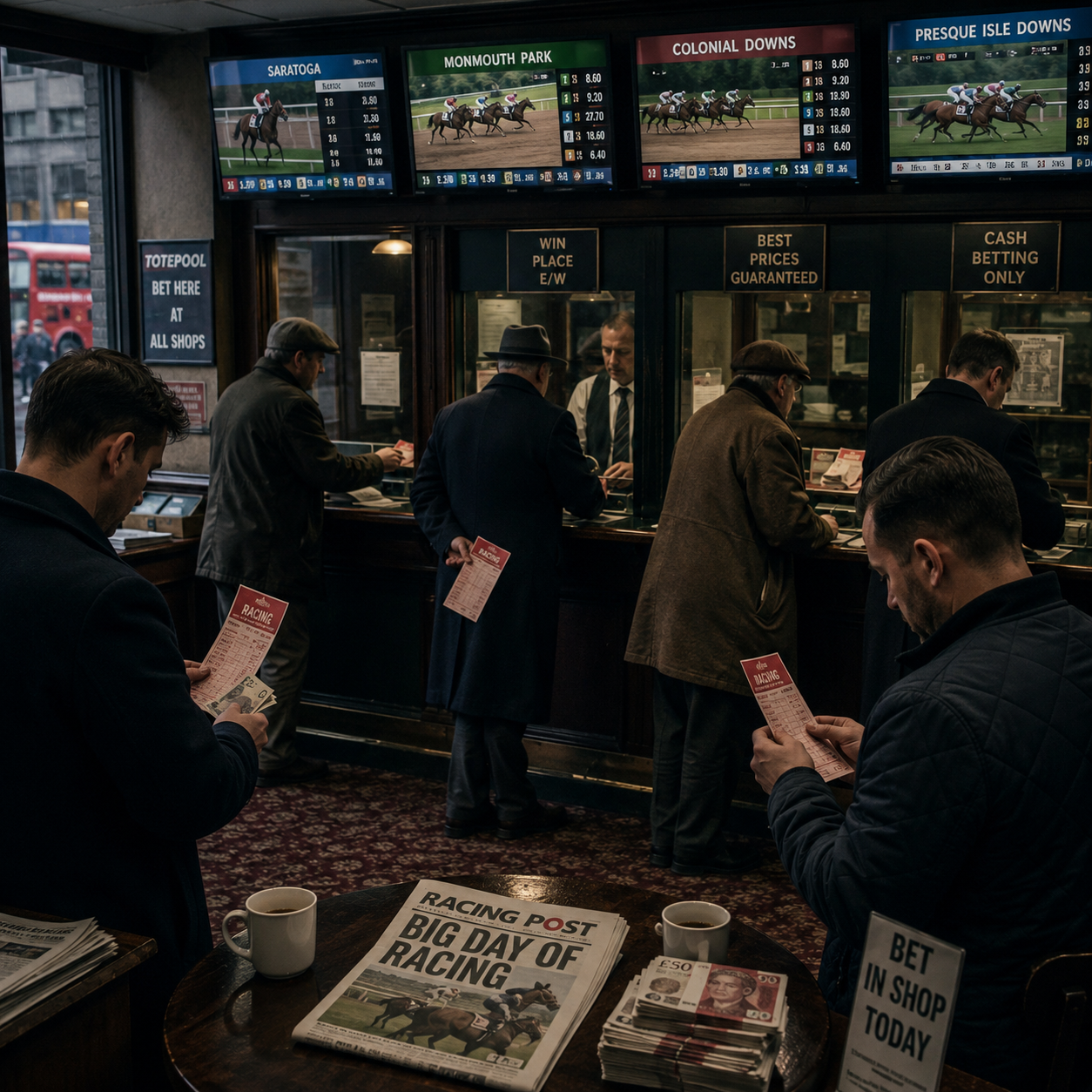
Horse Racing Nation’s Ed DeRosa reports that the British wagers were not random online bets placed by somebody clicking around from a couch. According to a bookmaker familiar with the action, the bets were made in person, in cash, at betting shops across London. None were placed online. The reported structure is even more interesting.
There were eight horses involved in 13 different combinations, consisting of win and each-way parlays using two- and three-race combinations. The bets were placed at starting price rather than simply locking in an obviously stale fixed price hours before the race. British bookmaker exposure reportedly approached $1 million after Sunday’s results before the two Monday scratches substantially reduced the eventual liability.
As a bettor, that tells me something. It tells me this appears organized and systematic.
Cash spread across multiple physical betting shops, eight horses, 13 different combinations, multiple racetracks and bets structured across more than one race is not somebody waking up Sunday morning, liking a horse and walking down the street to bet it. Somebody had a plan. The question is what the plan was based upon.
There is a perfectly legitimate answer available. Horse racing has a very long history of betting coups built around superior information. A group may have known horses were training far better than their published form suggested. They may have known the public workout information didn’t accurately represent the horses’ condition. They may have identified soft markets in Britain and executed a beautifully coordinated betting coup. If that’s what happened, tip your cap. Getting information the public doesn’t have and betting it better than everybody else isn’t race fixing. It isn’t doping. It isn’t cheating. It doesn’t even guarantee winning. It is horseplaying.
But the nature of these wagers also makes another explanation impossible to dismiss without looking. These bettors weren’t merely shopping one bad price. They were willing to construct a campaign around a group of horses. Starting-price wagers are particularly interesting to me for that reason. They were saying, in effect, we want these horses, not simply we want this particular 20-1 price. Again, that isn’t evidence of wrongdoing. It is evidence of confidence. Where did that confidence come from?
British bookmakers reportedly intend to pay the wagers absent a disqualification. That’s what bookmakers ultimately do when a wager is legitimate under their rules, even when somebody has beaten them badly. Bookmakers have their own risk-management tools, limits and methods of reducing or spreading exposure. A betting coup is not automatically evidence that the bookmaker was cheated. The integrity question is on the other side of the wager.
What did the bettors know?
Lisa Lazarus told ESPN that HISA began receiving calls Sunday night not just about the performances of these horses, but about wagering anomalies in both the United States and United Kingdom. She described the situation as “very unusual.” ESPN also reports that all four Sunday winners were immediately subjected to post-race drug testing by HIWU. That last point is important.
We’ve seen allegations online claiming that subsequent attempts to obtain samples were somehow avoided, including stories involving a van leaving Saratoga. We have not independently verified those claims. But let’s separate two different things.
If HISA’s statement to ESPN is accurate, all four winners were already sampled immediately after their races. Under HISA’s ADMC rules, a horse selected for post-race testing is required to report to the test barn as soon as practicable. HIWU oversees the selection of horses for testing and the chain-of-custody process. NYRA’s own rules contemplate horses leaving the test barn only after those procedures have been completed. Therefore, if there really was a later incident involving a van or an attempt to obtain additional samples, it could not logically be the initial routine post-race testing of the four winners HISA says were already sampled. It would have to involve something else, possibly additional targeted or out-of-competition testing. This is important. So is establishing whether the alleged incident happened at all.
Who requested the additional samples? Which horses were sought? When? Who was responsible for those horses at that moment? Was access refused or delayed? Did a van leave? Was anybody instructed not to leave? Was any HISA or HIWU rule implicated?
Those aren’t Twitter questions anymore. Those have specific factual answers. There is another part of this investigation I believe deserves considerably more attention than it has received.
Everybody naturally looks at the winners. I understand why. Four horses winning unexpectedly attracts attention. Huge form reversals attract attention. Longshot payouts attract attention. Winners go to the test barn. But if anyone is examining the possibility of a sophisticated attempt to influence wagering outcomes, looking only at horses that ran faster than expected may be looking at only half the equation.
We recently asked a different question on these pages: Who is watching the horse that runs slower? That question deserves consideration here without accusing anyone involved in these races of doing anything improper. Think about the sophistication required to organize the wagering being described. If this was an entirely legitimate information-based betting coup, no problem. The bettors knew their horses were live, the bookmakers didn’t, and somebody got paid. But if investigators are examining whether anything beyond superior information occurred, then they should assume whoever designed something this organized would also understand the first rule of modern American racing integrity:
The winner is going to get tested. That isn’t exactly a secret. Which raises the question we have already posed independently of this investigation. What if influencing a race doesn’t require making your horse run faster? What if valuable information consists of knowing another horse isn’t going to run his race? HIWU can test horses regardless of finishing position, and its testing program includes intelligence-based selections. That is important and should be acknowledged.
The question is whether investigators are examining the losers in these races with the same intensity as the winners. Which horses dramatically underperformed? Which horses were expected to show speed and didn’t? Which horses never became involved? Did wagering patterns disproportionately exclude particular contenders? Were any of those horses selected for testing? Were veterinary and treatment records examined? JS
HISA’s own FAQ says trainers must maintain treatment and medication records and make them available when requested. Horses returning after layoffs of 150 days or more also require post-layoff reports documenting the reason for the layoff, examinations, treatments, surgeries and exercise history. Given the lengthy layoffs involved here, those records seem like an obvious place to look. Follow the horses. Follow the money. And don’t assume the only horse worth looking at is the one standing in the winner’s circle. There is also a relationship between the two principal Sunday trainers that is now established rather than inferred.
Quiroz told Thoroughbred Daily News that he previously trained Classic Rock and M Bs Melanie Cares before they were sold to Ochoa. Horse Racing Nation reports that Ochoa bought those horses privately from Quiroz. So what initially appeared on paper to be two separate trainers winning at two different tracks is not quite that simple. That doesn’t make the arrangement improper. It makes the custody history relevant. Who physically trained each horse through the layoff? When did ownership change? When did responsibility change? When did the horses leave one person’s custody and enter another’s? Where exactly were they housed during that period?
Fair Hill remains part of those questions, particularly because published reporting has established that some of the workout information there is trainer-reported rather than independently clocked in the traditional racetrack sense. Again, that doesn’t make the works fraudulent. It means investigators should verify them rather than assume the printed line answers the question. The wagering records should be treated the same way.
The extraordinarily short Monmouth Double was the first red flag serious horseplayers saw. Now we know there was coordinated wagering activity overseas as well. Paulick Report cites Racing Post reporting that at least 10 British betting shops were visited, while Horse Racing Nation reports cash wagers spread across London and 13 combinations involving eight horses. Those records exist. The U.S. tote records exist. The timestamps exist. The British betting tickets exist. The surveillance video in betting shops may exist. The horses’ veterinary records exist. The samples exist. The ownership and trainer records exist. This is no longer a mystery racing has to solve by reading X. The authorities have considerably more tools than we do. Will they use them?
Our job isn’t to convict anybody. It isn’t even to decide what happened. Our job is to recognize when what we’re looking at warrants questions, ask the right ones, separate evidence from nonsense and keep following the facts.
My own view as someone who has spent a lifetime betting on horses is straightforward. The wagering described so far looks planned, organized and systematic. That is an observation about the betting, not an accusation about the races. A sophisticated group of bettors appears to have believed it had a substantial edge involving a specific group of horses across multiple racetracks. They acted on that belief aggressively enough to attract the attention of bookmakers on another continent.
The $64,000 question—or apparently closer to the million-dollar question—is why they believed it. Superior legitimate information? A brilliant old-fashioned betting coup? Something improper involving the horses? Something involving other horses in the races? Something nobody has thought of yet? We don’t know. Neither the loudest person on X nor the quietest person in the racing office knows simply because they have an opinion. But we’re past the point where nothing to see here is a serious answer.
Something happened Sunday. We knew that much when we started. Now we know the betting around it wasn’t random. The next answers have to come from the people who can see what we can’t.nAnd we’ll be watching what they find. Or don’t find.