

There are 1000 ways to lose a race, and only one way to win it, or is there?
When we talk about doping in horse racing, almost everything revolves around the same premise. Somebody is trying to make a horse run faster.
That is understandable. We have seen enough trainers move horses up dramatically over the years to know why that is where everyone’s mind goes. A horse improves ten Beyer points. A horse suddenly runs through conditions. A horse changes barns and becomes Secretariat. The questions start, the horse gets tested and everyone wants to know what was in him. But there is another side to this that gets considerably less attention. What if the horse somebody wants to affect isn’t the horse they want to win? What if they want another horse to lose? That isn’t conspiracy theory. It isn’t even new. It is part of the documented history of horse racing.
In the early 1970s, Anthony “Big Tony” Ciulla became one of the most notorious race fixers in American racing. His operation involved bribing jockeys to keep horses from finishing in the money. Eventually he cooperated with federal investigators and testified about race fixing throughout the sport. There were more direct methods. A 1976 Rhode Island Supreme Court decision reads today like something out of a movie. The state’s witness described himself as a specialist who went into the stable area and injected selected horses with acepromazine, a tranquilizer. According to the testimony recounted by the court, seven horses were injected in a matter of roughly an hour. The purpose wasn’t difficult to understand. They weren’t trying to make those horses faster.
A 1973 congressional report on organized crime in horse racing similarly documented methods used to influence pari-mutuel racing, including fixing races by drugging horses. And it wasn’t confined to ancient American racing history. In 1990, two favored horses who performed poorly at Doncaster in England were subsequently found to have been given a fast-acting tranquilizer. One finished last in a five-horse field. The other finished fourth after being a joint favorite. One trainer became suspicious specifically because his horse didn’t run the race he expected and requested testing. Think about that for a minute. The suspicious performance wasn’t an extraordinary performance. It was a bad one. The horse of a different color if you will.
Today, American Thoroughbred racing has a far more sophisticated testing system than racing had during those eras. Under HISA’s Anti-Doping and Medication Control Program, administered by HIWU, testing isn’t restricted to winners. HIWU specifically states that post-race samples can be taken from a horse after a race regardless of where that horse finished. Blood, urine and, depending upon the testing type, hair can be collected. There is also out-of-competition testing, post-work testing and targeted testing. That deserves to be stated clearly. This isn’t an argument that HISA only tests winners. It doesn’t. The question is different.
How often does unexpected underperformance itself become the reason a horse is selected for testing?
There is a difference between having the authority to test a horse that finishes sixth and having an investigative system specifically designed to recognize when the horse finishing sixth is the horse everybody should be looking at. That is where wagering integrity enters the conversation. Horseplayers naturally concentrate on finding the winner. Someone attempting to manipulate a race doesn’t necessarily have to. If you somehow know with certainty that one legitimate contender isn’t going to win, you possess extremely valuable information. You don’t necessarily need to know exactly which remaining horse will win. Depending upon the race and wager, eliminating a horse everyone else believes is a legitimate contender can fundamentally change the mathematics of exactas, trifectas, Pick 4s, Pick 5s and Pick 6s. The information is different, but information is what wagering markets run on. Everybody else is handicapping a five-horse race. You may effectively be handicapping a four-horse race. And that raises another question racing should be sophisticated enough to ask in 2026. Can unusual wagering activity help identify the horse that should be tested? HIWU already says its out-of-competition program incorporates intelligence and data analysis when horses are selected for testing. HISA’s national system was expressly built to move beyond the fragmented state-by-state enforcement structure racing operated under for decades. Good. Then this is exactly the kind of question that system should be capable of addressing.
The Saratoga race fixing scandal of the 70’s was built on horses being held or “pulled” to run out of the money. It is easier to accomplish and more complicated to detect than making a horse run faster. JS
Suppose a horse takes significant wagering action but runs inexplicably poorly. Or suppose the wagering isn’t against the horse in the conventional sense, but sophisticated money appears in exactas, doubles or horizontal wagers constructed conspicuously around that horse losing. Does anybody flag it? Does somebody compare the wagering pattern with the horse’s performance? Does somebody tell the test barn, we want that horse too? I don’t know the answer. That is precisely why I am asking, even suggesting.
There are perfectly legitimate reasons for horses to run poorly every day. They stumble. They get bad rides. They don’t handle the surface. They bleed. They don’t ship well. They get caught in traffic. They don’t like dirt in their face. They come back with physical problems. Sometimes they simply don’t run. Anyone who has handicapped horses seriously for any length of time has been wrong about a horse more times than they could possibly count. Horses humble everyone I often say. A bad performance proves absolutely nothing. But racing integrity cannot be built around the assumption that only unexpectedly good performances deserve scrutiny. History won’t allow us that luxury.
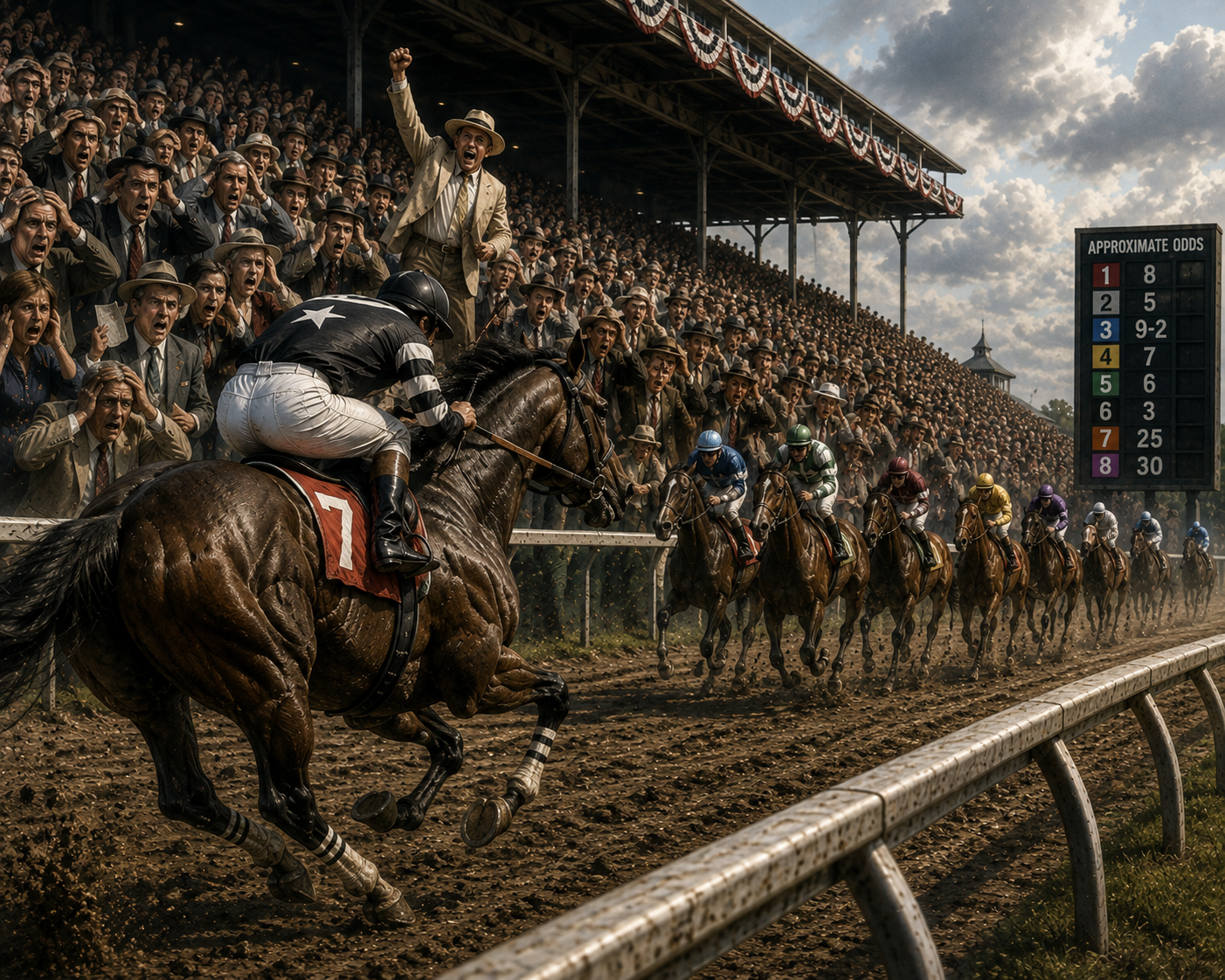
There is another reason this matters under a modern anti-doping program. HISA and HIWU regulate an enormous range of substances, including medications capable of affecting the central nervous system and performance. The regulatory framework is not written solely around substances that enhance performance. HISA maintains separate categories of banned substances and controlled medications, with uniform testing standards administered nationally. So the scientific capability and regulatory authority exist. The question is how the investigative net is cast. If a 25-1 shot improves dramatically and wins by eight lengths, everybody looks at the winner. If the 6-5 favorite inexplicably runs eighth, everybody tears up their tickets and goes to the next race. Maybe 99.9 percent of the time that is exactly where the story should end. Integrity isn’t really about the 99.9 percent. It is about whether the system can recognize the other one. And this is where I think racing has to start thinking more like the people who might actually try to beat the system. Don’t ask only how someone could make a horse run faster. Ask how someone could make money from knowing a horse wasn’t going to run. Don’t look only at who benefited on the racetrack. Look at who benefited at the windows or ADW. Don’t look only for abnormal improvement. Look for abnormal regression accompanied by abnormal wagering. And when those things intersect, test the horse that lost. Maybe nothing happened. Most of the time, nothing probably did. That’s fine. Testing isn’t an accusation. Investigation isn’t a conviction. Asking a question isn’t declaring somebody guilty. It is what an integrity system is supposed to do.
HISA and HIWU have taken plenty of criticism over picograms, nanograms, contamination cases, budgets and whether the national system is catching the people the industry commonly calls the “real cheaters.” Some of that criticism has been justified and some of it hasn’t. But if racing wants a truly modern integrity system, it can’t simply become better at solving the problems racing already knows how to look for. It has to anticipate the problems somebody trying to beat the system hopes nobody is looking for. We have spent decades asking what somebody might give a horse to make him run faster. History tells us there is another question worth asking.
Who is watching the horse that suddenly runs slower?