

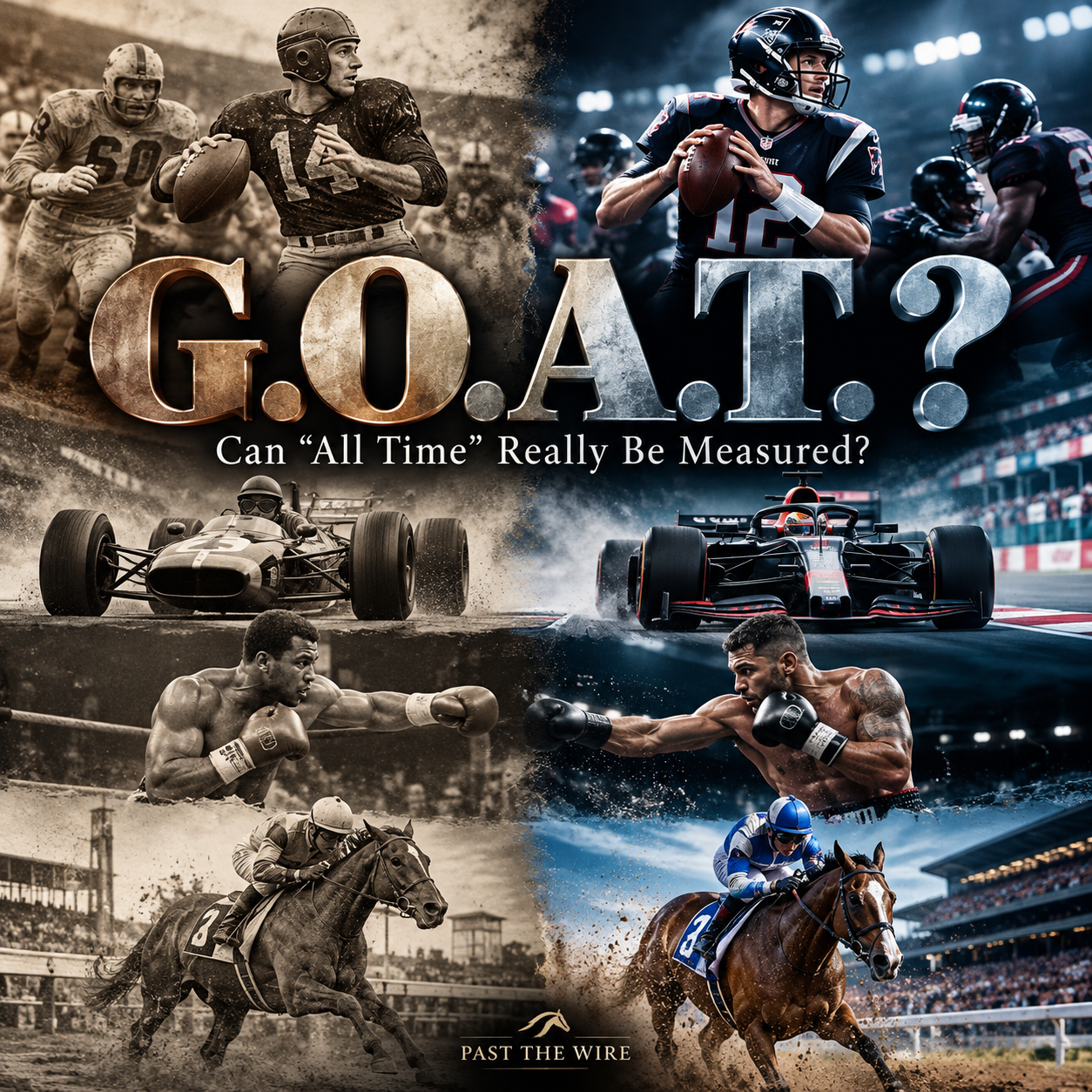

Who is the GOAT in every sport?
Everybody wants to crown somebody. Turn on any sports show, scroll any timeline, sit at any bar, and before long somebody is banging the table about who the greatest of all time is. GOAT. Four letters, said with total certainty, usually by people who never stop to ask what they’re actually measuring. I’ll say what most won’t. You can’t fairly and objectively compare athletes from different eras. Too much changes. The rules change, the equipment changes, the medicine changes, the money changes, and the very thing being measured changes with them. What you’re left with isn’t a verdict. It’s an opinion with a stat sheet stapled to it. We know what “they” say about opinions.
Take the NFL, because it makes the case better than anything. Tom Brady was a great quarterback by any standard. I’m not here to take anything from him. But great and greatest of all time are two different conversations. Would his completion percentage look the same if he’d played when cornerbacks could put hands on a receiver all the way down the field? Bump and run beyond five yards was outlawed in 1978, and the passing game has been climbing ever since. That isn’t a knock on Brady. It’s the water every modern quarterback swims in, and nobody who played before it got to swim there.
Then there’s the question of survival. Would Brady have had the longevity to win seven Super Bowls if he had to absorb shots to the knees after the ball was already gone, the way Joe Namath and Terry Bradshaw did? Namath’s knees were wrecked before he was thirty. Here’s the part that should end the argument on its own. When Brady tore his ACL in 2008 on a low hit in the pocket, the league tightened the rule against hitting quarterbacks below the knee. People around the game still call it the Brady Rule. The man most often crowned the greatest ever played the back half of his career under protection his own injury helped create. You can’t then turn around and compare his longevity to men who never had it.
And what about poise? Brady’s calm under pressure was real. But would it have been the same if it took a four inch needle before kickoff just to get him on the field, and smelling salts were standard sideline equipment? Players in those days played through things that would sideline a man for a month today, and nobody wrote about it because nobody thought it was news. It’s impossible to say how Brady would have handled that world. It’s just as impossible to say how Namath or Bradshaw or Johnny Unitas would have performed in this one, with today’s protection, today’s nutrition, today’s surgeons, today’s film and today’s offenses. The honest answer runs both directions. They don’t reconcile.
Formula 1 is the same story told at two hundred miles an hour. The cars today are not the same machines Ayrton Senna and Nigel Mansell had to drive. Those men muscled cars around corners with manual gearboxes and, for much of that era, no power steering, and they had no telemetry telling them how much tread was left on the tires. It was feel. It was instinct. It was the seat of the pants. Senna won his home race in Brazil in 1991 with the car stuck in sixth gear and had to be lifted out of the cockpit afterward because his body had seized up. Go back further and Juan Manuel Fangio won five championships in an era when drivers died at a rate nobody would accept now. So when someone tells you the driver with the most titles is the best driver who ever lived, ask them which car, which rules, which decade, and which risks. The count on the resume is a count. It is not a ranking.
Boxing was the first sport to teach me this. Championship fights went fifteen rounds until the early 1980s, and then they went twelve. Those last three rounds are where you found out who a man really was, and an entire generation of fighters never had to answer that question. Baseball is no different. Babe Ruth never faced a Black pitcher, never played a night game coast to coast, and never saw a fresh reliever throwing a hundred miles an hour in the seventh inning. Bob Gibson posted a 1.12 earned run average in 1968, and the league answered by lowering the mound the next year. When the sport changes the field itself to stop a player, what exactly are you comparing him to afterward?
Pitchers once routinely finished games. Four-man rotations existed. Complete games were expected from the best pitchers, not treated like sightings of Halley’s Comet. Today pitchers are managed through pitch counts, velocity measurements, spin rates, biomechanical analysis and bullpens filled with arms throwing close to 100 miles per hour. Does that make today’s pitchers better? Does throwing 300 innings make the old ones better? Or were they simply being asked to perform completely different jobs under the same heading of “pitcher”?
Basketball has the same problem. Put a great modern shooter into an era before the three-point line and you have fundamentally changed the value of one of his greatest weapons. Put a dominant player from an earlier era into today’s spacing, training and officiating and perhaps his game changes completely. Then reverse it. Take today’s player and send him into a league where the paint was considerably less hospitable and physical contact was part of the price of admission. We can imagine what happens. We can’t know. Lebron or Jordan, you can go on all day. I’ll go with neither.
Horse racing may be the hardest case of all, and I’ve lived inside it my whole life. The drugs have changed. Race day medication changed what a horse could do and how often it could do it, and the rules on it are changing again now. The breed has changed. We’ve bred for speed and precocity and sale ring looks, and the horses race less than they ever did. Kelso made sixty-three starts and was still winning at eight. Forego carried 137 pounds and won. Dr. Fager set a mile record carrying 134. Today a champion might make six or seven starts in his whole career and you’d be hard pressed to find a trainer willing to put 130 on anything. Training has changed. Surfaces have changed. Even the speed figures we lean on, and I lean on them as hard as anybody, are built inside their own era. A number tells you how fast a horse ran against what was in front of him that day, over that racetrack, under those conditions. It doesn’t tell you how he’d have run against a horse born forty years earlier. To a student of the game, a true student, calling Flightline the best ever, is simply ridiculous, not because he wasn’t great, but because nobody gets to crown him.
And there’s something in this game no number captures at all. Like fighters, some horses look another one in the eye and say no, not today, you don’t go by me. Ruffian had it. You saw it every time she ran. You can’t put that on a chart and you can’t carry it across decades. You only know it when two horses are side by side in the stretch, and that’s the point. Unless we put them in the gate together, saying this one twenty years ago was better than that one forty years ago, who isn’t as good as this one today, is really just talk.
So what can we say honestly? We can say who dominated their own time. That’s a fair fight. Same rules, same equipment, same medicine, same competition. How far a champion stood above the field he actually faced is the only measure that holds up, and it’s a demanding one. Brady clears it. Senna clears it. Secretariat clears it by thirty-one lengths. That’s greatness, and it deserves every word written about it. Greatest of all time is something else. It asks us to judge a race that was never run. And anyone who has ever cashed a ticket or torn one up knows the race that wasn’t run doesn’t pay.
I never said you couldn’t make the best entrance ever:
Liaten to LT:



Comments