

I have been gambling for most of my life. I have made bets when I thought I had the nuts, made bets when I knew I didn’t, made bets I probably shouldn’t have made, and made a few that changed my life. One thing I learned a long time ago is this: before you make the bet, understand exactly what you are betting on. Ray Paulick might want to revisit that lesson.
Yesterday the Paulick Report published a piece titled “Q&A: The Jockey Club Addresses Its Relationship With HISA.” It was written by Chelsea Hackbarth and presented as a series of questions submitted to The Jockey Club concerning its relationship with HISA, its role in HISA’s creation, its data systems, InCompass, security, access to information and, naturally, the fallout from the Marshall Gramm situation. There was just one little problem.
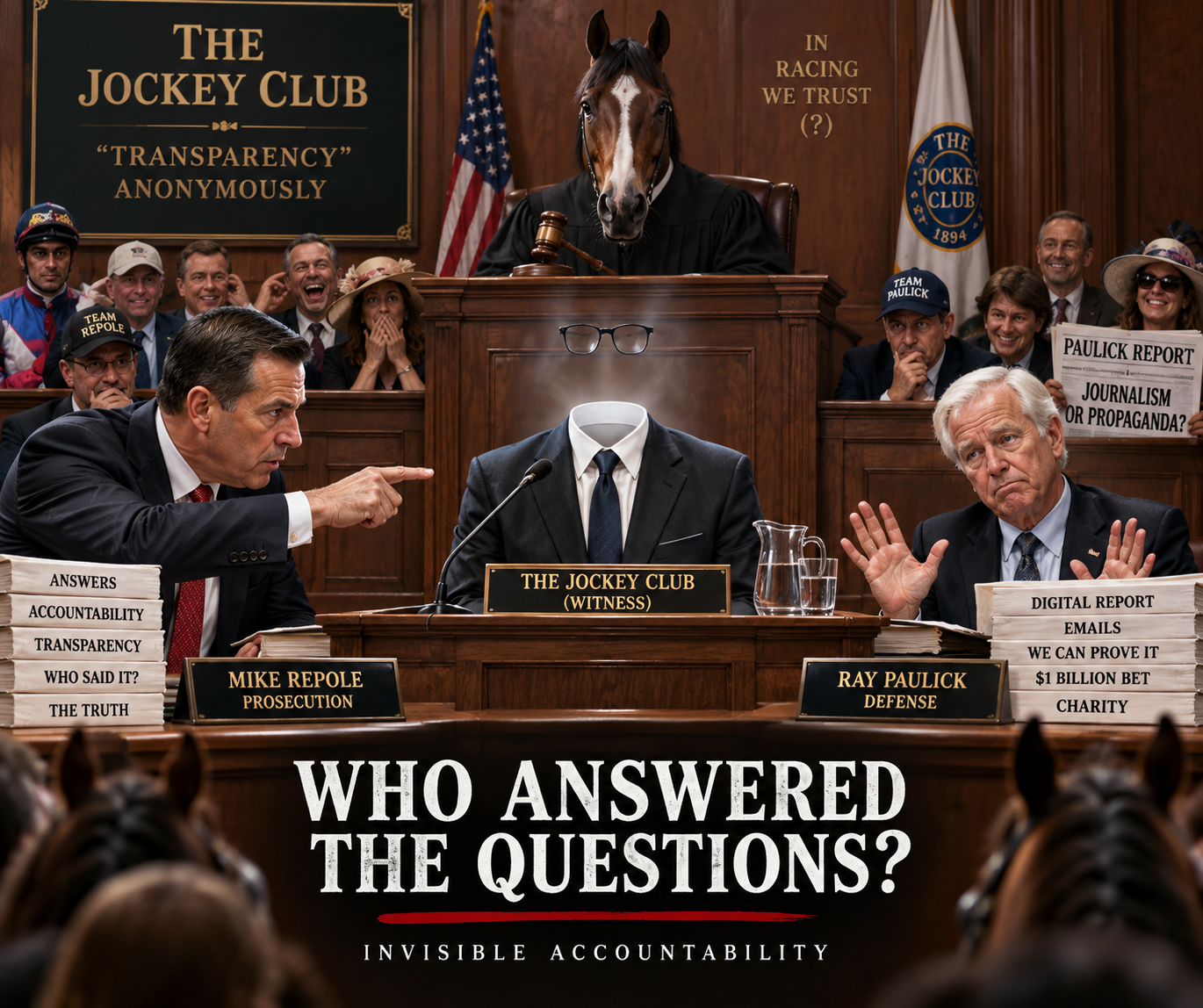
Who answered the questions? The article doesn’t say.
I went back and read it again because surely I had missed something. I hadn’t. The article says, “The Jockey Club provided the following responses in writing.” It further says the responses were published in full, had not been edited, and that Paulick Report reordered some questions for clarity. What it does not tell its readers is the name of the human being who answered them. I have been around horse racing a long time and have met a lot of people along the way. I have never met a guy named Jockey Club. I suppose it’s possible. I mean Frank Zappa named a kid Moonbeam or something like that.
Somebody answered those questions. Somebody typed the words. Somebody authorized them. Somebody decided these were The Jockey Club’s official responses to some very serious questions involving federal legislation, HISA, confidential data and the infrastructure connecting these organizations. Who? That isn’t a trick question. It isn’t an accusation. It isn’t bullying. It is Journalism 101. Who said it?
Mike Repole noticed the same thing, although Mike being Mike, he expressed himself somewhat less delicately. He unloaded on The Jockey Club and the Paulick Report, accused the publication of carrying water for an organization with which it has financial ties, and offered a billion-dollar wager over what he believes has been taking place. Ray responded. According to Ray, “The positive thing about living in a digital world is that we have a verifiable trail of communications – internally and externally – on most topics. It would come out during a discovery phase of litigation.”
Ray then said Chelsea Hackbarth had responded to Mike, that Mike was wrong in his assumptions, and that Paulick Report could prove it. He even accepted Mike’s billion-dollar wager and volunteered Mike’s billion dollars to Thoroughbred Aftercare Alliance if Paulick Report prevailed. Very generous. There is only one problem.
What exactly are we betting on?
Because Ray may very well possess emails that establish exactly how this particular Q&A came together. For purposes of this discussion, I’ll give him every benefit of every doubt. Let’s assume Chelsea conceived every question independently. Let’s assume nobody at The Jockey Club suggested a question, deleted one, softened one or changed one. Let’s assume the answers came back untouched. Let’s even assume the internal email chain identifies the person who answered the questions, despite the fact the published article doesn’t. Fine. Ray wins all of that. It proves absolutely nothing about the larger question Mike is raising.
A digital trail can prove that an email was sent. It can prove what the email contained. It can identify recipients, dates, attachments, drafts and responses. It can be enormously valuable evidence, and anybody who has followed my writing knows I have said that myself repeatedly. What it cannot do is magically prove a negative across years of relationships between an industry publication, its advertisers, its sponsors and the interconnected organizations and individuals it covers.
An email chain cannot prove that a conversation never occurred somewhere else. It cannot prove that an understanding never developed over years. It cannot prove that editorial judgment has never been affected by access, advertising, sponsorship or relationships. It cannot prove that somebody never understood where the boundaries were without needing those boundaries put into an email.
And most importantly, Ray doesn’t get to pretend the financial relationship itself is some conspiracy theory invented by Mike Repole or Past The Wire.
The Paulick Report has disclosed it.
Andrew Cohen’s “Keeping Pace” column has carried this disclosure:
“The Jockey Club is a sponsor of the Keeping Pace column.”
That isn’t Mike saying it. It isn’t me saying it. It appeared on the Paulick Report. In February, it appeared beneath a column specifically criticizing Mike Repole during his battle with The Jockey Club. Another Keeping Pace column concerning Repole and The Jockey Club expressly stated that The Jockey Club was a sponsor of the column. It doesn’t prove Ray Paulick is handed an envelope containing instructions on what to write every Monday morning. I have never claimed it does. It doesn’t prove Andrew Cohen doesn’t believe what he writes. It doesn’t prove Chelsea Hackbarth was instructed how to conduct this Q&A. It proves something much simpler and completely indisputable:
There is a financial relationship significant enough that the Paulick Report itself has considered it appropriate to disclose.
That raises the question I have been asking for months. Why is that relationship disclosed sometimes when The Jockey Club is the subject and apparently not others? Readers deserve to know.
I’ve written about this before, and I have deliberately been careful with my words. In The Consequences Paulick Forgot to Mention, I documented relationships involving Paulick Report, OwnerView and businesses associated with Jockey Club leadership. I specifically wrote that none of those relationships proved Paulick’s editorial conclusions were purchased. That remains my position today. But disclosure exists precisely because readers shouldn’t have to prove corruption before being told about a financial relationship.
There is more. In The Architecture of Influence, I went back to Ray Paulick’s own words from his BloodHorse days. Ray wrote candidly about having been influenced at times by advertisers, board members and organizational pressures. He described working in an environment controlled by an old-guard board dominated by Jockey Club members and acknowledged that he had to choose his battles carefully. Those are important words because they demonstrate something Ray obviously understood then that apparently has become considerably more complicated now.
Influence doesn’t require an email saying, “Ray, don’t write this.” Human beings don’t work that way. Institutions don’t work that way. Relationships don’t work that way. Sometimes influence is explicit. Sometimes it is subtle. Sometimes it is financial. Sometimes it comes through access. Sometimes nobody has to say anything at all because everyone in the room already understands the room. That doesn’t prove improper influence occurred in this particular article. It means Ray’s proposed digital proof cannot establish that it never has. Which brings us back to the billion-dollar bet. I love action. Everybody who knows me knows that. But let’s make it a real bet.
Define the proposition. Define what constitutes proof. Put real money behind it. Put the money in escrow. Have an independent party determine whether the conditions have been satisfied. Then we can gamble. Offering to donate somebody else’s imaginary billion dollars to charity after winning an undefined wager makes for a nice social media post. It doesn’t resolve anything. The funny part is Ray actually made one point with which I completely agree.
There is a digital footprint. Absolutely. Let’s see it. Not because I think Chelsea Hackbarth fabricated the questions. I don’t. Not because I believe somebody at The Jockey Club necessarily dictated the answers or controlled the article. I have no evidence of that and I am not alleging it. Let’s see it because Ray himself just made the digital record the centerpiece of his defense. And while we’re opening things up, answer the question that started this whole mess.
Who answered the questions for The Jockey Club?
Was it Shannon Luce? A communications executive? General counsel? Someone from InCompass? Multiple people? A committee? Were the responses assembled by counsel and approved by somebody else? I don’t know. Neither does the reader. That’s the point. This is especially remarkable because the Q&A itself repeatedly invokes transparency. The very first answer says The Jockey Club issued its Aug. 26 statement “because we want to be transparent.” Okay. Be transparent. Put a name on the answers.
Mike Repole can be abrasive. He can go too far. He can make everything personal. I’ve disagreed with him publicly before and undoubtedly will again. He has with me. It is never disrespectful, to the contrary it is geographical, it is just how we talk. If you publish ten answers from one of the most powerful organizations in Thoroughbred racing on questions involving federal legislation, HISA, data security and millions of confidential equine records, readers are entitled to know whose answers they are.
“The Jockey Club” isn’t a person.
And Ray’s response doesn’t answer that question. Instead, he escalated the argument, invoked litigation and discovery, accepted a billion-dollar wager and told us Mike Repole’s assumptions can be proven false. Maybe some of them can. Prove them. But don’t promise that a collection of emails can establish something no collection of emails can establish. Don’t conflate evidence about the production of one article with proof of editorial independence across a longstanding financial and institutional relationship. And don’t disclose sponsorship when convenient and then act offended when somebody asks whether that sponsorship matters.
This isn’t high school anymore. The problems facing this industry aren’t funny. The questions surrounding HISA’s data aren’t funny. The questions surrounding The Jockey Club’s role in creating HISA aren’t funny. Questions about media independence and financial disclosure aren’t funny either. The billion-dollar bullshit bets aren’t helping.
Mike asked a legitimate question beneath all the noise. I’m asking it too.
Tell us who answered. Then, if Ray wants to open the digital record and make a real wager on a clearly defined proposition with real money, I’ll bring the popcorn. Until then, enough barking.
Mr. Blonde said it better.
“Are you gonna bark all day, little doggie, or are you gonna bite?”