

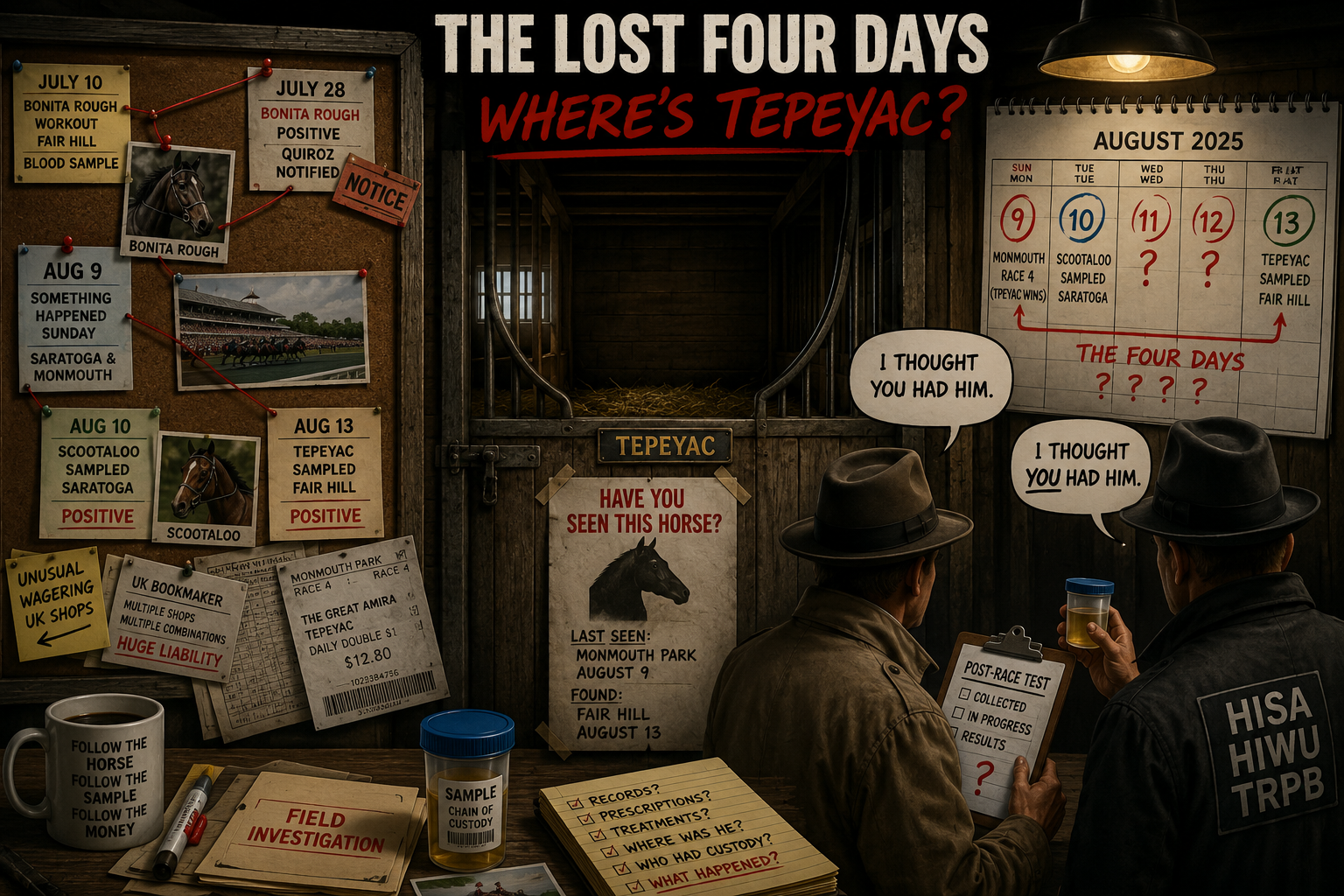

When we first wrote “Something Happened Sunday,” the title was deliberate. Something happened. We knew that much. What we did not know was exactly what happened, who knew what, when they knew it, or whether several things that appeared connected actually were.
I also released this video, and knew far less then than I do now. That said, there is still a long way to go. It did get me an interview with Sujata Rao at Bloomberg London however. They are covering the story as well.
There had been highly unusual wagering activity involving a group of horses running at Saratoga and Monmouth Park. British bookmakers had reportedly taken coordinated wagers across multiple shops. Horses with questionable or difficult-to-explain recent form suddenly ran enormous races. At Monmouth, The Great Amira won at a big price and Tepeyac followed her into the winner’s circle, yet the Daily Double connecting them paid surprisingly little relative to their individual odds. At Saratoga there were more horses, more questions and eventually HISA, HIWU and the Thoroughbred Racing Protective Bureau looking into what had happened.
We asked questions then because questions were all the facts allowed. Now HISA has released a seven-page Notice of Violation and Provisional Suspension against trainer Angel Quiroz. It answers some of those questions. It also makes the entire sequence considerably stranger.
According to HISA, three horses under Quiroz’s care have now produced Adverse Analytical Findings for albuterol: Bonita Rough, Scootaloo and Tepeyac. Albuterol is classified as a Banned Substance unless prescribed to the particular horse as an inhaled bronchodilator within the permitted veterinarian-client-patient relationship. Each alleged Anti-Doping Rule Violation involving a Banned Substance potentially carries a two-year period of ineligibility and a $25,000 fine.
Two of those horses, Scootaloo and Tepeyac, were already names in the investigation surrounding August 9. The third may be the horse that changes how we look at the entire timeline because Bonita Rough tested positive before Something Happened Sunday ever happened.
Start With Bonita Rough
According to HISA, Bonita Rough worked at Fair Hill Training Center on July 10 in an effort to come off the veterinarian’s list. A blood sample was collected after that workout and subsequently returned an Adverse Analytical Finding for albuterol. On July 28, HIWU served Quiroz with notice of that finding.
That date matters. We don’t have to speculate about when the laboratory first knew. We don’t have to calculate how many days a positive ordinarily takes compared with a negative, and we don’t have to reverse-engineer the process. By July 28, Quiroz had been formally notified of the Bonita Rough albuterol finding. August 9 was twelve days later.
There is another remarkable part of the Bonita Rough case. According to HISA’s filing, Quiroz waived analysis of the B sample and told HIWU that he had nebulized Bonita Rough with albuterol that he received from Bonita Rough’s veterinarian at Gulfstream. Quiroz allegedly said the veterinarian had prescribed the medication to another horse but told him he could use it on Bonita Rough if needed. That sounds sloppy at best. It shouldn’t but I have spent enough time on the backside to know it happens more often than we’d like to think, believe, or admit.
Waiving a B sample should not casually be called an admission of guilt. It means Quiroz elected not to have the B sample analyzed. He nevertheless apparently acknowledged administering the substance and offered an explanation for why it was present. Whether that explanation satisfies the rules is a different question, and HISA alleges that it does not. HISA also says there were no records in its portal showing an albuterol dispensation, prescription or treatment for Bonita Rough.
So what happened after July 28? What did HIWU do after notifying Quiroz? What did HISA know? Was the rest of his stable placed under enhanced scrutiny? Were additional horses tested? Were veterinary and treatment records immediately examined? Were horses preparing to race identified? Did anyone look at the horses coming from Fair Hill? Was HISA limited by its own rules in what it could do before the Bonita Rough case proceeded further?
Those aren’t accusations. They are questions created by HISA’s own timeline. By July 28, HISA and HIWU had formally notified Quiroz of Bonita Rough’s albuterol finding. Twelve days later, August 9 happened. What did the regulator do during those twelve days, and what, under its own rules, could it have done?
Then Came August 9
Tepeyac won at Monmouth Park on August 9. Scootaloo raced at Saratoga that afternoon and finished fourth after a troubled beginning. They were among the group of horses that had attracted attention because of extraordinary wagering activity overseas and unusual betting patterns here. At the time, HISA publicly acknowledged an investigation. The industry began trying to figure out what had happened. So did I.
Now we know that while everyone was looking forward from August 9, there was already an albuterol case sitting behind it. That changes the question. It is no longer merely what did HISA learn after August 9? It is also what did HISA know before August 9, and what did it do with what it knew?
One positive test does not make an entire stable guilty. It shouldn’t. A trainer cannot simply be presumed guilty, nor should all of his horses automatically become guilty by association. Due process matters when we like the accused and when we don’t. Maybe HISA followed its rules perfectly. If so, say that, because then we may be looking at something every bit as important as an enforcement failure: a regulatory process that worked exactly as written and still permitted everything that followed.
Scootaloo Changes The Timeline Again
Scootaloo raced at Saratoga August 9. The following day, August 10, Sample Collection Personnel took an out-of-competition sample from her at Saratoga. UC Davis subsequently reported an Adverse Analytical Finding for albuterol. HISA itself emphasizes that the sample was taken 13 days after Quiroz had first been notified of Bonita Rough’s potential albuterol violation.
That emphasis is important because HISA is making the connection in time, not us. Why was Scootaloo tested August 10? Was it because of the unusual wagering activity? Was it because investigators had identified the horses involved in those wagers? Was it because she was trained by Quiroz? Was Bonita Rough’s July 28 finding part of the decision? Was it intelligence received from Britain? Was it information developed by the TRPB? Was it some combination of those things?
There were also reports and rumors at the time about horses being sought, transportation, horses potentially leaving Saratoga and authorities attempting to locate or test them. We did not report rumor as fact then and won’t convert it into fact now. What we now know is that HIWU did sample Scootaloo at Saratoga the next day. When was the decision made to test her? Was an attempt made Sunday? Where was she between the conclusion of her race and collection of the August 10 sample? Was anyone instructed to keep her at Saratoga or not to ship? Did investigators have uninterrupted access to her? There may be perfectly mundane answers to every one of those questions. Let’s hear them.
Then There Is Tepeyac
This is where the timeline gets even harder to ignore. Tepeyac won at Monmouth on August 9. According to HISA’s new notice, Sample Collection Personnel did not collect the out-of-competition sample that produced his albuterol finding until August 13—four days later—and they collected it at Fair Hill Training Center in Maryland.
Where was Tepeyac during those four days? When did he leave Monmouth and arrive at Fair Hill? Who had custody of him? Was HISA aware of his location throughout that period? Was he being monitored? Was anyone instructed not to treat him? What medications, if any, were administered between August 9 and August 13? Was he examined by a veterinarian? Was anything prescribed? And why August 13? Why was Scootaloo sampled the next day while the Tepeyac sample described in this notice was collected four days later?
Maybe there is a simple investigative explanation. Then give it to us, because there is an even bigger question.
What Happened To Tepeyac’s August 9 Post-Race Test?
This may be the single most important unanswered question created by the new information. When the August 9 investigation became public, HISA indicated that the four winners involved had undergone immediate post-race testing. Tepeyac won at Monmouth. If that representation was accurate, then a post-race sample should exist from August 9.
“Consistent with HIWU’s test distribution plan, all horses that won the races referenced were immediately selected for post-race testing.”
The albuterol finding HISA identifies in this notice comes from an August 13 out-of-competition sample at Fair Hill. So what did Tepeyac’s August 9 post-race sample show? Was it negative for albuterol? Was it positive? Has the testing been completed? Was albuterol included in the analysis performed on that sample?
If the August 9 sample was negative and the August 13 sample was positive, that doesn’t prove anything nefarious occurred. Albuterol could have been administered sometime after the race. But if that is what happened, somewhere inside those four days the substance entered the horse’s system. When did that happen, where did it happen, why was it administered, who administered it and under whose veterinary authority? Those become particularly relevant questions because HISA says there were no portal records reflecting the dispensation, prescription or treatment of albuterol for Tepeyac.
If the August 9 sample was also positive, that presents an entirely different set of questions. Either answer matters. What doesn’t make sense is leaving the question unanswered.
Were The August 9 Tests Negative, Or Are They Still Pending?
This question extends beyond Tepeyac. We were told the winners were tested. Fine. Have all of those tests cleared? We should not assume silence means negative, and we should not assume silence means positive. We should know.
Which horses were tested August 9? Which samples have completed laboratory analysis? What substances were screened for? Were any findings reported? Are any results still pending? This becomes more important, not less, because we now have an alleged Banned Substance finding involving a trainer whose horses were part of the August 9 episode, followed by findings involving two horses whose names were already part of that story.
If everything from August 9 came back clean, say so. That would itself be enormously useful information. If Tepeyac was negative August 9 and positive August 13, that four-day window becomes central. If some testing remains outstanding, say that. We shouldn’t have to infer laboratory results from the absence of a press release.
And Then There Are The Records
Buried in a footnote to HISA’s notice is another fact that deserves considerably more attention. On August 13, HISA requested examination records, treatment records, medication-administration records and billing records for all Covered Horses under Quiroz’s care from June 1 through August 12. According to the August 31 notice, Quiroz had not provided those requested records as of the date of the filing.
Think about that date range. June 1 through August 12 encompasses the preparation period leading into August 9. What do those records show? Who treated the horses? What medications were purchased? Which horses were nebulized? Were there other albuterol treatments? Which veterinarians were involved? Do invoices correspond with treatments, and do the medical records correspond with what was entered into the HISA portal? Why, according to HISA, had those records still not been produced by August 31?
Again, Quiroz may have an answer, and he deserves the opportunity to provide one. But HISA’s own filing says something else that makes the records particularly relevant: according to its portal review, there were no albuterol prescriptions, dispensations or treatments recorded for Bonita Rough, Scootaloo or Tepeyac while Quiroz was their Responsible Person. One horse could raise a question. Three horses receiving findings for the same substance, with no corresponding portal records according to HISA, raises considerably more.
Bonita Rough Wasn’t The End Of It
This may be the fact HISA considers most serious. The Bonita Rough sample was collected July 10 and Quiroz was notified July 28. Scootaloo was sampled August 10. Tepeyac was sampled August 13. Two of the three samples producing the alleged albuterol findings were therefore collected after Quiroz already knew about the first one.
HISA expressly relies upon that chronology. It says the discovery of Banned Substances in multiple horses under Quiroz’s care, including findings after he was already on notice of the first alleged violation, presented an “immediate threat of serious injury or death” to Covered Horses or Riders. Those aren’t our words. They’re HISA’s.
HISA went beyond the underlying HIWU anti-doping proceedings and invoked its Racetrack Safety authority to provisionally suspend Quiroz’s registration. Fair enough, but HISA’s conclusion creates another unavoidable question: when did the threat become immediate? Was it September 1, August 28 when the later analytical findings were communicated, August 13 when Tepeyac was sampled, August 10 when Scootaloo was sampled, or July 28 when Quiroz was notified about Bonita Rough?
Obviously HISA could not know the results of samples that had not yet been analyzed. Nobody should expect clairvoyance from a regulator. That is precisely why we need the chronology. What did HISA know on each date, what authority did it possess at that point, and what did it do?
Maybe HISA Followed The Rules
There is a temptation with a story like this to decide first who the villain is and work backward. I’m not interested in doing that. I am not part of the lynch mob or the peanut gallery. I call what I see, how I see it, and ask the questions I want to know and I believe the industry should know. It makes no difference to me who has the answers, nor who I am asking.
There are legitimate questions about HISA here, but HISA also deserves credit for doing some things regulators in this sport historically haven’t always done very well. It investigated. It conducted out-of-competition testing. It developed additional cases. It used its safety authority. Now it has released a remarkably detailed factual basis explaining why it acted. That transparency is useful, and it is precisely that transparency that allows us to ask these questions.
Maybe the answer is that HISA couldn’t suspend Quiroz after Bonita Rough because the applicable rules didn’t permit it. Maybe the laboratory timeline made earlier action impossible. Maybe due process required exactly what occurred. Maybe investigators were quietly watching the barn while all of this was unfolding. Maybe Tepeyac’s whereabouts from August 9 through August 13 are completely accounted for. Maybe the August 9 sample was clean.
Good. Tell us.
Because if HISA followed every applicable rule and this sequence still occurred, then perhaps the question isn’t whether HISA failed. Perhaps the question is whether the process has a hole in it. That is worth examining too.
And None Of This Explains The Betting
This is the part that cannot get lost because medication positives are now dominating the conversation. The wagering came first. Someone, or some group of people, possessed enough confidence in a specific collection of horses running at different American racetracks to place coordinated wagers through British betting shops. Those wagers reportedly created enormous liability. Horses with difficult recent form suddenly produced dramatically improved performances.
Not every horse won, and that matters. Scootaloo didn’t. But Tepeyac did. Now Scootaloo and Tepeyac have something else in common: both subsequently produced alleged albuterol findings. Bonita Rough, another Quiroz horse, had already produced one.
Does that connect the betting to the medication findings? No. There is presently nothing in this HISA document establishing that the people making those wagers knew anything about albuterol, knew anything about medication, communicated with Quiroz or anybody associated with the horses, or possessed anything other than extraordinarily good handicapping information. Nothing says they didn’t either.
The August 13 positive does not establish what was in Tepeyac on August 9. Scootaloo’s August 10 positive does not tell us what was in her when the gate opened August 9. Bonita Rough’s July 10 positive doesn’t prove another horse was treated. We aren’t going to make those leaps.
Neither are we going to pretend the coincidences aren’t there. What did the bettors know? That was one of the questions at the beginning. It remains one of the questions now.
Follow The Horse, Follow The Sample, Follow The Money
This shouldn’t be difficult to investigate methodically. Build the timeline. Establish where every horse was, who had custody, when each horse left Fair Hill, when each arrived at Saratoga or Monmouth and when each left. Establish when every sample was collected, when each laboratory received it, when the result became known, when HISA and HIWU learned it and when Quiroz was notified. Then establish what treatment and veterinary records exist, what was entered into the HISA portal and what wasn’t.
Then overlay the wagering. When were the British bets placed, at which shops and in what combinations? Were the same horses repeatedly linked? Were bets placed before or after particular horses shipped? Were there common individuals or funding sources? Were there corresponding wagers in American pari-mutuel pools? Was the remarkably short Monmouth Daily Double the result of related wagering, unrelated sophisticated wagering, or simple coincidence? When, and precisely where was the Monmouth Double wager placed? Were there other wagers placed alongside it at the same time by the same person? Are there cameras? Was identification required to place the bets in the UK? Were any backmarkers tested? There are answers to all these questions. Despite the lack of urgency corruption in horse racing attracts from Law Enforcement, the potential of a coup at this level deserves high level scrutiny beyond the powers of a regulatory agency.
Follow the horses, follow the samples and follow the money. Eventually those timelines either intersect or they don’t.
We Have More Facts. We Don’t Have The Answer.
Angel Quiroz is accused of violations. The allegations have not all been finally adjudicated, and he is entitled to the process afforded him under the rules. The bettors haven’t been shown to have done anything illegal. A positive drug test doesn’t prove a fixed race. A form reversal doesn’t prove doping. An unusually short Daily Double doesn’t prove inside information. A horse testing positive August 13 doesn’t prove what was in his system August 9. Those distinctions aren’t technicalities. They are the difference between investigating something and simply deciding what happened.
But there is an opposite mistake we aren’t going to make either. We aren’t going to look away because the questions are uncomfortable.
By July 28, Quiroz had been notified of Bonita Rough’s albuterol finding. August 9 happened. Scootaloo raced August 9 and was sampled August 10; that sample produced another albuterol finding. Tepeyac won August 9 and was sampled August 13 at Fair Hill; that sample produced another albuterol finding. HISA says none of the three horses had an albuterol prescription, dispensation or treatment recorded in its portal. HISA requested extensive treatment, medication and billing records and says they had not been supplied as of August 31. HISA now considers the circumstances serious enough to describe them as presenting an immediate threat of serious injury or death and has provisionally suspended Quiroz.
Meanwhile, we still don’t know what Tepeyac’s August 9 post-race sample showed. We don’t know why the sample identified in this notice wasn’t collected until August 13. We don’t know what happened with Tepeyac during those four days. We don’t know whether all the August 9 samples have cleared. We don’t know what additional testing occurred after Bonita Rough. We don’t know what HISA could have done after July 28, what it actually did, or whether its rules prevented it from doing more. And we still don’t know what those bettors knew.
Maybe every question has an innocent answer. Maybe some don’t. That’s what investigations are for.
When we first looked at this, we said something happened Sunday. HISA has now told us considerably more about what happened before Sunday and after Sunday. Somehow, instead of making August 9 easier to understand, it has made the middle of the story even harder to explain.
We have dates. We have samples. We have positives. We have wagering. We have a timeline that keeps getting more interesting every time another piece of it becomes public. What we don’t have yet is the evidence that tells us whether all those pieces belong to the same puzzle.
“It’s not what you know. It’s what you can prove.”
We’re still waiting.
This has to be one of the craziest days in horse racing. And imagine if Scootaloo breaks good and wins, never underestimate trouble out of the gate.