

A Blow to the Prediction Markets, Follow That Money and Where it Goes
There are certain places where irony is simply too good to ignore.
Nevada.
Of all places, Nevada. The state synonymous with gambling in America. Las Vegas. Sportsbooks. Casinos. Odds flashing across giant screens. A state whose gaming industry is not something hidden in the shadows or tolerated reluctantly, but regulated, taxed, protected and woven into its economic identity. If not for Bugsy Siegel and gambling, would Las Vegas even exist? And it is Nevada that may have just delivered the biggest legal blow yet to the exploding prediction market industry. Technically, Nevada did not do it. Three judges on the United States Court of Appeals for the Ninth Circuit did. Federal court. Federal law. Important distinction. Still, the setting could not have been scripted much better.
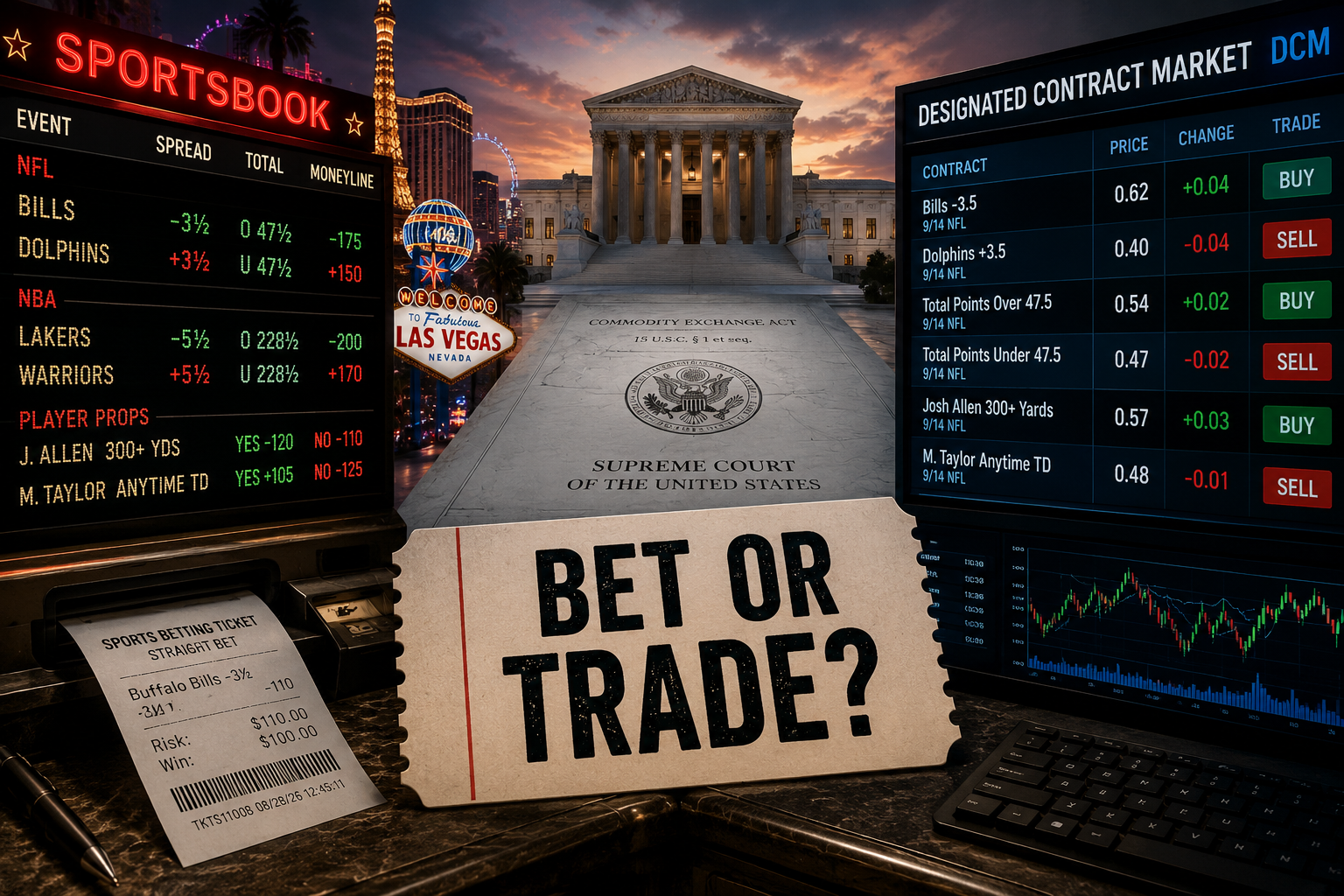
Nevada looked at what Kalshi was offering and essentially said: We know gambling. This is gambling. If you want to take sports wagers here, get licensed like everyone else. Kalshi said no. We are not a sportsbook. We are a federally regulated financial exchange offering event contracts under the jurisdiction of the Commodity Futures Trading Commission, commonly known as the CFTC. These aren’t bets. They are trades. On Friday, three federal appellate judges looked at that argument and weren’t buying it. Not even a little.
“The substance of the sports event contracts offered on Kalshi’s DCM is sports gambling, regardless of whether Kalshi calls them swaps.”
That is considerably more significant than simply saying Nevada won a lawsuit. It may ultimately force the Supreme Court of the United States to answer a question that has been building since prediction markets began exploding across America: When is a trade really a bet, and who gets to decide? Before we go any further, CNN’s reporting on Friday’s decision deserves a slight correction. CNN characterized the ruling broadly as a federal appeals court deciding that states can regulate prediction markets like gambling. That’s close enough for the evening news. It isn’t quite what happened. The Ninth Circuit did not declare every prediction market in America gambling. It did not rule that contracts concerning elections, interest rates, inflation, weather, gold prices, entertainment awards or countless other events automatically fall under state gaming laws. The court addressed Kalshi’s sports event contracts and concluded that Kalshi had not shown that federal commodities law preempts Nevada’s gaming laws as applied to those contracts. The court affirmed the dissolution of Kalshi’s preliminary injunction concerning sports contracts while sending the separate question involving election contracts back for additional consideration.
Sports are the bull’s-eye here. It also happens to be where the money is. Approximately 90 percent of Kalshi’s trading volume now comes from sports-related event contracts. Kalshi reportedly handled more than $1 billion on the Super Bowl alone, and lifetime sports volume has reached approximately $16.8 billion. Put that number in perspective. That’s more than twice Nevada’s entire sports betting handle for 2025. So this isn’t Nevada picking a philosophical fight with some experimental financial product operating on the fringes. There is real money here. Enormous money. There is also something else worth remembering. Nevada isn’t opposed to gambling. That sounds ridiculously obvious, but legally and rhetorically it matters.
Nevada isn’t arguing sports betting is immoral and must be stopped. It is saying that if you are going to conduct sports betting inside Nevada, you have to operate within Nevada’s highly regulated gaming system. Licenses. Taxes. Compliance. Age restrictions. Integrity controls. Responsible gaming requirements. All the things traditional sportsbooks have to deal with. Kalshi’s position effectively says none of that applies because the transaction takes place on a federally regulated designated contract market. That brings us to the heart of this case. And surprisingly, Kalshi has a pretty good legal argument.
I actually thought federal court would ultimately side with them. The reason is a concept called federal preemption. Don’t let the legal terminology complicate something fairly simple. When Congress creates federal law governing an area and gives a federal agency exclusive jurisdiction over it, a state generally cannot come along and create conflicting rules governing the same thing. Kalshi is regulated by the CFTC. Kalshi operates what is known as a Designated Contract Market, or DCM. Under the Commodity Exchange Act, the CFTC has exclusive jurisdiction over certain derivatives, including swaps, traded on those markets. So Kalshi’s argument follows a very logical path. Our sports event contracts are swaps. The Commodity Exchange Act gives the CFTC exclusive jurisdiction over swaps traded on our federally regulated exchange. Therefore Nevada cannot regulate those same contracts as gambling. Simple. And earlier this year, Kalshi won that argument.
The Third Circuit Court of Appeals reached essentially the opposite conclusion from the Ninth Circuit in a case involving New Jersey. The Third Circuit held 2-1 that Kalshi’s sports contracts likely qualify as swaps under the Commodity Exchange Act and therefore fall within the CFTC’s exclusive jurisdiction. New Jersey’s gambling laws were consequently preempted as applied to those contracts. That was why I believed Kalshi had the better hand in federal court. There is just one problem. Before federal law can preempt Nevada’s regulation of a swap, Kalshi first has to establish that what it is selling is actually a swap. The Ninth Circuit attacked the argument right there. Not at the end. At the beginning. And once that domino falls, everything behind it falls with it. Traditional swaps exist largely to transfer financial or commercial risk. Interest rates. Currency fluctuations. Commodity prices. Credit risk. The kinds of things derivatives markets were created to manage.
There is an underlying exposure. Someone has risk and uses the contract to transfer or hedge it. Now compare that with me sitting on my couch Sunday morning deciding that Buffalo is going to beat Miami by more than 3½ points. I didn’t have Buffalo Bills risk when I woke up. I created it when I decided I liked Buffalo -3½. That’s the distinction the Ninth Circuit finds important. And suddenly the word swap begins doing an awful lot of work. Because Kalshi doesn’t merely offer something vaguely connected to sports outcomes.
Customers can take positions resembling moneyline wagers. Point spreads. Totals. Player propositions. Exact outcomes. Combinations of outcomes that economically begin looking an awful lot like parlays. At some point common sense enters the courtroom. If I take the Bills -3½ on DraftKings, everyone agrees I made a sports bet. If I acquire a contract on Kalshi that pays based upon whether Buffalo wins by more than 3½ points, we’re told I made a trade. Economically, what changed? Apparently the Ninth Circuit had the same question. And Kalshi didn’t help itself. The company has argued in court that its sports contracts are not sports betting while previously marketing its product using the language of sports betting, including telling consumers they could legally bet on sports throughout the country. The judges noticed.
They called Kalshi’s attempt to distinguish its sports contracts from sportsbook betting “disingenuous.” That’s a nasty word to find in a federal appellate opinion when you’re the party making the argument. You cannot advertise something to customers as sports betting and then walk into court and act shocked when regulators call it sports betting. The Ninth Circuit even reached for Shakespeare. A rose by another name. Call it a contract. Call it a trade. Call it a position. Call it a swap. The court looked underneath the label and saw a bet.
That doesn’t end the argument, however. Far from it.
The Commodity Exchange Act defines swaps very broadly. It includes contracts whose value or payment depends upon events or contingencies associated with potential financial, economic or commercial consequences. Professional sports unquestionably have financial and economic consequences. Television rights. Advertising. Sponsorships. Franchise values. Employment. Stadiums. Tourism. Merchandising. Entire businesses rise and fall around sporting events. That was central to the Third Circuit’s reasoning. And there is an additional problem for the states. Congress specifically used the word “gaming” when addressing certain event contracts within the Commodity Exchange Act. Kalshi can reasonably ask a very good question: If Congress never contemplated gaming-related contracts existing within the CFTC’s jurisdiction, why did Congress specifically tell the CFTC how to deal with contracts involving gaming? That is not wordplay. That’s statutory text.
The states have an equally compelling response. Congress may have authorized the CFTC to regulate legitimate derivatives that happen to involve gaming-related events. That does not necessarily mean Congress intended to transform every possible wager into a federally protected financial instrument simply because someone places it on a regulated exchange.
And that leads directly into what may eventually become Kalshi’s biggest problem. Where is the limiting principle? If the Super Bowl qualifies as a swap because the Super Bowl has economic consequences, what doesn’t? Roulette has economic consequences. Poker has economic consequences. A boxing match has economic consequences. The Kentucky Derby certainly has economic consequences. An Academy Award has economic consequences. For that matter, put enough money, advertising and commercial activity around a coin flip and the coin flip has economic consequences.
If virtually any uncertain future event can become a federally protected derivative merely because someone builds a contract around its outcome, the definition of a swap becomes almost limitless. That is where the Ninth Circuit’s reasoning starts becoming particularly persuasive. Did Congress really intend to federalize sports gambling through the Dodd-Frank financial reforms enacted in the aftermath of the 2008 financial crisis? Maybe.
Statutes sometimes produce consequences Congress didn’t specifically contemplate. Courts interpret the words Congress enacted, not what legislators might have imagined happening sixteen years later. But if Congress intended to displace generations of state gambling regulation, you would expect it to have said so fairly clearly.
That brings another Supreme Court case into this discussion.
Murphy v. NCAA.
In 2018, the Supreme Court struck down the federal law that effectively prevented states from legalizing sports wagering. The decision opened the door for the state-by-state sports betting system we have today. States built regulatory systems around that authority. Some allow sports wagering broadly. Others restrict it. Some don’t permit it. States determine licensing, taxation, minimum ages, college betting restrictions, responsible gaming programs and integrity requirements. Then along comes a federally regulated prediction exchange saying, in effect: None of that applies to us.
If Kalshi is correct, something extraordinary happened. America spent years developing state sports wagering regimes following Murphy, while a completely separate path to nationwide sports wagering was sitting inside federal commodities law all along. Maybe that’s what Congress wrote. But the Supreme Court may eventually ask whether Congress really displaced such a traditional area of state authority without saying something considerably more explicit.
And now we have exactly the kind of situation that tends to attract the Supreme Court. Two federal appellate courts. The same basic product. The same federal statute. Opposite answers. The Third Circuit says these sports contracts qualify as swaps and federal jurisdiction preempts state gaming laws. The Ninth Circuit says these sports contracts are sports bets, not the swaps Congress placed beyond Nevada’s reach. That is what lawyers call a circuit split. For everyone else, it means something much simpler. A contract could effectively be a federally protected financial product in one part of America and unlicensed gambling in another. Same company. Same contract. Same federal law. Different answer depending upon where you’re standing.That cannot remain unresolved forever.
Other cases are already moving through courts around the country, and today’s ruling makes eventual Supreme Court review considerably more likely. Reuters likewise noted that the Ninth Circuit decision directly conflicts with the Third Circuit ruling.
Meanwhile, something fascinating is happening across town in Washington.
The CFTC is trying to rewrite the rulebook while the courts are still deciding what the existing rulebook says.
In June, the CFTC proposed amendments to Regulation 40.11 and a new framework governing event contracts involving enumerated activities including gaming. The current Commission is plainly more receptive to prediction markets and is considering a framework under which many mainstream sports contracts could remain permissible while contracts involving particularly problematic events or manipulation risks receive different treatment. That may help Kalshi. It doesn’t necessarily save Kalshi. There is an enormous difference between an agency interpreting its regulations and an agency expanding the jurisdiction Congress gave it.
The CFTC can write regulations. It cannot rewrite an Act of Congress.
If the Supreme Court ultimately concludes that ordinary recreational sports wagers aren’t “swaps” within the meaning of the Commodity Exchange Act, the CFTC cannot simply wave a regulatory wand and make them swaps. Congress would have to fix that. Interestingly, all of this also shows why we shouldn’t paint prediction markets themselves as some elaborate attempt to disguise gambling. There are legitimate uses for event contracts that look very much like traditional hedging. Businesses are already experimenting with prediction markets to protect against unusual risks for which conventional financial instruments may not exist. Reuters recently documented businesses using event contracts involving labor rules, shipping conditions and other real commercial exposures.
Weather provides an easy example. Suppose extreme heat materially hurts my business. I purchase a contract paying me if the temperature exceeds 103 degrees. I’m not merely predicting the weather for entertainment. I already possess the risk. The contract helps offset it. That’s a hedge. Now suppose I think Patrick Mahomes throws for more than 300 yards Sunday, so I buy a contract paying me if he does. What exactly am I hedging? Nothing. I think Mahomes is going over. So I put my money where my opinion is. We have had a word for that for a very long time. A bet. Maybe the eventual answer doesn’t have to destroy prediction markets or hand them complete victory. There is a middle ground. Contracts involving genuine economic risk could remain within the federal derivatives structure. Interest rates. Inflation. Commodity-related events. Weather risks. Commercial events. Perhaps elections and other categories require their own analysis. Sports contracts that function like traditional recreational wagering could remain subject to state gaming laws. Messy? Absolutely. But it would preserve the innovative financial applications of prediction markets without accepting the proposition that every question capable of being answered yes or no can be converted into a federally protected derivative.
The problem for Kalshi is that such a compromise could represent a legal victory for prediction markets while simultaneously being a devastating business result for Kalshi. Remember where we started. Sports account for roughly 90 percent of Kalshi’s trading volume. This isn’t the side business. It’s the engine. And there is another constituency watching all of this very carefully. Tribal gaming. States and tribes have spent decades negotiating gaming compacts and exclusivity arrangements involving enormous amounts of money. Prediction markets potentially create a way around those arrangements by saying the activity isn’t gaming at all. Tribal representatives have been increasingly vocal that this threatens both state regulatory structures and tribal sovereignty. The issue surfaced again this month at the Racing and Gaming Conference in Saratoga. You don’t need to agree with the tribes to understand the problem. If Congress intended a financial regulator to blow through state gaming laws and negotiated tribal gaming arrangements nationwide, somebody eventually has to demonstrate where Congress actually said that.
Which brings this directly into our own backyard. Horse racing. Interestingly, racing may provide one of the best examples in the entire debate of what congressional clarity actually looks like. The Interstate Horseracing Act specifically addresses interstate wagering on horse races and establishes requirements involving the parties whose races and wagering rights are being used. That is one reason you haven’t been opening Kalshi and finding Kentucky Derby win markets sitting next to NFL games. Racing has pushed back aggressively. Churchill Downs has made clear that prediction markets have not been given permission to offer wagering on the Derby, while racing organizations have argued that the Interstate Horseracing Act controls interstate wagers involving horse races. Whether every future legal argument over racing ultimately comes out that way is another question. But the comparison is instructive. When Congress wanted to regulate interstate wagering on horse racing, Congress passed a law dealing with interstate wagering on horse racing. It addressed the activity. It addressed consent. It addressed racing.
That makes the question surrounding sports prediction markets all the more interesting. Did Congress similarly create nationwide federal sports wagering through legislation designed primarily to regulate derivatives following a financial crisis? Or are prediction markets taking extraordinarily broad financial language and stretching it into territory Congress never intended it to occupy?
Asked another way:
Did Congress create this market, or did technology discover a loophole?
I don’t know that anyone can honestly answer that yet. Kalshi’s legal position is much stronger than simply saying, “We’re not gambling because we call them contracts.” The Third Circuit proves that. Three federal appellate judges considered the statutory language and two of them agreed with Kalshi. Now three other federal appellate judges have examined essentially the same question and reached the opposite conclusion. And I find one final aspect of this fascinating. Nevada didn’t need prediction markets to teach it what gambling looks like. The state has spent generations figuring out how to regulate gambling while simultaneously building an economy around it. That doesn’t make Nevada automatically right. It does make the setting perfect. A new industry arrived with a new vocabulary and a federal license and said: We’re different. Nevada looked at the point spreads, totals, propositions and sports outcomes and said: No, you’re not. The Ninth Circuit agreed. For now.
Kalshi has already said it will seek further review. The company continues to maintain that CFTC regulations do not prohibit its sports contracts and points to the CFTC’s ongoing rulemaking as further support for its position. So this isn’t over. Not remotely. The Third Circuit has spoken. The Ninth Circuit has answered. Other courts are weighing in. The CFTC is rewriting regulations. States are defending their gaming authority. Tribes are defending theirs. Billions of dollars are moving through the markets while everyone argues about what the markets actually are. And somewhere down the road, quite possibly inside the Supreme Court of the United States, nine justices may finally have to strip away all the terminology and answer something gamblers figured was pretty simple long ago. When I put money down because I believe one team is going to beat another, did I make a trade? Or did I make a bet?
Sometimes the most complicated legal battles begin with the simplest questions. And this one may ultimately decide who controls a very large piece of the future of gambling in America.