
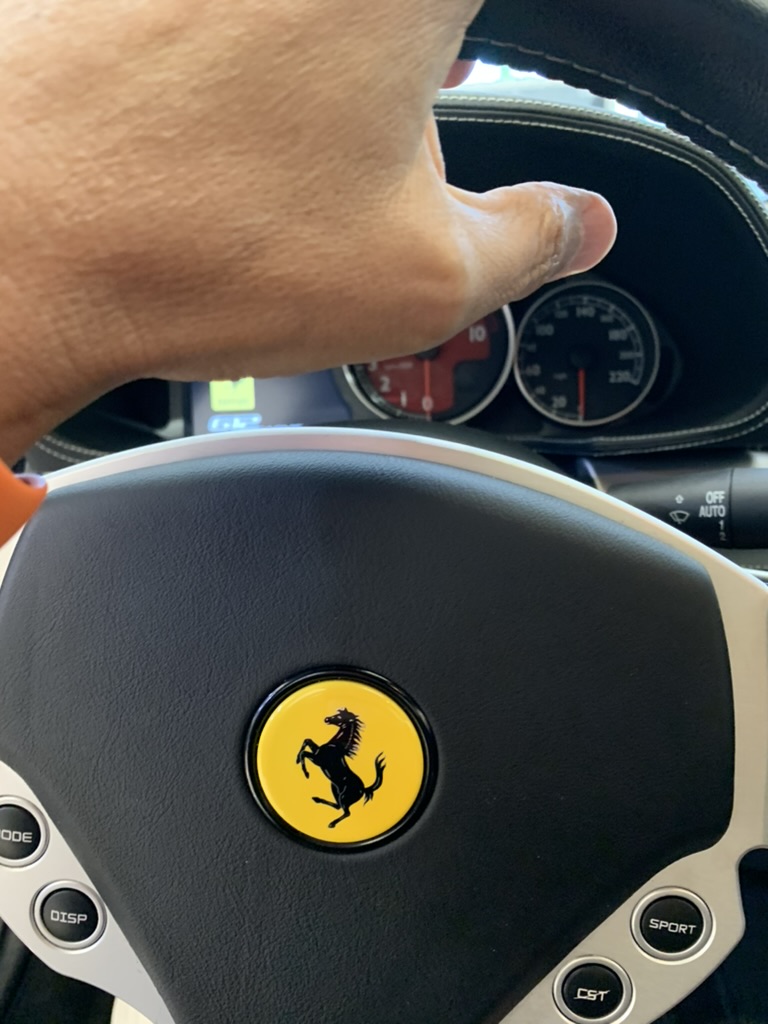
“Pick 6 King Jon Stettin driving the prancing horse, Ferrari”
Jon Stettin
Tom Brady and Logan Paul exchanged middle fingers from nearby suites at the World Cup Final while Michael Rubin stood between them recording the moment. Two days earlier, Brady had slapped Paul across the face onstage at Fanatics Fest. Months before that, Brady called him a “bitch,” dismissed professional wrestling as “cute,” and told Paul to come play with the big boys.
Maybe it is real. More likely it is a carefully manufactured storyline designed to create attention and possibly lead somewhere with WWE. Either way, it worked. People watched it. People shared it. People talked about it. I watched it and thought about Ferrari. That may sound like a strange place to go, but branding is a strange and fascinating business. How do you make people want something they do not need? How do you make them gravitate toward a product, a company, or even a person?
There are plenty of conventional answers. Price, style, color, quality, availability, advertising, and some combination of all of them. The best brands, however, go further. They do not merely give people reasons to buy something. They create a reason to want it before the customer has even decided what it is they are buying. That is not marketing. It is not advertising. It is the deliberate creation of desire.
Richard Mille makes a fabulous machine.
The watches are technically ambitious, instantly recognizable, and constructed from materials more commonly associated with aerospace engineering and Formula 1 than traditional watchmaking. Richard Mille did not simply build an expensive watch, slap a ridiculous price on it, and hope wealthy people would be foolish enough to buy it. The product was there. The brilliance was understanding that the price could become part of the product. Richard Mille launched in 2001 without the centuries of history behind Patek Philippe or the worldwide recognition of Rolex. The watches were priced at levels that would have sounded almost preposterous for a new company. That boldness could have destroyed the brand before it started. Instead, it helped define it.
The latest industry estimates place Richard Mille among the six largest Swiss watch brands by sales while producing only a few thousand watches a year. There are other magnificent watches, other complicated movements, and other limited editions. There are not many watches that can communicate the same thing from across a room. Then Richard Mille put them on the right wrists.
Rafael Nadal did not simply wear one while attending a dinner or posing for an advertisement. He began wearing a specially engineered Richard Mille while competing in 2010. One of the greatest tennis players in history was swinging a racket with an extraordinarily expensive mechanical watch strapped to his wrist. Other elite athletes followed. That accomplished something no ordinary advertisement could. It demonstrated the machine while elevating the symbol. Now the young superstar wants one. The Hollywood powerhouse wants one. The billionaire entrepreneur wants one. The person who wants to look like any of them wants one.
Richard Mille had the watch. Then it had the watch.
Ferrari went further.
Car people have always wanted a Ferrari, including during the years when some of them looked magnificent but ran like crap. The unmistakable Italian styling, the prancing horse, the bold red, and the growl from the exhaust were enough to make people dream about owning one. It did not matter that older Ferraris could be temperamental, expensive to maintain, and far less reliable than the modern cars carrying the name.
People wanted them. Those who could afford them wanted them, and plenty of people who could not afford them wanted them even more. Ferrari eventually expanded beyond the car. Clothing, sunglasses, luggage, accessories, theme parks, racing experiences, and an entire world built around the prancing horse transformed ownership into something larger. Ferrari became a lifestyle. That still does not fully explain what Ferrari created. Ferrari did not merely make its cars expensive. It made access to them feel selective.
Walk into a Ferrari dealership prepared to buy a new car and the conversation has a familiar rhythm.
The new one you want already has several deposits on it. The dealer may be able to obtain an allocation for you next year, perhaps the year after that. There are no promises. Ferrari controls production, the dealer receives only so many build slots, and established customers naturally receive consideration. There is, however, a beautiful pre-owned Ferrari sitting on the floor today. You can drive that one home. Once you establish a relationship with the dealer and become part of the Ferrari family, obtaining a future allocation becomes considerably easier. Would you prefer to wait a year or two for a possibility, or would you like to drive this Purosangue home today? Every Ferrari dealer somehow speaks the same language.
Ferrari will tell you there is no universal rule requiring someone to own a pre-owned Ferrari before buying a new one. Technically, that may be true. There does not have to be a written rule when the available choices consistently lead the customer to the same decision. Ferrari never denies you the car. It offers you a path toward deserving it. The pre-owned Ferrari is no longer merely a used car. It becomes admission. It can cost more than a new one because it is available now. The customer is not only buying the car sitting on the floor. He is buying the possibility of being offered the next one.
Ferrari never has to say that directly. It simply arranges the choices until buying the pre-owned car feels like your idea. That is the real genius.
Most companies pursue customers. Ferrari trains customers to pursue Ferrari. You can have enough money to buy the car and still be made to feel fortunate that Ferrari allowed you into the family.
Once inside, the relationship carries expectations. Sell certain cars too quickly and the next allocation may never come. Modify the wrong car in the wrong way and the factory may not appreciate it. Ferrari does not have to arrive at your garage and take the car back. It controls the warranty, the authorized service network, the future allocation, and whether the door opens the next time you knock. You own the Ferrari. Ferrari still owns your desire for the next one.
Patek Philippe and Rolex use their own versions of the same psychology with their most desirable watches. Having enough money does not mean the watch is available to you. The authorized dealer decides whose telephone rings when a particular model arrives. The product is expensive. Access is priceless.
What does any of that have to do with Tom Brady and Logan Paul? Everything.
Products are branded through price, quality, identity, and controlled availability. People are no different. How a great athlete carries himself after the uniform comes off becomes its own brand decision. More exposure may produce more money. It does not automatically create more value. Brady is called the GOAT, and he was unquestionably a phenomenal quarterback. Seven Super Bowl championships, five Super Bowl MVP awards, and a career defined by winning make the argument easy to understand.
“All time,” however, is a dangerous phrase. Football has changed dramatically across generations, particularly in the way quarterbacks are protected. Could Brady have taken Jack Lambert coming untouched from his blind side, helmet driven into his knees, reached for the smelling salts, returned to the huddle, changed the play at the line, and thrown a touchdown dart? I do not know. Joe Namath could, and he is barely permitted into the GOAT conversation today. His knees were already severely damaged at the beginning of his professional career. He played in an era when quarterbacks absorbed hits that would bring suspensions, fines, and weeks of television debate today. He kept getting back up.
None of that means Brady was not great. It means comparing greatness across eras is more complicated than counting trophies and repeating a label. Branding helps determine who becomes timeless and who is remembered as merely great.
Michael Jordan understood this as well as anyone.
Jordan sells sneakers, tequila, memorabilia, video games, clothing, and the Jordan name. He owned an NBA franchise, co-owns a NASCAR team, and has built a business empire that continued growing long after he stopped taking the final shot. Jordan sells plenty. What he has almost never sold is unlimited access to Michael Jordan.
His most famous observation about business and politics was not made during a press conference or delivered as some carefully polished corporate doctrine. “Republicans buy sneakers, too” was an offhand joke made on a team bus during the 1990 North Carolina Senate race. The comment did not become public until years later, and Jordan eventually confirmed saying it while explaining that it had been made in jest.
The line grew beyond the moment. It became a permanent explanation for Jordan’s reluctance to make himself politically available to either side. Whether he intended it as a branding strategy or not, it functioned as one. Republicans could see what they wanted in Jordan. Democrats could see what they wanted. People across countries, cultures, political parties, and generations could claim some piece of him because Jordan rarely said enough to make anyone surrender the version they had created. That was not necessarily heroic. It was not activism. It was branding.
Silence, correctly priced, can be its own Richard Mille.
Jordan does not flood podcasts with his opinions. He does not insert himself into every cultural argument. He does not manufacture a weekly controversy to remind people that he remains relevant. His products are everywhere. The man is not.
Scarcity does the rest. Logan Paul built something entirely different, and he built it extremely well. His product is unlimited access to Logan Paul. The arguments, stunts, spectacle, outrage, embarrassment, and constant visibility are not threats to his brand. They are the brand. Logan Paul does not lose anything by exchanging middle fingers with Tom Brady. The moment fits perfectly inside the world he created. If people praise him, he wins. If people hate him, he wins. If people are angry enough to share the clip and explain why they cannot stand him, he may win even more.
Tom Brady is different.
During his career, access to Brady was controlled. He played, won, answered what he had to answer, and largely protected the image. He was excellence, discipline, preparation, and winning. Even the famous public destruction of his personal cellphone during Deflategate somehow added to the sense that nobody was getting through the door unless Brady allowed it.
Now he is everywhere. He broadcasts games, appears on podcasts, promotes businesses, sells products, participates in public stunts, and increasingly allows the machinery around modern celebrity to turn him into content. There is nothing wrong with working. There is nothing wrong with building businesses, accepting endorsements, broadcasting football, or even having fun with professional wrestling. Brady has every right to shape his second act however he chooses. The question is whether he is expanding his brand or spending it.
Attention and value are not the same thing. Logan Paul’s business requires the next camera, the next stunt, the next opponent, and the next viral moment. Brady’s value was built through achievement and relative scarcity. Placing those two brands together does not create an equal exchange. Logan Paul gains stature by standing next to Tom Brady. Tom Brady gains attention by standing next to Logan Paul. Only one of those commodities was scarce.
The middle fingers at the World Cup Final will probably be forgotten. The branding decision behind them should not be. Richard Mille controls the scarcity of the product. Ferrari controls the scarcity of access. Michael Jordan controls the scarcity of himself. Logan Paul sells the exact opposite, and he has become enormously successful doing it. The mistake would be believing the same strategy works equally well for everyone.
Ferrari understands that producing more cars might create more revenue today while making every Ferrari mean a little less tomorrow. Michael Jordan understood that selling more products did not require selling more of himself.
Tom Brady may want to consider whether the same principle applies to Tom Brady.