
From White Abarrio’s courtroom battle to Renegade’s quarter cracks and a Keeneland meet with a record vet scratch rate, a collision of safety culture, regulatory inexperience, and institutional amnesia is threatening the integrity of our biggest races.
Let me be direct before a single word of this piece is misread: I want sound horses. I want every horse that walks onto a racetrack to be fit to run. I have zero tolerance for anyone — owner, trainer, or anyone else in the barn — who knowingly sends an unsound horse to the gate. That position is not negotiable and it is not in tension with anything that follows.
What follows is a serious examination of a system that is beginning to show real cracks — not in its intentions, which are admirable, but in its execution. And with the 152nd Kentucky Derby days away, with the co-favorite running in specially made shoes to manage quarter cracks, with a third starter already scratched due to a foot injury, and with a landmark federal lawsuit working its way through a Los Angeles courtroom over a horse that was scratched from the Breeders’ Cup and then went out and beat the reigning Horse of the Year, it is long past time to ask the hard questions.
The system was built on the right values. The question is whether it’s being operated by people with the experience to honor them.
A NUMBER THAT DEMANDS EXPLANATION
The Keeneland April meet just concluded with a regulatory veterinarian scratch rate of nearly five percent — 58 horses deemed unfit to run for unsoundness across the meet. That is a striking number. Per data from the Kentucky Horse Racing & Gaming Corporation and Equibase, a linear regression of Kentucky vet scratch rates shows a small but consistent upward trend over the past several years, though no single year represents a statistically dramatic spike. The trajectory, however, is unmistakable.
Now, in the first four days of Churchill’s Spring meet — with the Derby on Saturday — 12 more horses have been scratched for unsoundness. The backstretch anxiety that has accompanied these meets is real and documented. Trainer Kenny McPeek has been among the most outspoken. He is not alone. Multiple trainers, owners, and private veterinarians have described feeling targeted, or at minimum, feeling that regulatory vets are scratching horses whose movement patterns are idiosyncratic but long-established — horses that have raced safely, often many times, with the very gait that is suddenly disqualifying them.
Again, I’m not dismissing the regulatory vets’ job. It is genuinely difficult, thankless, and consequential. They are responsible for the safety of a thousand-pound athlete and the human on his back. But the horsemen raising concerns are not, in the overwhelming majority, arguing that lame horses should race. They are arguing that familiarity with an individual horse matters — that knowing what normal looks like for this horse, on this morning, in this climate, in this barn is irreplaceable information that a pre-race checklist alone cannot supply.
WHITE ABARRIO: THE CASE THAT CHANGED EVERYTHING
If there is a single data point that crystallizes the stakes of this debate, it is White Abarrio.
On November 1, 2025, White Abarrio — the 2023 Breeders’ Cup Classic winner, a Grade 1 stakes earner multiple times over — walked toward the starting gate for the Breeders’ Cup Dirt Mile at Del Mar. A regulatory veterinarian observed his gait during the post parade warmup and, in what the subsequent lawsuit describes as a visual inspection lasting only a few seconds, determined he was unsound in his left front leg. White Abarrio was scratched from a $1 million race.
His attending veterinarian, who examined him immediately afterward, found no lameness. No justification for the scratch. The connections were, to put it diplomatically, stunned.
What made this incident impossible to rationalize away was what came before it — and what came after. Before: White Abarrio underwent an 18F NaF PET scan five days prior to the race and a Sleip AI gait analysis the day before. Multiple daily veterinary reports from the Breeders’ Cup’s own team noted his characteristic ‘choppy gait’ and, in each instance, concluded he was ‘racing sound.’ The PET scan results, interpreted by noted equine imaging expert Dr. Mathieu Spriet, found the findings ‘within the range of normal for a racehorse in training.’ The horse had run 24 races and won 10 of them with this same gait. He had never once been scratched for it.
The most uncomfortable detail: the same regulatory veterinarian who scratched him at the 2025 Breeders’ Cup had examined him before his 2023 Classic victory at the same event, noted the identical choppy gait, and cleared him to run. The same gait. The same vet. Two different conclusions.
He was scratched based on a gait he’d raced with 24 times — including a Breeders’ Cup Classic win cleared by the same vet two years earlier.
After: White Abarrio returned to competition in January 2026 and ran second in the $3 million Pegasus World Cup Invitational at Gulfstream Park — a Grade 1 stakes race against some of the best older horses in training. He then went to Oaklawn Park and won the Grade 2 Oaklawn Handicap, defeating Sovereignty — last year’s Horse of the Year — and Journalism, one of the finest 3-year-olds of the 2025 season. Whatever was ‘wrong’ with White Abarrio on November 1st, 2025, it was not sufficient to prevent him from defeating champions.
The owners — Gary Barber and C2 Racing Stable’s Clint and Mark Cornett — have filed suit in Los Angeles Superior Court against Breeders’ Cup Ltd., the California Horse Racing Board, and Del Mar, seeking over $10 million in damages. Their statement is worth reading plainly: ‘When established rules and protocols are disregarded, and veterinarians act as though they have the authority to scratch with impunity, we cannot remain silent.’
Allegations are allegations. The defendants have not yet formally responded. But the documented facts — advanced diagnostics cleared, daily exams cleared, same gait, same vet, different outcome — present a factual record that deserves serious scrutiny regardless of how the litigation resolves.
DERBY WEEK: THREE HORSES, THREE FOOT STORIES
The Kentucky Derby field now carries its own version of this anxiety. Three starters have prominent foot-related concerns in the days leading up to Saturday’s race.
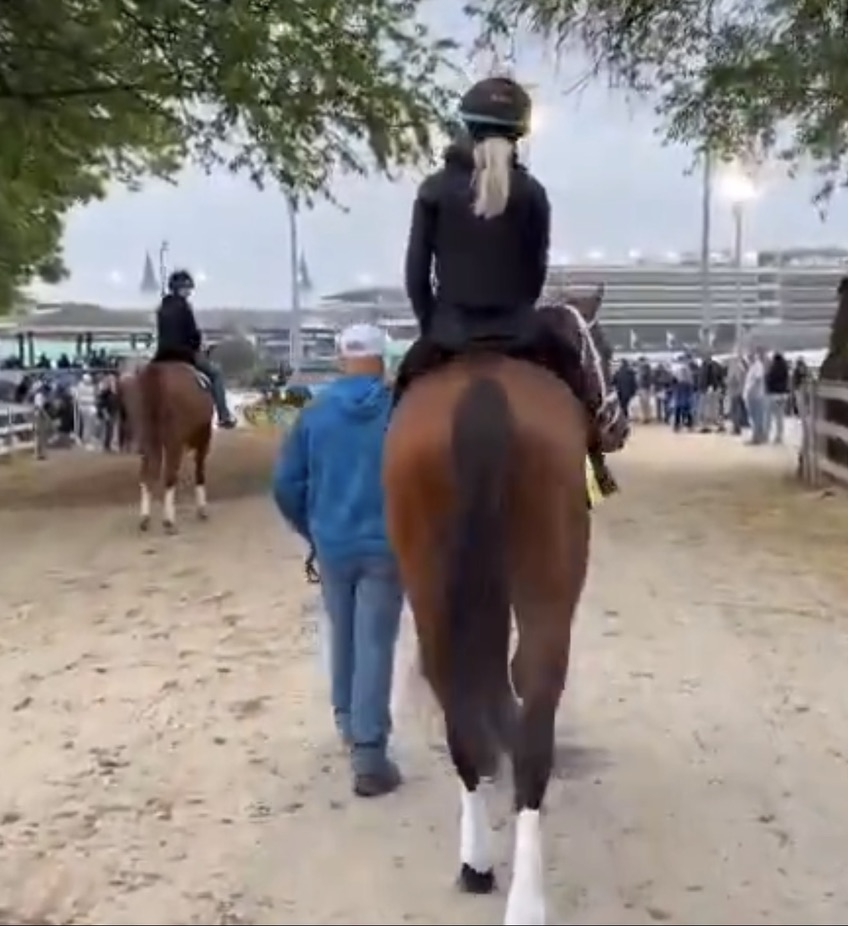
Renegade, the morning-line co-favorite trained by Todd Pletcher, will run in three-quarter shoes on both front feet to manage quarter cracks. Pletcher has been transparent about it: the horse had the same shoeing arrangement for the Arkansas Derby at Oaklawn Park on March 28 — which he won by four lengths. The shoes relieve pressure on the inside quarter. This is not a horse being sneaked to the gate in compromised condition. This is a trainer being forthcoming about a managed, chronic condition that did not prevent his horse from running the best race of his career five weeks ago.
Golden Tempo, trained by Cherie DeVaux, is dealing with cracked heels on both front feet. DeVaux does not believe it will keep him from running. Cracked heels are a skin condition — uncomfortable, requiring management, but not inherently a disqualifying lameness issue in the way a structural injury would be.
Silent Tactic was not so fortunate. Trainer Mark Casse scratched him on April 29th, four days before the race, due to a bruised foot. Casse indicated the horse could potentially return for the Preakness Stakes on May 16th — suggesting the injury is considered manageable with rest, not career-threatening. But he is out of this Derby.
And then, as this piece was being finalized, came word that Fulleffort has scratched with a chip in his left hind ankle. That is a concrete, diagnosable structural finding — the kind of scratch nobody disputes, the kind the system was built to catch. It is worth noting precisely because it illustrates the distinction at the heart of this entire debate: a chip on imaging is not a choppy gait in the post parade. One is pathology. One may be personality. The regulatory framework needs to be sophisticated enough — and staffed by practitioners experienced enough — to know the difference. Fulleffort’s scratch is the system working. The White Abarrio scratch was the system failing. Both happened. Only one generated a lawsuit.
These are three horses, three different foot conditions, three different management responses. None of them, on the available evidence, represents a reckless effort to run a broken horse. All of them exist in a regulatory climate where the White Abarrio precedent now looms over every pre-race exam. If a horse’s normal gait can get him scratched from the Breeders’ Cup by a vet who cleared that same gait two years earlier, what happens to Renegade on Saturday morning if a regulatory vet has a different read on how those three-quarter shoes are affecting his movement?
THE DEEPER PROBLEM: WHO IS DOING THESE EXAMS?
The uncomfortable substrate beneath all of this is the well-documented shortage of experienced regulatory veterinarians. The Jockey Club launched a Racing Regulatory Veterinarian Fellowship last year — a loan repayment program offering up to $25,000 to incentivize recent veterinary graduates to pursue regulatory careers. The program was created explicitly to address the talent pipeline problem. The industry acknowledges the shortage. HISA has formally acknowledged it. The federal rulemaking process around HISA’s racetrack safety requirements explicitly addressed the difficulty of finding enough qualified regulatory vets to meet the mandated minimums.
This matters enormously in the context of the horsemen’s complaints. The institutional knowledge required to do this job well cannot be downloaded. You have to know horses. You have to know Thoroughbreds specifically — the way they move, the way stress remodeling affects their gates, the way one horse’s normal jog is another horse’s career-ending lameness flag. You have to have seen thousands of horses in pre-race exams over years to develop the pattern recognition that separates a genuine soundness concern from an idiosyncratic but stable movement characteristic.
If the regulatory system is increasingly being staffed by capable but less experienced veterinarians who lack that deep Thoroughbred-specific institutional knowledge, then the system’s increased scratch rate may reflect not a genuine increase in unsound horses — but a decrease in the expertise required to distinguish the unsound from the unusual.
That is not an attack on any individual vet. It is a structural critique of a profession that is struggling to attract and retain experienced practitioners in a role that is difficult, publicly scrutinized, legally consequential. The veterinary shortage is not limited to the horse racing industry. It is a nationwide problem. It can be a very thankless job, with enormous pressure and stress, and they often cannot control the outcome.
Are we producing more unsound horses, or are we producing fewer vets who know how to tell the difference?
THE QUESTION RACING HAS TO ANSWER
There are genuinely two distinct possibilities here, and the data does not currently allow us to resolve them with certainty. The first is that the upward trend in vet scratches reflects genuine improvement in the system — vets catching horses that would previously have run and been injured, doing exactly what the post-Santa Anita safety overhaul intended. On this reading, the horsemen’s complaints are the cost of doing the right thing, and a few wrongful scratches are an acceptable price for the horses that were legitimately protected.
The second possibility is more troubling: that the system has developed a structural overcorrection, driven by a combination of regulatory anxiety in a politically charged climate, diagnostic tools that flag statistical variation as pathology, and a shortage of experienced vets who can contextualize what they’re seeing against the full baseline of what a sound racehorse’s body actually looks like under competitive training.
White Abarrio’s subsequent race record — a second-place finish in the Pegasus followed by a Grade 2 win over Sovereignty and Journalism — does not prove the second possibility is universally true. But it is one data point that cannot simply be waved away. And the documented facts of that case — advanced diagnostics cleared, daily exams cleared, characteristic gait cleared by the same vet two years earlier — make a compelling argument that in at least one high-profile instance, the system produced a profoundly wrong result with serious financial and competitive consequences.
The lawsuit may or may not succeed. That is not the point. The point is that an industry navigating declining public confidence, federal oversight, shrinking handle, and an existential argument about its own safety record cannot afford a regulatory apparatus that produces outcomes like the White Abarrio scratch at the Breeders’ Cup — and then offers no transparency, no explanation, and no accountability.
CHRB executive director Scott Chaney dismissed the volume of Breeders’ Cup vet scratches as ‘unremarkable.’ That framing is tone-deaf at best. When a past Breeders’ Cup Classic winner — a horse with 200 pages of diagnostic documentation clearing him as sound — is scratched based on a few seconds of visual observation by a vet who had seen that same gait and cleared it before, ‘unremarkable’ is not an appropriate response. It is a failure of institutional self-awareness.
WHAT THIS MEANS COMING INTO SATURDAY
Coming into this Kentucky Derby, we have a field that includes a co-favorite with managed quarter cracks, a contender with cracked heels, two scratches due to foot injuries — one a bruised foot, one a bone chip — and a backstretch community that is running the White Abarrio precedent through their heads every morning during the pre-race exam. That is not a healthy regulatory environment. That is an environment producing anxiety and adversarialism where there should be collaboration.
The solution is not to weaken safety standards. The solution is to demand that those standards be applied by people with sufficient expertise to implement them correctly — consistently, transparently, and with appropriate deference to documented individual horse history. It is to insist that pre-race diagnostic data be used to inform veterinary judgment rather than override it or be ignored in favor of a three-second visual. It is to require that when a regulatory vet makes a scratch decision that contradicts a week of daily clearances, there is a documented, defensible reason — not a vague reference to ‘unsoundness’ with no further detail available.
Horsemen are not the enemy of horse safety. The vast majority of them have devoted their lives to these animals and know them better than any regulatory vet who sees them for thirty seconds on exam morning. The goal should be a system that integrates their knowledge with the best available science and oversight — not one that treats their expertise as suspect and their horses as liabilities to be managed rather than athletes to be understood.
We are heading into the first Saturday in May. The most famous race in the world. A co-favorite who managed quarter cracks all the way to an Arkansas Derby win is now trying to manage them through Churchill Downs. That story deserves to be told clearly, without hysteria, and without pretending the system that will examine him Saturday morning is operating at peak effectiveness.
We want sound horses. We want safe racing. And we want a regulatory apparatus capable of telling the difference between a horse that shouldn’t run and a horse that simply runs differently than the textbook says it should.
Right now, we are not fully confident we have all three.
Best Intentions Gone Wrong: