

The racing was magnificent. Everything around it? Well.……..
Let me say upfront what I always say, because I believe it and because it is the only intellectually honest place to start: Churchill Downs is a publicly traded company. They answer to shareholders. They are not a nonprofit steward of the sport’s soul — they are a corporation, and corporations exist to make money. I have never had a problem with that, and I do not have one now.
That said, when you own the Kentucky Derby — the most famous horse race in the history of civilization, 152 years old and still drawing 150,000 people to a single afternoon — certain moral, ethical, and sporting obligations come attached. You don’t get to pick and choose which traditions you honor based on what the network is paying this cycle.
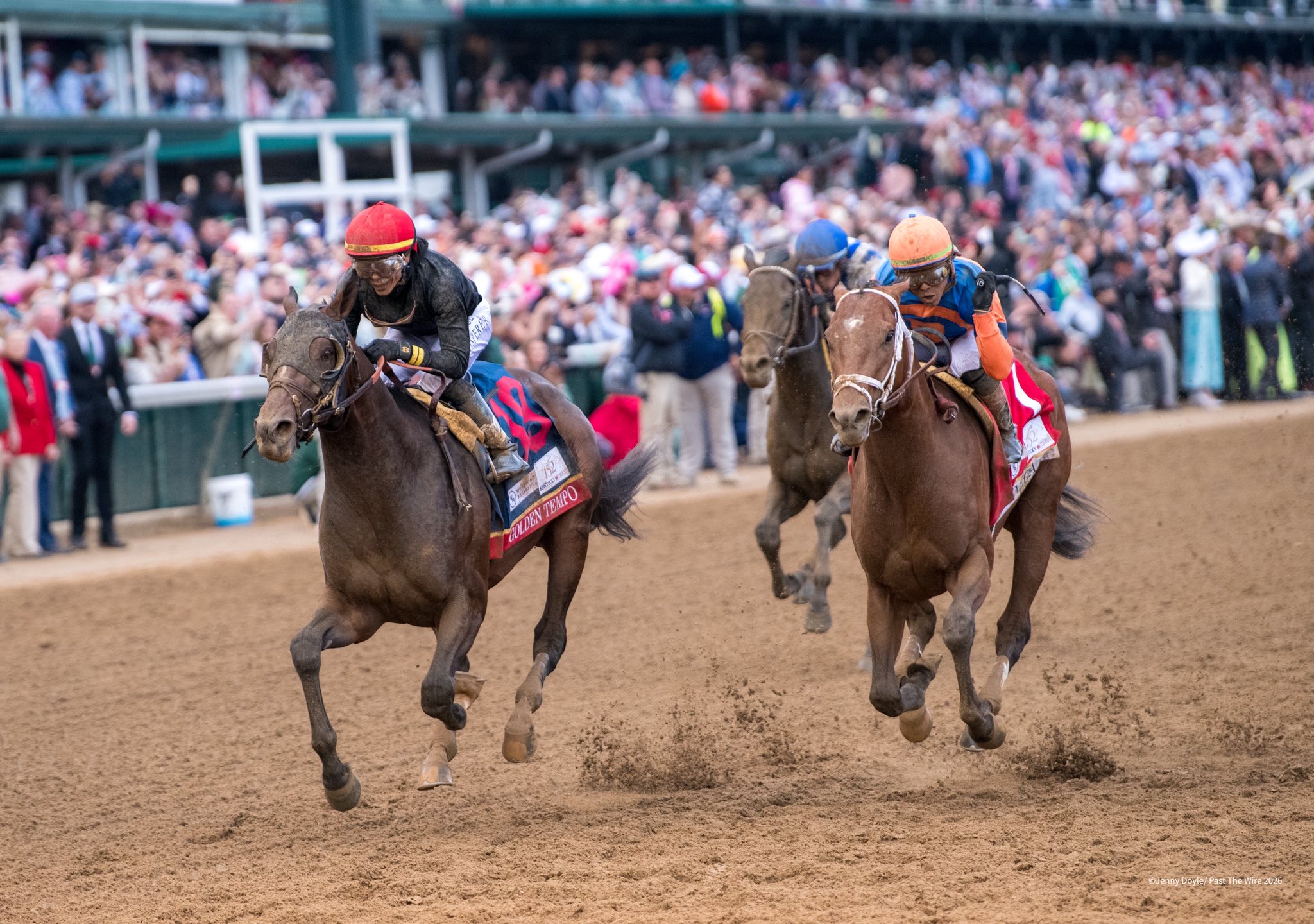
The race itself? An A-plus. A historically epic finish between two brothers that will never be replicated. Cherie DeVaux becoming the first female trainer to win the Run for the Roses. Golden Tempo coming from nineteenth of nineteen to win by a neck. Jose Ortiz sweeping the Oaks-Derby double. All of it: perfect. Championship racing at its absolute apex.
Everything around it? Class dismissed.
THE KENTUCKY OAKS: Southern Hospitality Is Apparently a Tax Write-Off
The Kentucky Oaks has been run at 6 p.m. for longer than most people reading this have been alive. It is not just a race. It is a Friday night tradition in Louisville. Restaurants fill. Bars fill. Local spots that survive off Derby week do a meaningful portion of their annual business in those hours after the fillies run.
This year, NBC moved it to primetime. Post time: 8:40 p.m. For the first time in the Oaks’ 151-year history, the race ran under the lights. The grandstand, which holds more than 100,000 people, had large swaths of empty seats by the time the horses went to the gate. Chad Brown, who trained the winner, publicly complained that the trophy presentation — a tradition held in the infield — had to be moved to the paddock because of the hour. He said it was the only negative of the night. He was being diplomatic.
Local business owners were considerably less so. One told the New York Times: “They are trying to cut us out of the equation. It’s terrible for small businesses. The only thing I see is greed.” Another offered the definitive summary: “Churchill Downs has officially decided the Kentucky Oaks belongs to NBC, not Louisville.”
And here is the part where I try to be fair: I understand that some of these establishments gouge customers all week. Twenty dollars for a beer. Twenty-five and up for a mint julep in a souvenir cup. And for the record have you ever tasted a mint julep? Fifty for a plate of food that costs eight dollars to make. For those places, pardon me if I struggle to locate my sympathy in the couch cushions. But the honest local joints — the ones with fair prices and real neighborhoods to serve — got hosed. And not incidentally, so did the horses. They ran a Grade I stakes race for three-year-old fillies in front of empty seats at 8:40 at night because NBC wanted a ratings window.
Oh, and the Oaks is locked into primetime for at least the next six years under the current deal. So Louisville’s local business community has six more years to experience the full warmth of corporate Southern hospitality.
THE STREAMING SITUATION: Churchill Downs’ War on Its Own Customers
Now we arrive at the part of the program that is not funny. Not dark funny. Actually not funny at all.
RTN — the Racing Television Network — is a subscription service that horseplayers pay for specifically to watch the track feed. Not the NBC production with celebrities sipping bourbon and drone shots of the infield. The track feed. The one bettors like on when handicapping, watch replays in real time, and track will pays. These are not casual fans. These are the players. The ones who move handle. The ones the industry sold out entire regulatory frameworks to attract with ADW accounts and CAW provisions. These are the bread-and-butter customers that everyone in racing claims are the foundation of the sport’s economic survival.
On Derby Day, RTN subscribers were blocked. The feed was moved to Peacock — the NBC streaming platform that requires a paid subscription — and NBC Sports Network. If you wanted to watch, here were your options:
Option one: Open a Peacock account you never wanted.
Option two: Navigate a channel switch mid-day when coverage moved between platforms.
Option three: Do what many did, which I will not detail here but which NBC Sports fully deserves for arranging this scenario in the first place.
Here is a hint, free of charge, for whoever runs strategy at Churchill Downs and NBC: serious gamblers do not want friction when they have their game faces on. You know the game face. The same one the industry spent decades chasing. The same focus and tunnel-vision intensity that moves millions of dollars through the pari-mutuel pools on Derby Day. That person does not want to create a streaming account during the card. That person does not want to discover that they need to switch to a different NBC channel two hours into their session. That person wants to watch the races. That is all.
Pick a station. Leave it there. For one day, one race, one weekend — act like you care about the people who actually fund this sport, not just the ones who show up in hats.
THE PRODUCTION: A Soap Opera, a Drone, and Kidney Stones
Since we are cataloguing everything, let us address the broadcast itself.
First: the drone camera. NBC loves the drone shot. They return to it constantly. The overhead angle of a horse race has one significant drawback, which is that it makes the second horse look like it might be in front half the time. When a bettor has a meaningful sum of money at risk and cannot tell from the broadcast whether their selection is winning or losing, they are not having a good experience. They are having a bad experience. A stressful bad experience. The drone camera is visually stunning for a highlight package. It is a disaster for someone trying to read a race with money on it. Show the horses. Show the finish. From the front stretch. Where we can see who is winning.
Second: we do not need to know which television personality is late because they are fighting kidney stones in their hotel room. I appreciate transparency. I appreciate personality-driven broadcasting. I do not need medical bulletins about the broadcast team’s urological situations on the day I am trying to handicap 19 horses.
Third, and this one I genuinely could not have invented: during an official stewards’ inquiry — a moment when the outcome of the race may be under review, when bettors are watching to understand whether they have won or lost — cameras caught what appeared to be a soap opera playing on a television screen in the stewards’ room while the review was being conducted.
A. Soap. Opera.
In the room where the race officials are watching the replay of the race that may or may not determine who wins the most famous horse race in the world.
I will not speculate on whether Young and the Restless influences stewards’ decisions. I will simply note that perhaps the next logical step is submitting inquiries to an AI chatbot and asking it to adjudicate based on the overhead drone footage.
While we’re at it: we don’t need to be told to pick our Derby horse by its name, its color, or what song it reminds you of. We are a gambling sport. We have past performances, speed figures, pace projections, connections, and a century and a half of handicapping tradition. We have the Past the Wire seminar. “Pick by name” works for your aunt’s office pool. Save it for that.
THE CELEBRITY OWNER: Metrics Are Not a Racehorse
I want to be careful here, because the individual in question appears to be a perfectly pleasant young man. This is not personal. This is about a pattern that the sport keeps repeating and keeps calling growth.
Griffin Johnson is a 27-year-old social media personality with over 17 million followers across his platforms. He was brought into horse racing as a minority owner through the ABR “A Stake in Stardom” program with West Point Thoroughbreds. He had a horse in the Derby field. He has chronicled his racing experience on Instagram and TikTok. He has been celebrated by West Point, the Jockey Club, and America’s Best Racing as a next-generation ambassador for the sport.
Let me ask the question that nobody in the sport’s promotional apparatus appears to want to ask: what, specifically, has gotten better for horse racing since he came aboard? Not for him — for the sport.
Has he talked about wagering on his platforms? Has he explained to his millions of followers that this is a skill game — that there is a difference between picking a horse because you like the name and actually handicapping a race? Does he know what a part wheel is? A key horse? Does he know that the handle — the dollars wagered through the pari-mutuel pools — is the economic engine that funds purses, that funds horsemen, that funds everything? I do not know the answer. I genuinely do not. What I do know is that there is no public record of him purchasing a horse at auction under his own name or stable. There is no record of him transitioning from promotional ambassador to principal owner. Maybe he has, maybe he will, and maybe he hasn’t and won’t.
He is, to borrow the most accurate available description, a modern celebrity co-owner. West Point sells participations. They have done it with athletes and influencers before. It is a fine business model. It brings eyeballs to the Derby on social media. It gives a young man in a co-owner’s silks a story to tell his followers.
But the sport heralded him as a great new owner while he hyped a horse that finished nowhere near the board. And the deeper question — the one worth asking — is whether any of his 17 million followers placed a single bet on the Kentucky Derby. Or downloaded an ADW app. Or bought a Brisnet subscription. Or did anything other than watch the social media content and move on with their lives.
The sport has been chasing celebrity adjacency for two decades. It has not solved the handle problem, the fan acquisition problem, or the new-bettor pipeline problem. If Griffin Johnson wants to genuinely help grow this game, he needs a well-informed advisor who can connect his platform to wagering literacy, to the skill game, to the actual product. I am available. Though based on current indications, the budget allocation for real growth infrastructure may not be what it is for influencer partnerships.
THE RACING: Where the Grade Goes
Here is the part where I exhale.
The racing was great. The Derby was everything we want and then some. An epic wire finish between two brothers that will not be replicated in our lifetimes. The first female trainer to win the Run for the Roses. A 23-1 shot coming from last place to win by a neck. Jose Ortiz sweeping the Oaks-Derby double — the ninth jockey to accomplish it in history. Two horses with serious foot issues, both managed to the gate on special shoeing, finishing one and two. The sport, when the horses run and the riders ride and the whole magnificent structure actually functions as intended — it is incomparable.
The racing itself: A-plus. No question. No argument. Championship racing at the highest level.
Everything around it: somewhere between a D and an F, depending on which insult hurt you the most.
The Derby is 152 years old. It does not need gimmicks. It does not need to block its core customers from watching to move streaming subscribers. It does not need soap operas in the stewards’ room. It does not need a race moved to 8:40 at night to satisfy a network’s primetime window at the expense of the city that hosts it.
It needs the horses. And the riders. And the people who love both enough to bet on them with actual knowledge and actual money.
The rest is just noise. Expensive, shareholder-approved, six-years-of-contractually-obligated noise.