

The White Abarrio lawsuit is about one horse and one scratch. The questions underneath it are about an entire system — and the institution that runs it.
Let me start with a time. Eight o’clock in the morning.
That was the official scratch deadline published by the Breeders’ Cup for all Saturday championship races at Del Mar on November 1, 2025. It is in the Breeders’ Cup’s own Horsemen’s Information Guide. Scratch time for all Saturday Championships races to be contested: 8:00 AM PDT. The process for making that determination — veterinary examinations, daily observations, advanced diagnostics — had been running all week. The Breeders’ Cup had assembled a veterinary team. The California Horse Racing Board had its regulatory veterinarians on site. White Abarrio had undergone an 18F NaF PET scan at the Breeders’ Cup’s own request. He had been examined every single day in the week leading up to the race. He had been examined the morning of the race. He was cleared each time and documented as racing sound.
Then, in the post parade — after the 8:00 AM deadline, after a week of examinations, after a morning-of clearance, with jockey Irad Ortiz Jr. already aboard and the field walking to the gate — a veterinarian made a snap judgment and called the stewards. White Abarrio, the 2023 Breeders’ Cup Classic winner, was scratched from the Dirt Mile minutes before post time.
The owners, C2 Racing Stable and Gary Barber, have now filed suit in California Superior Court against Breeders’ Cup Limited, the CHRB, and Del Mar, alleging intentional and negligent interference with prospective economic relations, gross negligence, breach of contract, breach of the implied covenant of good faith and fair dealing, and violation of the California Business and Professions Code. They are seeking compensatory damages currently believed to exceed ten million dollars, plus punitive damages. The defendants have declined to comment on pending litigation, which is their right. The questions the lawsuit raises, however, do not wait for a verdict.
Because the eight o’clock deadline is not a footnote. It is the center of the story.
If something disqualifying was observable in the post parade, what exactly was the veterinary team looking at all week — and specifically, what were they looking at at 8:00 AM that same morning when they cleared him to run?
The lawsuit’s answer, and the documented record behind it, is that nothing changed. The gait the post-parade veterinarian flagged as disqualifying was the same gait White Abarrio has carried for his entire career. It is in nearly every pre-race veterinary inspection of the horse that has ever been conducted. The suit makes a specific, documented allegation that Dr. Brant Cassady, the on-track veterinarian whose recommendation triggered the scratch, had himself examined White Abarrio before the 2023 Breeders’ Cup Classic — noted the choppy gait — and cleared the horse as racing sound. White Abarrio won that race. He won it with the same gait he was scratched for two years later.
The suit states it plainly: it was the same gait with which White Abarrio had already run in 24 races and won 10 of them. It had never caused a scratch. Not once. Not in his career at Gulfstream, not at Keeneland, not at Churchill, and not in his prior Breeders’ Cup appearance where Cassady himself signed off on it.
One of two things is therefore true. Either something genuinely acute happened to this horse between 8:00 AM and the post parade that the entire week of examinations, the PET scan, and the morning-of clearance failed to detect — in which case the diagnostic protocols failed catastrophically and the public deserves a detailed account of how. Or nothing changed, and a horse was scratched from a $1 million Grade I race on the basis of a characteristic that had been observed, documented, and cleared by this same veterinary apparatus dozens of times before — including by the same veterinarian.
Neither answer is comfortable. Both demand transparency. Neither has been offered.
What the Contract Says
The Breeders’ Cup pre-entry form, publicly available in its 2025 Horsemen’s Information Guide, states that pre-entry fees and entry fees are non-refundable except in the event of sickness or disability certified by the track or state veterinarian, or in the event a horse is prevented from starting by a decision of the Racing Directors panel to limit the field. The language is not ambiguous. A veterinary certification of sickness or disability is the mechanism that unlocks a fee refund under a vet scratch.
That creates a contractual paradox sitting at the heart of this lawsuit. The owners are in court arguing there was no legitimate disability. The Breeders’ Cup is pointing at the CHRB and declining to comment. But the CHRB-issued certification of unsoundness — which White Abarrio’s CHRB vet list entry confirms was made — is simultaneously the regulatory action the plaintiffs are contesting and the contractual predicate for any fee refund. You cannot have the certification be both valid enough to keep the fees and invalid enough to be legally actionable. The litigation will sort that out. What it reveals in the meantime is a fee structure designed to insulate the Breeders’ Cup from financial exposure in exactly this scenario, regardless of whether the underlying veterinary decision was correct.
I have written at length in this space about the Breeders’ Cup’s financial architecture — its reserve accumulation, its 990 filings, the relationship between its revenues and its accountability to the broader industry it governs. The entry fee mechanism is a piece of that architecture. It is non-refundable by default. The exception is narrow and controlled by the same regulatory apparatus whose judgment is now being contested in a court of law. If the owners are right, the Breeders’ Cup collected and retained fees under a scratch it cannot defend. If the Breeders’ Cup is right, it should be able to say so publicly, in detail, with the documentation that supports that position. It has done neither.
The Chaney Defense — and Why It Does Not Answer the Question
CHRB executive director Scott Chaney, who readers of this publication will recognize from our ongoing coverage of the California regulatory environment, defended the Breeders’ Cup vet scratches on FanDuel TV in the days following the incident. Chaney cited aggregate data: horses scratched in the post parade in California last year took an average of 108 days to return to racing, compared to an average of 39 days for their cohorts. He described the scratches as examples of the system working as it should.
The aggregate statistic is not nothing. Post-parade scratches, as a class, do appear to identify horses with real issues that manifest under the stress of race-day conditions. The veterinary profession’s aggregate record in this area is defensible. The CHRB’s record on horse safety in California has improved measurably over recent years and that improvement is real.
But aggregate statistics do not answer specific questions about specific horses. White Abarrio cleared a five-furlong breeze required by the CHRB to come off the vet’s list after the scratch — and was removed from that list immediately. If the same CHRB veterinary apparatus that scratched him as unsound then cleared him off the vet’s list after a single five-furlong work, the evidentiary weight of the original post-parade assessment becomes harder to defend, not easier. That is not a criticism of the CHRB as an institution. It is a factual observation about the consistency of the record, and it is precisely the kind of factual observation that courts are equipped to evaluate.
Chaney’s aggregate defense is a legitimate institutional response. It is not a specific response to the specific question the owners are asking. Those are different things, and conflating them does not serve the public’s understanding of what actually happened.
This Was Not an Isolated Event
White Abarrio’s scratch drew the most attention because of who he is — a former Classic winner, a recognizable name, a horse the betting public had wagered on as a major player in the Dirt Mile. It also happened heading to the starting gate. But he was not the only high-profile name removed from a race at the 2025 Breeders’ Cup under disputed or unexplained circumstances.
Mystik Dan, the 2024 Kentucky Derby winner, was scratched by regulatory vets the morning of the race. Blackout Time was scratched from the Juvenile. Grade I winners Tamara and Sweet Azteca were both removed from the Filly and Mare Sprint. Coolmore and Aidan O’Brien’s Precise was scratched. Trainer Kenny McPeek stated publicly that neither of his two scratched horses had any history of unsoundness and that he had loaded them on the plane without a single soundness concern. That is four trainers across multiple races describing horses they believed were fit to run being removed from the sport’s championship event. Some of those scratches may have been entirely correct. Some may have prevented catastrophic injuries we will never know about. But not one of them produced a public explanation. Not one. The Breeders’ Cup said nothing specific. The CHRB said nothing specific. HISA, asked directly for comment, referred inquirers back to the CHRB.
A pattern of high-volume unexplained scratches at the sport’s most watched event, combined with a communications posture of institutional silence and a fee structure that is non-refundable by default, is not a recipe for the trust the industry claims to want from its participants and its wagering public.
The betting public deserves to know why the horse they handicapped and wagered on was removed from a race. That is not an unreasonable ask. It is the minimum standard of transparency that any legitimate sport owes its customers.
The Playbook Has Not Changed
When Past The Wire asked the Breeders’ Cup to appear on PTW TV and engage with questions about its financial governance, its reserve accumulation, and its accountability to the industry it governs, they declined. The empty chair spoke then. When the White Abarrio situation broke, the Breeders’ Cup vice president of communications said only that the organization cannot comment on pending or threatened litigation and that it fully supports the CHRB’s decision-making process. No specific explanation. No timeline for transparency. No acknowledgment that the owners are owed anything beyond the redirect.
This is the same playbook. Different chapter, identical response. An institution with the financial resources to conduct a week-long veterinary diagnostic program involving PET imaging and AI-based gait analysis cannot produce a post-event explanation of why a cleared horse was scratched in the post parade? The capability clearly exists. The will to deploy it in service of the public and the horsemen apparently does not.
Gary Barber and C2 Racing Stable tried to resolve this privately, according to the suit. Multiple good-faith efforts. They were left with no real alternative. That sentence belongs in the framing of this story because it tells you something about how the institution responds when it is not in front of a camera and not subject to compulsory process. It took a lawsuit to get documents demanded and preserved. It took a California Superior Court filing to put anyone on the record with an obligation to answer.
That is not how a well-governed sport operates.
What the Litigation Will Demand
The plaintiffs have requested that the Breeders’ Cup, the CHRB, and Del Mar preserve and disclose all relevant documents related to the White Abarrio scratch. In litigation, that means veterinary examination records, daily inspection notes, PET scan results, Cassady’s prior examination records including his 2023 Breeders’ Cup Classic file on White Abarrio, internal communications between the veterinary team and the stewards, and the timeline of the decision in the post parade down to the minute.
If those documents become part of the public record through discovery, the industry will see whether the process that cleared White Abarrio every day for a week and the process that scratched him in the post parade can be reconciled. If they can be reconciled, the defendants have a case. If they cannot, the suit’s central allegation — that the decision was indefensible given that all medical protocols had been completed and passed without issue — will have documentary support.
Either way, transparency comes through the courts, not through the Breeders’ Cup communications department. That tells you something about who is providing oversight of the sport’s most important event and how that oversight is exercised.
Mongolian Groom Gave His Life for These Protocols
Before we return to eight o’clock in the morning, we need to stop at Santa Anita. November 2, 2019.
In the final race of the 2019 Breeders’ Cup World Championships, a four-year-old gelding named Mongolian Groom broke down in the stretch of the Classic. He was pulled up by jockey Abel Cedillo, vanned off the track, taken to the equine hospital at Santa Anita, and euthanized. He was one of 42 horses to die at Santa Anita that year. His death was shown on national television. It happened against the backdrop of one of the most intense periods of public scrutiny this sport had ever faced.
The Breeders’ Cup commissioned Dr. Larry Bramlage of Rood and Riddle Equine Hospital to conduct a comprehensive investigation into Mongolian Groom’s death and into the pre-race safety protocols that had been in place that weekend. Bramlage’s report, released in January 2020, found that there were opportunities to remove Mongolian Groom from competition that were missed due to time constraints or process deficiencies. Multiple veterinarians during 2019 had noted short or choppy movement in the horse’s hind end — observations that, in retrospect, pointed toward the stress fractures in his hind cannon bones that the necropsy later confirmed. The examination process had not been structured to catch what it needed to catch.
Bramlage’s six recommendations reshaped how the Breeders’ Cup conducts pre-race veterinary evaluations. Among them: make diagnostic imaging part of pre-race exams for selected horses; focus responsibility for individual horse exams rather than diffusing it across too many veterinarians; improve the quality of on-track observations; take advantage of all available video footage. Those recommendations are the direct origin of the 18F NaF PET imaging, the AI-assisted Sleip gait analysis, and the structured daily examination protocols that White Abarrio underwent in the week before the 2025 Dirt Mile.
Mongolian Groom did not choose to run. He was entered, cleared, and sent to the gate by the humans responsible for him, through a veterinary process that Bramlage concluded was insufficient. He paid for that insufficiency with his life. The sport owes him, at a minimum, the acknowledgment that the protocols built in his memory are worth defending with transparency, including when their conclusions are inconvenient, including when the litigation is uncomfortable, and including when a horse they cleared all week ends up scratched in the post parade and the institution responsible would rather point elsewhere than explain itself.
The PET scan White Abarrio received was Mongolian Groom’s legacy. The daily examinations were Mongolian Groom’s legacy. The structured veterinary observation protocols were Mongolian Groom’s legacy. When those protocols clear a horse and something else overrides them with no explanation, Mongolian Groom’s legacy deserves better than silence.
The Process Existed. It Had a Time.
I want to come back to eight o’clock in the morning, because it is the editorial and factual anchor of this entire story.
The Breeders’ Cup designed a scratch process. It set a deadline. It assembled a veterinary team. It required a PET scan. It conducted daily examinations. It built, in other words, exactly the kind of comprehensive pre-race safety protocol that the sport has been demanding since Mongolian Groom died on national television. That process cleared White Abarrio. At 8:00 AM on November 1, 2025, White Abarrio was a horse the Breeders’ Cup’s own veterinary apparatus had certified as fit to run.
What happened between 8:00 AM and the post parade is the only question that matters medically and legally. The Breeders’ Cup has chosen, to date, not to answer it. The CHRB has chosen not to answer it. Del Mar has chosen not to answer it.
A California Superior Court will now ask.
For horsemen, trainers, and owners considering whether to ship horses across the country, pay entry fees, and participate in the Breeders’ Cup World Championships, the answer matters enormously. Not because the veterinary decision was necessarily wrong — it may have been correct, and we cannot know without the documents. But because a process that clears a horse every day for a week, including the morning of the race, and then scratches him in the post parade with no public explanation, is a process that no participant can plan around, no bettor can trust, and no institution can defend through silence alone.
The Breeders’ Cup built a safety program and marketed it as a reason to trust the championship. White Abarrio’s owners trusted the championship. They complied with every protocol. They answered every request. They did everything right.
They found out what trust costs when the door closes and the institution stops talking.
One More Thing Worth Noting
Since the Breeders’ Cup Dirt Mile scratch, White Abarrio has answered every question about his soundness that a racetrack can ask. He came back to finish a hard-closing second to stablemate Skippylongstocking in the 2026 Pegasus World Cup Invitational at Gulfstream — finishing five and a half lengths clear of the third-place finisher, which is not the running line of a horse whose left front leg was failing him. He is entered this Saturday in the Grade 2 Oaklawn Handicap against as formidable a field as the handicap division has assembled in years: reigning Horse of the Year Sovereignty making his 4-year-old debut, and 2025 Preakness winner Journalism.
White Abarrio, the horse who was scratched in the post parade five months ago by a veterinarian who looked at his characteristic gait and decided it was suddenly disqualifying, is lining up against the best older horses in the country this weekend. The horse the CHRB listed as unsound passed their own clearance breeze and came off the vet’s list immediately. The horse who was too lame to run in a $1 million Dirt Mile is now 7-2 on the morning line against the Horse of the Year.
We are not saying the scratch was wrong. We cannot know that without the documents now being demanded in discovery. What we are saying is that the horse’s subsequent record makes the case for transparency more urgent, not less. The owners deserve answers. The bettors who had tickets on him that day deserved answers. The sport, which built its safety protocols on Mongolian Groom’s grave, deserves to know whether those protocols mean what they say they mean — or whether they can be overridden by a snap judgment in the post parade with no documentation required and no explanation owed.
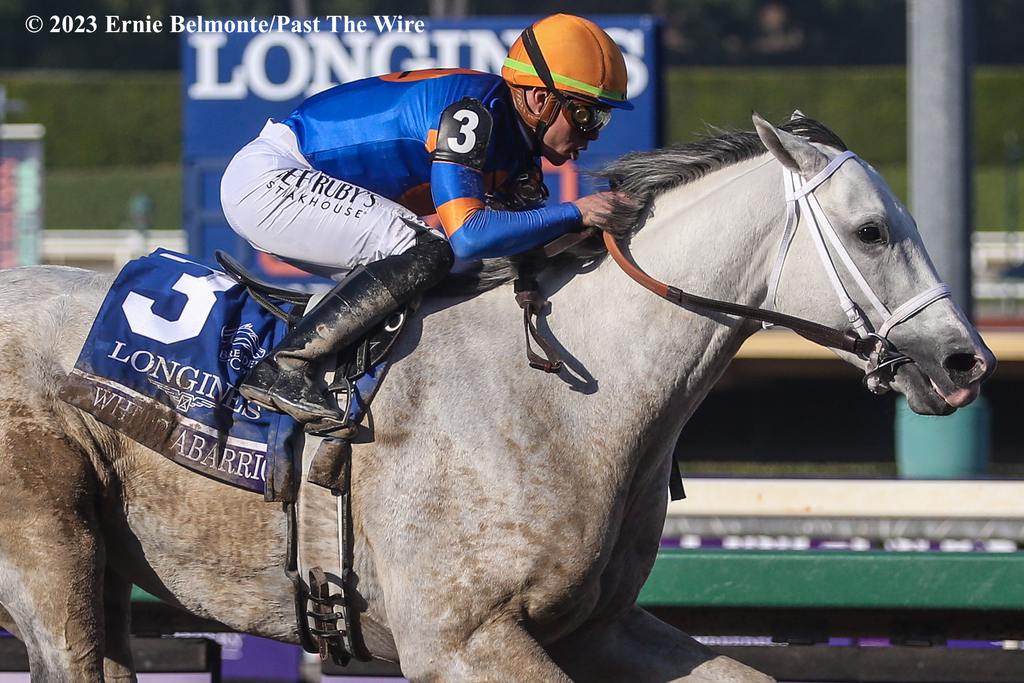
Nice shades, no comment: