


The Leak, The Noise, and The Pipeline
The Mystery Past Performances, Who, What, Where, Why, How and When
Let me start with something that comes without hesitation: I got part of this wrong the first time, and I want to correct it on the record before going further.
When images of what appeared to be past performances with embedded veterinary treatment records began circulating last week, my initial read was that this was regulatory data, records pulled from HISA’s system or InCompass and somehow leaked into the wild. That framing informed my first piece on this subject. Upon closer scrutiny of these custom past performances, I have to revise that read substantially. Not the conclusions about the leak itself, and not the horseplayer argument, those hold. But the nature of the document at the center of this story is different from what I first described, and the difference matters enormously.
These were not regulatory past performances in my view. They appear to be a custom, privately built handicapping product. And that changes the entire story. When I miss something that’s sitting right there in front of me, I own it and this one will get the scrutiny it deserves, all the way through.
What These Documents Actually Are
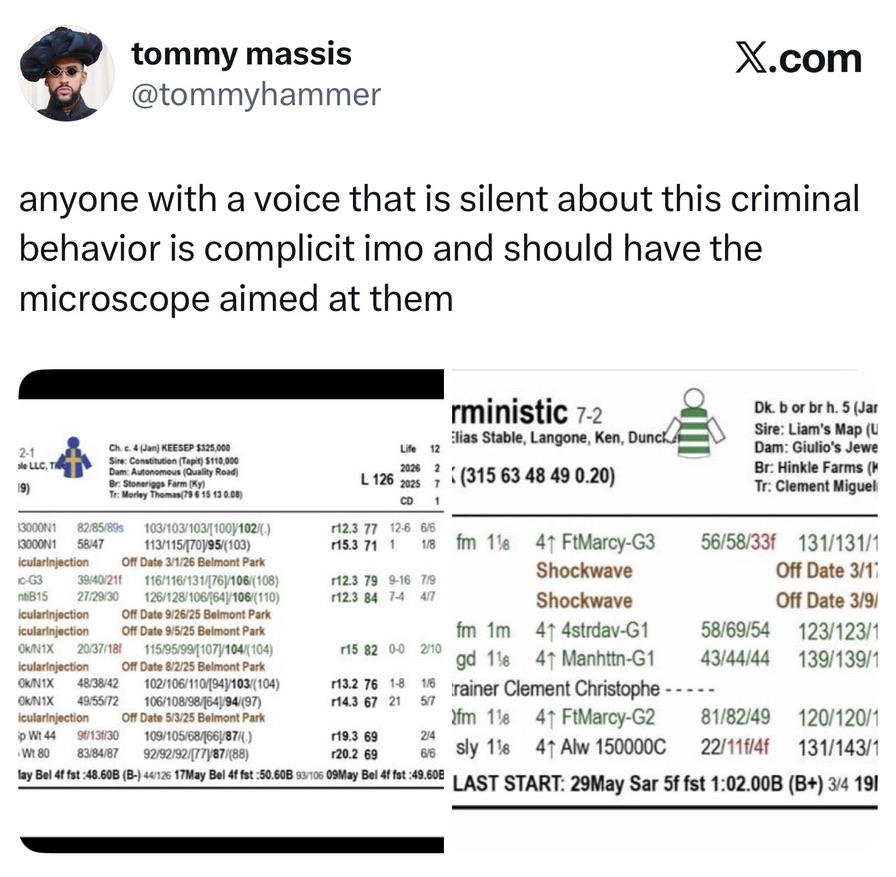
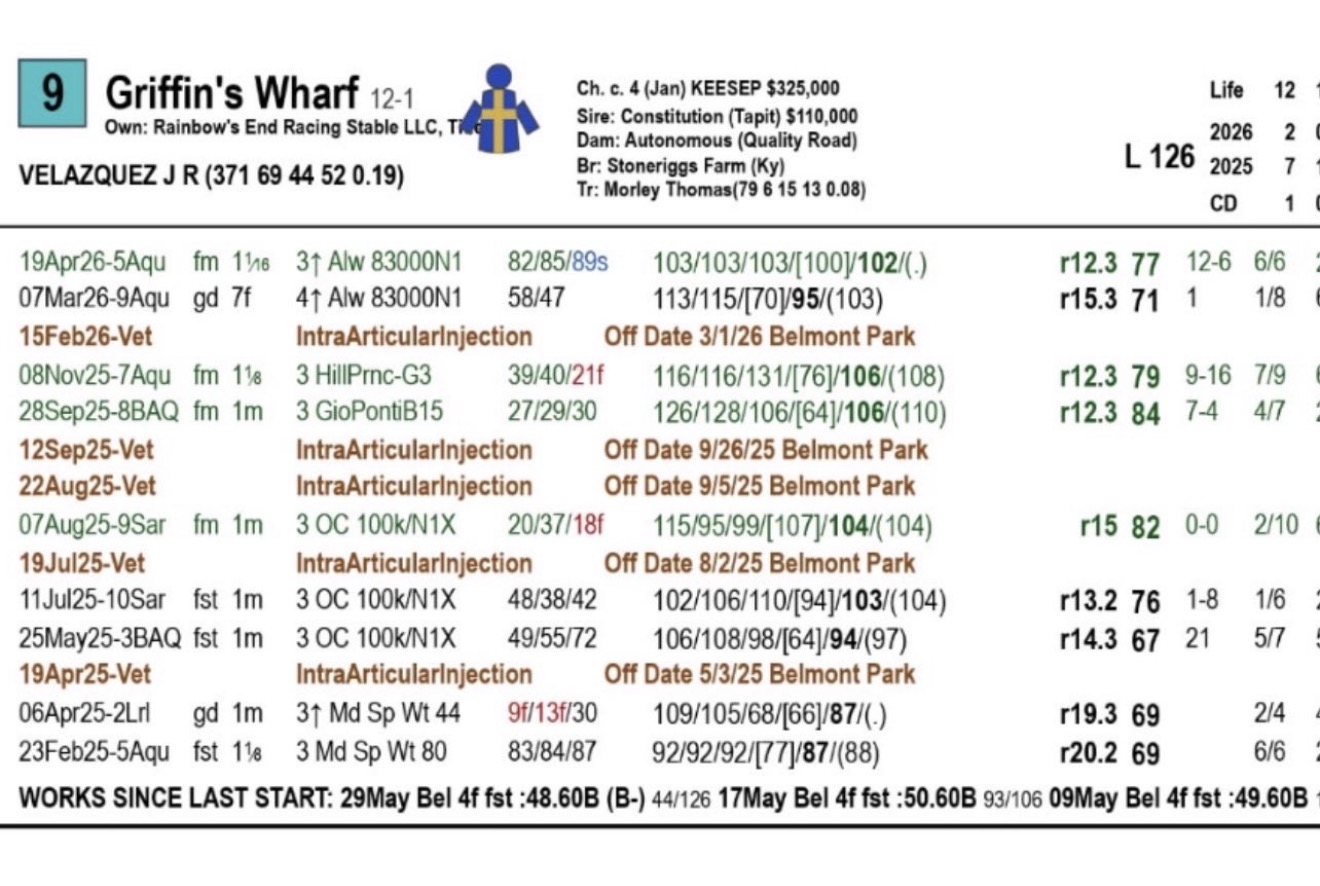
The second and closer look at the past performances tells the full picture. Look at what is actually in those running lines beyond the veterinary entries:
Ragozin figures, properly notated with condition symbols consistent with the Ragozin symbol sheet. Beyer-type speed figures in a separate column. Race shape numbers running on what appears to be a 99-point scale, lower figures in red indicating fast pace favoring closers, higher figures in blue indicating slow pace favoring speed. Workout rankings with field size context. Complete trainer and jockey statistics. Standard race lines. And then, inserted chronologically into the running lines precisely where a race would appear, veterinary events including intra-articular injections with treatment dates and off-dates.
Someone built what looks like a private handicapping product first. The veterinary data was imported into it as a field. This is not InCompass printing past performances. This is a sophisticated, resourced private PP construction and the vet data is one ingredient among many.
That changes the questions entirely. The question is no longer simply who leaked regulatory data. The real question is: who had access, who extracted it, who merged it, who consumed it, and who paid for it?
A Word on the Images Themselves
Before going further, there is something about these documents that deserves attention, because it speaks directly to how this material traveled.
The person who posted these images on social media, Justin Wunderler, under his X account @GhostOfSwiftHitter claimed they were screenshots of an iPad and that someone saw the past performances on a tablet, photographed the screen with another device, and sent the photos along. He may believe that. Having now reviewed multiple versions of these images at higher resolution, that story does not hold up. Also noted is sharing the “pictures” with this particular account guaranteed their leaking and winding up in plain social media view. By any standard the account is very active.
The Griffin’s Wharf PP in particular is razor sharp edge to edge. The text renders with perfect clarity across the entire image. The table corners are perfectly squared. The horizontal lines are perfectly parallel. There is no keystoning, the slight trapezoidal distortion you invariably get when a camera photographs a flat screen at even a minimal angle. There is no barrel distortion at the edges. There is no screen glare, no ambient light variation across the surface, and the blacks are true black rather than the slightly washed-out black that results from photographing a backlit display. The clarity holds at full resolution, which a genuine photograph of a screen, even a good one, even on a high-end phone, essentially never does once you look closely at character edges and pixel transitions.
What these images are is probably not a camera photograph of a tablet screen. What they look like is a native digital file, a PDF, a direct device screenshot, or a document transmitted electronically and then captured natively. I am not a forensic image analyst and will not overclaim on this point. But the visual characteristics are inconsistent with the stated provenance, and the inconsistency matters for a specific reason: if these documents were transmitted digitally rather than photographed off a screen, then whoever passed them along had the actual file. Not a glimpse of someone else’s display. The document itself, in digital form, shared person to person.
That is a meaningfully tighter chain of custody than the “someone saw it on an iPad” story suggests. Someone with the file sent the file. The social media poster may be the last link in that chain but the chain itself implies deliberate document transmission, not an opportunistic photograph. That question should be part of any serious investigation into how these materials traveled from wherever they originated to a public social media account.
The Connection Nobody Had Made Yet
Here is where this story took a sharp turn, and credit belongs to the X racing community for surfacing it. Industry voice Ed DeRosa connected something that had gone unnoticed: the two horses whose custom past performances were leaked, Griffin’s Wharf and Deterministic are trained by the husbands of two NYRA on-air personalities.
Griffin’s Wharf is trained by Tom Morley. His wife, Maggie Wolfendale-Morley, has served as NYRA’s paddock analyst since 2010 and is one of the most recognized voices on NYRA television broadcasts. Deterministic is trained by Miguel Clement, whose wife, Acacia Clement, also provides on-air commentary for NYRA racing coverage. Both women are fixtures of NYRA’s broadcast team, primarily covering New York racing.
DeRosa is right that this is worth flagging, and I want to be careful and fair about exactly what it does and does not suggest. Nothing here implies wrongdoing by either broadcaster, either trainer, or NYRA itself. There is no evidence at this point that either family had anything to do with how this information was obtained or distributed.
But here is what makes this more than a passing coincidence, and it is worth saying plainly: whoever built this product almost certainly did not generate custom past performances for only two horses. A tool incorporating Ragozin figures, Beyer-type figures, race shape analysis, workout grades, and veterinary history was built to operate at scale, across a large field of horses, likely an entire circuit or more. Out of what was presumably a much larger pool of available material, the two examples that made their way into public circulation both happen to be trained by the husbands of NYRA’s on-air talent.
That is a choice, not a coincidence of sampling. If someone is sitting on a deep library of these custom PPs and deliberately selected these two to push into public view, the question is no longer just who built the product, it is why these two horses were chosen to surface publicly, and what message, if any, that selection was meant to send, if any. It could be aimed at the broadcasters themselves. It could be aimed at NYRA more broadly, using personnel with public-facing recognition to maximize attention. It could be incidental to something else entirely that we do not yet understand. I am not going to pretend to know which of those it is. But the selective release pattern is itself a piece of evidence, and it deserves the same scrutiny as the data inside the documents. This is a thread Past The Wire is pulling, not dropping.
This Would Not Be the First Time
If the InCompass hypothesis holds up, it would not be the first time that system has been at the center of a New York racing scandal involving improperly shared information and that history is directly relevant here.
In 2018, the Daily Racing Form first reported that prominent New York trainer Linda Rice had received entry information and past performances of rival horses from a NYRA racing office employee, Jose Morales, who sent her past performances and the names of likely entries before they became public — in some cases enabling her to choose more favorable spots for her own horses before the competition was known. The New York State Gaming Commission’s investigation, which traced back to a broader 2014 inquiry into NYRA racing office personnel improperly sharing InCompass system access with horsemen and jockey agents, ultimately found Rice’s conduct to be “intentional, serious and extensive” and constituted “improper and corrupt conduct.” In May 2021, the Commission revoked her training license for a minimum of three years and fined her $50,000.
Rice appealed. The fight was lengthy, running through the New York court system for roughly two years and in June 2023 the Appellate Division of the New York Supreme Court ruled that while there was substantial evidence supporting the Commission’s underlying finding that Rice knew she was receiving improper information, the three-year license revocation itself was “so disproportionate to the offense and shockingly unfair as to constitute an abuse of discretion as a matter of law.” The court sent the penalty back to the Commission for reassessment, but explicitly barred any outcome involving license revocation. The Commission subsequently increased her fine to $100,000 in lieu of the revocation. Rice kept her license and has continued training since, turning in strong results in the years following the resolution of her case.
I want to be precise about what that history does and does not tell us. It does not mean today’s InCompass-sourced leak originated the same way, or involves the same kind of actors, or rises to the same level of conduct found in the Rice matter. What it does establish is that InCompass has, at least once before, been the system through which improperly obtained pre-entry and past performance information moved from a NYRA racing office employee into the hands of a horseman seeking a competitive edge and that the consequences for the receiving party, even when severe at the outset, can ultimately be substantially reduced on appeal. If this current matter is confirmed to have moved through InCompass, NYRA and The Jockey Club owe the industry a hard look at whether the structural vulnerability that enabled the Rice case has ever actually been closed, or whether it simply went quiet for several years before resurfacing in a different form.
The Pipeline: Five Lanes
Past The Wire is pursuing this investigation across five distinct lines of inquiry. Here is where each one stands.
Lane One: Identify the PP Skeleton
Before the vet data, what are these past performances? That is the fingerprint. The base product contains custom race-shape figures, a Beyer-type speed figure, what appear to be Ragozin figures properly notated, workout grades, trainer and jockey statistics, and standard race lines. Someone built this product independently of the veterinary data. The vet entries were added as an imported field, inserted chronologically into the existing framework.
This means the source is not simply a racing office employee printing something off a regulatory screen. It looks considerably more like a private PP builder, an existing product or service into which a veterinary data feed was integrated at some point.
The key question in Lane One: who in racing already receives or builds past performances in this exact format, without the veterinary lines? Find the skeleton and you are halfway home. That is a call to figure services, private PP builders, and clocker operations serving elite clients. Someone in that world will recognize this product immediately.
There is a related question on the proprietary figures themselves. Ragozin figures are not publicly available. They are sold to specific users under specific terms. If the figures embedded in these past performances are genuine Ragozin numbers and the notation is consistent with the Ragozin symbol sheet, then the question of whether those figures are appearing in this product with or without authorization from the Ragozin organization is a separate matter entirely, with its own legal implications. The same question applies to whoever produced the Beyer-type figures in the speed column. Past The Wire is pursuing both of those licensing questions directly.
Lane Two: Separate the Source from the Assembler
The person who accessed the veterinary data may not be the person who built the past performances. The person who built the past performances may not be the end consumer. And the person who posted this on social media is almost certainly none of the above.
Consider the possible structure: a source with authorized access to InCompass or EquiTAPS, a racing office employee, a regulatory vet, a track official, extracts treatment data, perhaps regularly, perhaps in bulk. A separate assembler incorporates that data feed into a pre-existing private PP product. A consumer, likely a high-volume wagering operation, CAW or private partnership of some sort receives and uses the finished product. And then somewhere downstream, someone posts it publicly on a social media.
The public leak on X may be the last rat in the sewer. The original extraction may be older, more professional, and quite possibly still ongoing. Those are radically different problems, and conflating them obscures both.
It is also worth noting and this connects directly to the image analysis above that the path from the original consumer to the social media poster almost certainly involved multiple hands. A document built for a serious wagering operation does not accidentally wander onto a social media account. Somebody in that chain made a decision to move it outward. Whether that was the original consumer, an intermediary, or someone who stumbled into possession of a file they did not fully understand is one of the more interesting questions in this story.
Lane Three: The “Why” Tells You the Customer
Nobody builds this product casually. The combination of Ragozin figures, Beyer-type figures, race shape numbers, workout grades, veterinary events, and complete formatted past performances represents a significant investment of time, data relationships, and resources. This was built for someone trying to model races at scale or make materially sharper decisions on a high volume of races.
That does not automatically prove a CAW operation is the consumer. But the design points toward a private wagering group, a high-volume player or syndicate, an owner or breeder intelligence product, or a private figure service serving elite clients. The most important question in Lane Three: was this generated for one race, one circuit, or every race run in America? If these past performances exist for New York horses only, the access point is probably a single track or circuit. If they are national in scope, you are looking at a sustained data operation that penetrated InCompass at a meaningful scale, batch queries, possible API access, regular extraction over time. That distinction changes the magnitude of what happened and who is responsible for it.
Lane Four: The InCompass Pressure Point
This is where The Jockey Club has questions to answer, and the silence from that organization since this story broke is itself a story.
InCompass Solutions, a technology company formed by The Jockey Club in 2001 to centralize software applications and systems serving North American racetracks and simulcast outlets, operates the central database through which racing office personnel, regulatory veterinarians, and track officials access horse eligibility and treatment information. EquiTAPS, launched in September 2022, enables users to submit veterinary treatment and procedure records to racing authorities for horses in their care and to give authorized parties in other jurisdictions access to those records. When required by HISA’s regulations, treatment and procedure information entered into EquiTAPS is automatically forwarded to HISA.
The data chain runs: trainer or veterinarian to EquiTAPS to InCompass backend to HISA portal, with authorized parties, regulatory vets, racing office personnel, state commissions, able to access records relevant to their function.
Past The Wire has submitted formal written inquiries to both The Jockey Club and InCompass/TJC Technology Services and is awaiting response. The questions submitted include the following, and the industry is entitled to public answers:
Who specifically can see veterinary list reasons within InCompass, not just eligibility status, but treatment details? Can racing office staff see those treatment details for horses at all jurisdictions, or only horses at their own track? Are downloads, exports, or batch queries logged and audited? Are there API endpoints, and if so, who has access to them and what volume controls govern their use? Has any authorized account shown abnormal access patterns? And most pointedly: why does a racing office need to see treatment details at all, rather than simple eligibility status?
That last question is the one without a clean answer. A racing secretary needs to know whether a horse is eligible to race. The answer is yes or no. There is no operational reason a racing office requires the specific drug or therapy administered, the date, the location, and the off-date. If InCompass is displaying that level of detail to racing office personnel across all jurisdictions, that is an architectural decision that created an unnecessary vulnerability. Whether it was exploited is the question under investigation. Whether it should have existed in the first place is a question The Jockey Club should have been asking long before this week and arguably should have settled for good after the Linda Rice matter exposed exactly how vulnerable that office-level access can be.
It is also worth noting that the InCompass RTO system’s own login page carries language reserving all data rights to their respective owners and identifying InCompass Solutions, The Jockey Club, and Equibase as data contributors. What those data rights protections mean in practice and whether they extend to the veterinary treatment records flowing through EquiTAPS is something the user agreement would clarify. Past The Wire has formally requested that document. We do not have it yet.
Lane Five: The Public Interest Split
The editorial position here should not get dragged to either pole of the “release everything” versus “release nothing” debate, because both poles miss the actual issue.
Unauthorized access to a private database is wrong regardless of what the data contains or who benefits. The horsemen whose horses’ treatment histories appear in these custom past performances have a legitimate grievance, not because the regulatory system recorded that information, which is the framework they operate under, but because someone appears to have used authorized access for unauthorized purposes. That is a violation of the system’s integrity regardless of whether the underlying data is sympathetic.
At the same time, bettors are right to care about the asymmetry this product represents. The retail horseplayer competing against an operation that may have had access to treatment histories for every horse in America is operating at a meaningful informational disadvantage. And the CAW angle while legitimate, must be proven, not assumed. The design of this product points toward a sophisticated consumer. That is not the same as proof.
The Jockey Club and InCompass have questions to answer about their own architecture. HISA has conducted its review and pointed the investigation elsewhere. The ball is in The Jockey Club’s court, and their silence is increasingly conspicuous.
The Horseplayer Reality Check — Revised but Holding
My original position that this information does not turn a loser into a winner requires some refinement in light of what we now know about this product, but the core of it stands.
For the retail horseplayer, the original argument holds. Knowing that Deterministic received Shockwave therapy twice before winning the Manhattan does not change the fundamental calculus of handicapping. The losing Shockwave horses still exist and still beat you. Successful horseplayers do not win because they have more data. They win because they know what to do with it and more critically, what not to do with it. I have fifty years of professional experience betting horses. Information alone does not a winner make.
But I need to be more precise about the other end of the spectrum. For a high-volume operation modeling hundreds or thousands of races systematically, every marginal data point has compounding value. That is precisely why someone built this product. A tool incorporating Ragozin figures, Beyer-type figures, race shape analysis, and veterinary history was not built for casual use. It was built to give a modeling operation a systematic edge across a large sample. Whether that edge is decisive in any single race is beside the point. Over volume, marginal advantages compound. The public does not have this tool, and there is a legitimate equity question in that asymmetry.
The more precise statement is this: this product was designed to help its consumer, and was almost certainly built for someone already sophisticated enough to use it. For that consumer, it likely does provide meaningful value at scale. For the 98 percent of horseplayers operating without it adding this information to their existing approach would not change their results materially, because information is not their fundamental problem.
The Legal Questions — Which Remain Open
This is where intellectual honesty requires the most care, because the answers are genuinely unsettled and anyone who tells you otherwise is overclaiming.
InCompass is a private system. Its login page carries language noting that data rights are reserved by their owners. EquiTAPS, per its public launch materials, provides access to authorized parties for regulatory purposes. Neither statement constitutes a public terms of service document specifying what authorized users may or may not do with what they access. What those agreements say matters enormously and we are pursuing them.
The primary federal statute governing unauthorized computer access, the Computer Fraud and Abuse Act, was significantly narrowed by the Supreme Court’s 2021 decision in Van Buren v. United States. The Court held that a person “exceeds authorized access” under the CFAA only when they access areas of a system they were not permitted to access at all, not when they access permitted areas for an improper purpose. In plain terms: a racing office employee with legitimate InCompass credentials who accesses veterinary treatment records within their permitted scope, then extracts and sells that data to a PP builder, may not have violated the CFAA under Van Buren even though what they did is obviously wrong. The access itself has to exceed what was technically permitted, not merely violate the purpose for which access was granted.
That does not mean no law was broken. Trade secret misappropriation, breach of contract, state computer crime statutes, and depending on jurisdiction racing commission regulations governing licensed personnel could all apply. New York’s “improper practices” regulation, the same provision underlying the Linda Rice case, forbids any improper, corrupt, or fraudulent act or practice in relation to racing, and courts have upheld its application to racing office information leaks. That regulation, not the CFAA, may end up being the more directly relevant instrument if a New York-licensed individual is found responsible here. Whether it applies to a racing office employee, a private PP builder with no racing license, or a wagering entity is a separate and unresolved question.
There is also the question of who else in the pipeline bears exposure. Even if the original extraction does not constitute a CFAA violation under Van Buren, the person who incorporated that data into a commercial PP product, and the entity that paid for and used it, may face different legal exposure depending on what they knew about how the data was obtained. Knowingly receiving and commercially exploiting data extracted from a private regulatory database is a different legal question than the extraction itself and one that has not been tested in this specific context.
And then there is the track employee question that nobody wants to say plainly: some people with authorized InCompass access are also bettors. That is simply a fact of the racing world. Whether an authorized user accessing treatment data for their own wagering purposes without exporting or selling it, constitutes a violation of anything is a question whose answer depends entirely on what the user agreement says, what racing commission rules apply, and whether Van Buren’s narrow reading of the CFAA provides cover. We do not know the answers yet. We are saying so clearly rather than pretending otherwise.
To be direct: this looks potentially serious. The InCompass breach hypothesis is the most supported by available evidence. Whether what happened is criminal, civil, or a terms of service violation and which specific laws govern which actors we do not yet know. What we know is that the questions need to be asked, and the people who can answer them owe the industry those answers.
Give Credit Where It’s Due
It needs to be said plainly: Lisa Lazarus, whatever one thinks of any individual position she has taken on this or any other issue, has been the only racing executive in this entire saga to step forward and address it directly, on the record, by name. She did not wait to be cornered. She did not hide behind a spokesperson. She answered the questions she was asked in the Ask HISA column hosted on TDN and produced by Dan Ross, and stated clearly that the HISA portal was not the source, and pointed the investigation toward where it most likely belongs. She did the same thing when we raised the Ortiz brothers cockfighting issue. Lazarus also appeared on the At The Races with Steve Byk and answered his questions.
Whether you agree with everything she said is beside the point. Immediate transparency, even imperfect transparency, is better than silence. The Jockey Club has had the same opportunity to step forward this week and has not taken it. That contrast is instructive, and it is consistent with a pattern this publication has tracked on other issues. Lazarus answers. Others go quiet. Industry stakeholders should notice the difference.
One More Question Nobody Is Asking
Buried in Lisa Lazarus’s Ask HISA response on TDN Monday was a disclosure that deserves considerably more attention than it has received: HISA is collaborating with Palantir to analyze its veterinary and safety data.
Palantir is not a neutral name. It is one of the most powerful and controversial data intelligence companies in the world, with deep roots in government surveillance, military intelligence contracting, and large-scale predictive analytics. Its involvement in racing data analysis is not inherently improper if Palantir’s tools help HISA identify injury patterns and save horses’ lives, that is worth examining on its merits.
But it is precisely the kind of disclosure that warrants follow-up questions, and Past The Wire will be asking them. What is the scope of HISA’s data-sharing arrangement with Palantir? What does Palantir have access to? What are the contractual protections on that data? And does the industry, the horsemen paying HISA assessments whose horses’ treatment records populate that database know their data is being analyzed by one of the most formidable surveillance technology companies in the world?
These are not accusations. They are questions. In the current environment, they are questions that need answers on the record.
What We Know, What We Don’t, and What Comes Next
What we know: Custom past performances were built incorporating proprietary Ragozin figures, Beyer-type speed figures, race shape analysis, workout grades, and veterinary treatment records including intra-articular injections and shockwave therapy, with treatment dates and off-dates embedded chronologically into the running lines. HISA’s portal is not the source, Lazarus confirmed this and the data discrepancies support it. The most likely source is InCompass, a system with a documented prior history of improperly shared racing office information in the Linda Rice case. The document was built as a private commercial handicapping product, not a regulatory printout. The image characteristics are inconsistent with the stated “iPad photograph” provenance and suggest the document traveled as a digital file. The two horses selected for public release so far are trained by the husbands of two NYRA on-air personalities — out of what was almost certainly a much larger available pool, which makes the selection itself look deliberate rather than incidental. The person who posted it publicly is almost certainly downstream from the original misconduct and appears to have had no understanding of what they were actually holding.
What we do not know: The identity of the source, the assembler, or the primary consumer. Whether the extraction was national or regional in scope. Whether it is ongoing. What InCompass’s terms of service actually prohibit. What specific laws if any were violated by which actors in the pipeline. Whether Ragozin and the Beyer figure operation are aware their proprietary figures appear in this product and whether their licensing agreements were honored. Why these two specific horses, out of a presumably much larger library, were chosen to surface publicly, and whether that selection was aimed at the broadcasters, at NYRA, or served some other purpose entirely. How many other custom products built on improperly extracted regulatory data may exist that have not yet surfaced publicly.
What comes next: Past The Wire has submitted formal written inquiries to The Jockey Club, InCompass, and TJC Technology Services and is awaiting response. We are pursuing the user agreement documentation. We are working to identify who builds past performances in this exact skeleton format. We are following the Palantir disclosure. And we will continue reporting this story wherever it leads, and without accepting silence from institutions that owe the industry a full accounting.
The scandal is not that the data exists. The scandal is that somebody may have had selective, unauthorized commercial access to it and may have been selling it. That is the whole ballgame. And we are just getting started.
Photos: @GhostOfSwiftHitter X account feed
Story will be updated as facts are learned.