

Jon Stettin
On June 22, 2026, the Indiana Fever beat the Phoenix Mercury 86 to 77 at Gainbridge Fieldhouse in Indianapolis. You probably did not hear about the score. You probably heard about the point.
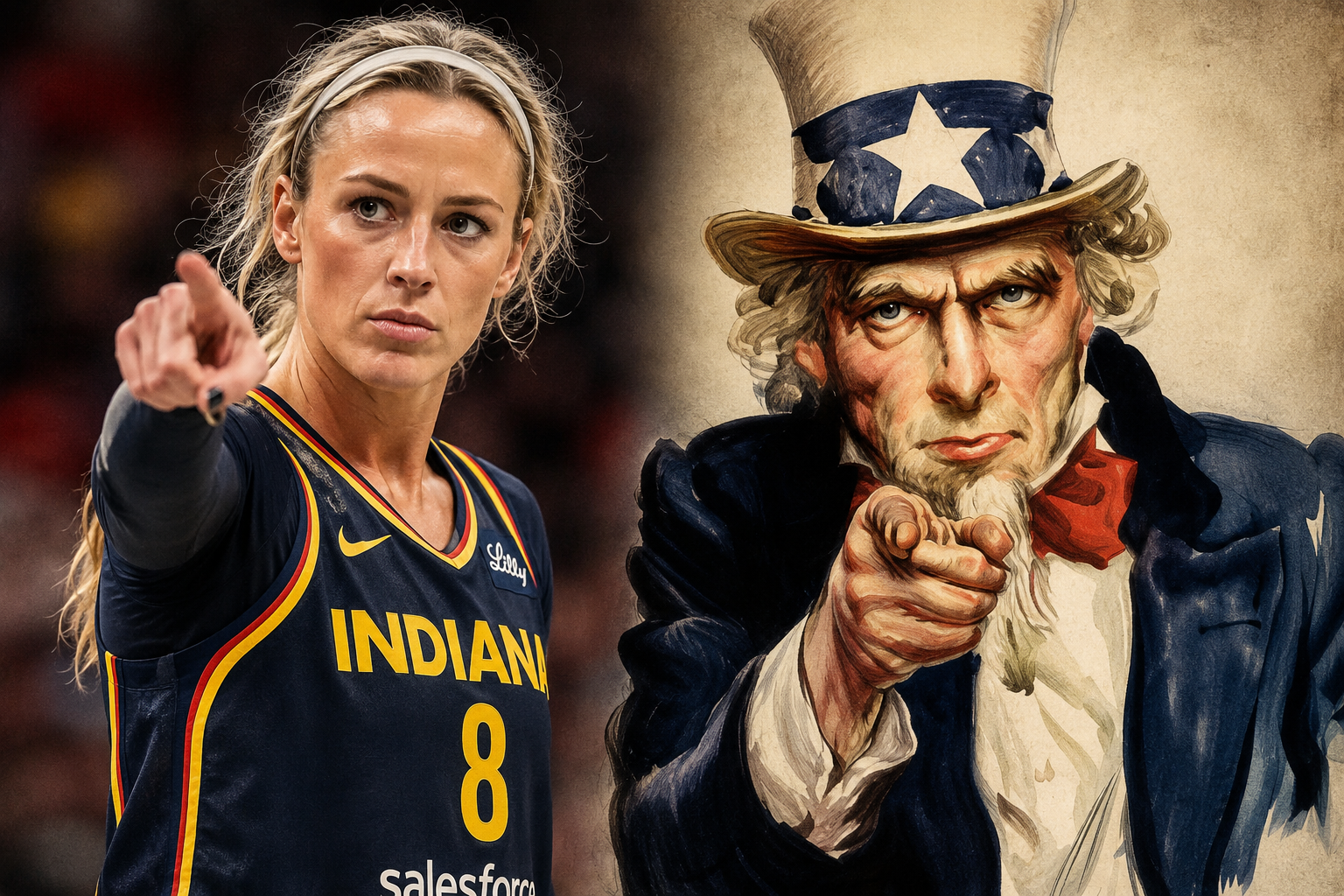
Late in the fourth quarter, Fever guard Caitlin Clark and Mercury forward DeWanna Bonner exchanged words following a foul. The officials assessed Clark a technical. Fever forward Sophie Cunningham walked onto the floor and asked the referee, calmly and plainly, why only Clark received one if Bonner had also done something extra. While she was asking the question she was pointing at Bonner. Bonner told her to stop pointing. Cunningham did not stop. For twenty-two unbroken seconds she held that finger extended, expressionless, not saying a word, following Bonner around the court with her eyes while five total technical fouls were assessed and one player was ejected.
The clip posted by a user named @JerryWatkins22 on X accumulated 31.6 million views in six days. Merriam-Webster used the image on their official account. The Atlanta Falcons used it. United States Senator Mike Lee used it to argue for legislation. ESPN anchor Pat McAfee called it a perfect response. Know Your Meme officially catalogued it. On her podcast, Cunningham called it the stupidest thing she had ever done and said she could not stop because the pointing was visibly working, that Bonner was losing composure while Cunningham stood there in silence doing absolutely nothing but indicate.
The biggest sports meme in America right now was not born because someone hit a game-winning shot. It was born because millions of people instantly recognized that something was not right.
That is not a coincidence. It is a diagnosis.
A Different Kind of Point
In 1917, illustrator James Montgomery Flagg created what became one of the most reproduced images in American history. He used his own face as the model, added the white goatee and the top hat, and painted Uncle Sam pointing directly outward at the viewer with the caption: I Want You for U.S. Army. Over four million copies were printed between 1917 and 1918. The image was revived for World War II. It became a permanent part of the American cultural vocabulary, used in political cartoons, advertisements, parodies, and protest art for more than a century afterward.
The point in that image was directed outward. It said: there is a shared challenge in front of all of us, and every one of us has a stake in the outcome. It did not matter what you looked like or where you came from. The tide was coming for everyone and the work to stop it belonged to everyone. It was a gesture of collective obligation at a moment when the country understood, however imperfectly, that individual survival and collective survival were the same thing.
The Cunningham point was directed inward. It said: I can see what you are doing, and I am the only one on this floor willing to say so out loud, because the people whose job it is to say so will not. It was not a call to unity. It was a call out. And it went viral across every platform and every demographic because millions of people who have never watched a WNBA game in their lives recognized the gesture immediately. Someone pointing at what everyone can plainly see but no authority will name.
We have traveled a considerable distance from one kind of point to the other. That distance is the story underneath this story.
What The Numbers Say
I want to be honest about where I am coming from. I do not have a rooting interest in the WNBA. I am not a league partisan. I am not trying to adjudicate the social debates that have surrounded Caitlin Clark’s presence in the league since the day she was drafted. I look at sports the way I have looked at horse racing, poker tables, and wagering markets my entire professional life. I follow the money, because money does not have an agenda. It does not post on X. It does not care about anyone’s narrative. It simply reflects what people value. And right now the money in women’s basketball is screaming one name, while the institution benefiting from that name seems determined to look the other way.
Before Caitlin Clark arrived in the WNBA, the league averaged 462,000 television viewers per game. In her rookie season in 2024, games across ABC, ESPN and CBS tripled to an average of 1.32 million viewers. ESPN alone posted a 170 percent increase in WNBA viewership, from 454,000 per game to 1.2 million. NBA TV increased 346 percent. The 2024 WNBA All-Star Game drew 3.4 million viewers, an increase of 305 percent over the prior year. The 2024 NCAA championship game Clark played in drew 18.9 million viewers, the first women’s title game in history to outdraw the men’s.
Attendance in 2023 averaged 6,615 fans per game. In 2024 it averaged 9,807, a 48 percent increase and the highest figure in 22 years. The league went from 45 sellouts in 2023 to 154 in 2024, a 242 percent increase. All 12 WNBA teams saw at least double-digit year-over-year attendance growth. Merchandise sales across WNBA platforms and flagship locations were up 601 percent from 2023. League Pass subscriptions grew 366 percent. The 2025 season set an all-time attendance record of 2,501,609 fans, surpassing a mark set in 2002 when the league had 16 teams and more games to do it.
In 2025, even while Clark missed 13 of her team’s first 26 games due to injury, the league averaged 794,000 viewers per nationally televised game, a 21 percent increase over 2024’s already historic full-season average. Non-Fever games alone were up 37 percent year over year. The tide had lifted every boat in the harbor, including the boats belonging to players who spent two years making her tenure as difficult as possible.
The WNBA’s previous media rights deal paid the league $43 million per year. The new deal, which began taking shape in July 2024 and now stands at $3.1 billion total, pays the league $281 million per year. That is 6.5 times the previous figure. Franchise values that averaged $96 million in early 2024 now average $460 million. The Golden State Valkyries, admitted to the league for a $50 million expansion fee, are valued today at one billion dollars. Expansion fees for franchises entering the league in 2028 through 2030 have reached $250 million, a 400 percent increase in entry cost in under two years.
A rising tide raises all boats. That is not a metaphor in this case. It is a balance sheet.
What The Players Did With It
Caitlin Clark is a straight white woman in a league that is predominantly Black and LGBTQ. That is a fact, not an accusation, and stating it plainly is not an indictment of anyone’s identity or experience. It is the context without which the behavior of a significant portion of the league’s players cannot be honestly explained.
In her rookie season in 2024, Clark absorbed five flagrant fouls, representing nearly 17 percent of all flagrant fouls called in the entire league that year. Chicago Sky guard Chennedy Carter delivered a shoulder and hip check away from the ball on an inbound play while Clark was not holding it. No foul was called on the floor. The league upgraded it to flagrant-1 the following day after public pressure. Diamond DeShields charged into Clark at full speed like a linebacker and sent her sliding across the hardwood. She shrieked in pain. Flagrant-1 on review. DiJonai Carrington left Clark with a black eye. Marina Mabrey shoved her and received a technical on the floor, which the league upgraded to flagrant-2 the next day only after the video circulated widely. On June 24, 2026, Phoenix Mercury forward Alyssa Thomas pressed her closed fist against Clark’s throat during a loose ball scramble while Clark was on the floor. No foul was called. The league retroactively assessed a flagrant-2 and a one-game suspension after national outrage reached a volume the office could not ignore.
The pattern across three seasons is documented and consistent. No call on the floor. Public outrage. Retroactive upgrade the following day. The league acting only when the alternative is worse than the action. Fever coach Stephanie White said after the Thomas incident that her team had a generational talent and a WNBA superstar who had taken two cheap shots in a single game that went uncalled, and that this type of thing happens every single game. Cunningham, on the same podcast episode where she explained the pointing meme, said the league and its referees do absolutely nothing to protect Clark, that the targeting is deliberate, and that the WNBA is failing its own most valuable asset every night it takes the floor.
Players can resent whoever they want. Competitors are not required to think like economists. Commissioners are.
Great commissioners do not create stars. They recognize them before everyone else does. That is David Stern. That is Pete Rozelle. That is Dana White. That is every executive who built a lasting sports enterprise on the back of a transcendent talent and had the institutional clarity to understand that protecting the star was not favoritism. It was stewardship.
Imagine if David Stern had watched Magic Johnson get repeatedly fouled out of games while officials shrugged, and then responded to the public outcry by issuing statements condemning criticism directed at the players committing the fouls. It is unimaginable. Not because Stern was a saint. Because Stern understood the difference between a problem and an asset, and he was not confused about which one Magic Johnson was.
Commissioner Cathy Engelbert allowed officiating to drift for three seasons without meaningful intervention. She addressed it only after Minnesota Lynx star Napheesa Collier delivered a pointed public rebuke at the end of the 2025 playoffs. Not after Carter. Not after DeShields. Not after Thomas put a fist in Clark’s throat. After Collier. The league’s official response to Thomas punching Clark in the throat was a statement vehemently condemning hate directed at Thomas and the Mercury. It did not address what Thomas had done to Clark or whether the league intended to protect its biggest star going forward. It is difficult to name another professional sports league that has appeared more uncomfortable with the success of its own most valuable player than with the conduct of the players targeting her.
The league created conditions in which a significant portion of its players convinced themselves that Clark’s popularity is illegitimate because of what she looks like rather than what she does, and that undermining her is a form of justice rather than a form of self-sabotage. That belief has cost every one of them money. It cost them more money during the seasons they were taking those shots than they will ever be able to calculate.
The woman who generated the commercial wave that lifted every salary in that league earned $78,066 in 2025 while absorbing a fist to the throat with no live call on the floor.
The History They Are Ignoring
The new WNBA collective bargaining agreement, reached in March 2026, has been called one of the most transformational labor deals in major professional sports history. The league minimum salary went from $64,000 to $277,500. The new minimum is higher than last year’s supermax of $249,000. The overall salary cap went from $1.5 million per team to $7 million. Angel Reese, one of the players most visibly antagonistic toward Clark since their college rivalry, saw her salary go from $75,000 to $350,000. Chennedy Carter, who delivered the hip check that launched three seasons of controversy, had her salary floor lifted by the same wave. Every player who took a hard shot at Clark on the court or a subtle shot at her off it is making significantly more money today because of the commercial infrastructure Clark built.
There is a historical precedent for exactly this situation, and the people running the WNBA should know it by heart because it involves the league that owns them.
In the late 1970s the NBA was in genuine crisis. Franchises were folding. Television ratings had collapsed badly enough that the 1980 NBA Finals between the Los Angeles Lakers and the Philadelphia 76ers were broadcast on tape delay. The league was losing money and losing relevance simultaneously. Then Magic Johnson and Larry Bird arrived, two players who genuinely did not like each other, who represented genuinely different Americas, and whose rivalry carried a cultural charge that made every game they played feel like something larger than basketball. The NBA did not manage that rivalry down. It did not issue statements about the divisiveness of the Bird-Magic dynamic or form task forces to ensure neither player received disproportionate attention. It built a commercial empire around them. Then it did the same thing with Michael Jordan. Then Kobe Bryant. Then LeBron James. Every successful era in NBA history has been built on the same understanding: transcendent stars are not accidents to be managed. They are opportunities to be seized.
The WNBA has its transcendent star. She arrived pre-built, with a following developed over four years of college basketball that shattered viewership records and made her a household name before she played a professional minute. She walked in the door and tripled the television audience in her first season. She missed half of her second season to injury and the numbers still went up 21 percent. She is, by every measurable standard, the most impactful arrival in the history of women’s professional basketball. And the league has spent three years retroactively upgrading the fouls committed against her the morning after they happen.
The poker analogy is instructive here alongside the basketball one. The WNBA has spent thirty years trying to market itself as a skill game to an audience that was not watching. Clark did not market the skill game. She played it at a level that made the argument make itself, the same way Chris Moneymaker did not persuade anyone that poker was compelling. He just won the World Series of Poker as an amateur on television with a hole card camera showing every viewer exactly what he was thinking, and fifty million people decided they wanted to learn the game. You cannot manufacture that. When it appears, you protect it. You build around it. You do not let it absorb a fist to the throat and issue a statement defending the person who threw the punch.
Arithmetic does not negotiate with narrative. Neither does history. The NBA learned both of those lessons forty years ago. The WNBA is still taking the test.
What The Point Means
James Montgomery Flagg’s Uncle Sam pointed outward in 1917 at a shared external threat and said every one of us has skin in this game. The image worked because the country it was made for still had enough shared civic vocabulary to hear that message and respond to it. You could disagree about everything else and still understand that a rising threat required a collective answer, that what happened to one affected what happened to all, that individual fate and collective fate were not separable things.
That vocabulary has eroded considerably. What we have now is a culture organized around competing narratives, each one sealed enough that the arithmetic visible from outside it is invisible from within. The WNBA players who targeted Clark did not see themselves as undermining their own salary structure. They saw themselves as resisting an illegitimate coronation. The league that failed to protect her did not see itself as sacrificing a billion-dollar asset. It saw itself as navigating a minefield carefully enough to avoid a worse explosion. The media apparatus that framed every incident as a Rorschach test about race and identity was not wrong that those things were present. It was wrong that those things were the story, because the story underneath all of it was arithmetic, and arithmetic does not negotiate with narrative.
Sophie Cunningham did not set out to make the defining sports meme of 2026. She walked out onto a basketball floor and pointed at something everyone in that arena could see while the people whose job it was to call it refused to. She kept pointing for twenty-two seconds because the pointing was working, because it was the one thing she could do that required no authority to be granted and no institutional approval to deploy. She had a finger and she had standing and she used both.
Merriam-Webster used that image. A United States Senator used it. Brands and franchises across every sport used it. Millions of people who do not know what a flagrant-2 foul is recognized the gesture and made it their own, because the gesture is universal. It is what you do when the institution will not move and the thing being ignored is sitting right there in plain sight.
That is what the WNBA has produced in three seasons of mismanaging its greatest asset. Not a scandal. Not a rivalry. A gesture that the entire internet recognized as the appropriate response to watching authority look the other way.
History remembers its famous points. Uncle Sam pointed outward at a nation in 1917 and asked it to come together around a shared threat, to recognize that what happened to one of us would happen to all of us. Sophie Cunningham pointed inward at an institution in 2026 that could not recognize its own good fortune, at a league that had been handed the most valuable asset in the history of women’s professional sports and responded by allowing that asset to be punched in the throat while the referees watched.
One became a recruiting poster. The other became a meme. Different centuries. Different gestures. Same finger. Entirely different understanding of what serves the greater good.
The WNBA is not unique in this failure. It is just a small, clear, well-documented version of something much larger, playing out in real time on hardwood floors in front of cameras that catch everything and officials who review the tape only when the public demands it. Institutions across American life have become so consumed by the narratives inside them that they lose sight of the obvious thing standing right in front of them. The obvious thing in this case is a player who built a billion-dollar commercial wave, absorbed three seasons of targeting, and keeps showing up and making the next basket.
Caitlin Clark will keep playing. The numbers will keep going up. And somewhere in a league with a $3.1 billion media deal built substantially on the back of one player it cannot figure out how to protect, a commissioner will keep releasing statements about hate directed at the people who hurt her, while the player who generated all of it takes her next shot, gets up off the floor, and makes it.
That is not a culture war. That is a business catastrophe dressed up as one. And until the people running that league can see the difference, the point will keep standing, silent and extended, at something everyone can see.
An index finger is ultimately more powerful than a middle finger. Uncle Sam’s point reminded us how great we can be when we are united. Sophie’s point reminded us how broken we become when we choose to be divided.