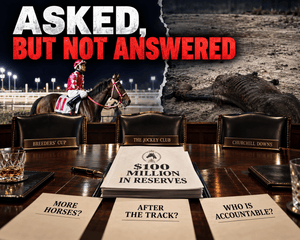



Everett Dobson personally replied to a prominent owner who called him a fraud. He has not replied to Past The Wire. The difference tells you everything.
Editor’s Note: This is a follow-up to “Hold Us To It,” published June 14, 2026, which documented that Dobson’s promise of a personal response to every email had not been fulfilled after PTW emailed him directly on June 3. Since publication, new information has come to light that materially advances the story.
Three days ago, Past The Wire documented something simple. Everett Dobson, the new Chair of The Jockey Club, had published his personal email address and made an explicit promise: every message would receive a response. We emailed him. We received an autoresponder from a managed institutional inbox. We waited. Nothing came.
We published the record. The sequence. The silence.
Today, new information landed in our inbox, forwarded to us by someone in the industry who was watching and it changes the story in one significant way.
Everett Dobson does respond to emails. Just not to ours.
WHAT WE NOW KNOW
On June 4, 2026, the day after Dobson published his letter, a prominent California owner named Jerry Jamgotchian sent an email to everett@jockeyclub.com. He copied it to a dozen industry figures: Frank Angst at the Blood-Horse, the Thoroughbred Daily News, the Daily Racing Form, Ray Paulick, Mike Ziegler at Churchill Downs, and others.
The email was not diplomatic. Jamgotchian, a multiple graded stakes winning owner with 30 years in the game and nearly $10 million in career earnings told Dobson directly that he had no confidence in The Jockey Club, that TJC and the Breeders’ Cup were focused on extracting money from the sport while ignoring the people who sustain it, and that racing was on a path to ending up like dog racing. He called Dobson’s letter years too late and purely a PR response to Mike Repole’s pressure campaign. He said hope is not a business strategy.
It was, by any measure, a harsher and more confrontational communication than the professional press inquiry Past The Wire submitted.
On June 17, 2026, Everett Dobson personally responded to Jerry Jamgotchian. The reply read:
“Hi, Jerry, thanks for your email. I came into this job last July with the expectation to improve the sport of thoroughbred racing and breeding. I hope to someday earn back your confidence.”
Thirteen words of substance. His name at the bottom. A personal reply.
Past The Wire has received nothing.
THE SIGNIFICANCE OF THE DISTINCTION
We want to be precise here, because precision is what separates accountability journalism from score-settling.
We are not arguing that Dobson should not have responded to Jamgotchian. He should have. Jamgotchian is a major owner with a legitimate grievance and he deserves engagement. The response, however brief, was the right thing to do.
What we are documenting is what the response reveals: Dobson is capable of personal replies. He is choosing who receives them.
The criteria for that choice are now visible. Jamgotchian’s email was sent with a dozen industry witnesses copied. It was scorched earth. It named specific failures, compared the organization to a dying sport, and told the Chair of The Jockey Club to his face that he should step down. It carried the implicit weight of a public statement dressed as private correspondence.
Past The Wire submitted a professional press inquiry to the address Dobson himself published, in direct response to the promise he personally made, from an outlet that has covered The Jockey Club’s governance and finances for years.
The owner who threatened to quit the sport got a personal reply. The journalist who asked questions got an autoresponder.
That is not a coincidence. That is a policy.
THE JAMGOTCHIAN EMAIL IS ALSO A DOCUMENT
Beyond what it revealed about Dobson’s response habits, the Jamgotchian email itself is worth reading carefully. It is not the complaint of a casual observer. This is a man who has owned horses for three decades, who watched the California market deteriorate track by track, who stopped racing in California nearly ten years ago and says he will soon stop racing altogether.
He makes specific allegations: that TJC and the Breeders’ Cup extract money from the sport, invest it externally, and return nothing of substance to the participants who generate it. He cites reduced data fees, registration fees, Breeders’ Cup ticket prices, purse assistance, and PETA confrontation as things the organizations could do but don’t. He identifies HISA, which The Jockey Club had a hand in creating as a mechanism that has reduced owners, trainers and breeders and closed racetracks.
These are serious charges from a credentialed participant. Dobson’s thirteen-word reply did not address a single one of them.
That is fine, as far as it goes. A 200-word screed deserves acknowledgment, not a dissertation. But it does raise the question of whether the response was engagement or management, whether Dobson replied because he wanted to address Jamgotchian’s concerns, or because he wanted to close a loop that had been copied to the Blood-Horse and the Daily Racing Form.
We don’t know the answer to that. We report what we can document.
THE CAW THREAD
One additional element of the forwarded correspondence deserves mention. A separate writer identified only as Andy, who is with permission, Andy Asaro, forwarding the chain to Jamgotchian included a detailed analysis of Computer-Assisted Wagering and the tote system’s exploitability. The note closed with a direct challenge: stop betting on horse racing until the industry addresses the structural disadvantage imposed on retail bettors.
Past The Wire has covered CAW extensively, the Dickey v. Stronach litigation, NYRA’s guardrail implementation, the O’Rourke interview, the economics of pool concentration. The argument Andy makes, that CAW operators effectively receive a rebate on every wager while also getting to bet last, the equivalent of a poker player holding the button every hand is not a fringe position. It is a structural critique that NYRA itself acknowledged when it implemented its minute-to-post restrictions.
What connects the CAW thread to this story is simple: these are the voices Dobson said he wanted to hear from. Industry participants with specific grievances, documented evidence, and proposals for change. The inbox is open, he told us. Every message will receive a response.
The inbox, it turns out, is more carefully managed than that.
WHERE THIS STANDS
Past The Wire emailed Everett Dobson on June 3, 2026, the same day his letter was published. We received an automated acknowledgment. We have received nothing since.
Jerry Jamgotchian emailed Dobson on June 4, 2026. He received a personal reply, June 17, thirteen days later, but a reply nonetheless.
We are now on day fifteen.
We will continue to report what the record shows. The record, at the moment, shows a Chair who promised to respond to everyone and is responding to some. It shows an institution whose public posture of openness and whose actual communication habits remain, as they have always been, two different things.
Dobson told Jamgotchian he hoped to someday earn back his confidence.
Earning back confidence starts with keeping promises. All of them. Not the ones that come with a carbon copy list.
it is what it is: