

Every Major American Sport Has Faced This Question. Every One of Them Answered It the Same Way. Not Horse Racing
The Kentucky Horse Racing and Gaming Commission has a privilege that no other racing regulator in the world shares. They govern the Kentucky Derby. Not just any race, the race. The one everybody knows The most exciting two minutes in sports. Not horse racing. Sports. The Super Bowl has a halftime show. The Derby has two minutes and a nation holds its breath.
That privilege comes with a responsibility that should be inspiring. To be the benchmark. To set the standard. To lead this sport the way the Derby leads every other race ever run.
In November 2025, the KHRG had the opportunity to be exactly that.
They were not.
In 1963, NFL Commissioner Pete Rozelle suspended two of the most celebrated players in professional football. Paul Hornung had won the Heisman Trophy, the NFL MVP, and was the centerpiece of the Green Bay Packers dynasty. Alex Karras was the most dominant defensive player in the game. Their careers, their legacies, and their livelihoods were placed on hold for an entire season.
Rozelle was explicit about why. He was also explicit about what the evidence did not show.
“There is absolutely no evidence of any criminality. No bribes, no game-fixing or point-shaving.”
NFL Commissioner Pete Rozelle, April 17, 1963
No criminality. No fixed games. No corrupted outcomes. And yet two of the NFL’s biggest stars were suspended for a full season, because Rozelle understood something that racing’s regulators appear to have forgotten sixty-three years later.
“This sport has grown so quickly and gained so much of the approval of the American public that the only way it can be hurt is through gambling. I considered this in reaching my decision.”
Commissioner Pete Rozelle, 1963
The only way it can be hurt is through gambling.
That principle has governed professional sports in America for more than six decades. It has been invoked by commissioners across every major league, applied to the biggest stars in their sports, and upheld without apology even when no criminal conviction existed and no game was compromised. It is not a novel legal theory. It is the foundational standard of professional sports integrity.
The Kentucky Horse Racing and Gaming Corporation had that standard available to them in November 2025. They had the regulatory framework to apply it. They had the evidence to support it. They had the explicit authority under Kentucky Rule 809 KAR 10:008 to act on conduct alone, without any criminal predicate whatsoever.
They conducted a review that produced no written report, left no documented findings, and resulted in no action. They responded to seven specific questions from Past The Wire with four sentences that answered none of them.
What follows is the record of what other major professional sports did when faced with the same question. And then what the KHRG did.
1963: Rozelle and the Standard That Started It All
The Hornung-Karras suspensions were not just disciplinary decisions. They were a statement about what professional football would and would not tolerate made at the precise moment the NFL was ascending to cultural dominance in America. Rozelle understood that the sport’s growing popularity made it a target. That the integrity of the wagering markets surrounding it was not a legal formality but an existential concern.
He acted without a criminal conviction. He acted without compromised games. He acted because association with gambling was itself incompatible with participation in professional football. The suspensions lasted a full season. Both players were ultimately reinstated. Both were eventually inducted into the Pro Football Hall of Fame. The standard Rozelle established that day has never been walked back.
1989: Baseball and Pete Rose
Pete Rose is perhaps the most debated disciplinary case in American sports history, and reasonable people disagree about whether the punishment fit the conduct. Past The Wire will not relitigate that debate here.
What is not debatable is the institutional principle Commissioner Bart Giamatti applied. Baseball determined that the integrity of its product was more important than the personal achievement of one of its most revered stars. Rose had more hits than any player in the history of the game. He was, by any measure, one of the greatest to ever play it. Baseball banned him for life anyway, because the sport concluded that no individual achievement, however extraordinary, superseded the obligation to protect the integrity of the game.
That is not a statement about Pete Rose. It is a statement about the standard.
2007: Goodell, Vick, and the Gambling Dimension
When NFL Commissioner Roger Goodell suspended Michael Vick indefinitely in August 2007, the facts before him included a federal guilty plea, an admitted dogfighting enterprise, and the killing of animals. The conduct was severe by any measure. But what Goodell wrote in his suspension letter has received far less attention than it deserves because it speaks directly to the situation in horse racing today.
Goodell did not suspend Vick solely for the cruelty. He suspended him because of the gambling.
“Your admitted conduct was not only illegal, but also cruel and reprehensible. Your team, the NFL, and NFL fans have all been hurt by your actions.”
NFL Commissioner Roger Goodell, letter to Michael Vick, August 24, 2007
“Your plea agreement and the plea agreements of your co-defendants also demonstrate your significant involvement in illegal gambling. Even if you personally did not place bets, as you contend, your actions in funding the betting and your association with illegal gambling both violate the terms of your NFL Player Contract and expose you to corrupting influences in derogation of one of the most fundamental responsibilities of an NFL player.”
Commissioner Roger Goodell, letter to Michael Vick, August 24, 2007
Read that language carefully. Even if you personally did not place bets. Association with illegal gambling alone, funding it, being connected to it, was sufficient to constitute a violation of the most fundamental responsibilities of an NFL player. Goodell did not require Vick to have personally wagered. He required only that Vick’s association with an illegal gambling enterprise was documented.
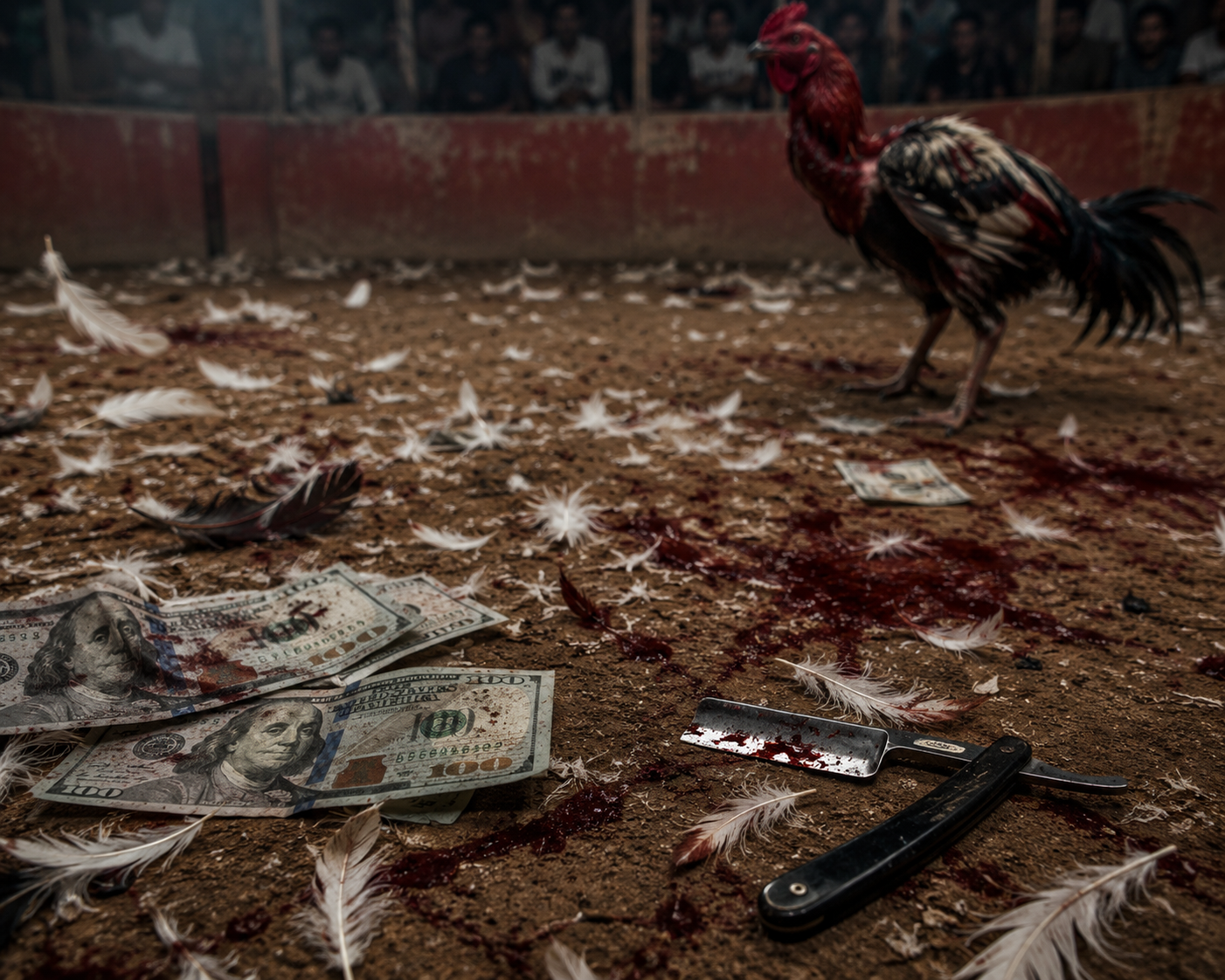
Cockfighting is not incidental to gambling. It is a cash-driven, illegal gambling enterprise. Peer-reviewed academic research including Dr. Fred Hawley’s foundational criminological study of cockfighting subculture published in Society and Animals — documents that organized cockfighting events are inseparable from the wagering that surrounds them. The gambling is the engine. The birds are the mechanism.
There is video evidence of the Ortiz brothers at cockfighting events. There are public statements describing cockfighting as a passion. There is documented promotional involvement. Under the standard Roger Goodell applied in 2007 not personal betting required, association sufficient the KHRG had more than enough.
Goodell acted. The KHRG did not.
2019 and 2022: Shaw, Ridley, and No Criminal Predicate Required
In 2019, the NFL suspended cornerback Josh Shaw indefinitely for betting on NFL games. No criminal charges were filed. No game was compromised. Conduct alone was sufficient. Shaw received the longest active suspension in NFL history at the time.
In 2022, the NFL suspended wide receiver Calvin Ridley for an entire season for betting on NFL games during a five-day period while he was away from his team on the non-football illness list. He bet a total of $1,500. No criminal charges. No compromised games. No inside information used. The NFL’s own investigation confirmed none of those aggravating factors were present.
Goodell suspended him anyway. His letter explained why in terms that have direct application to what the KHRG faced in November 2025.
“There is nothing more fundamental to the NFL’s success and to the reputation of everyone associated with our league than upholding the integrity of the game. This is the responsibility of every player, coach, owner, game official, and anyone else employed in the league. Your actions put the integrity of the game at risk, threatened to damage public confidence in professional football, and potentially undermined the reputations of your fellow players throughout the NFL. For decades, gambling on NFL games has been considered among the most significant violations of league policy warranting the most substantial sanction.”
Commissioner Roger Goodell, letter to Calvin Ridley, March 2022
No criminal charges. No compromised games. No inside information. Full season suspension. The integrity of the market was sufficient grounds. The threat to public confidence was sufficient grounds. The potential damage to the reputations of fellow players was sufficient grounds.
The Ortiz brothers are not peripheral figures in racing. They are two of the most prominent jockeys in the sport. Their riding decisions shape wagering outcomes in every race they enter. The reputations of every clean competitor who rides against them, every trainer who puts them up, every owner who hires them, every bettor who handicaps a race they are in all of those reputations are connected to the standards the KHRG enforces. Or does not enforce.
What Makes Racing’s Failure More Consequential
Every comparison above involves a sport acting to protect the integrity of external gambling on its product. Bettors wagering on NFL games. The league acting to ensure those bettors could trust the product.
Horse racing is not analogous to those sports. It is categorically different and the KHRG’s failure is therefore more consequential, not less.
The KHRG is not only a racing regulator. It is a gaming regulator. Its statutory mandate is the integrity of pari-mutuel wagering in Kentucky. The sport does not exist separately from the wagering. The wagering is the sport’s economic foundation, its regulatory justification, and its social contract with the public. The participants whose conduct is at issue are the literal product on which legal bets are placed.
Former MLB Deputy Commissioner Fay Vincent identified the core principle with precision. The reason gambling integrity matters, Vincent said, is this: if you fix the games, if you rig the outcome, what fan is going to care about the result? In racing, that question is not abstract. The result is a wagering event. The fan is a bettor. The integrity of the result is the entire transaction.
The NFL acted to protect external gambling markets. The KHRG exists to protect internal ones. The obligation is not analogous. It is greater. And the KHRG is the same entity that cleared the two jockeys whose conduct is at issue. The regulator and the gaming authority are one and the same. That conflict has never been acknowledged, addressed, or explained.
The KHRC’s Response — and What It Didn’t Say
Past The Wire submitted seven specific questions to the KHRG’s senior leadership on May 21, 2026 specifically; President and CEO Jamie Eads, Chief Legal Officer Ashleigh Bailey, Chief Enforcement and Investigations Officer Carlton Shier, Director of Enforcement Paul Brooker, and VP of Racing and Chief State Steward Barbara Borden, who ran the original investigation.
The questions covered the following:
- The basis for the KHRG’s determination under Rule 809’s conduct clause — specifically, why video evidence, public statements, and promotional involvement did not constitute conduct against the best interests of horse racing.
- Why no written investigative report was produced and what was said in the stewards’ meeting with the Ortiz brothers.
- Whether the KHRG made an independent legal determination regarding federal law, or treated the absence of criminal charges as dispositive.
- How the KHRG reconciles its inaction with its obligations as a gaming regulator to the integrity of pari-mutuel wagering markets and the bettors who participate in them.
- What evidentiary threshold would trigger action under Rule 809’s conduct clause, given that the Baffert v. Churchill Downs litigation confirmed racing entities possess broad integrity-based authority to act without waiting for criminal conviction.
- Whether the KHRG considers the matter closed, and on what basis.
- Whether the KHRG has been in contact with the New York State Gaming Commission or any other jurisdiction regarding this matter, or whether each has acted in isolation.
The KHRG responded the same day. Their complete statement:
KHRG conducted an investigation following reports of Irad Ortiz Jr. and Jose Ortiz participating in a cockfighting event. The investigation included the stewards meeting with Irad and Jose. Following the investigation, KHRG stewards elected not to take administrative action against them. We will have no further comment on this matter at this time.
Four sentences. Seven questions. None addressed.
The statement confirms three facts: that an investigation occurred, that a meeting took place, and that no action was taken. It does not address the basis for that determination under Rule 809’s conduct clause. It does not address the absence of a written report. It does not address the applicability of federal law. It does not address the wagering integrity implications. It does not identify the evidentiary standard applied. It does not state whether the matter is considered closed. It does not address whether the KHRG coordinated with other jurisdictions.
The New York State Gaming Commission has not responded to any document requests on this matter we are aware of. No jurisdiction has explained the standard that applies. The written record of the November 2025 investigation consists of a text message chain and documentation of Google searches on Puerto Rico cockfighting law.
That is the complete public record of horse racing’s response to documented involvement by two of its most prominent participants in a federal felony and an illegal gambling enterprise.
Churchill Downs Incorporated owns the Kentucky Derby. Not licenses it, not manages it, owns it. They own the most famous two minutes in sports, the property, the brand, and the gate. They also established, through federal litigation, that a private racing entity may ban a licensee from its premises on integrity grounds alone, without waiting for regulatory action, without requiring a criminal conviction, and without a state commission’s approval. The Baffert v. Churchill Downs case went to federal court. Churchill Downs won. The precedent they fought for and secured confirmed that private property rights in racing are a legitimate and powerful integrity tool available, legal, and judicially blessed.
The Kentucky Derby was run on the first Saturday in May 2026. Irad and Jose Ortiz rode in it.
Churchill Downs said nothing.
No Action Is a Decision
The comparisons above are not offered to argue that the Ortiz brothers deserve precisely the same punishment that Vick or Ridley or Hornung received. The facts of each case differ. The sports differ. The regulatory structures differ.
They are offered to establish something simpler: that every major professional sport in America has faced a version of this question and answered it the same way. The standard is not a criminal conviction. The standard is the integrity of the wagering market and the public’s confidence in the sport. That standard has been applied to betting on games, to funding illegal gambling enterprises, to association with gamblers and in every case, the sport acted.
Racing did not.
That choice has consequences that extend beyond the Ortiz brothers. When a regulator with explicit statutory authority reviews documented evidence of conduct within its jurisdictional mandate and declines to act, that decision establishes precedent. It does not require a written opinion. It is created by what regulators do and by what they don’t do.
The KHRG has now answered, in practice, the question of what evidence is sufficient to trigger action under Rule 809’s conduct clause. The answer, demonstrated and on the public record, is: more than this. Video evidence, public statements, promotional involvement, and documented association with an illegal gambling enterprise are not enough. Every future licensee who engages in similar conduct will cite November 2025. Their lawyers will cite it. The KHRG will be asked to explain why the same standard does not apply.
That is not a threat. It is a description of how regulatory precedent works. Racing has spent a century building integrity rules precisely to prevent the moment when a licensee can point to an unanswered question and say: you already decided this.
The KHRG decided it in November 2025. They just didn’t write it down.
The Questions That Remain
The Paulick Report confirmed through public records that the investigation occurred. USA Today confirmed the underlying conduct on its front page. Past The Wire has been reporting this story since November 2025.
What has not been confirmed, answered, or explained:
What the Ortiz brothers told the stewards in their meeting. What legal standard the KHRG applied to the conduct clause of Rule 809. Whether the KHRG considered the federal statutory prohibition independently of the absence of criminal charges. Whether any jurisdiction has coordinated a regulatory response or each has acted or declined to act in isolation. What evidence, short of a criminal conviction, would ever be sufficient.
Commissioner Rozelle answered that last question in 1963. Commissioner Goodell answered it in 2007 and again in 2022. They answered it the same way both times, across different eras, different sports, and different sets of facts. The integrity of the wagering market is non-negotiable. The standard is conduct. The conduct is documented.
Horse racing is the only major American sport that operates its own wagering markets, where the regulator and the gaming authority are one entity, where the participants whose integrity is at issue are the product on which legal bets are placed. It has more reason than any other sport to apply the standard those commissioners established. It has more at stake if it doesn’t.
The KHRG was asked seven specific questions. They answered none of them.
Past The Wire is still asking.
“The integrity of the game is not a phrase. It is not a press release. It is the only thing standing between a sport and the moment its public stops believing the result matters.”
Past The Wire
The KHRG could have been somebody……………..
Sources Referenced:
Rozelle statement on Hornung-Karras suspensions, April 17, 1963. Sports Illustrated Vault / ESPN Classic.
Goodell letter to Michael Vick, August 24, 2007. NFL.com official record.
Goodell letter to Calvin Ridley, March 7, 2022. NFL.com official record.
Hawley, Fred. “The Moral and Conceptual Universe of Cockfighters: Symbolism and Rationalization.” Society and Animals, Vol. 1, No. 2, 1993.
Kentucky Rule 809 KAR 10:008. Kentucky Horse Racing and Gaming Corporation regulatory code.
7 U.S.C. Section 2156, Animal Welfare Act, as amended by the 2018 Farm Bill, effective December 2019.
KHRG correspondence with Past The Wire, May 21, 2026. On the record.
Related Coverage: