
Updated May 15, 2026: This article has been updated to include specific details regarding the timeline and scope of the TDN’s coverage.
Horse Racing Knew. Nobody Moved. Now It’s on the Front Page.
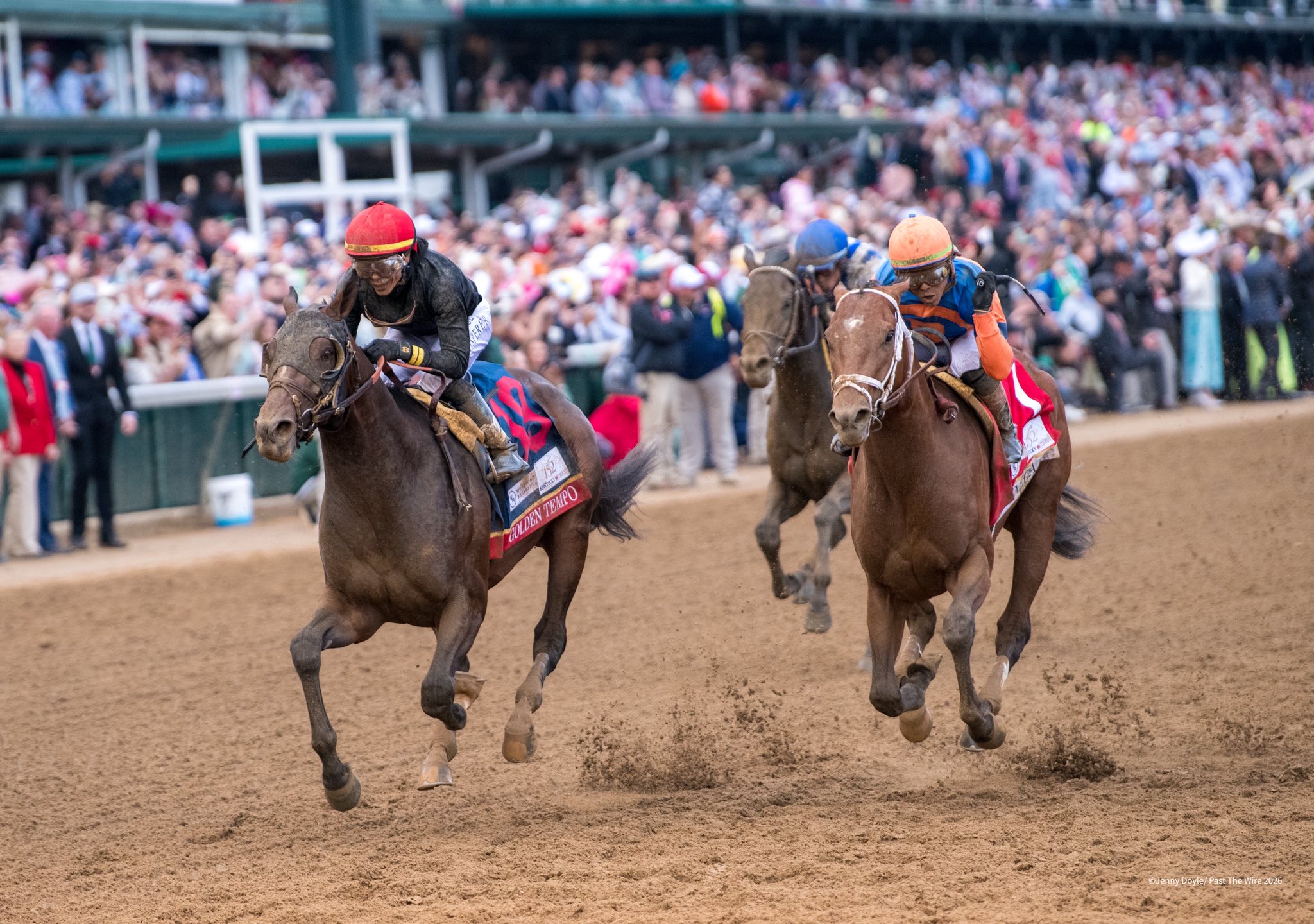
Jose and Irad Ortiz Cockfighting Public After a Kentucky Derby win.
USA Today published it this morning. The story is national now, carried across every wire, linked in every sports feed, attached to the names of two top jockeys who just finished first and second in the Kentucky Derby, two days before the Preakness and one of baseball’s most famous closers. Photographs. A Facebook advertisement. An unrelated law enforcement incident in Maricopa County on April 4 that turned up 157 roosters and $18,000 in cash.
Past The Wire has been on this story since November.
We want to be precise about that, not for credit, though credit is a factual matter and we’ll get to it, but because the timeline is the story. The timeline is an indictment.
What We Published, and When
In November 2025, a video surfaced on X appearing to show Jose Ortiz and Irad Ortiz Jr. collecting cash off the pit floor at Club Gallistico de Naguabo, a cockfighting venue in Puerto Rico. Two of the top jockeys in American racing, in a cockfighting ring, in a jurisdiction where it is a federal crime.
Past The Wire covered it. We spoke with PETA. We reached out to HISA for comment. We published The Ethics Gap, calling out the selective outrage of an industry that had banned a Hall of Fame trainer over a therapeutic ointment while staying completely silent about its two most prominent jockeys and a federal felony. We addressed it by name in our formal questions submitted before the HISA Town Hall in April. We asked, in writing, on the record: was an investigation conducted? If so, what were the findings?
We received no answer.
TDN did write a story on it. Only after A PETA demand letter on The Eclipse Awards. That was in late January about two months after they were aware of it. Prior to that, nothing. That was the full extent of racing media coverage of a federal felony allegedly involving the sport’s two most decorated jockeys. Not just any federal felony, one involving the torture and abuse of animals and illegal gambling.
Meanwhile, the Paulick Report, which has never seen a condominium purchase by Javier Castellano it didn’t think was news, published nothing. Zero. The condominium was covered. The cockfighting was not. We will let you draw your own conclusions about what the industry considers newsworthy and why.
What USA Today Found
USA Today Sports went further. Their reporting today adds photographs, including a Facebook post from January 14, 2025, showing Jose and Irad Ortiz holding roosters while standing in the pit of a cockfighting arena in Puerto Rico and a December 17 Facebook advertisement billing the brothers as participants in the Gran Campeón Caribeño tournament, the Caribbean Grand Champion, in which, the advertisement notes, the brothers “harbor a passion for fighting cocks.”
This was not ambiguous. This was promotional material. The Ortiz brothers were not accidental bystanders at an event they stumbled into. They were advertised participants, competing for a championship, in an activity that has been a federal felony in every U.S. jurisdiction since 2019.
The story also links Los Angeles Dodgers pitcher Edwin Díaz to the same world. Díaz is arguably the most famous closer in baseball, a World Series hero with his own entrance trumpet fanfare. He is Puerto Rican. He is also not a member of the horse racing industry, which means his inclusion in this story transforms a racing governance problem into a national sports story that racing cannot contain or manage.
This Is Not a Cultural Debate
We want to be clear about something, because the cultural argument will be made, and it deserves a direct answer.
Cockfighting has deep roots in Puerto Rican culture. That is a historical fact. It is also irrelevant to the legal and moral question at hand.
The Supreme Court of the United States heard Puerto Rico’s legal challenge to the federal ban and refused to intervene in 2021. The law has been settled. The maximum penalty for a participant in a cockfight is five years in federal prison. The penalty for a spectator is one year. These are not gray areas. These are not subjective interpretations. These are statutes.
Culture is not a shield for a choice. These men chose, as adults, with full knowledge of the federal prohibition, to enter cockfighting pits. The USA Today description of what happens in those pits, razor blades strapped to talons, fights that end in death, animals discarded still alive into barrels — is not a cultural tradition worth protecting. It is the torture of a defenseless creature for gambling entertainment. You do not get to call that heritage. You do not get to hide a choice behind identity.
A sport that euthanizes horses on the track and faces constant public scrutiny over animal welfare cannot afford morally or strategically, to look the other way when its top participants are photographed in animal torture pits. The cognitive dissonance is not subtle.
The Illegal Gambling Problem Nobody Is Discussing
There is a dimension to this story that the mainstream coverage has largely passed over, and it matters enormously to horse racing specifically.
Cockfighting is not just an animal cruelty felony. It is an illegal gambling operation. Federal law classifies it as such. The $18,000 recovered at the Maricopa County scene on April 4 is not incidental. Cockfighting venues are, at their core, unregulated wagering enterprises outside any licensing framework, any tax structure, any audit trail.
Horse racing is a licensed, regulated gambling industry. Its entire legal architecture rests on the premise that wagering integrity can be maintained, that the people who participate in its ecosystem are subject to background checks, licensing standards, and character requirements precisely because money changes hands based on their conduct.
The question the Kentucky racing commission — and every state commission that licenses either Ortiz brother must answer is this: how do you license participants in a regulated gambling enterprise when those participants have documented involvement in an illegal gambling operation? That is not a rhetorical question. That is a licensing question with legal teeth.
And it has not been asked. Not once. Not by any racing commission in any state where the Ortiz brothers hold licenses.
The Kentucky Investigation — Does It Exist?
There are references in circulation to a Kentucky investigation into this matter. We are asking, publicly and directly: does such an investigation exist? If so, what is its scope, what is its status, and when will the industry be informed of its findings?
The opacity here is not acceptable. The Ortiz brothers ride at Churchill Downs. They rode in the Kentucky Derby two weeks ago. Jose Ortiz won it. If the Kentucky Horse Racing Commission opened an inquiry at any point in the past six months, the public, the wagering public that funds this industry has a right to know that an investigation exists, what triggered it, and where it stands.
Silence on an open investigation is not the same as transparency. And silence on a non-existent investigation is worse.
Where the Authority Lives — And Who Has Refused to Use It
At the HISA Town Hall in April, CEO Lisa Lazarus addressed the cockfighting matter making her the only regulatory or industry leader in American racing to do so publicly. She was correct on the jurisdictional question: HISA does not license jockeys. HISA does not have direct authority here. She pointed, accurately, to where the authority does live: the individual state racing commissions that issue and renew jockey licenses.
Generally State licensing boards have extraordinarily broad discretion. They do not need a conviction. They do not need a federal indictment. They do not need to prove anything beyond reasonable doubt in a court of law. If a state racing commission decides it does not want to license a particular individual, it can decline to do so. The legal standard for discretionary licensing denial is low by design, because character and integrity are foundational requirements in a regulated gambling industry.
So let’s be precise about what has happened since November 2025: video evidence emerged of two prominent licensed jockeys in a federal felony environment. The evidence was public. It was reported. PETA sent formal letters demanding action. Past The Wire covered it and demanded answers. And every state racing commission, New York, Kentucky, Florida, California, that licenses either Ortiz brother chose, with full awareness of the documented evidence, to do absolutely nothing.
That is a documented, six-month institutional failure with named authority, named power, and a paper trail.
The Preakness is in 48 hours. The Ortiz brothers are scheduled to ride. What does the Maryland Racing Commission do now?
The Industry Was Afraid to Touch This
We cannot state this as fact. We can observe it.
When a story surfaces involving the two most prominent jockeys in American racing, the sport’s biggest stars at the moment of its biggest spotlight, one of whom would go on to win the Kentucky Derby and the entire media apparatus of that sport produces a handful of sentences over six months, one of two conclusions is available. Either the story was not considered newsworthy. Or it was considered too dangerous to touch.
The condominium was newsworthy. The federal felony was not.
We leave it to the reader to assess which conclusion is more plausible, and what it says about an industry that cannot afford the optics of examining its own stars while simultaneously claiming it stands for the welfare of animals.
The cowardice of that calculation, if that is what it was, has now produced the worst possible outcome: USA Today, national distribution, two days before the Preakness, with photographs. Racing did not get ahead of it. Racing got buried by it.
What This Publication Has Said, and What We Are Saying Now
Past The Wire covered this story in November when it was uncomfortable. We covered it in February when we published The Ethics Gap. We included it in our formal HISA Town Hall questions in April. We are covering it today. We will cover it until someone with authority over a racing license addresses it.
We are calling on the Maryland Racing Commission to address, before the Preakness, whether the documented evidence affects its licensing posture toward either Ortiz brother.
We are calling on the Kentucky Horse Racing Commission to confirm publicly whether an investigation exists, its current status, and its timeline.
We are calling on every state racing commission that licenses either Ortiz brother to answer one question on the record: what standard of documented evidence of a federal felony would be sufficient to trigger a licensing review?
And we are calling on the racing media the same outlets that cover condominium purchases as news, to do their jobs.
The story was there in November. It is still there now. The only difference is that USA Today found the photographs.
“The most common way people give up their power is by thinking they don’t have any.” — Alice Walker