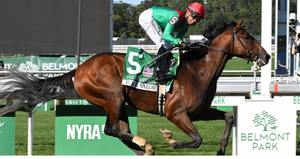

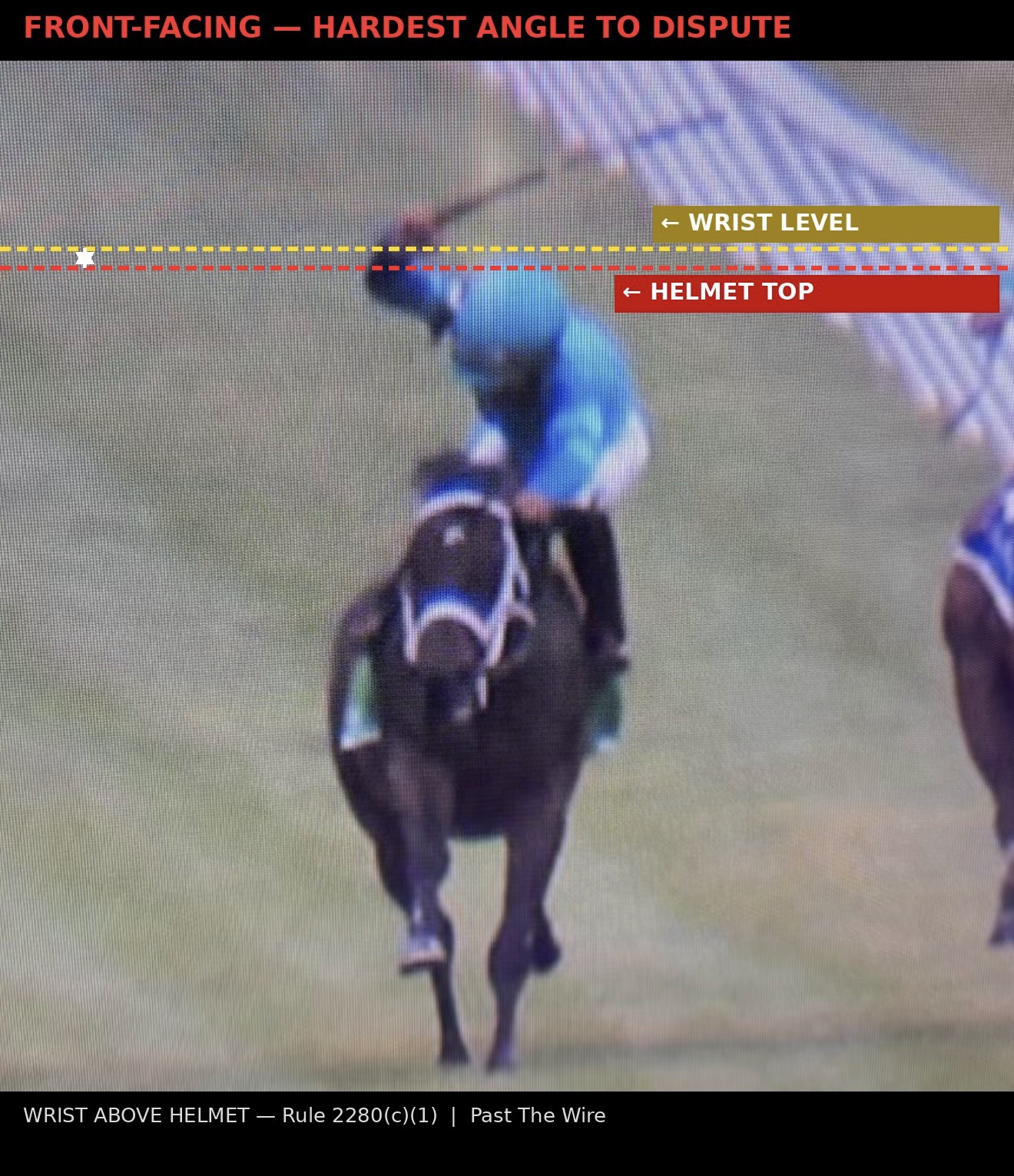

Pierre Gasly crossed the finish line third at Monaco. Then two five-second penalties for pit lane speeding dropped him to seventh, and a driver who had dreamed his entire life of a Monaco podium found out about it the way most of us find out about bad news now, on a phone, after the fact. He said he was heartbroken. He said he couldn’t comprehend it.
Five days later, he was standing on that podium. Not in a ceremony. Not symbolically. The FIA stewards reconvened, took testimony from Alpine, from the FIA’s own technical leadership, and from Formula One Management as the official timekeeper, and determined that the timing loop measurement used to calculate pit lane speed was wrong by 77 centimeters. Not a little wrong in a way that gets explained away. Wrong enough that Gasly never broke 60 km/h at all. The stewards rescinded both penalties, restored him to third, reallocated the championship points, and published the entire proceeding as Document 98, with names attached, testimony summarized, and a formal order: penalty rescinded, five seconds removed, classification amended.
I called the original penalty correct under the information available at the time. I’ll call this correct too, because it is. That’s not a contradiction. That’s what a governance system that actually works looks like in real time, get it wrong, find out you got it wrong, say so in writing, and fix it before the next race weekend even starts.
Compare that to what I watched happen at two different American racetracks over the last month, both involving the same jockey, both involving the same unambiguous rule, and neither of which produced anything resembling Document 98.
Laurel Park: The Stewards Looked At The Tape
Paco Lopez won the Preakness aboard Napoleon Solo. I watched the same head-on and pan replay the Maryland stewards watched. From the three-sixteenths pole to the wire, Lopez raised his wrist above his helmet before striking the horse on three separate occasions. HISA Rule 2280(c)(1) doesn’t have a style exception. The wrist is either above the helmet or it isn’t.
The stewards’ finding: no violation, no action. Administrative steward Adam Campola told two outlets that Lopez has an “unorthodox style,” stays busy on a horse, moves around a lot. The number of strikes was never the issue, four, comfortably under the limit. The issue was wrist position, and on that question the stewards apparently saw something the rest of us didn’t. No written finding. No frame-by-frame. No explanation for how stills that multiple journalists reviewed independently got evaluated and waved off. HISA deferred entirely, saying it had no basis to call the stewards’ call “clearly erroneous,” and declined further comment.
This is a jockey who six months earlier had been hit with HISA’s most significant whip violation penalty on record, for this exact infraction, and effectively never served it. HISA CEO Lisa Lazarus had written to his counsel in plain English: “Raising the crop with his wrist above the helmet is unacceptable.” Her stated goal wasn’t punishment, it was compliance. Lopez came back April 1. He won the Preakness May 16. The stills say the wrist went up again. The stewards said it didn’t happen.
Saratoga: Same Jockey, Same Rule, Same Result
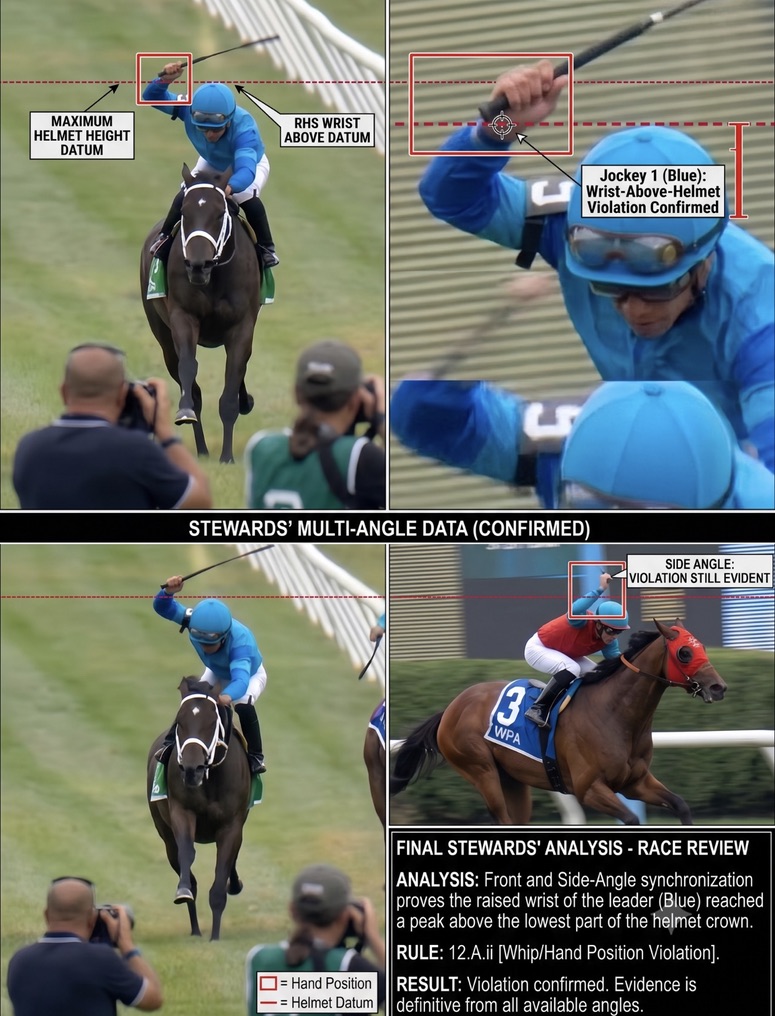
Three weeks later, Belmont week. Lopez wins Race 3 aboard Bonus Move. I watched him raise his wrist above his helmet, by rule the violation regardless of head position, three separate times from the eighth pole to the wire. I sent Mark Guilfoil, HISA’s head of stewarding, an on-the-record text during the card identifying the horse, the race, and the specific violation, and I told him in advance what the defense would be: that he was lowering his head, not raising his wrist, a distinction the rule doesn’t make. Guilfoil wrote back that he’d go stand with the stewards.
Lopez’s next mount, Book ‘Em Danno in the True North, one strike, wrist down, whip put away, conspicuous patting on the gallop-out. That is not how Paco Lopez rides. I said out loud, before I had any confirmation, that this was a man who’d just been spoken to. I was right.
Guilfoil confirmed it afterward, on the record: he reviewed the footage with the stewards, spoke to Lopez and his agent. Then he sent me photographs, taken by HISA’s own head of stewarding off the stewards’ review monitors, showing exactly what I’d described. The wrist. The position. The violation the rule exists to catch.
The formal outcome of all of that: no action. No ruling. No document. Nothing.
Document 27, Document 36, and Now Document 98
I made this comparison once already, on the day before the Belmont, because the timing was too perfect to ignore. The same week Saratoga couldn’t produce a written finding on a Preakness-winning jockey raising his wrist above his helmet three times in a stakes race, the FIA published Document 27 and Document 36, formal written rulings, four stewards’ signatures, issued within hours, fining two Mercedes drivers for pit lane speeding violations of 0.3 km/h and 0.1 km/h. In a practice session. Free practice.
Now add Document 98 to the stack. This is the part that should actually keep people at HISA and at the state racing commissions up at night, not because F1 punished a tiny infraction with total seriousness, we already knew that, but because F1 also showed it can be wrong, admit it was wrong, and unwind the consequences, publicly, with the paper trail intact, inside a single race week. Alpine filed a right of review. The stewards reconvened. FOM’s own people testified that their measurement was off. The stewards didn’t protect the original call to save face. They reversed it, in writing, and reallocated championship points retroactively.
That is the part racing doesn’t have. Not “the stewards got it wrong and never admitted it,” that happens everywhere, including at Saratoga with Allemuese, including with a 1 1/8-mile turf race run at 1 1/16 miles, twice, seven years apart, at the same track. The part racing doesn’t have is the mechanism. There’s no Document 98 equivalent for Paco Lopez. There’s no formal process where new evidence, three still images and a HISA official’s own admission that he reviewed them, triggers a published, reasoned, appealable written ruling. There’s a text exchange. There’s “wrist above helmet” followed by an invitation to look at other camera angles, as if the rule were a matter of perspective rather than physics. This is not isolated by any means. Let us know when you find the report by the KHRG on the Ortiz brothers cockfighting and illegal gambling investigation.
Document 98:
What Governance Actually Looks Like
I’m not asking horse racing to fine jockeys 100 euros for being a tenth of a kilometer over a limit. I’m asking for the structural thing underneath that, a written record that exists, that names who decided what and why, that can be wrong and then corrected on the record when it is.
Monaco gave us both halves of that this week. A call that initially cost a driver his lifelong dream of a podium at Monaco, and five days later, a formal, signed, public reversal of that exact call when the evidence demanded it. Right of review. Significant and relevant new element. Reconvened hearing. Decision rendered. Published.
Saratoga and Laurel gave us a jockey raising his wrist above his helmet on camera, repeatedly, in graded company, weeks apart, with a head of stewarding who looked at the same footage I did, said the same thing I did about what it showed, spoke to the rider, and then produced nothing the public can point to. Not a wrong ruling. Not even a ruling.
I said I thought Gasly’s reinstatement was the right call. I still do. But the part of this story that should actually matter to the people running American racing isn’t whether Gasly deserved his podium back. It’s that there was a process capable of giving it back to him, on the record, in days, when the facts changed. Racing has the facts. Racing has had the facts for a month. What racing doesn’t have is Document 98.
This is what racing has:
That’s not a culture problem. Culture is the excuse institutions reach for when they don’t want to build the mechanism. The mechanism is buildable. Formula 1 just built it again, in public, in 72 hours, over a 77-centimeter measurement error in a pit lane in Monte Carlo.
Related coverage: What The Belmont Didn’t Tell You — But We Will | The Stewards Looked At The Tape — And Said They Didn’t See It —- Will The Real Sport of Kings
P3!