

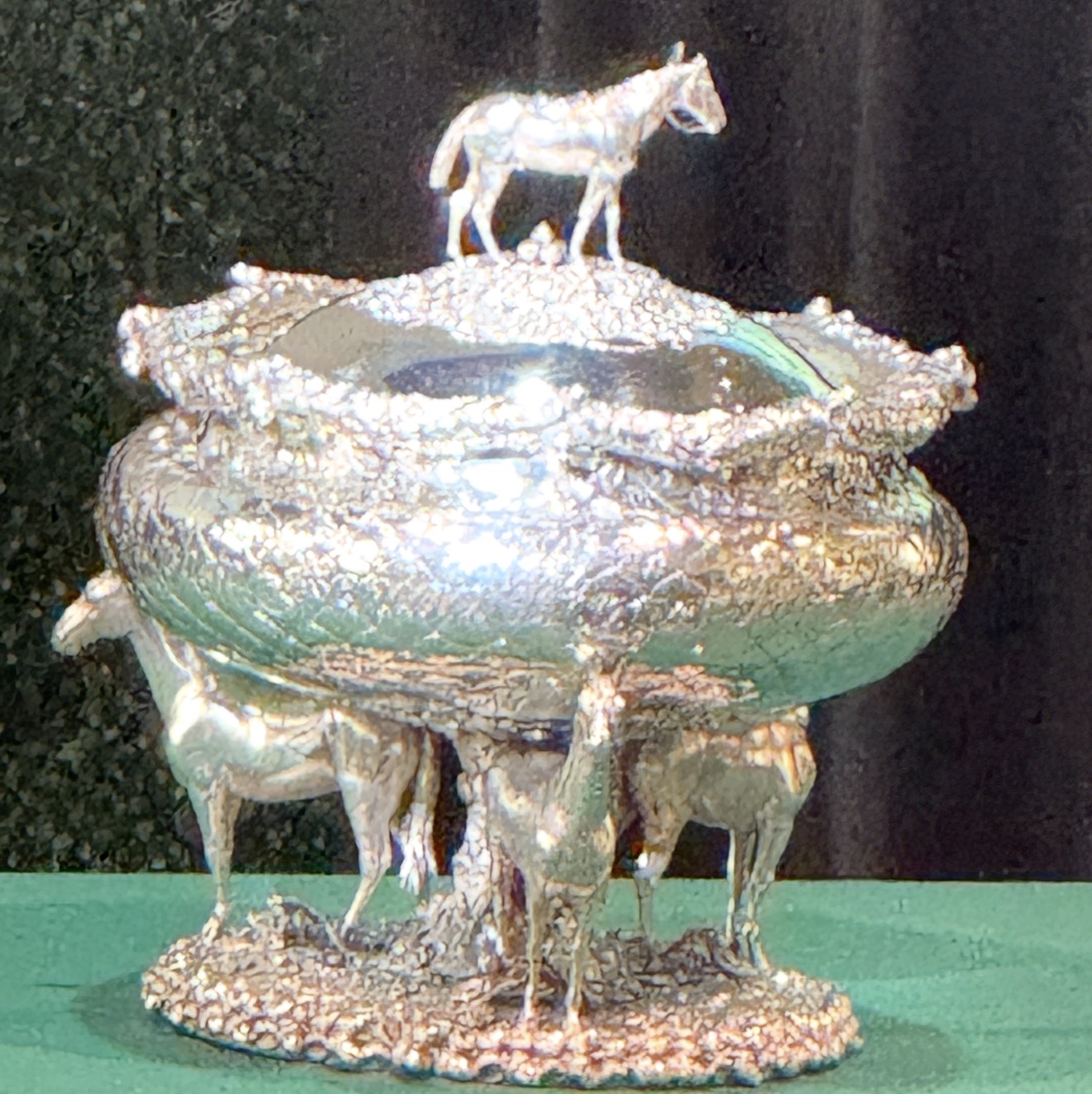

A Belmont Week Review: The Good, The Bad, and The Unsaid
Saratoga Race Course hosted the Belmont Stakes for the third and final time this past weekend, and if you watched only the broadcast you saw something genuinely beautiful, a storied venue, a competitive field, a thrilling finish, and a production worthy of the occasion. Golden Tempo, trained by Cherie DeVaux, added a Belmont to his Kentucky Derby and cemented a place in racing history.
Past The Wire watched the same race. We also watched the data, the texts, the stewards’ monitors, the FIA rulebook, and twenty years of handle figures. What follows is a full accounting of Belmont week 2026, credit where it is due, questions that remain unanswered, and the institutional story the mainstream coverage either missed or chose not to tell.
The Broadcast: Finally, Something That Worked
Let’s start with the good, because there was genuine good here and it deserves to be said plainly.
FOX Sports’ coverage of the Belmont Stakes Racing Festival was the best national broadcast presentation of a racing week this sport has produced in years. The Saratoga setting did the heavy lifting it always does, the place photographs itself but FOX let it breathe rather than drowning it in manufactured pageantry. There were no extended segments about hats. The mint julep did not make a cameo. Racing was the product.
The NYRA-FOX partnership, now in its tenth year and anchored by an eight-year exclusive deal through 2030, produced something that felt earned rather than assembled. FOX ran two distinct Saturday afternoon programs, one for general audiences on the main network, one for serious horseplayers on FS1. That bifurcation matters. It acknowledges that the sport has two audiences with different needs and stops pretending one broadcast can serve both.
Three voices deserve specific recognition. Andy Serling brought the horseplayer’s perspective with the kind of precision and honesty the sport’s broadcast history has systematically avoided. Maggie Wolfendale represented the fan’s point of view without condescension or oversimplification. Samantha Perry brought the horseman’s lens, the inside view that too rarely makes the national broadcast. Three perspectives, three authentic voices, all in the same week. That is a rarity in this sport and it should be acknowledged.
Serling, Wolfendale, and Perry — bettor, fan, horseman — in the same week. A rarity. It should be noted and repeated.
Not everything on the broadcast side was commendable. Some of the handicapping presented to viewers, selections with no realistic path to victory offered as actionable wagers would have financially damaged any novice who followed along. The sport cannot simultaneously claim it wants new customers and then point them toward wagers that just don’t make sense on its biggest showcase weekend. That contradiction is not a small one.
Accessibility also improved markedly compared to the Derby. The race was easier to find, easier to follow, and the production quality was visibly superior to prior years. Some of that is the Fox-NBC comparison, different networks, different production cultures, different commitments to the product. But viewers experience results, not intentions, and the result this weekend was better.
The Calls
Frank Mirahmadi was stellar all week.
FanDuel’s Exit and What It Actually Means
In March 2026, FanDuel CEO Amy Howe told more than 100 employees on a company-wide video call that the network they had built, first as TVG, then as FanDuel TV, a fixture in American racing homes since 1999 did not align with the company’s long-term strategy. The phase-out runs through end of 2027. More than 100 jobs gone.
FanDuel handled $2.239 billion through the Oregon Racing Commission hub in 2025. It held a 32.8 percent market share of the $6.824 billion bet through that hub — second only to Churchill Downs’ TwinSpires at 37.7 percent. This is not a company that failed at horse racing. This is a company that succeeded at horse racing and decided the return on investment no longer justified the infrastructure of a dedicated linear network.
Read that again carefully. One of the two dominant wagering platforms in the sport concluded that a full television network devoted to racing is not worth maintaining, even with $2.2 billion in annual handle flowing through its platform. That is not a programming decision. That is a verdict.
FanDuel didn’t fail at horse racing. They succeeded — and still decided the network wasn’t worth it. That is a verdict, not a programming decision.
NYRA and FOX are now discussing plans to fill the void. Tony Allevato, NYRA’s chief revenue officer and a former TVG producer, told the Paulick Report: ‘If you’re a horse racing fan that’s 45 and under, you’ve literally only known the world in racing with a TVG or FanDuel TV in it.’ That is both a tribute to what TVG built and an honest acknowledgment of how significant its departure is.
FOX Sports aired 1,000 hours of live racing in 2025 and has expansion plans. The NYRA-FOX partnership has the infrastructure and the will to scale. But the question hanging over all of it is the same one that hangs over every structural conversation in this sport: who is the customer, and what do they actually need?
Everett Dobson’s broadcast appearance was, in this writer’s view, a missed opportunity that became a low point. The moment had genuine potential, the new Jockey Club chairman, a fresh face, a big stage, something real to say about where this sport is going. What we got was detached fluff. Reach out to Gen X. Get those TV viewers into the game. The Oklahoma City Thunder are wonderful. Nothing that engaged the hard questions sitting right in front of him, falling handle, a dominant wagering platform just announced it’s going dark, enforcement gaps at his sport’s showcase venue. The cameras were on. The moment was there. He didn’t use it. Email him and wait for some type of answer.
The Numbers: Record Viewers, Falling Handle, and the CAW Confession
The 2026 Kentucky Derby drew 19.6 million viewers, the most-watched edition of the race on record, breaking a mark that had stood since 1989. A peak of 24.4 million watched Golden Tempo’s final run to the wire. These are genuinely remarkable numbers.
Kentucky Derby handle was down 1.8 percent. Preakness handle was down 8.0 percent. Belmont single-race handle was down 20.9 percent, $42.5 million against $53.8 million the year prior, an $11.3 million decline at the same venue, same distance, with one more horse in the field.
This is the central paradox of American horse racing in 2026, and it is not new: the sport’s showcase events draw audiences that would be the envy of most professional sports leagues, while the betting handle that actually funds the industry continues to contract. Fans are not bettors. Viewers are not customers. The Derby will always be watched. Getting those people to a track on any given Wednesday, or getting them to open a wagering app on a random Saturday in March, is an entirely different undertaking that record television numbers do nothing to solve.
Fans are not bettors. Viewers are not customers. The Derby will always be watched. Getting those same people to bet a Tuesday card at a mid-tier track is a different sport entirely.
The most significant number in this entire conversation was provided not by a data analyst or a trade publication but by NYRA officials themselves, who stated late last week that betting by computer-assisted wagering groups had dropped nearly 50 percent since NYRA implemented guardrail restrictions in February, declining from approximately 20 to 22 percent of all pools to 12 to 13 percent of handle.
Past The Wire has been covering the CAW story longer and more comprehensively than any other publication in this sport. We documented the original NYRA guardrails announcement, the subsequent expansion to all wagering pools, and the conversation with NYRA president and CEO David O’Rourke that produced the first frank public accounting of what the restrictions had actually done to handle. The DRF’s post-Belmont piece confirmed what our coverage had already established: remove the speed traders from the final two minutes, and the single-race pools contract dramatically.
The Belmont handle decline is not cleanly attributable to any single cause. The Preakness was run without Golden Tempo and produced a lackluster narrative; the natural bounce-back effect for the Belmont’s return of the Derby winner should have provided some tailwind. A larger field, nine horses versus eight in 2025 should statistically drive exotic pool volume upward. The handle fell anyway. That combination of factors makes the CAW explanation harder to dismiss, not easier.
The broader picture is damning regardless of any single race. U.S. Thoroughbred handle has now declined four of the past five years. Total handle in 2025 was approximately $11.57 billion, the lowest since the COVID year of 2020, and down from a 2003 peak of $15.18 billion that, adjusted for inflation, represents a decline of more than 57 percent in real value. This has occurred while legal sports betting surged past $121 billion annually and the broader gambling market expanded in every measurable direction. The sport is not losing to a recession. It is losing to competition, and the competition is winning.
The Track: Lightning Fast, Then Quiet
Saratoga’s track produced some of the fastest times of the meet’s early days on Friday and Saturday of Belmont week. The surface was playing at a level that drew notice from horseplayers throughout the card.
Then, ahead of the Belmont Stakes itself, conditions appeared to level, a light rain arrived near post time and the track superintendent is not talking. Not to us anyway. Whether the surface shift affected the Belmont’s running or was simply a function of weather, the absence of any public accounting from the relevant official is its own answer. This is a sport where the most basic operational transparency is treated as optional. The question is fair. The silence is noted.
The Rule That Applies Everywhere Except Here
On June 5, 2026 the day before the Belmont Stakes the FIA Stewards at the Monaco Grand Prix issued Document 27. George Russell, Car 63, Mercedes-AMG Petronas F1 Team, had exceeded the pit lane speed limit of 60 km/h — by 0.3 km/h. Fine: 100 euros. Four stewards named and signed. Document number, timestamp, formal written ruling, publicly issued.
Hours later, Document 36. Kimi Antonelli, Car 12, same team. Pit lane speeding — 60.1 km/h. Exceeded the limit by 0.1 km/h. Same fine. Same four signatures. Same public record.
Zero point one kilometers per hour over in a free practice session at Monaco. Formal written ruling. No warnings. No informal conversations. No appeals to style.
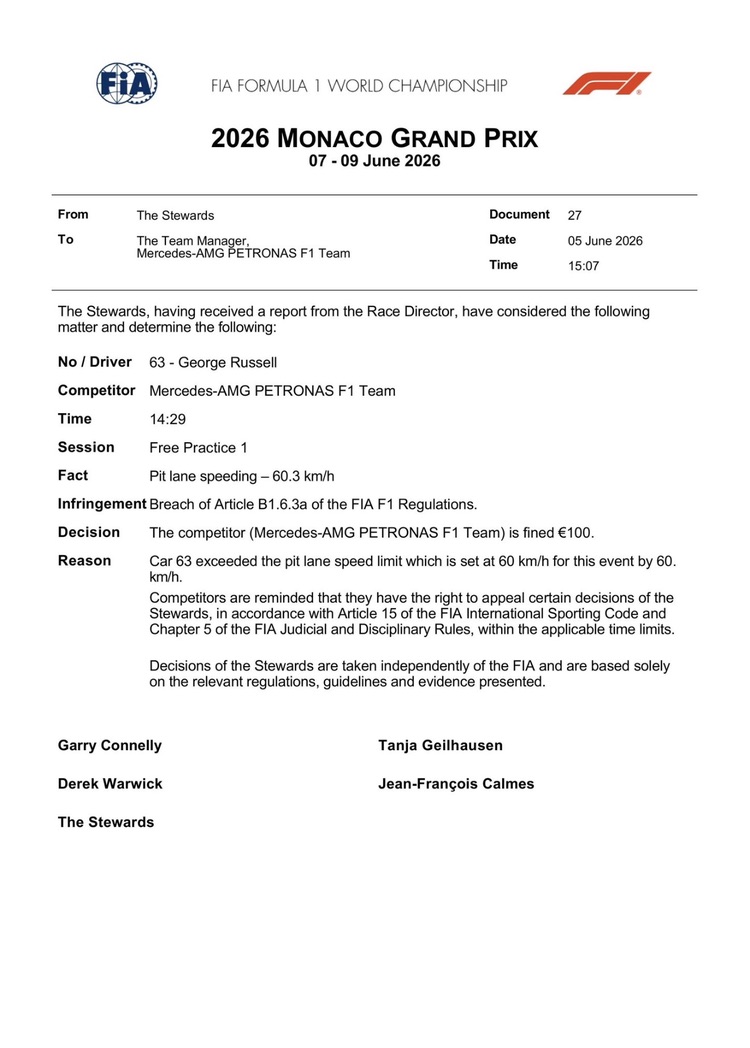
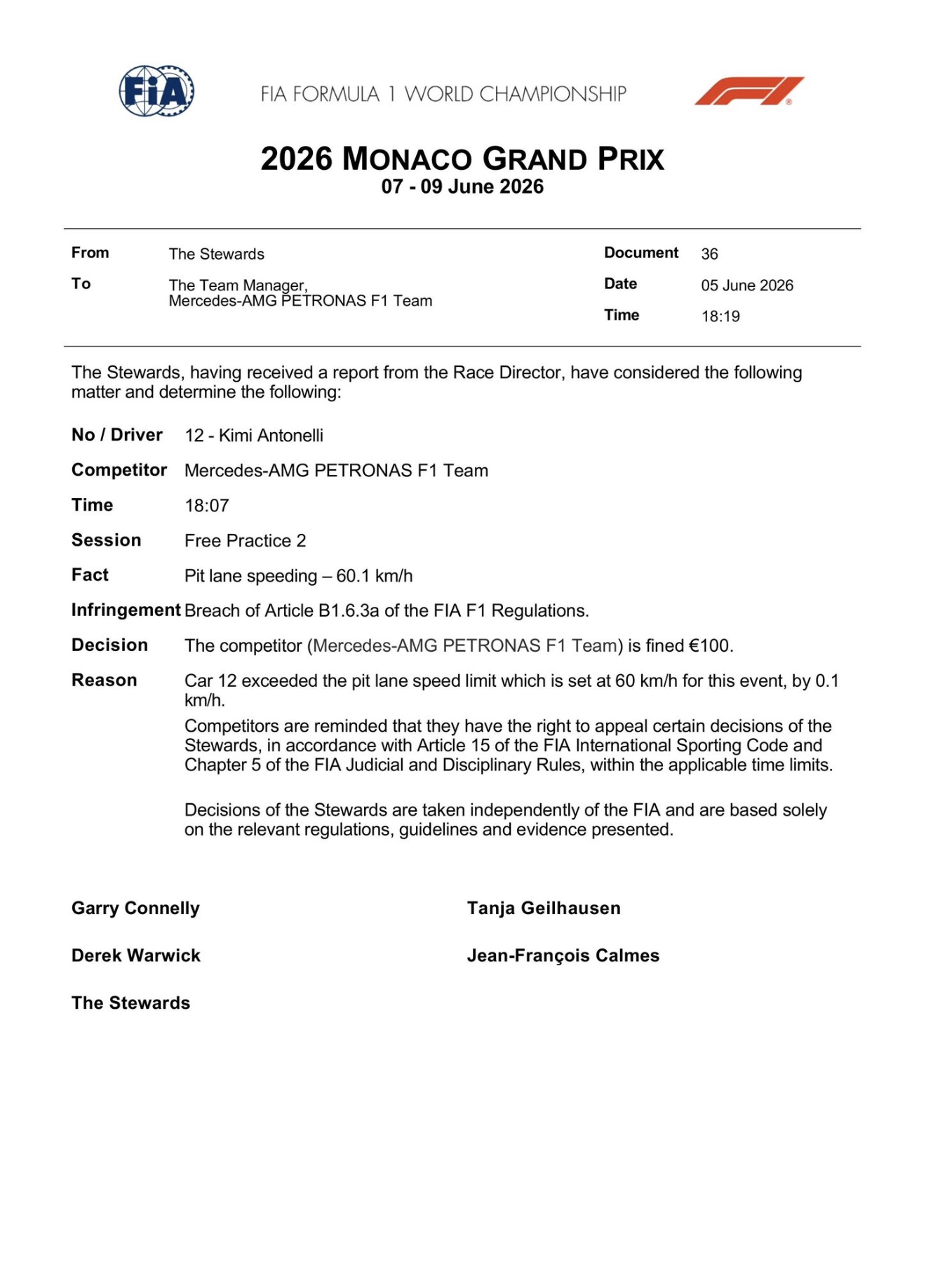
Now consider what happened at Saratoga Race Course during the Belmont Stakes Racing Festival.
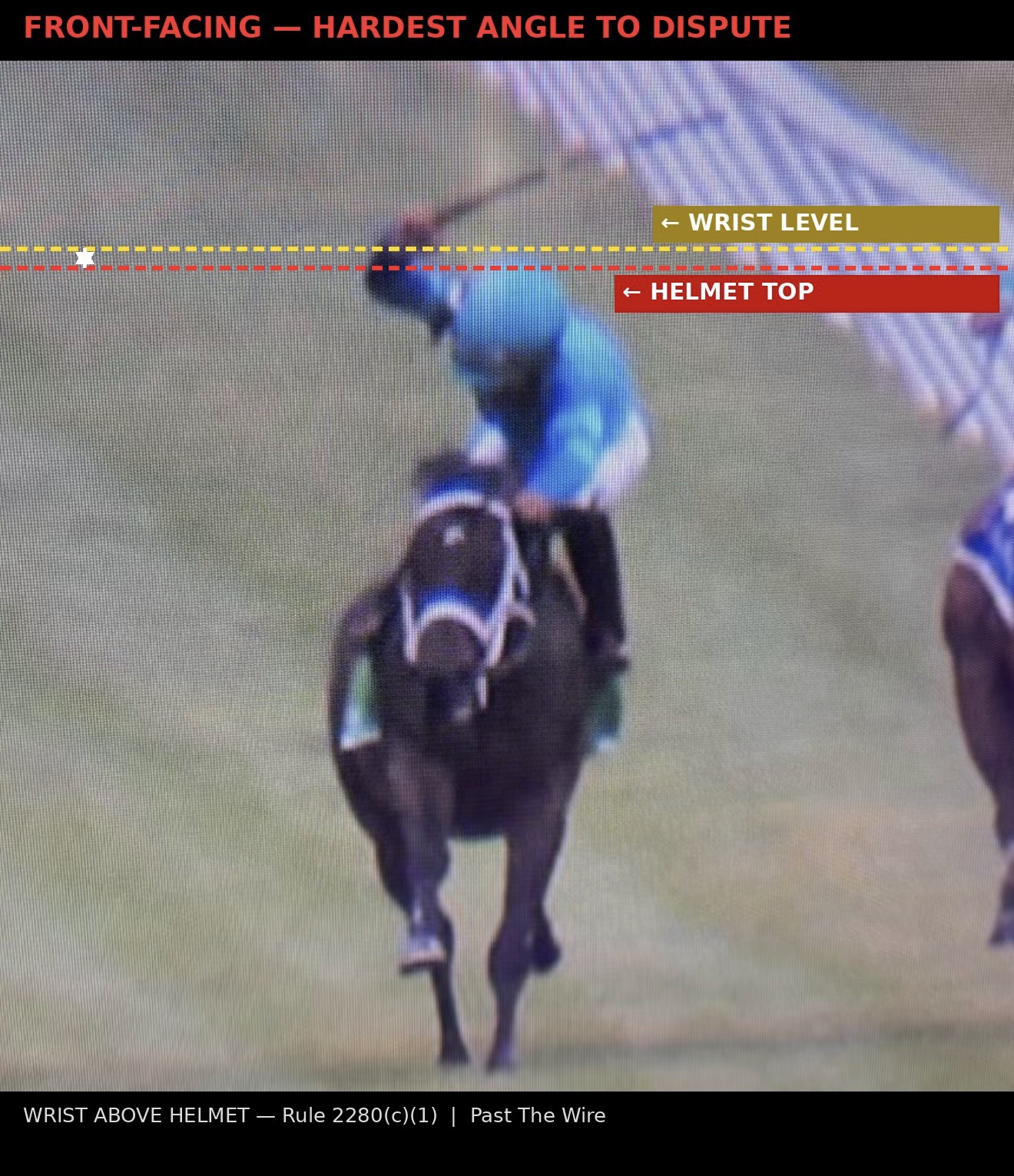
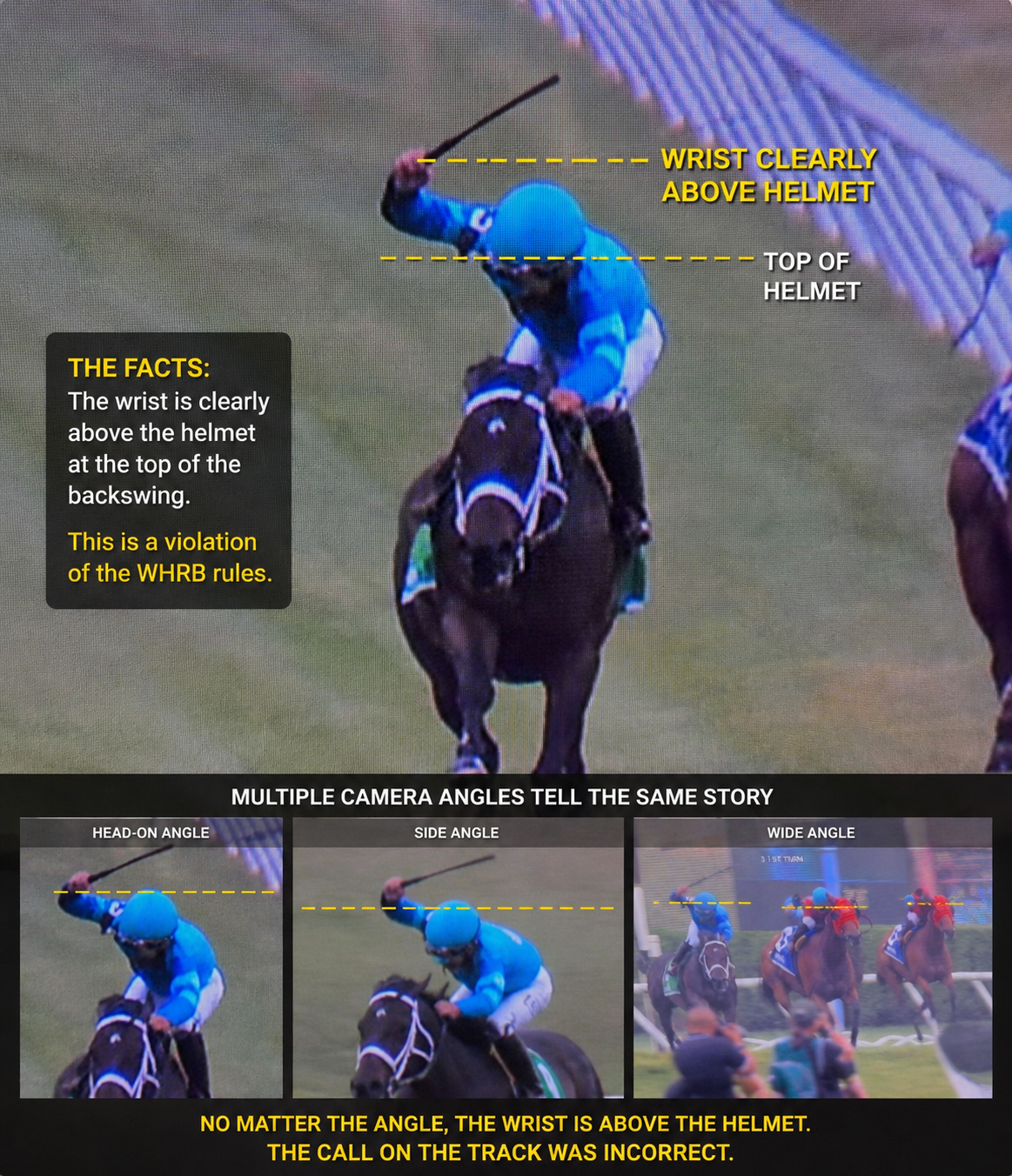
Paco Lopez the jockey who skirted a six-month HISA suspension for repeated whip violations including raising his wrist above his helmet in violation of Rule 2280(c)(1) won Race 3 aboard Bonus Move. Past The Wire observed Lopez raise his wrist above his helmet not lowering his head below his wrist, which by rule makes no difference, three times from the eighth pole to the wire.
During the card, Past The Wire sent an on-the-record text to Mark Guilfoil, HISA’s head of stewarding, who was physically present at Saratoga. The message identified the horse, the race, the specific violation, and correctly anticipated the defense that would otherwise be deployed that Lopez was lowering his head rather than raising his wrist, a distinction the rule does not recognize. Guilfoil responded: ‘I will go to stand and talk with stewards as im at Saratoga today.’
Lopez subsequently rode Book ‘Em Danno in Race 8, the True North Stakes. He used one whip strike, with his wrist above his head, then put the whip away. He visibly and conspicuously petted the horse on the gallop back. This is not Paco Lopez’s documented operating mode. I immediately said to myself that is a man who was spoken to between races. I was correct.
Following the card, Past The Wire followed up with Guilfoil asking on the record whether any action had been taken or whether a formal ruling was forthcoming. His response: ‘Yes. Im traveling now and will call you tomorrow. I spoke with stews, Paco and his agent. No action. Sending pics and video I took of the stews TV.’
He then sent photographs taken by the head of HISA stewarding, from the stewards’ own review monitors, showing the race footage that appear to document exactly what Past The Wire described. The wrist. The position. The violation the rule was written to address.
HISA’s head of stewarding photographed the stewards’ monitors and sent the images to a Past the Wire. He spoke to the jockey and his agent. The formal record shows: no action.
No action. No written ruling. No public document. No formal record that anything occurred.
Compare that to Documents 27 and 36 from Monaco.
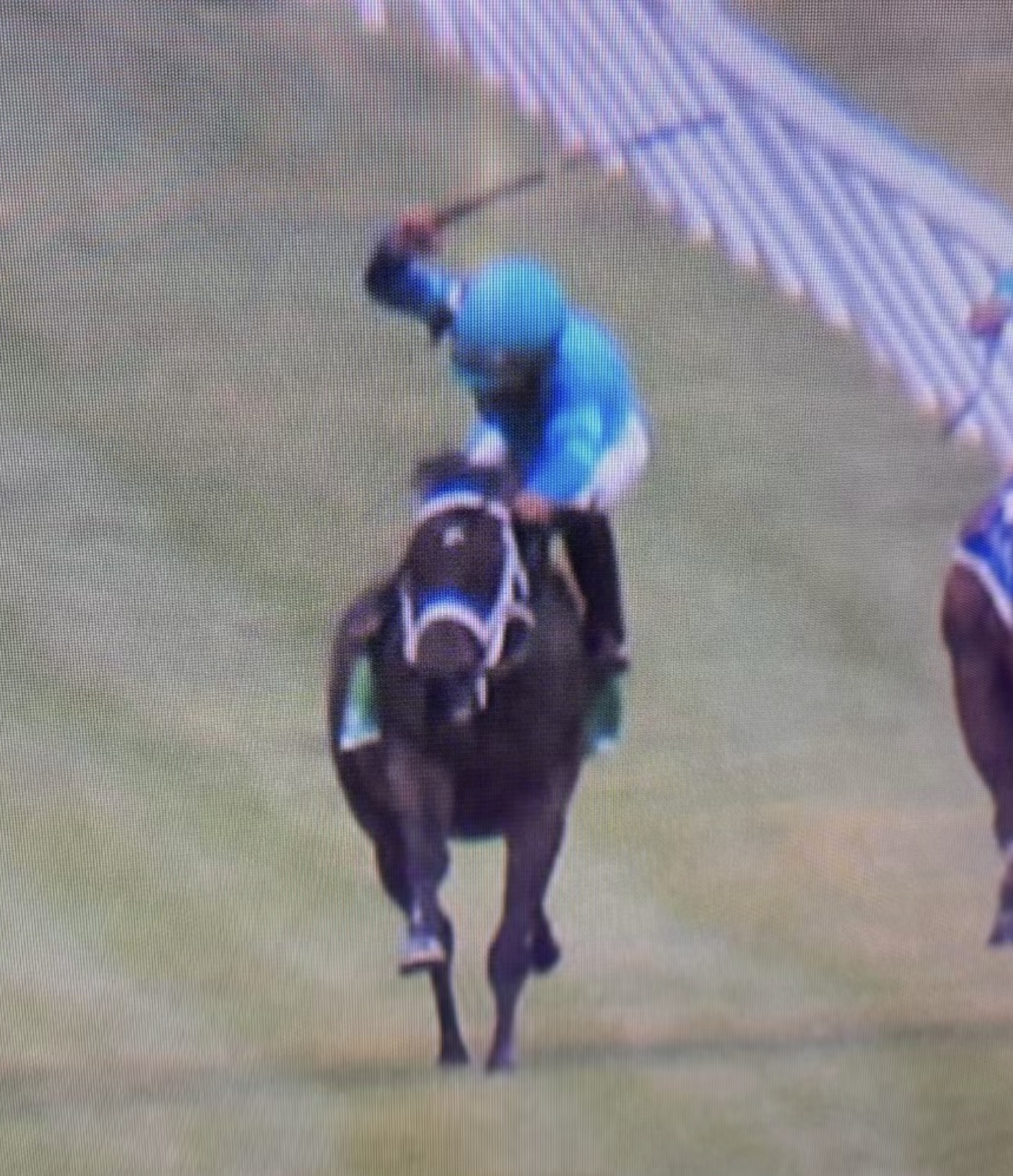
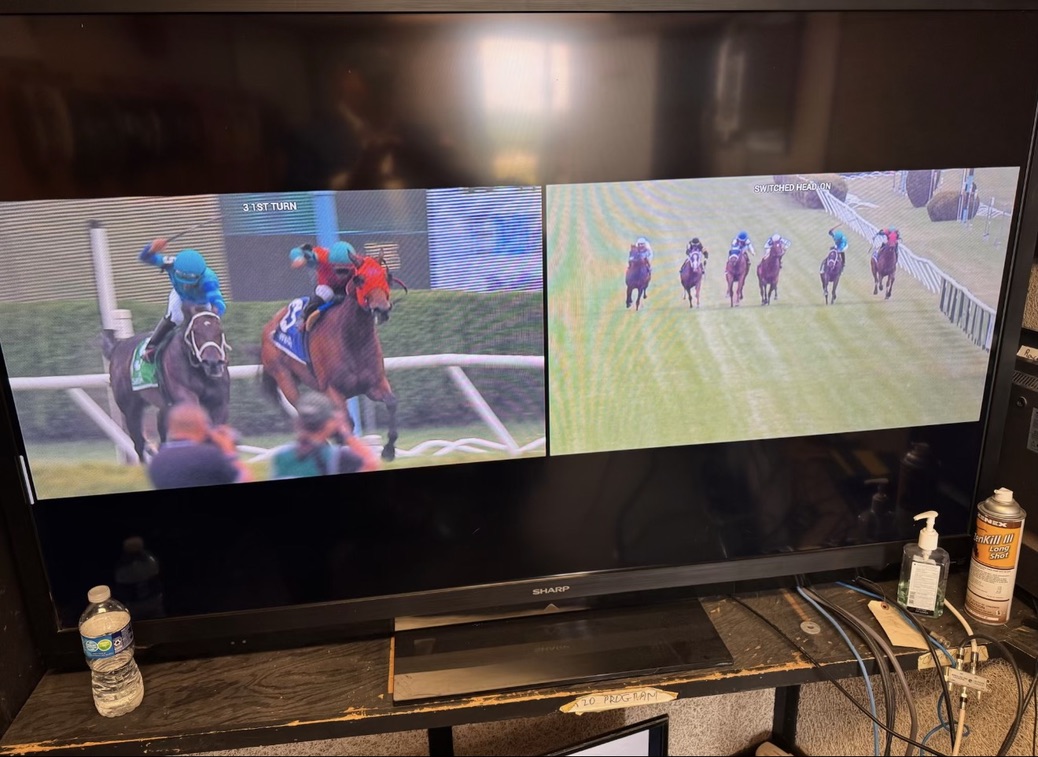
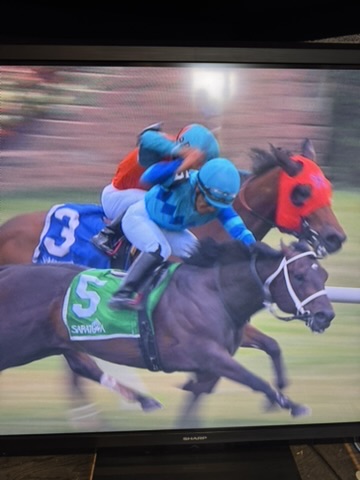
Formula 1 fined two drivers from the same team, one of them by 0.1 km/h in a practice session with formal written rulings bearing four signatures, publicly issued within hours. Horse racing’s head of stewarding photographed his own monitors, confirmed he spoke to the jockey and his agent, and produced nothing for the public record.
This is not a philosophical argument about sport cultures. This is a documented, same-weekend comparison of what enforcement looks like when an institution means it versus when it manages it. We have covered this distinction across the Lopez story for months from the original suspension to the Preakness ride to the Maryland stewards’ ‘unorthodox style’ ruling that produced no written finding, to the conversation with Guilfoil that followed our second piece. The pattern is consistent. The institution sees what it sees. What it does with that and what it puts in writing is another matter entirely.
This is not the first time Saratoga’s officiating apparatus has fallen short of the standard the venue demands. Past The Wire has covered this ground before. Those with long memories will recall Allemuese, the wrong horse disqualified at this track, an incident this writer witnessed firsthand. Last August, the final race of a Saturday card here was run at the wrong distance, a 1 1/8-mile turf race contested at 1 1/16 miles due to a misplaced gate, the same mistake that had occurred at this same track seven years earlier. NYRA apologized. Bettors got nothing back. The stewards are different people today, and none of these incidents are the same in cause. But they share a venue, a governing body, and a pattern. You would think that after disqualifying the wrong horse, after running races at the wrong distance twice, getting everything else right would be the non-negotiable floor. The Guilfoil exchange suggests that floor remains aspirational.
We expect a call from Mark Guilfoil. If and when that call produces anything on the record that adds to this accounting, we will report it. What is already on the record speaks for itself.
The Sport They Keep Promising to Grow
Everett Dobson, the new chairman of The Jockey Club, has spoken publicly about the need to reach new audiences, commissioning a series of YouTube and TikTok shorts designed to bring younger viewers into the sport. This is not an unreasonable impulse. The industry’s demographic challenge is real and documented.
But here is the tension that nobody in the governance class will say plainly: the Kentucky Derby drew 19.6 million viewers, a record and handle was down 1.8 percent. Saratoga’s FOX Saturday broadcasts average more than 500,000 viewers, more than the NHL’s regular season on TNT and college basketball on FOX and FS1. The sport is being watched. The sport is not being bet.
Getting someone to watch a two-minute race on a Saturday afternoon and getting them to open a wagering account, learn pari-mutuel mechanics, navigate a takeout structure that extracts 15 to 25 percent from every dollar, and return to bet a Wednesday card at a mid-tier track are not the same challenge. They are not even related challenges. The industry has spent a decade conflating them and a decade being surprised that viewership gains do not translate to handle growth.
Meanwhile, the legal sports betting market where the price is transparent, the interface is intuitive, the house edge is understood, and the product is available on any phone surpassed $121 billion in annual handle. Racing is competing with that product for the same marginal gambling dollar. TikTok shorts about Saratoga’s beauty are not going to change that arithmetic.
The FanDuel exit is the commercial punctuation on this argument. A company that handled $2.2 billion in racing wagers annually decided that a dedicated racing network was not viable for its long-term strategy. It is not that they stopped believing in racing’s audience. It is that the audience that watches does not translate efficiently enough to the audience that bets.
What We Covered, and Why It Matters
Past The Wire covered Belmont week the way we cover everything, with the documents in front of us and the questions that follow from them.
We covered the CAW years before the NYRA guardrails announcement through the O’Rourke interview through this weekend’s handle data. We covered the Lopez enforcement thread from the six-month suspension through the Preakness ride through the Saratoga incidents that HISA’s own head of stewarding photographed and documented and chose not to act on formally. We covered the FanDuel exit the day it broke. We covered the handle decline against the inflation-adjusted twenty-year picture that puts every individual race’s numbers in proper context. We covered the cockfighting nobody wants to talk about but is still in the room.
The broadcast was genuinely good this weekend. Saratoga is genuinely beautiful. Golden Tempo is genuinely a champion. All of that is true.
Also true: single-race handle fell 20.9 percent at the same venue with a larger field. The head of HISA stewarding photographed steward review monitors and sent the images to us, confirmed he spoke to the jockey and his agent, and produced no formal public ruling. Formula 1 fined a driver 0.1 km/h over a pit lane limit in a practice session with a written ruling bearing four signatures the same weekend. The sport’s dominant wagering television network is going dark by 2027. U.S. handle has declined four of the past five years and is down 57 percent in real terms from its 2003 peak.
Saratoga deserves the spotlight. The sport deserves honest accounting. So do the bettors. So do the “customers.” We will keep providing the latter. We’ll end with another positive, at least nobody in the room was watching soap operas or were sharp enough to shut it off before photographs were taken.
Editor’s Update — June 8, 2026
Mark Guilfoil did not call. He texted. We note the distinction without belaboring it. We say what we mean and do what we say, and we extend the same expectation to others. The communication arrived. Partial credit, if that exists.
In that exchange, Guilfoil invited Past The Wire to visit the stewards’ room at Saratoga to view the race footage from all available camera angles simultaneously, noting the race had been preserved specifically for that purpose. His position, without stating it directly, is that the stewards’ monitor view tells a different story. He wrote: “Amazing how different angles look different depending on the angle of camera.”
We appreciate the invite. Florida is not Saratoga and the timing is not convenient. We are considering whether a PTW representative could make that visit.
What has not changed: Guilfoil confirmed on the record that he reviewed the footage, spoke to Paco Lopez and his agent, and took no action. When Past The Wire responded that no camera angle changes what the images document, his reply was three words: “Wrist above helmet.” He then suggested looking at other angles.
We looked. Several of them. You can be the judge.
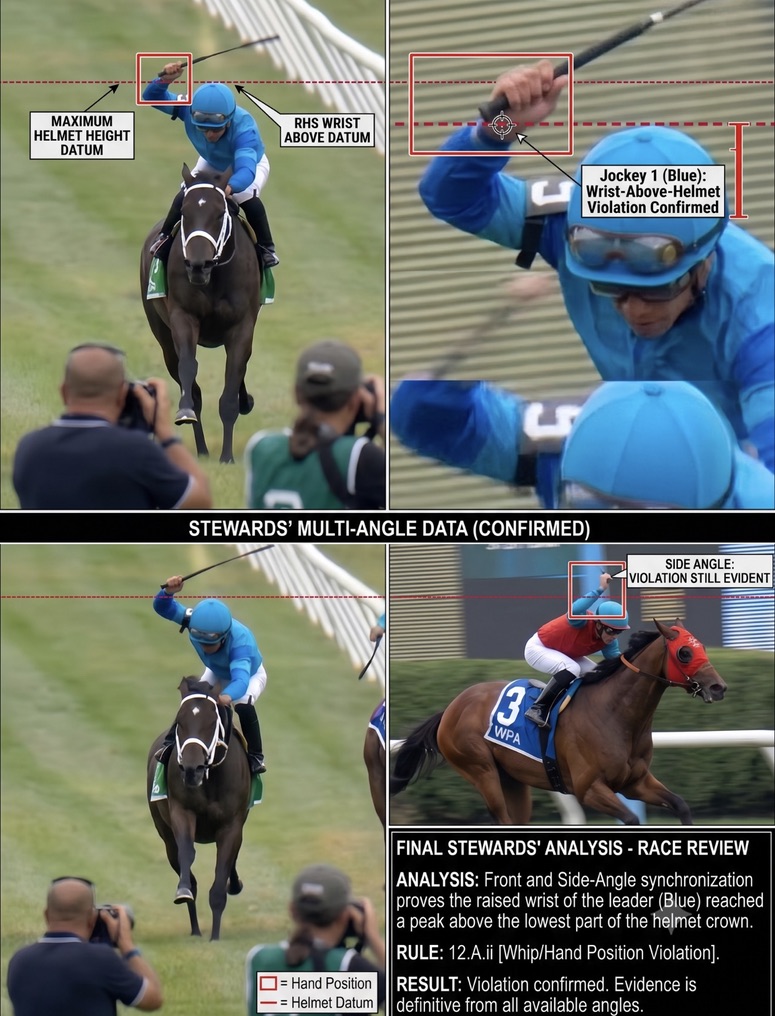
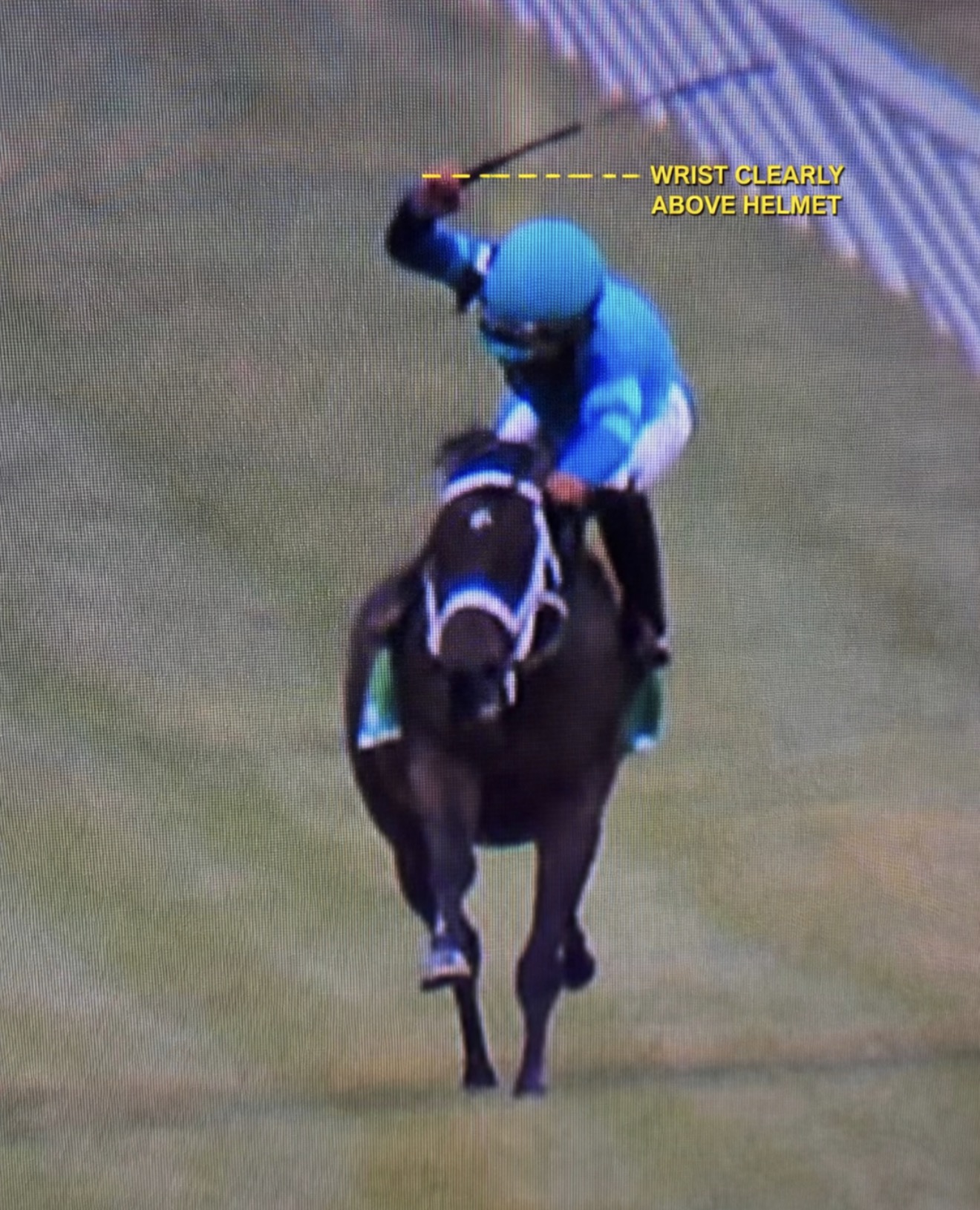
Related coverage: The Stewards Looked At The Tape — And Said They Didn’t See It | When Handle Becomes Destructive | The Enforcement Problem HISA Can’t Outsource Away
It Fits, but you have to get it: