
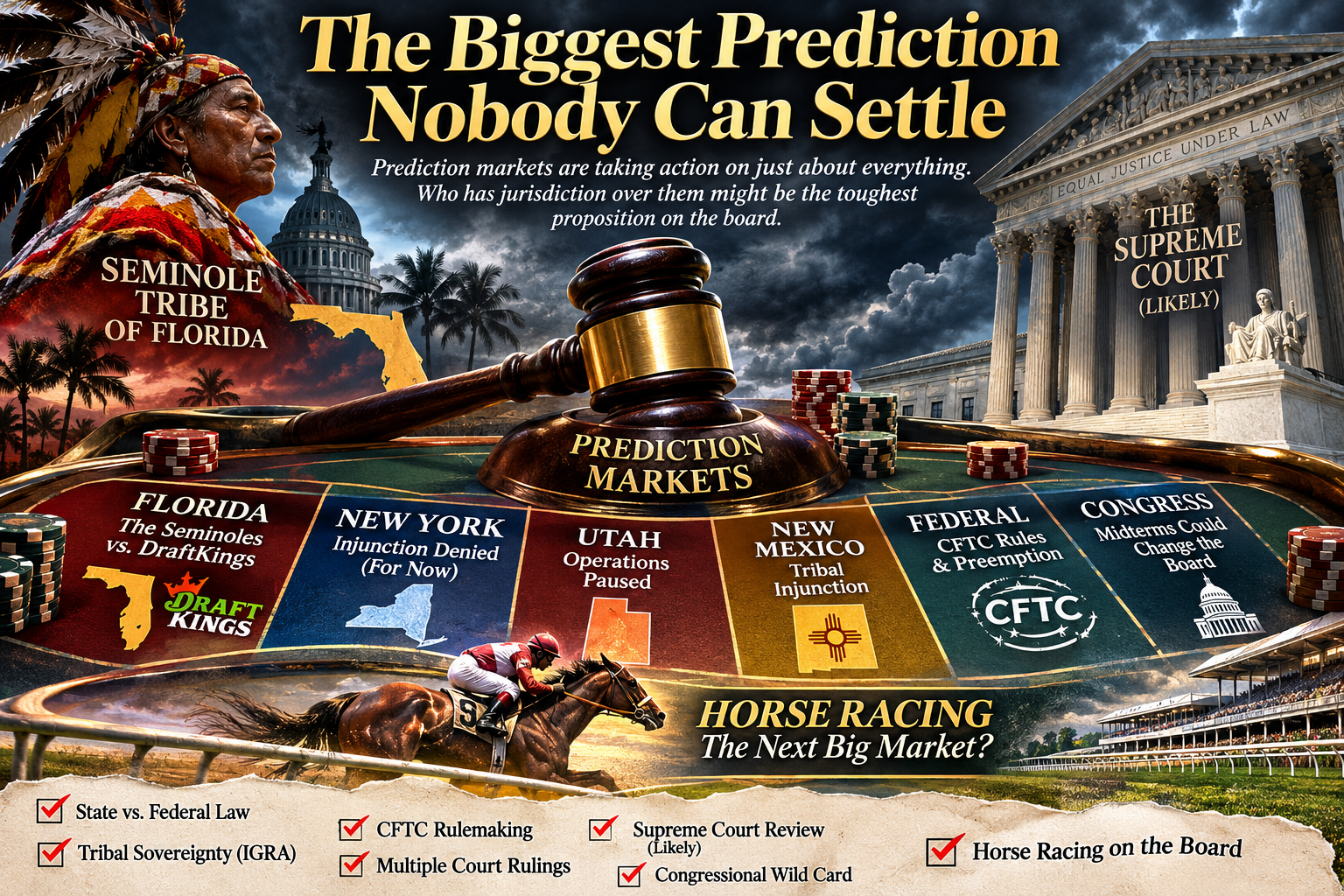

Prediction markets are taking action on just about everything. Who has jurisdiction over them might be the toughest proposition on the board.
If you have been following the prediction market space, and anyone with a vested interest in the gambling industry should be, you might need a pretty large whiteboard to keep track of the litigation. You might also want to use a pencil as opposed to a permanent marker. Things are changing that fast, and what is legal today in one jurisdiction might not be legal tomorrow in another. Interestingly enough, we are talking about the same companies offering essentially the same products under the same federal law.
Sam Schwartz, who does an excellent job covering the space in The PM Pulse, reported several developments over the past few days that, when looked at collectively rather than individually, paint a fascinating picture of where this industry might be heading. We have a federal regulatory agency fighting states, states fighting operators, operators fighting states, sovereign tribal nations fighting operators, and courts disagreeing with other courts. While all this is going on, the companies involved continue to expand, raise money, introduce new products, and enter into marketing and sponsorship agreements.
The commercial expansion of prediction markets is well ahead of the legal establishment of their business model. That is not necessarily an indictment of the companies involved, but it is something anyone doing business with them, investing in them, regulating them, or competing with them should understand.
Utah has taken things further than most states, actually bringing criminal charges against Kalshi and its two co-founders. Kalshi has subsequently suspended much of its operation in Utah, and the state’s attorney general has moved to dismiss the criminal charges without prejudice. That last part is important. Without prejudice means the charges can be brought again. Utah’s civil litigation continues, as does Kalshi’s federal appeal. Nobody should mistake the requested dismissal of the criminal charges for a settlement of the underlying legal issue.
In New York, a judge declined to immediately shut down Kalshi, not because she determined Kalshi was operating legally, but because she wanted the opportunity to hear more comprehensive arguments. The judge herself acknowledged the likelihood of the issue ultimately being decided by the United States Supreme Court. There is also a discussion underway about whether people between the ages of 18 and 20 should be permitted to participate in certain markets. The traditional sports betting age in New York is 21.
Also in New York, legislation has been introduced that would tax prediction market operators and recognize the legality of federally registered exchanges. Think about that for a minute. While the attorney general is litigating against the operation of prediction markets, a state senator is proposing a mechanism to recognize and tax them. You don’t have to go from state to state to find different approaches to prediction markets. You can find them within the same state.
It is Florida, however, where things get particularly interesting, at least to me.
I have followed the Seminoles and their involvement in gaming in Florida for quite some time. I have always found them to be a formidable adversary, whether the battle takes place in a courtroom or in the legislature. There are people who have been in the gambling business a long time, with deep resources of their own, who have learned that firsthand. Challengers have won a round here and there, but the compact has survived every challenge, and the U.S. Supreme Court declined to hear one in 2024.
DraftKings is in Florida. You don’t have to take my word for it, and you don’t have to take the Seminoles’ or the Florida attorney general’s word for it. DraftKings announced it themselves on August 27 under the headline, “DraftKings is available in Florida.” The company told investors its new “Super App” would offer sports event contracts in states where it has no sportsbook.
DraftKings is careful to point out that its traditional sportsbook and casino are not available in Florida. What is available includes prediction markets, horse racing, fantasy sports and other products, several of which can be accessed through the company’s integrated app. The distinction between a sports wager and a sports event contract is a large part of what this litigation is about. DraftKings sees one as a state-regulated gambling product and the other as a federally regulated financial product. The Seminoles and the Florida attorney general see things differently.
What makes this even more interesting is that DraftKings filed its own challenge to the Seminoles’ gaming compact in Florida state court in September, before the Seminoles filed their lawsuit against DraftKings in October. DraftKings has characterized the lawsuit as retaliatory in its subsequent court filings. That is an allegation, not a finding, but it does tell us something about the nature of the relationship between these two entities.
DraftKings moved the Seminoles’ lawsuit to federal court on November 9. The Seminoles intend to seek its return to state court, and on November 24 Florida Attorney General James Uthmeier moved to intervene on the side of the Seminoles, indicating he would support their efforts to have the litigation returned to state court.
Before these people even get to litigate what they are fighting about, they are going to litigate where they get to fight about it. That is not uncommon in litigation of this magnitude, and there is generally a good reason both sides want to be in the court they are seeking to be in.
The Seminoles bring another element into this discussion that should not be overlooked. This is not simply a matter of a state gaming commission trying to protect its jurisdiction or licensed bookmakers trying to protect their market share. We are talking about a sovereign tribal nation, the Indian Gaming Regulatory Act, a negotiated gaming compact, and a state with a significant financial interest in that compact. The agreement provided for a guaranteed minimum of $2.5 billion in payments over its first five years.
Federal judges in both California and New Mexico have now issued preliminary injunctions restricting Kalshi from offering sports event contracts on certain tribal lands. Those cases are not identical to the Florida case, but they make it increasingly difficult to view the entire prediction market controversy as nothing more than a jurisdictional disagreement between state gaming regulators and the Commodity Futures Trading Commission.
The CFTC, meanwhile, is not sitting on the sidelines. It has actively supported the position that these contracts fall under its federal regulatory authority, and it is moving toward new rules governing prediction markets. A final revision of its rule addressing certain event contracts has been submitted to the White House Office of Management and Budget for review.
The CFTC can promulgate rules, but whether those rules are consistent with the authority Congress actually granted the agency is something the courts can examine. The current position of the CFTC is no more a guarantee of the ultimate legality of these products than a cease-and-desist letter from a state gaming regulator is a guarantee of their illegality.
We now have four federal appellate circuits that have weighed in on aspects of the sports event contract issue at the preliminary injunction stage. The Third Circuit sided with Kalshi in the New Jersey litigation. The Ninth, Sixth and Fourth Circuits reached outcomes more favorable to the states’ ability to enforce their gambling laws, although the reasoning is not identical across the decisions. That is one win and three losses for Kalshi at the appellate level. We have what is commonly referred to in legal circles as a circuit split, and that is one of the more compelling reasons for the United States Supreme Court to agree to hear a case.
New Jersey has already petitioned the Supreme Court to review its case involving Kalshi. Robinhood and Crypto.com have also filed related petitions. We are no longer speculating about whether someone will take this issue to the Supreme Court. They have. We are waiting to see whether the Supreme Court will take the issue.
I believe they will, although what form that review takes and how much of the controversy it actually resolves remain legitimate questions.
There is also the matter of timing. Kalshi’s response to New Jersey’s petition is due December 7, which points to the justices considering it in January. Gaming attorney Daniel Wallach has laid out a path to a decision by June 2027. If it slips even a few weeks, we are likely looking at the fall term and a decision in 2028.
The results of the recent midterm elections will change control of both houses of Congress and, significantly, the Senate that would be responsible for confirming any new Supreme Court justice should a vacancy arise. Justice Alito has said he intends to stay through this term, so there is no guarantee the composition of the Court will change during the pendency of this litigation, but the possibility exists. There is also the possibility Congress itself gets involved and revisits the language in the Commodity Exchange Act that so much of this litigation revolves around.
The political and regulatory landscape under which this business model was developed and introduced might not be the same landscape under which it ultimately has to operate.
I would not be surprised to see some of the related federal litigation consolidated or coordinated, particularly the numerous consumer class actions involving common defendants and allegations. Some of that is already happening in New York. I am less inclined to think we will see all of these cases involving states, tribes and operators consolidated into one enormous federal lawsuit. There are too many different legal issues, parties and factual circumstances. What I do anticipate is a controlling decision from the Supreme Court on some of the central questions, which would have major ramifications for the litigation proceeding in the lower courts.
Now, where does this leave horse racing? Is anybody in horse racing paying close enough attention?
DraftKings already offers horse racing in Florida, and the company itself acknowledges that its traditional racing product operates under a separate regulatory framework from sports betting. I have not seen anything to suggest the existing pari-mutuel racing product is itself a specific target of the Seminoles’ lawsuit. That does not mean horse racing should be looking at this litigation from the stands.
We already have a preview. This spring Polymarket listed a Kentucky Derby market and pulled it at Churchill Downs’ request. Kalshi has never listed one. The NTRA told the CFTC that offering contracts on horse racing without proper consent violates federal law. For now, the industry has held the line. The question is whether that line holds if the states lose.
If sports event contracts ultimately prevail as federally regulated financial instruments that can be offered without individual state gaming licenses, what stops an exchange from offering a similar contract on the Kentucky Derby or the Breeders’ Cup Classic, provided it satisfies the applicable federal requirements? What would that mean for the Interstate Horseracing Act, an act governing interstate wagering on horse racing that predates the internet as we know it today by many years? Would the consent requirements applicable to traditional interstate horse racing wagering apply to these contracts?
Who gets paid for putting on the show? The racetracks, the horsemen, the people putting up the purses, the people providing the data, and ultimately the people whose investment makes the event possible all have some vested interest in the answer to that question.
Horse racing has spent decades negotiating percentages of takeout, signal fees, data rights and revenue-sharing agreements. It has fought internally over who gets what percentage of the pie, while in many instances failing to recognize how much smaller the pie might become. Here comes a potentially substantial new market for the very product horse racing produces, operating under a regulatory structure the industry might have far less influence over than the one it operates under today.
There could be tremendous opportunities for horse racing in prediction markets. I have said that before, and I still believe it. There could also be serious financial consequences for the sport if the products are developed and distributed without appropriate commercial arrangements with those who produce them. Those opportunities and consequences are not mutually exclusive.
My prediction in the prediction market space is that the ultimate resolution will be much more complicated than a simple determination that prediction markets are legal or illegal. We may see distinctions between types of contracts, distinctions involving tribal lands, restrictions on the age of participants, advertising regulations, and a restructuring of some of the products currently being offered. Some issues might be decided by the courts, others by Congress, and still others through negotiated commercial arrangements.
I also expect the more established gambling companies to have some interesting decisions to make. They have invested large sums of money obtaining state gaming licenses, complying with state regulations and paying state taxes. Some are now simultaneously pursuing a business model that challenges the necessity of much of what they have already invested in. There is a certain irony in that.
As for DraftKings and the Seminoles, that is one particular battle I will be watching closely. Neither side appears to be looking for a quick exit, and neither has an insignificant amount of money riding on the outcome. DraftKings has already acknowledged in its most recent quarterly SEC filing, which discusses the Seminole lawsuit, that an adverse outcome “could expose the Company to substantial damages or penalties” with a material adverse impact on its operations and cash flows.
There are people trading contracts on who will win football games, who will win elections, what the Federal Reserve will do, and even whether an earthquake will occur. There is certainly no shortage of things to speculate on in the prediction market space.
The biggest proposition on the board, however, might be the future of the prediction markets themselves. I am not sure anybody has a particularly good line on that one just yet.

Comments