


Knife and Fork: The Triple Crown Gets Carved
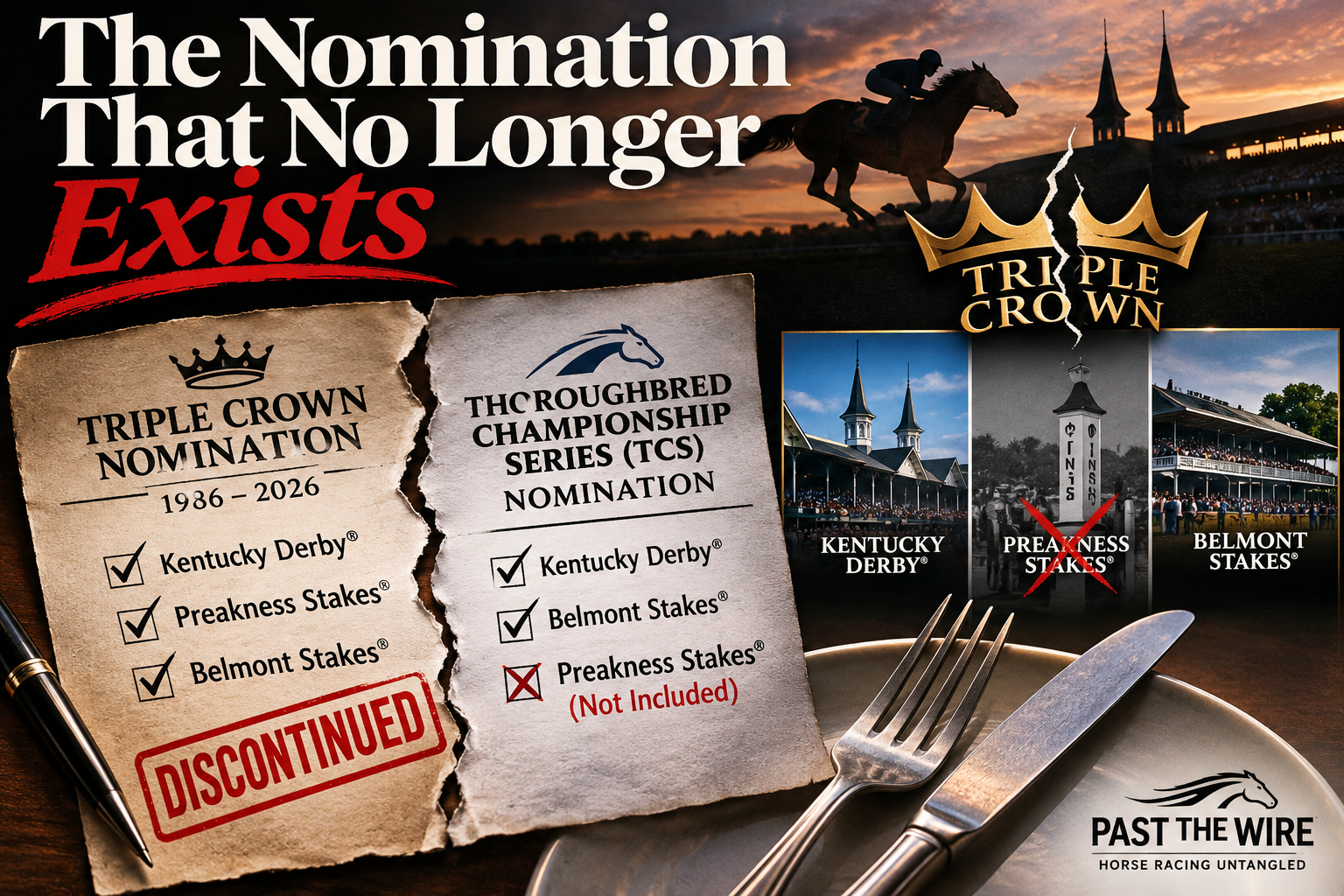
Since 1986, if you wanted a three year old eligible for the Kentucky Derby, the Preakness and the Belmont, you made one nomination. One form, one fee, three races. It was the paperwork version of the Triple Crown itself, the one thread tying three tracks in three states into a single story. As of today, that thread is cut.
Churchill Downs announced Thursday that owners who want to nominate horses to the 2027 Kentucky Derby and Belmont Stakes will do it through the Thoroughbred Championship Series it built with NYRA, not through the Triple Crown. A Churchill spokesperson told BloodHorse there is no plan to accept nominations for the 2027 Triple Crown races. The series has grown to 10 races, six for the colts and four for the fillies, at Churchill, Belmont Park and Saratoga, with $5 million in Derby division bonuses and $1 million on the Oaks side. The Preakness is not one of them.
Nobody announced the end of the Triple Crown. Nobody had to. They just stopped taking nominations for it.
“In No Way Does This Touch the Triple Crown”
When NYRA and Churchill rolled out the series on August 3, NYRA’s David O’Rourke told BloodHorse the Triple Crown could continue alongside it. He went further. He said the Preakness could be added someday, and then he said it plainly: “in no way does this touch the Triple Crown.” That was 101 days ago.
Two days after that announcement, Maryland moved the Preakness to Sunday, May 23, 2027, 22 days after the Derby. The Belmont stayed on June 5, which leaves 13 days between a mile and three sixteenths at Pimlico and a mile and a half in New York. So for 2027 the Triple Crown has three races, two nomination systems, a Sunday Preakness and a turnaround most modern trainers will not even consider. If that is not touching the Triple Crown, I would hate to see what touching it looks like.
They did not kill it. They sat down with a knife and fork, carved off the two pieces they own, and left the middle on the plate.
What Mike Repole Told Me Eight Days Ago
On November 4, Mike Repole sat down with me for almost two hours on Past The Wire TV. He is a top owner, a self described commissioner of the sport, and since October one of the largest individual shareholders in Churchill Downs. I asked him how the series helps racing without hurting the Triple Crown. He told me he had the inside track: “before the announcement, I knew from both sides what was happening.”
His case for the series was about the horse, and it is a fair one. He told me that if Renegade had won the Derby he would have wanted to run back in the Preakness, but there was “more than a 50% chance” Todd Pletcher would have said he could not get the horse there. Then he asked the question nobody in Baltimore wants to answer: “Running a horse back in two weeks. Is that really safe for the horse?” That is a real argument and I respect it.
So I asked him straight. Couldn’t they have included the Preakness in the championship series and kept the Triple Crown intact? His first answer was “anybody who wants to go to the Preakness can go to the Preakness.” I told him that wasn’t my question. His second answer was one word. “Yes.”
Then he went to the calendar. The Preakness on a Sunday, sometimes on Indy 500 day, with the Belmont 13 days behind it. He said he would have signed off on three weeks and three weeks. And he told me where the responsibility sits: “Churchill doesn’t move their date. They’re the first one.” Between Maryland and NYRA, “one person didn’t want to move their date and the other person didn’t want to move their date.”
I am not suggesting Mike knew anything about today’s nomination change. I am also not saying he didn’t. He is a shareholder, not a board member, and he defended the series on the merits, on camera, in his own words. But at the top of that interview I asked him which Mike shows up when Churchill makes a decision that helps the shareholders and hurts the game. On this one, we don’t get that answer. Mike sees an opportunity to grow racing where I see a risk of sacrificing something irreplaceable. Both positions can be sincerely held.
Here is the part that should keep everyone up at night, and it came from Mike, not me. He told me the Derby draws 25 million viewers, and “the day after the Derby when you go to the Preakness you go from 25 million viewers to 5 million, and if you don’t have a Triple Crown winner you probably go to 2.5.” Read that again. The only thing that carries a casual fan from the first Saturday in May into June is three words. Going for the Triple Crown.
Two of the Three
The Triple Crown never belonged to one company. It belonged to three races, three tracks and three states, and to every fan who ever stood at a television in June waiting to see if this was the year. What changed today was changed by two of the three players, not all three. The two who own the first and third legs built a series around themselves, and the one in the middle found out along with the rest of us. You can dress that up any way you want. It is still two people deciding for three.
Now let me be fair, because I owe you that. Maybe it was time. Maybe the game evolved to the point where this had to be done. The modern three year old does not run back in two weeks, and the numbers say so. Of the 95 horses who ran in the Derby since 2022, just 13 went on to the Preakness. The Belmont has been run at Saratoga. The spacing that made the Triple Crown a test of a horse’s toughness now looks, to a lot of horsemen, like a test of how much risk you are willing to take with the horse.
The history is what it is. Thirteen horses. Thirty seven years between Affirmed and American Pharoah. Great horses got beat in the Belmont, and great careers were measured by how close they came. It has always been one of the most difficult feats in all of sports, and that difficulty was the whole point. Maybe, for everybody but the traditionalists, it simply ran its course. I am a traditionalist. I will admit that up front. But I have also been around long enough to know the difference between a tradition that fades on its own and one that gets taken apart.
Did We Break the Only Thing We Had Left?
So here is the real question. Can the excitement and prestige of the Triple Crown be duplicated, and dare we say surpassed, by a brand new points series added to a struggling game? Six races, a bonus pool, a championship race at Churchill in September and a standings table. Maybe it works. I hope it does, because this game needs something to work. But nobody outside of racing knows what ten points in the Jim Dandy means. Everybody knows what a Triple Crown is. Your neighbor who has never bet a race in his life knows American Pharoah and Justify.
That is the asset. Not the purses, not the bonuses, not the television windows. The foal crop is shrinking, tracks are closing, and handle has been flat or falling for twenty years. In the middle of all that, the Triple Crown was the one thing in this sport that crossed over to people who do not follow it. It was the one story we did not have to explain. And we just broke it apart to build something we will have to explain every single year.
In Part 2 of our interview, Mike told me that once racing leaves a state, “you’re not going to get it back. You’re just not.” He was talking about racetracks. It applies to traditions too. The series can be tweaked, rebranded and expanded. The Preakness can be added later, like O’Rourke said. But a Triple Crown that has been split into two nomination systems and two competing calendars does not snap back together because somebody changes their mind in five years.
All the king’s horses and all the king’s men. We all know how that one ends.
Past The Wire will be watching what Maryland does next, and what the first crop of TCS nominees looks like when the list comes out.
Maybe I get a pass for my reservations. I was on a chair standing on the third floor of the grandstand that day. I can still feel the electricity.


Comments