


Rules Are Rules Until They Aren’t
A Pre Breeders’ Cup Snafu
Horseplayers don’t ask for much. We know the takeout is too high. We know the game is hard. We know we’re going to lose photos, get stuck behind walls of horses, and watch our single get nailed on the wire. We accept all of that. What we don’t accept, and shouldn’t have to, is a racetrack that writes a rule, posts the rule, announces it is applying the rule, and then doesn’t apply the rule.
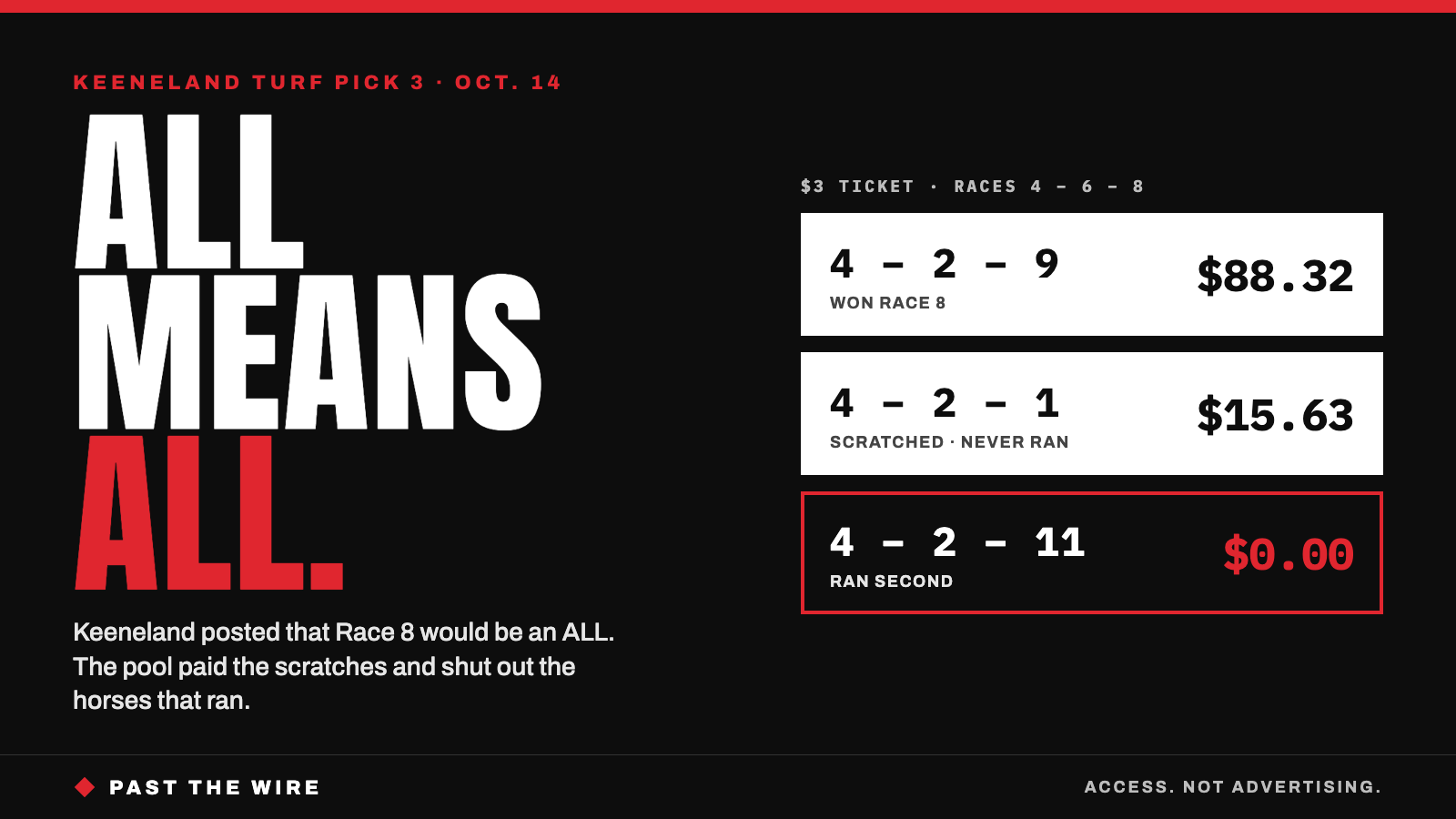
That’s what happened at Keeneland on Wednesday, October 14, in the $3 Keeneland Turf Pick 3.
The Turf Pick 3 that day covered Races 4, 6 and 8. Race 4 was scheduled to go at 2:36 p.m. The weather came in, as it was forecast to, and at 4:06 p.m. Keeneland posted on X that Race 8 had been taken off the turf. In that same post, Keeneland said Race 8 would be treated as an ALL race for the Pick 6, the Late Pick 5, the Late Pick 4, the Late Pick 3 and the Turf Pick 3. The main track was sloppy. Three fillies scratched because of the surface change: Fiery Lucy, My Stubborn Lassie and Temple Goddess. The race went off at 4:49, a mile on the dirt, and Lit Ship won it and paid $6.50.
You don’t need to be a mutuel manager to follow what should have happened next. The other pools did what Keeneland said they would do. The $3 Late Pick 3 came back 2-1-ALL and paid $42.18. The Pick 4 and Pick 5 paid with ALL in the last leg. The Turf Pick 3 did not. It paid 4-2-9, $88.32 for $3, on a pool of $61,869. But here’s the part that turns a mistake into a head-scratcher. The Turf Pick 3 did pay consolations, $15.63 for $3, on 4-2-1, 4-2-5 and 4-2-10. Those are the three horses that scratched. Read that again. If you had 4-2 and a filly who never left the barn, you got paid. If you had 4-2-11, Tramuntana, who dueled with the winner to the final sixteenth and ran second, you got nothing. Same for every other horse who actually ran. Understand what that means. A late scratch in the last leg of a Pick 3 earns a consolation on any ordinary day, surface change or no surface change. So those $15.63 payouts don’t show the off-turf rule was applied in part. They show it wasn’t applied at all. The Turf Pick 3 was settled like a normal race with three scratches, as if the race never left the grass and Keeneland never posted a word about an ALL.
This isn’t a gray area. Keeneland’s own wagering page says traditional Pick 3 rules apply to the Turf Pick 3. It says, in plain English, that a surface change in the second or third leg not made public before the start of the first race results in an All Win for runners who compete in the changed leg, with consolations for runners who scratch. Kentucky’s regulation, 810 KAR 6:020, goes further. When a surface change isn’t disclosed before off time of the first race of a Pick-(n), the stewards are required to declare the changed race an all-win, and every ticket holder is assigned the winner of that race. Required. Not allowed to. Required.
And there’s no argument about whether the trigger was met, because Keeneland made that call itself, in writing, at 4:06 p.m. Race 4, the first leg, was scheduled to go an hour and a half before that post went up. Jeremy Plonk even reminded players that morning that surface changes after a multi-race sequence starts mean an all-win at Keeneland. Everybody knew the rule. Keeneland announced the rule. The tote just didn’t follow it.
When players started asking questions on X, horseplayer Henry Karsen among the loudest, Keeneland’s answer was that for the Pick 3 and Turf Pick 3, players with a scratched horse received a consolation payout rather than an ALL. That’s true, and the chart backs it up. It’s also exactly how that pool would have paid on any ordinary afternoon with three scratches, and it has nothing to do with the complaint. Nobody is asking about the scratches. People are asking why a ticket with a horse that left the gate in Race 8 wasn’t paid as an ALL, when the regular Late Pick 3, ending in the exact same race, was. The answer given doesn’t answer that question. It answers a different one.
Here’s the part that should bother Keeneland most. This has happened before, at Keeneland, in this exact way. On October 26, 2011, Keeneland took a race off the turf after a Pick 3 had started, and the pool paid only the winner of the last leg instead of ALL. Keeneland caught it, recalculated the payout, told players how to cash the corrected tickets by mail or at the information window, and its mutuels director put his name on a statement that began, “We regret the error.” That’s how you handle it. Own it, fix it, pay it. Fifteen years later, same mistake, and so far, no fix and no apology.
The fix isn’t complicated, and the industry has a blueprint. When Sam Houston failed to pay Pick 5 consolations on a mandatory payout day, the track found the consolation tickets, paid them at corrected prices, and let the players who had already cashed at the incorrect, higher price keep their money. Nobody got clawed back. Nobody got shut out. The track ate it. That’s the template here. The 4-2-9 players cashed in good faith and should keep every dollar. The 4-2-ALL players should be paid what the pool would have paid them under the rule, and Keeneland should cover the difference. The Kentucky Horse Racing Commission has made tote companies seed future pools over calculation errors far smaller than this one. A commission that will do that over penny breakage can certainly ask a question about a $61,869 pool.
I want to be clear about something. I’m not alleging anyone at Keeneland did this on purpose. My guess, and it’s only a guess until someone tells me otherwise, is that the Turf Pick 3 is a separate specialty pool, it’s set up separately in the tote, and somebody never flagged it for the surface change the way every other pool was flagged that afternoon. Human error happens. But a mistake becomes a problem when it’s pointed out, publicly, and the response is a sentence that changes the subject.
So here are the questions, asked openly, to Keeneland and to the Kentucky Horse Racing Commission. Did the stewards formally declare Race 8 an all-win for the Turf Pick 3, as 810 KAR 6:020 requires, and if they did, why wasn’t the pool paid that way? Who entered the Turf Pick 3 payout, Keeneland’s mutuel department or the tote operator, and where did the process break down? Why was the Turf Pick 3 settled like a normal race with three scratches, paying consolations on the scratched horses but not the ALL on the nine that ran? How much was bet on 4-2 combinations in the Turf Pick 3, and what would the correct ALL price have been? Will Keeneland pay the 4-2-ALL ticket holders the way it did in 2011? And has the commission opened a review?
These are fair questions with factual answers. Past The Wire will publish Keeneland’s response and the commission’s response in full, unedited, the moment we receive them. If I have anything wrong here, show me and I’ll correct it just as publicly.
Keeneland is one of the best racetracks in America at a lot of things. It sells the experience, the tradition, the integrity of the place, better than anybody. It created the Turf Pick 3 with a 15 percent takeout to be good for players, and it is. That’s exactly why this matters. A rule written for the player’s protection is only worth something if it’s honored when it costs the house a little. ALL has to mean all. Every time. Not just in the pools that got the memo.


Comments