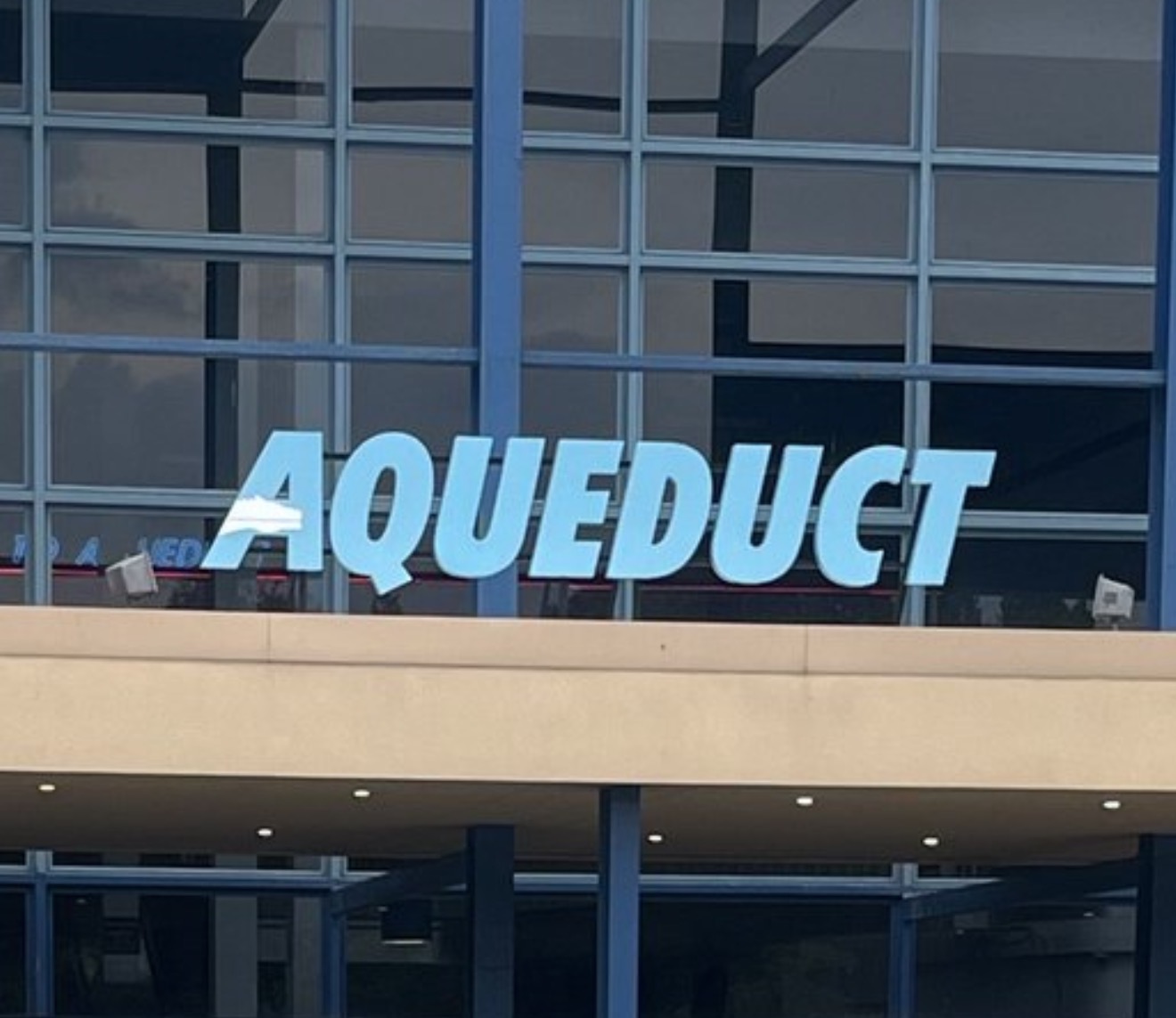
Some personal memories of the Big A, also known as Aqueduct Racetrack
New York City Doesn’t Have a Racetrack Anymore, It Has a Casino
Aqueduct, or the Big A as we always called it, was almost like a second home. I grew up around all three NYRA racetracks but Aqueduct was just a few exits down the Belt Parkway, and it literally felt like my backyard. I can’t even imagine how many days I spent there. The freezing ones, where the parking lot was black ice and it was harder to walk to and from your car than it was to pick a winner, stand out. The stampede of people coming down the ramp off the train was, in retrospect, a sight to behold, but back then it was just an ordinary part of the landscape. The Big A was the least glamorous of the NYRA tracks, but it had the character to hold its own for many years up against beautiful Belmont Park and historic Saratoga.
Before it was a ritual to head to the Sheepshead Bay Train Station at night, after 10 PM delivery time of course, I remember breakfast in our small cramped apartment looking at the entries page of the Post or The Daily News. If it was a weekend we didn’t have to say where we were going or what we were doing. The track was a given. An automatic. Rain, snow, sleet, freezing, blizzard, that it never mattered. We’d get there and they’d race. A cancelled card was an event. It hardly ever happened.
There were so many characters, so many familiar faces, so many crews, and of course the typical racetrack stereotype with the gruff voice, folded racing form and program, and stale cigar was bred at Aqueduct. Frankie The Shy, The Whale, Scrubhound, Roach, Vinny Zen, all regulars, and a regular meant daily attendance. Some days late, maybe the 4th or 5th race, but they always showed up.
It was there, sometime in the ’80s, that I met and became friends with Kentucky Derby-winning owner Ramiro Restrepo’s father, a generous, kind, and classy man and that friendship continues to this very day with his son. I look back fondly on discussing the plays that day with him and reflect on how we had no idea that someday his son would win the race of all races, and be gracious enough to make me feel like a part of it. That is priceless.
Look, I have never pretended to be a choirboy. But it was a different world back then, and unless you were a part of it you really can’t understand it. Judge if you will, it matters not. Now some of this will require you being a racetracker, or at least a street guy, otherwise it just won’t hit the same. It’s like trying to understand The Pope of Greenwich Village when you’re from Ohio.
The Battle-axe
Ah, the battle-axe. I’ll never forget her. A rainy, quiet morning on the first floor of the clubhouse. Right where the escalator would take you upstairs where the bagel place was on your left. There was a stairway there, and the doors of the Big A stairways were steel. Heavy steel.
There I am, standing under a TV watching the prior day’s replays, and that steel door swings open, swung with enough force that it hit the wall. The bang was beyond loud. It was thunderous. There she was. Hair in rollers. A housedress on. Slippers. A moth-eaten old coat. After the bang you couldn’t help but look up. She looked right through me and anyone else staring at her.
It was about an hour and a half before the first race. She scanned the clubhouse with precision. It seemed like the only person who wasn’t startled, the only one who didn’t look toward the bang, was him. Sixty-ish, frail, thin, staring down at his program, not the Racing Form, just the program with numbers. There were no programs with past performances back then. Just numbers, tip sheets, or the “form.”
When she spotted him it looked like a lioness spotting her next meal after a week of starving. Her voice rang out loud, as loud as the track announcer, but she had no microphone or megaphone. She didn’t need it.
Bang!!! A three-to-four-second delay, then: “I knew where to find you, you useless son of a bitch!”
He looked up in utter horror. I watched in equal horror as she dragged him down the escalator walking while the conveyor ran. She had him by the hair. He was speaking fast, desperately, but I couldn’t make out a word. I’ll never forget that bang or her face and voice. Ah, the Big A. We are talking late ’70s, early ’80s.
The Shape-Up
My Dad was a mutual clerk, as was my older brother. It was actually a coveted job back then. The union guys made $120 a day and worked from about 11 AM through the last race, which was around 5 or 5:30 PM. You didn’t even have to know how to count, the tote machine did everything for you. They got time and a half on Saturday and Sunday, which came to about $180 for those days, along with benefits, a pension, and a pretty cushy go of it. You had to know somebody to get the job. They had a shape-up where they put the extras, not yet in the union, to work as needed. You had to work a certain number of days in a year to make the union. Until then you were a $45-a-day extra.
I was 17, had just dropped out of school, and next thing I knew I was a mutual clerk extra shaping up at the Big A. It wasn’t for me. When I dropped out my Dad said, “Don’t think you’ll be hanging around the schoolyard getting in trouble. You’re coming to work every day with me.” I’m not sure what he was thinking, he created a monster, or at the least had a hand in it, but in the end I don’t think either of us would have had it any other way.
We were always involved in racing one way or another. My Mom was at the track the day before I was born, and a few days after with me in a stroller. And you wonder how I turned out this way.
I was probably the only extra who didn’t want to get picked up at the shape-up. I’d rather gamble, and I was getting good at it. Very good and people were starting to notice.
The Bay of Pigs
The sections where the mutual clerks worked were called bays. Bay 2 was also known as the Bay of Pigs, as hardcore a New York racetrack setting as you could find. But there was another, more sinister aspect of this bay. The clerks who worked there stole. Consistently. They short-changed bettors and had tricks worthy of a book all their own.
One guy lifted the laminate with a butter knife so that when he slid money, slid, by design, as opposed to handing it over or counting it out, the bottom bill would stick and the customer would walk away leaving it behind, winding up in the teller’s pocket. Some would leave sub-totals on the machine to be added to the next patron’s total after they bet. They were truly despicable, and they made all the clerks look bad. Everyone knew, and most looked away. The people who were watching, bay supervisors were mostly retired NYPD and called Willards after the rat. Do I have to say more? Okay, I will, they were far more interested in placing their bets than what any of the clerks were doing, or not doing.
My cousin was a charter, and he had two guys who followed his every bet. Because he was charting rather than handicapping, they bet last-second, at the $50 window in the Bay of Pigs, which happened to be right where they hung out on the first floor of the grandstand. When they won, they staked Gene, who worked that window handsomely.
I convinced my Dad that when he picked his Big A assignment, he should pick the Bay of Pigs. He thought I was nuts. I explained: if he was there, Cuzz would obviously bet with his own uncle rather than Gene, and so would his two guys. They’d stake him and he’d do well, which, given how my Dad and I operated, meant I’d do well too. He went along, very reluctantly.
My Dad was not one to mince words, back down, or take any crap whatsoever, regardless of the circumstances. He was a truly rare and fearless man who never displayed, not once, a self-preservation instinct.
Well, this one went kaput. Cuzz, for whatever reason, never once bet with his own uncle. Not one time. That meant his two guys didn’t either. So now my Dad was trapped in the Bay of Pigs.
That’s when we found out the policy. It wasn’t written, it was understood. Whenever a customer came back to complain, just give them the money. Don’t argue. Don’t deny. Don’t let it get loud or escalate. These guys were stealing so much that they were happy to give back anything anybody complained about.
Now the people betting in the Bay of Pigs were about as sharp as bowling balls. Inevitably they’d mistakenly come to my Dad’s window to complain. He was not a patient man. The conversations went like this: “Listen, take a good look at my face. I don’t do that. Go back to the window where you bet and remember me. I do not do that crap.” He was loud. The other clerks were horrified. “Joe, please, what are you doing? Just give them the money, we’ll give it back to you.” “No, and you know what, you deal with it.” This was daily. And that meant I heard about it daily, for the whole meet. He hated it, which meant he made sure I hated it more. “Look where you stuck me, you idiot” I heard that more times than I can remember. I still hear it. I just wish it was from much closer.
Joe never stole a dime from a bettor. The Bay of Pigs clerks were quietly relieved when he never picked that section again. Ultimately, Cuzz not betting with my Dad meant nothing, I was soon one of the bettors they were charting.
The Hole in the Fence
Before I officially dropped out in the 9th grade, my parents thought I was at school. I wasn’t. Many times I was at the hole in the fence, clearly visible on the TV replays they showed every night back then. The hole was midway on the far turn, slightly closer to the top of the stretch, and you could crouch down and watch the horses head for home unobstructed, maybe fifteen yards away.
I learned so much about race riding without ever having been legged up. Angel Cordero, Jorge Velasquez, Jacinto Vazquez, Eddie Belmonte, Ruben Hernandez, Eddie Maple, Laffit Pincay, Braulio Baeza, Ron Turcotte, the best of the best rode past me crouched at that fence while I was supposed to be in Algebra or Social Studies or some useless shop class.
It was not like watching a race on TV. You heard horses gasping, struggling, accelerating, kicking in. But it was more about the riders. “Coming through, MF — get out of my way.” “I got horse, I got horse, let me out.” “Get off the rail, I’m coming through.” “Come that close again, I’ll drop you.” I learned that race riding was race riding, a different game than anything you’d see from the grandstand. I became a better bettor watching from that fence. I’ll still do it occasionally if I can.
Contrary to some local stories, I did not make the hole. Nor do I know who did. I simply utilized it, and had people run my bets. It was not easy to cut school and be at the same place as your father without him knowing. Mom was a patron and often there as well. Challenges.
The Strike
The mutual clerks and NYRA management always had a tumultuous relationship. That always heated up at contract negotiation time. Management always wanted to take something away, and the clerks were pretty much reduced to fighting to keep what they had. They needed each other, though, so usually things got worked out, until the time the old regulars sold out the new regulars, essentially broke the union, and changed the job forever. That story is probably worth telling, but not here and not now.
One of those contract fights turned into a real old-school strike, picket lines on Rockaway Boulevard leading into the track. My Dad and all the regulars were in it. Those who crossed it had rocks thrown at their cars and were called scabs. Most of the other racetrack workers were against the clerks. They didn’t care about them, they just wanted racing to go on uninterrupted. Nobody likes their livelihood messed with until it’s their own behind at risk.
Management was desperate. They were bringing clerks in from other tracks to cross the picket line. Ads in the paper, anything they could do. Training was about an hour and you were on a window. In the land of the blind, the one-eyed man is king.
Interestingly, a lot of my friends needed jobs. Who didn’t? But who wants to be a scab? Well sometimes you can kill two birds with one stone as they say. I got a lot of my friends jobs. They all, every single one, lasted a single day, and somehow they were all terrible with math and money. They were all short in their cash drawers a few thousand apiece. Immediately fired and told not to return. I don’t remember how long the strike lasted, but I did buy a new car at 17 when it was over. It was a Cadillac.
The Betting Book
Back then I started taking one of those black-and-white marble-covered notebooks to the races with me. It was my Racing Form, the program, and my notebook all rolled into one system. I was in my late teens, maybe very early twenties, and driving a gleaming white Coupe de Ville with red leather interior, true spokes, and vogue tires. Back then that was the ticket. And it all came from the notebook. It was my second Cady.
I became known as a dangerous bettor, and a lot of people knew I kept a notebook with my own notes on horses who had troubled trips, and that I bet them back big when they ran again. It was the notebook that attracted Vic and Dom to me. (Not their real names) They had their regular table just to the left of the escalator leading up to the first floor of the clubhouse, right near the bagel stand where you could sit while you ate. Everyone knew who they were. Most nodded hello, but a seat at that table was by invitation only. I was invited.
Both had reputations as tough guys, well deserved I’m sure, but they were extremely kind to me and always gentlemen. Vic was already made at the time. I remained close to him until he passed. We got together years later in Florida. It was like time had not moved. Dom was straightened out later, and I heard he went bad, but by then we’d already lost touch, as things go.
The book carried us through two brutal winters. We became good friends and cashed some very nice bets. All good things come to an end, I guess. The book was no different. But while it lasted, it was something.
One day I went to bet an ice-cold $200 daily double at my friend Joe’s window. He was an extra, like I used to be. He said, “How the hell are you betting $200 cold doubles?” I told him about the book. Lovin Touch in the first leg, Christy’s Ridge in the nightcap, the latter in the book. Both won. When I cashed, Joe and I had a conversation that changed my life. He became a dear friend and a lasting influence. Turned out he was a big shot with a major New York City job, Civil Service, but big enough to hire provisionally. He convinced me I had to have a job, so I went with it.
I lasted a little over a year. Most of it involved driving an unmarked Gran Fury, if you know, you know, with a cherry bubble and a yelp horn, to and from the track to make our bets. Traffic was never a problem. But a weekend trip to Florida that stretched into four weeks changed my course again. I did meet a brother from another at that city job though. Angel is one of the best people I’ve ever known, and still is. Never out of sight, out of mind.
Oscar
I truly believe a chance meeting started the Oscar Barrera phenomenon that consumed New York racing. And I believe Shifty Sheik running Slew O Gold to a neck was probably the beginning of the end of it.
It was the last race on a cold, rainy day at the Big A. Only the hardcore were left. When you walked through the doors or turnstile that led from the first-floor grandstand into the first-floor clubhouse, you immediately came upon a bar or concession stand, I can no longer recall exactly which, despite passing it more times than any of us can count. Whatever it was, another stand was right next to it.
I saw him immediately when I walked through the doors. Wet, wearing a blue hoodie long before Bill Belichick somehow made them fashionable, sweating despite the cold, and sporting the biggest ear-to-ear grin I can remember. Jay was a sweet man. Kind and good-natured, all class. He owned a Sunoco station and every summer would tune up my old car to make sure I made Saratoga and back and let me pay him over time, no interest. Just class.
This was before the 7 Series, the S-Classes, the Lexuses and Jaguars, Maseratis, and Ferraris. At one point it was a 1972 Plymouth Duster. The passenger door was held closed by a rope tied to the headrest of the driver’s seat. A piece of cardboard covered the floorboard on the passenger side, and if you moved it you could literally see the road. Eventually it stalled on Rockaway Blvd., two blocks from the Big A parking lot. I took the plate, left the car there never to be seen again. I walked the rest of the way.
“Jay,” I said, “what are you doing here, and why the huge smile, did you make a hit?” He passed me a joint he was not so discreetly smoking, and somehow the smile got wider. “Can you keep a secret?” he asked. Of course I said yes.
And then I heard it for the first time. What would become New York racing legend, the kind of thing you had to witness to grasp. “This guy Oscar Barrera,” he said. “He doesn’t claim a lot of horses, maybe two or three a year, but when they run back, they always win. Always.” “Always?” I said. “Yes, always,” he answered. “I’ve been watching and betting them for years.” He showed me a roll of money that could choke a horse and said he’d taken everything from the station to bet.
I looked at my by-then waterlogged Daily Racing Form. The horse off the Oscar claim was Alturas. Jimmy Miranda was riding. He was 7-1 with three minutes to post. Jay said okay, he had to go, told me to bet him, and disappeared into the mist.
I had two hundred dollars to my name. No other income, nothing to fall back on, a racetrack hustler if you will. I looked at the form. Alturas had a shot. He did like the slop, and it was sloppy. But he looked far from a cinch. I needed money, was never scared to take a risk, and went to the window and bet $100 to win. I began the walk back to the apron, and instinct took over. I turned around and bet the other $100. If Jay was right, make it count. If he was wrong, you’ve left this place broke before.
Alturas broke with the pack and stalked from the outside. He took command coming off the far turn and drew away to win easily, four or five lengths. What was Jay onto?
What feels like a few weeks later, give or take whatever the schedule allowed, the next off-the-claim Oscar horse was Dancer’s Melody. A slow plodder who ran mile-and-a-quarter, mile-and-a-half slogs. Oscar had taken him from Sue Sedlacek, a competent trainer from a real horse family. The horse was racing at the bottom New York level in the slowest races on the grounds. Oscar ran him back in just days. We were still at Aqueduct, only now, fittingly, it was sunny. He entered him in a six-furlong allowance race, and every handicapping principle known to man said he would trail the field. He went wire to wire under Jean-Luc Samyn at about 8-1, running the fastest six furlongs of the meet. Every dollar to my name was on him and it was a lot more than the original $200.
Jay made me strike gold. To this day I favor Sunoco when I can find it, especially the 94-octane super unleaded nobody else has. My cars, which have since elevated considerably seem to relish it. Irony.
Soon everyone knew. That was not my doing or anything I had a hand in. Oscar became more active and people started noticing. It took over New York racing. People didn’t root for names they rooted Oscar, Oscar, Oscar. “Who do you like in the 5th?” was answered many times with one word: Oscar. His barn windows were spray-painted black. There was a sign: Keep Out. Eight-to-one turned into even money, but you could double, triple, or quadruple your money a few times a week. The Duster was now a white Coupe de Ville. The drive to Saratoga was no sweat, but I still stopped at Jay’s station. He could have just said hello but he told me.
How good was he? He ran the only horse I ever saw fall down and get up and win, Creme de la Fete. Somehow, the race miraculously wound up on YouTube. The only problem is when he goes down to his knees, and then gets uo and continues racing, happens at the top of the stretch and out of the cameras view. Nonetheless it is worth watching, you’ll see why:
The Voices
I have heard many race callers in my day. Most are good, some very good, and some great. Tom Durkin was calling races on the last day at the Big A — but contrary to popular belief, he is not the voice of New York racing or of Aqueduct. That distinction has to go to Fred Caposella. If you listen closely enough when you go through those turnstiles, you can still hear “It Is Now Post Time” said as only he could, with that signature announcer’s voice. I remember hearing it as a kid, and my brother Lou mimicking it to a T at home.
I remember Dave Johnson and his “Down the stretch they come.” Marshall Cassidy never got the credit he was due. He could call a race, and he had that racetrack voice that no matter how good you call, if you don’t have it, it just doesn’t hit right. I think Caposella is the only announcer whose voice can still be heard in the distance, if you go quiet enough and listen.
A Jockey Agent
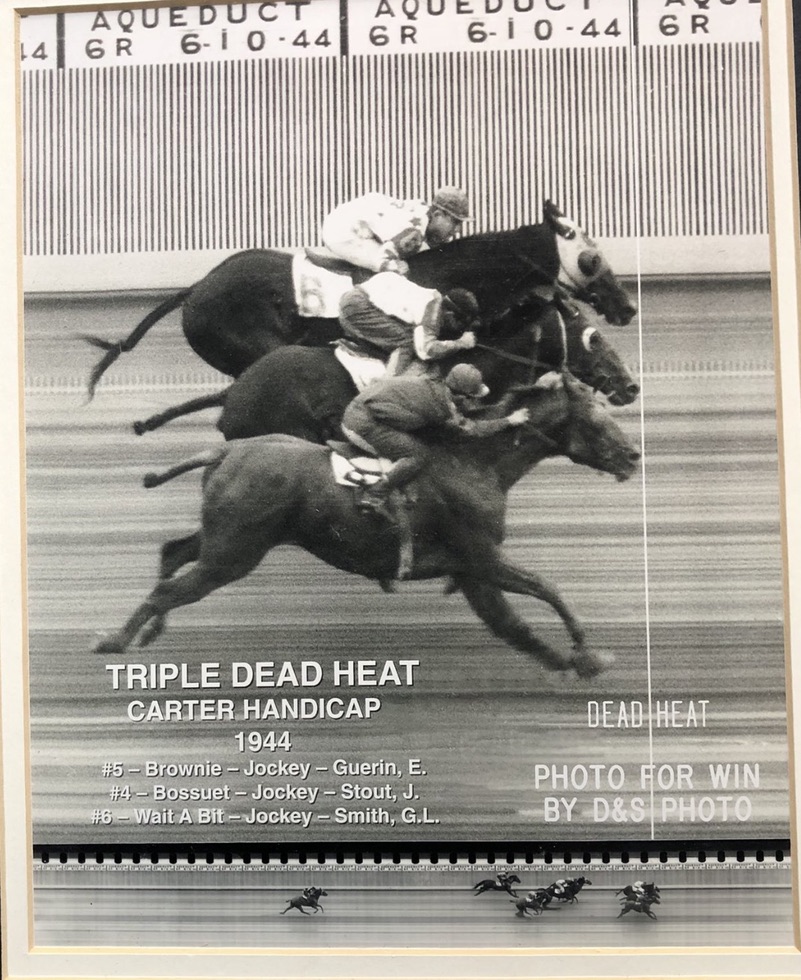
Yes I became a Jockey Agent for a short time. I was terrible at it but had the pleasure of representing Donald L. Smith for a time. He surely deserved better but we did manage to win a few races together. The very first one was at the Big A, Donald rode Charming Rhythm for Mike Galimi. Donald is currently a steward, and I have no doubt an excellent one. His father is part of Aqueduct history. Gayle Smith rode Wait a Bit in the famous Triple Dead heat in The Carter Handicap.
The Senses
Stairways where the air could get you high — oh yeah. Knishes — oh yeah. Hot dogs — oh yeah. Clam chowder — oh yeah. Cigar smoke — of course, oh yeah. Shylocks, as they were called then — oh yeah. Damon Runyon characters every few feet — oh yeah.
Tradition
Don Peppe’s after the races, not much food better after a big day. It was pretty good after a bad day also.
Fast Horses
That second Breeders’ Cup wasn’t the only day I saw fast horses race around Ozone Park. Damascus, Dr. Fager, Arts and Letters my earliest, vaguest memories. Secretariat, Riva Ridge, Forego, Ruffian, Seattle Slew, Prove Out, much clearer. Easy Goer, Lure, Lady’s Secret, clearer still. Far too many to name, and no slight to any not mentioned here.
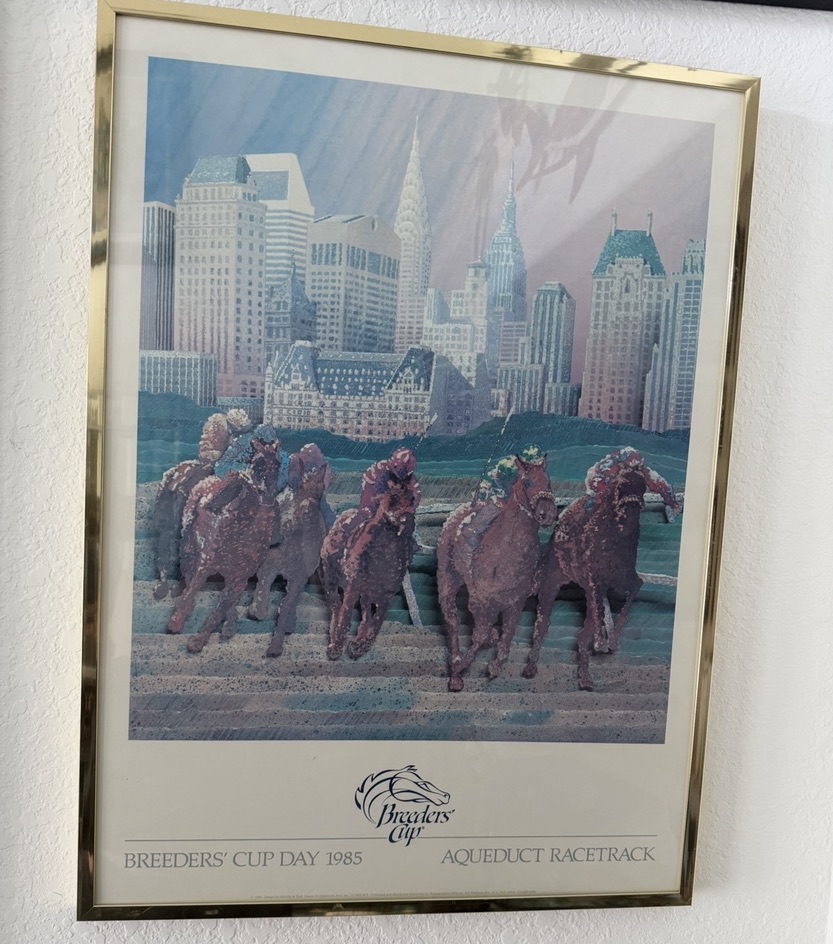
I was a mutual clerk extra the day of the second Breeders’ Cup at the Big A. Forty-five dollars a day was the pay. My Pick 6 ticket cost $4,800. I know the math doesn’t work but remember, I was a gambler forced to have a job, not someone with a job who gambles. Big difference. My single, Proud Truth in the Classic, won. I lost. I had to bet him to win just to break even. I got knocked out in the Sprint, the first leg, I didn’t use Precisionist off the layoff and cutting back. Ouch. Had Smile and a few others but was nailed. It still stings a bit.
But don’t think for one second that I would trade it. Don’t think for one second I wouldn’t wind up with a piece of Big A history for myself. I wish that ticket had started out differently, but at least we got that day. Thank you, Pauly Tow Truck.
I think this isn’t really about Aqueduct.
It’s about disappearing America.
It’s about an era where racetracks were neighborhoods, not entertainment venues. Where everyone had a nickname. Where you knew every mutual clerk. Where a man with a folded Racing Form could become part of your life for fifty years.
The Last Day
So today was the last day of the Big A, and a chapter of my life. The only thing I won’t miss is the traffic on the Belt Parkway.
There are eight million stories in the naked. This was just one of them.