

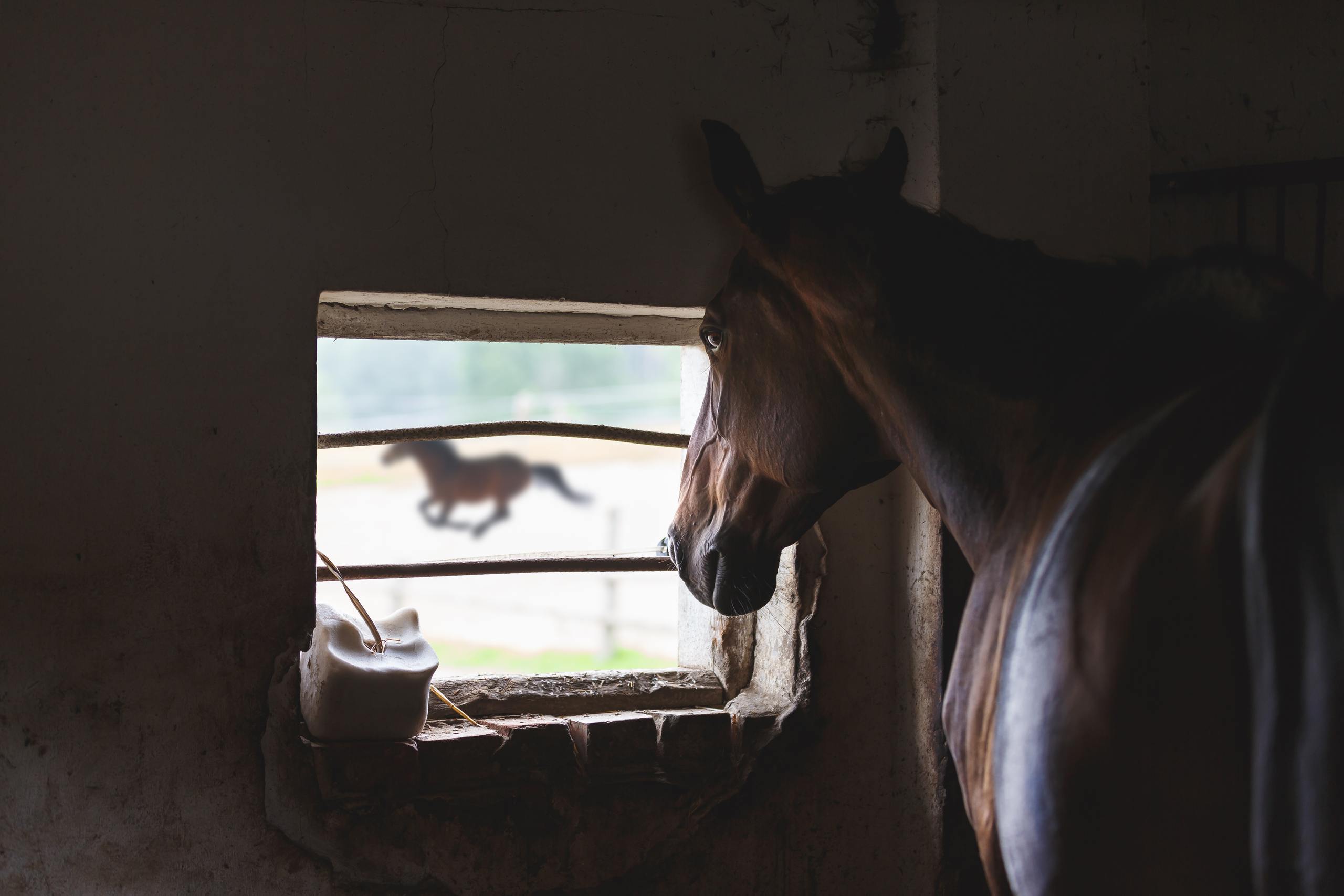
I want to tell you about a horse named Ryan. He didn’t run last week in The Kentucky Derby. He’s not running Saturday in The Preakness.
That may or may not be his registered name. The public record doesn’t say, and it doesn’t matter. What matters is what happened to him on April 21 at Thistledown, and what happened after.
Ryan sustained a slab fracture during morning training. For a lower-level racehorse, that diagnosis arrives with a nearly predetermined outcome. Not because a slab fracture is necessarily unsurvivable, but because the economics of saving one rarely pencil out. Surgery is expensive. Rehabilitation takes months. The horse has no commercial future. So the conversation that usually follows a morning like that ends the same way it has ended for countless horses before him.
His owner made a different call. Ryan was surrendered to the HISA Equine Recovery Foundation — HERF — and the chain of yes that kept him alive began.
HERF accepted Ryan and got him to Rood & Riddle Equine Hospital, where surgeons performed the operation free of charge. All other costs of care were covered by the foundation. Two days after the injury, Brook Ledge Horse Transportation vanned him, also free, to Denali Stud in Paris, Kentucky, where he became the first horse to enter HERF’s newly created Empty Stall Challenge program.
The Empty Stall Challenge is the brainchild of bloodstock agent and HERF board member David Ingordo, who has been asking farms across the country to look at unused stall space and consider what it could mean to a horse with nowhere else to go. Denali said yes. One of the most respected consignment operations in the business, more than 500 stakes horses have come through that program, opened a stall for a horse nobody will sell, nobody will breed, and nobody will bet on. They did it because it was the right thing to do.
“He’s settled into the farm really well,” Denali Vice President Conrad Bandoroff told Bill Finlay at TDN. “He’s got a great disposition to him and the outlook and the prognosis is excellent. He’s quiet. He’s an easy patient and we couldn’t be happier with how it’s going so far.”
Thirty days of stall rest. Then hand walking. Then a round pen. Then paddock turnout. In roughly 60 days, Ryan begins the next phase. He has a future now. He didn’t have one on April 21.
The Bigger Picture — Published Today
This morning, HISA released its 2026 First Quarter Metrics Report, and Ryan’s story now has documented company.
HERF saved five horses from euthanasia in Q1 alone. Three who would have been recorded as racing-related fatalities (Candy, Cosmo, and Quirky) and two who would have been training-related fatalities (Chrissy and Pie). All five are thriving and transitioning to second careers. Ryan came after that baseline was established. He is not the pilot program finding its footing. He is the program working at scale.
The broader numbers show continued movement in the right direction. Racing-related fatalities came in at 0.95 per 1,000 starts in Q1. Meaning 99.91% of starts occurred without a fatality. Crop rule violations dropped 32% year-over-year. These are not transformational numbers in isolation, but they are directionally consistent, and they are measurable.
HISA CEO Lisa Lazarus said it clearly in the report: “Our rules are driving meaningful, measurable improvements in safety across the industry, and now when a horse suffers an on-track reparable injury despite those protections, HERF gives us a way to fight for that animal’s life so they can go onto a second career.”
I’ve discussed HISA critically when the situation warranted it, and I’ll continue to. The governance questions don’t disappear because one program is working. But when something works, I’m going to say so. That’s the standard here, applied in both directions.
It’s worth noting what HERF actually is structurally: an independent 501(c)(3) nonprofit. It is not funded by HISA’s operating budget. It runs on private donations, including several six-figure contributions from individuals and organizations, and $30,000 raised by HISA employees out of their own pockets. Not one of them declined to give. That’s not institutional PR. That’s personal.
A Word on How We Got Here — and Where the Gap Still Is
Ryan’s owner made the right call by surrendering him to HERF, and I won’t pretend to know the circumstances that made paying for the surgery impossible. I don’t know them. Neither does anyone else writing about this publicly. What I do know is that the situation Ryan found himself in, injured, lower-level, financially stranded, is not rare. It is the norm.
I have long and, I’m aware, unpopularly advocated for some form of financial responsibility requirement tied to an owner’s license. Not as a barrier to entry, but as a baseline, some demonstrated capacity to provide for the welfare of an animal in your care when things go wrong. I understand the counterarguments. Racing needs owners, including small owners. The economics at the lower levels are already brutal. No one enters this sport planning for a slab fracture at Thistledown.
But horses are not property in the same moral sense as a car or a piece of real estate. They are living animals whose welfare depends entirely on the decisions of the humans who own them. We do credit checks before we let someone finance a vehicle. We require bonds and licenses across dozens of other industries where third parties bear the consequences of someone’s financial failure. The idea that we should have some framework, flexible, tiered, perhaps means-tested, for ensuring that a licensed owner has at least a pathway to address a welfare emergency for their horse is not radical. It is overdue. It should not be harder to buy a brand new “prancing horse” more commonly known as a Ferrari, than it is to buy a racehorse, but that is the reality.
HERF exists in part because that framework doesn’t exist. It is filling the gap with donated dollars and donated stall space and donated surgical expertise. That is admirable. It is also, by definition, a workaround for a structural problem the industry has never been willing to address at the source.
The Starfish
I talk about the starfish story a lot. You know it. The child on the beach throwing stranded starfish back into the ocean one at a time, while someone tells him it doesn’t matter — there are thousands of them. He replies it mattered to that one.
Ryan is at Denali Stud right now. It’s a Tuesday in May. He’s standing in a stall that someone offered because they were asked, being cared for by people who didn’t have to care, funded by a foundation that exists because enough people decided the gap it fills was unacceptable.
Candy, Cosmo, Quirky, Chrissy, and Pie are somewhere today too. All of them alive. All of them heading somewhere.
It mattered to those six. That matters to me.
One Life, You get to do what you should…..we’re not the same…..we get to carry each other: One Love