

The bizarre world of horse racing
Mike Repole went to his phone this week and said what a lot of people in this industry have been thinking for a long time. He didn’t use a press release. He didn’t go through a lawyer. He just said it. Loudly. Twice.
“The New York State Gaming Commission is everything that is wrong with horse racing regulation. In my opinion, they are incompetent, inflexible, arrogant, and completely disconnected from the people and horses they are supposed to serve.”
He went on from there. At length. He called the Commission bureaucratic, arrogant, and disconnected. He said he and Todd Pletcher are seriously questioning how much year-round support they want to give New York racing. He suggested the new Belmont Park built at a cost of more than $500 million, might soon be a costly, beautiful, empty building. And he closed with something that, in this publication, does not need to be sanitized.
Mike Repole in our view is good for horse racing. Not perfect, but good if not very good. He earns that, mostly. He fights for this sport when he believes in something, he puts his money where his mouth is, and he has been willing to say on the record what others whisper or just think silently. This is an honest accounting of the moment, and an honest accounting requires starting with the facts of the Pletcher case itself.
The Forte positive at the 2022 Hopeful Stakes at Saratoga involved meloxicam, a non-steroidal anti-inflammatory. The NYSGC voted unanimously to uphold both Forte’s disqualification and Pletcher’s 10-day suspension and $1,000 fine. Repole’s core argument is that this case would not constitute a violation under today’s tougher HISA national rules, because HISA permits meloxicam within a defined threshold. HISA CEO Lisa Lazarus acknowledged as much when the positive was announced. The New York State Supreme Court Appellate Division has now ruled against Pletcher in his appeal, meaning the suspension stands under New York’s pre-HISA framework even as the sport has evolved beyond it nationally. Repole’s point is not lawyerly spin. It is a legitimate indictment of regulatory sclerosis. New York is spending taxpayer money enforcing a standard that its own sport has moved beyond.
There is also a second Pletcher case. In March 2026, the State of New York Supreme Court Appellate Division unanimously threw out a 14-day suspension and $2,000 fine handed to Pletcher after a horse he trained tested positive for an overage of phenylbutazone following a 2022 race at Saratoga, remanding the matter back to the Gaming Commission for a rehearing. The court cited concerns about the fundamental fairness of the original hearing and called the Commission’s evidence hearsay. Two separate Pletcher cases. Both stemming from 2022. Both still alive in 2026. If you wanted to design a system to drive owners and trainers out of New York, you could not do better than this.
Repole is right about all of it. And that is exactly where Kyle Ferraro and Jenine Sahadi earned the right to say what they said.
Ferraro noted that Repole never spoke up for Bob Baffert during what was, by any honest accounting, a regulatory and media pile-on that the industry sat through in silence. He’s right. Sahadi, who knows something about how institutions in this sport operate, put it more broadly and more precisely:
“We are in this place because no one spoke up for anyone. Everyone was fine with all the Baffert suspensions and fines. Everyone was fine when Wong had his career decimated. It’s always someone else’s problem until you are the problem.”
That sentence should be carved somewhere. Not as an attack on Repole, but as the actual diagnosis of how this sport got here.
Baffert was vilified. Suspended. Banned by Churchill Downs from the Kentucky Derby for years. And the drug at the center of the Medina Spirit disqualification? Betamethasone. A corticosteroid that is now a legal, regulated substance in American racing. I have written about that irony before in these pages, and it does not get less ironic with repetition. Nobody who knows racing seriously believed betamethasone in a topical cream treating a skin condition actually helped Medina Spirit win the Kentucky Derby. But the industry found it convenient to stay quiet, and it did.
The result is exactly what Jenine described. Silence became the default, and the bill has been accumulating ever since.
Now we get to the part that genuinely requires the phrase you can’t make this up.
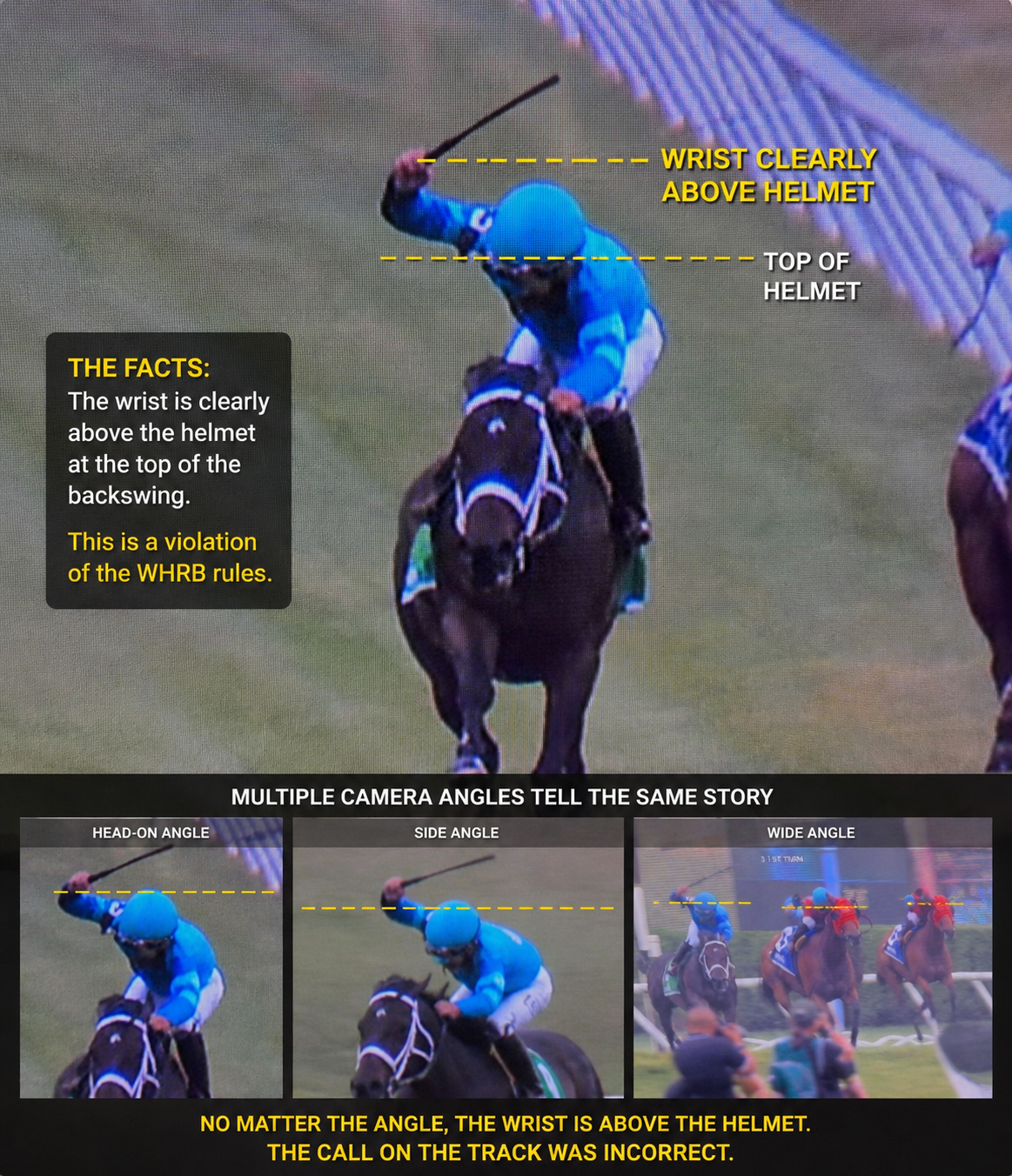
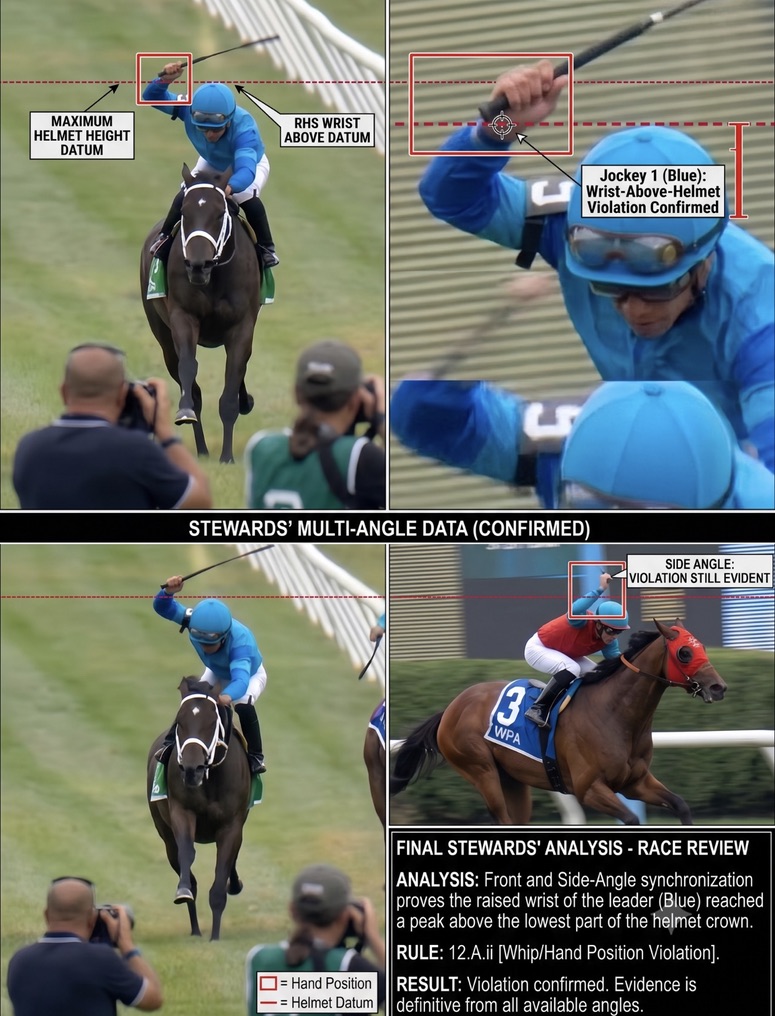
During the Belmont Stakes card run at Saratoga on June 6, I identified what appeared to be a repeat whip violation by jockey Paco Lopez in Race 3 aboard Bonus Move. This was not Lopez’s first encounter with this rule. He came into the Belmont having served or actually skirted a six-month HISA suspension for multiple whip violations and having accumulated 22 whip violations since HISA’s Racetrack Safety Program took effect in July 2022. I texted HISA Head of Stewarding Mark Guilfoil in real time with specific rule citations. He confirmed on the record that he spoke with the stewards, with Lopez, and with Lopez’s agent. No formal action was taken. Guilfoil then voluntarily sent me photographs he had taken of the stewards’ review monitors showing the race footage. You can read the full documented account, including annotated images and the on-the-record text exchange, at What The Belmont Didn’t Tell You But We Will. The prior Preakness coverage is at Lopez Wins Preakness — And Appears To Have Done It Breaking The Same Rule That Got Him Suspended and The Stewards Looked At The Tape — And Said They Didn’t See It.
I am not going to relitigate the stewards’ decision in this piece. I have done that elsewhere. What I will note is that this is the same regulatory environment Repole is describing. The same New York. The same Belmont card. The Commission that cannot let go of a 2022 medication case is operating alongside a stewarding apparatus that reviewed tape of a jockey with Lopez’s documented history and found nothing to act on formally. These are not disconnected stories.
The same Belmont card produced a formal enforcement action involving another jockey entirely. Junior Alvarado was fined $3,000 and handed a three-day suspension for striking Chief Wallabee eight times in the Belmont Stakes itself, two over the six-strike limit, finishing fourth. According to the stewards’ ruling, this was Alvarado’s third whip offense within 180 days, following violations aboard Grand Job in the Grade 1 Madison at Keeneland on April 4 and Spiced Up in an allowance at Keeneland on April 3. Under HISA rules, a third offense within 180 days triggers enhanced penalties.
Same card. One jockey finishes fourth, gets formally suspended. Another jockey, with 22 documented violations since July 2022 and a completed six-month suspension behind him, gets an informal conversation with stewards and rides away. You can agree or disagree with either outcome individually. Together they raise a question this sport does not have a clean answer to.
And then there is the email sitting in my inbox.
A public relations representative, apparently unaware of PTW’s extensive coverage of Paco Lopez and his history with whip rules, reached out this week to ask if I would be interested in speaking with Lopez about his extraordinary recovery from a potentially career-ending ankle injury and his rapid return to elite competition. She described in vivid detail how Lopez suffered a devastating ankle fracture at the Fair Grounds in February, how he was back galloping horses within seven weeks, and how he competed in the Wood Memorial and the Preakness. The email was genuinely well-written. The recovery is, on its own terms, remarkable.
The PR firm did not appear to be aware that PTW had published detailed annotated photo analysis of Lopez’s riding on the Belmont card. That I had documented on-the-record contact with HISA’s Head of Stewarding about that very card. That the piece they were hoping to place was landing in the inbox of the journalist who had done more reporting on Paco Lopez’s relationship with whip rules than any outlet in the country.
I replied that yes, I would be happy to speak with him. We are working on scheduling however this piece may “cancel” that.
This is the moment Jenine Sahadi was describing. Not Lopez’s ankle. Not Repole’s frustration. Not Pletcher’s suspensions. All of it together. An industry that handles its problems by ignoring them until they become someone else’s problem, by staying quiet until the noise becomes impossible to ignore, by showing up to the conversation four years late and expecting a clean slate. Does anyone know about the cockfighting? We do.
The horses deserve better. That part of Repole’s statement was right too.
We are back in The Twilight Zone, or maybe we never left: