
What Six Months of Industry Response Reveals About Who Actually Controls the Narrative in Horse Racing
The Record Needs to Be Stated Clearly
Past The Wire broke the story of the Ortiz brothers’ documented involvement in a federal felony cockfighting ring in November 2025. Not as rumor. Not as allegation. As documented reporting, sourced and published, while every other racing media outlet of consequence looked the other way.
It took PETA issuing a formal demand letter calling for the brothers to be barred from the Eclipse Awards before the Thoroughbred Daily News acknowledged the story existed. Even then, the acknowledgment was brief. The story quickly retreated back to being the exclusive province of this publication.
For six months, the sport’s regulatory bodies, its prominent media voices, and its institutional power structure made a collective choice about this story. That choice was silence.
In May 2026, USA Today published a front-page investigation. NBC was obligated to address it during the national Preakness broadcast. Dozens of publications that had ignored the story for half a year suddenly found it worth covering.
None of that changed what the industry’s guardians did next. Which was, again, very close to nothing.
When someone shows you who they are, believe them.
The Science Already Told Us What to Expect
On May 16, 2026, Past The Wire published The Psychology of Complicity, which applied three decades of peer-reviewed behavioral and sociological research to exactly this kind of institutional response. The piece drew on Albert Bandura’s foundational 1999 framework on Moral Disengagement, Eviatar Zerubavel’s sociology of denial, Dr. Fred Hawley’s fifteen years of field research into cockfighting culture, and the 2012 Lee and Quarles empirical study on empathy and animal cruelty.
The science named the mechanisms in advance. What followed was not surprising to anyone who read it.
This piece is the scorecard.
A Documented Pattern Worth Examining
Before analyzing what the industry did not do, it is worth examining carefully what it has done, loudly, repeatedly, and at length when other integrity stories arrived.
The Medina Spirit case. The Rick Dutrow case. The Jorge Navarro and Jason Servis federal indictments. In each of those stories, the volume from racing’s institutional voices, its prominent broadcasters, and its media personalities was substantial and sustained. Private property rights. Chain of custody. Who said what and when. The integrity of the testing process. The reputations of those making accusations. These conversations ran for months, in some cases years, in considerable detail and with evident passion.
The question the facts invite, and it is a question, not an accusation, is a simple one: What do those stories have in common that this one does not?
One answer that presents itself to any observer is this: in each of those prior cases, the subject of the integrity conversation was an individual operating, in the industry’s framing, outside its established order. The story, whatever its other dimensions, was compatible with a narrative that served the interests of the sport’s existing power structure.
The Ortiz story has a different political geometry. The subjects are two of the most prominent, most marketed, most commercially valuable athletes in the sport. The story arrived at a moment when the Jockey Club and Breeders’ Cup Limited are facing their own sustained public scrutiny. When exchange wagering and CAW issues are creating regulatory and financial pressure. When foal crop numbers continue to decline. When handle faces structural headwinds.
Whether the silence that followed is coincidence, instinct, or calculation is something this publication cannot and will not claim to know as fact. What can be stated as fact is that the silence exists, that it is selective, and that the selectivity follows a pattern. The reader is capable of drawing their own conclusions from a pattern.
Zerubavel’s framework for the sociology of denial offers one lens through which to examine it. He documented that conspiracies of silence in insular professional communities do not require coordination. They do not require a phone call or a directive. They operate through shared, unspoken understanding of what serves the group and what threatens it — what he called “the undiscussable,” uncomfortable truths that each member of the group is privately aware of but collectively unwilling to name.
Whether that framework applies here is, again, a question for the reader. The documented behavior is on the record for anyone to examine.
The Spectrum of Response
What the national exposure produced was not silence alone. It produced a spectrum, and every point on that spectrum maps against mechanisms the academic literature had already named.
The Cultural Defenders. Hawley spent fifteen years embedded inside cockfighting culture specifically to document its rationalization architecture. The arguments that arrived in the wake of this story — that cockfighting is tradition, that it is heritage, that American legal standards cannot be imposed on cultural practice — are documented in his 1993 peer-reviewed research word for word. They did not arrive as original arguments. They arrived as the organized, consistent rationalizations of a subculture that Hawley observed actively lobbying to protect itself from criminal sanction. The federal ban has been in place since 2019. The Supreme Court has upheld it. At that point, the psychological literature does not distinguish between cultural participant and criminal actor. The choice to participate or defend after the legal framework is established is, according to the research, a different psychological act than cultural tradition.
The Denial Infrastructure. Past The Wire published original reporting in November. USA Today published a front-page investigation in May. Documented footage exists. The federal statute is unambiguous. And yet the reflex to label serious reporting as manufactured outrage or agenda-driven attack activated immediately. Bandura named this mechanism Moral Justification, the process by which documented wrongdoing is reframed as fabricated attack to neutralize the moral weight of the evidence.
The Jurisdiction Argument. Every regulatory body pointed to another. HISA noted the boundaries of its authority. To be precise about the record: HISA CEO Lisa Lazarus is a notable exception to the institutional silence. When this publication posed the question directly to her at a HISA Town Hall, she answered it on the record. She denounced the conduct unequivocally. She acknowledged HISA’s jurisdictional limitations honestly and directed accountability to the state commissions that do hold the relevant authority. She did not deflect. She did not go quiet. Whatever one concludes about the adequacy of the overall regulatory response, Lazarus answered the question she was asked, and that distinguishes her meaningfully from the silence that surrounded her on every side. The record should reflect it. State commissions noted theirs. The fragmented, state-by-state architecture of American racing regulation, a structure that exists by design and is actively defended by the sport’s power structure performed what Bandura called Diffusion of Responsibility with mechanical precision. When accountability is everyone’s mandate, it becomes no one’s obligation. The gaps between jurisdictions are not accidents. The question of who benefits from their existence is one the public record is capable of answering.
The Loudest Voices, the Least Duty. This is the inversion that deserves the most attention. The people with zero institutional obligation to the horses, the wagering public, or the integrity of the sport, no regulatory authority, no fiduciary responsibility, no statutory mandate produced the most noise. The people with every institutional obligation produced the least action. Racing commissions exist specifically to protect the integrity of competition and the welfare of the animals within it. HISA was created by an act of Congress with an explicit mandate to do exactly that. The imbalance between the volume of the defenders and the silence of the guardians is a documented fact. What it means is a question every stakeholder in this sport is entitled to ask.
NBC and the One Sentence
NBC’s handling of the story during the Preakness broadcast deserves its own examination because it is, in miniature, the most visible example of how institutional media manages an uncomfortable truth without actually confronting it.
The broadcast devoted a heavily produced feature package to the brothers’ early life in Puerto Rico and their fraternal relationship. It was warmly made and professionally executed. It then delivered, in a single sentence by the broadcaster’s own accounting, the equivalent of a legal obligation checked off, the acknowledgment that questions had been raised, that no charges had been filed, that no racing jurisdiction had taken action, and that therefore the brothers were present and riding today.
That sentence was not journalism. It was the minimum required to avoid the accusation of having said nothing at all. The framing, no charges, no regulatory action, therefore no further examination warranted accepted the conclusions of the very institutions whose silence is itself the story.
Bandura called the language choice Euphemistic Labeling. NBC called it “cockfighting stories.” Not a federal felony. Not documented animal cruelty. Not filmed evidence of a criminal enterprise driven by illegal gambling. Stories. The word was chosen. Words in a national broadcast are always chosen.
The broadcast then, in what can only be described as an extraordinary coincidence of scheduling, aired a profile of trainer Brittany Russell and her jockey husband on their farm prominently featuring the chickens they raise.
This publication will leave that sequence of editorial choices to speak for itself.
The Access Question and the Unanswered Ask
There is a category of racing media that operates at the intersection of entertainment, access, and audience broadcasters and commentators with verified platforms, significant reach, and genuine influence within the sport’s most important stakeholder communities. They are skilled at what they do. Their audiences are real and engaged.
In the days following the national exposure of this story, Past The Wire publicly directed a documented, data-driven question to one such prominent broadcaster asking, given what the published, peer-reviewed science says about the psychology of participants and the sociology of institutional silence, whether they had thoughts they wished to share with their audience.
The question went unanswered.
This is documented. It is public record. It is not characterization.
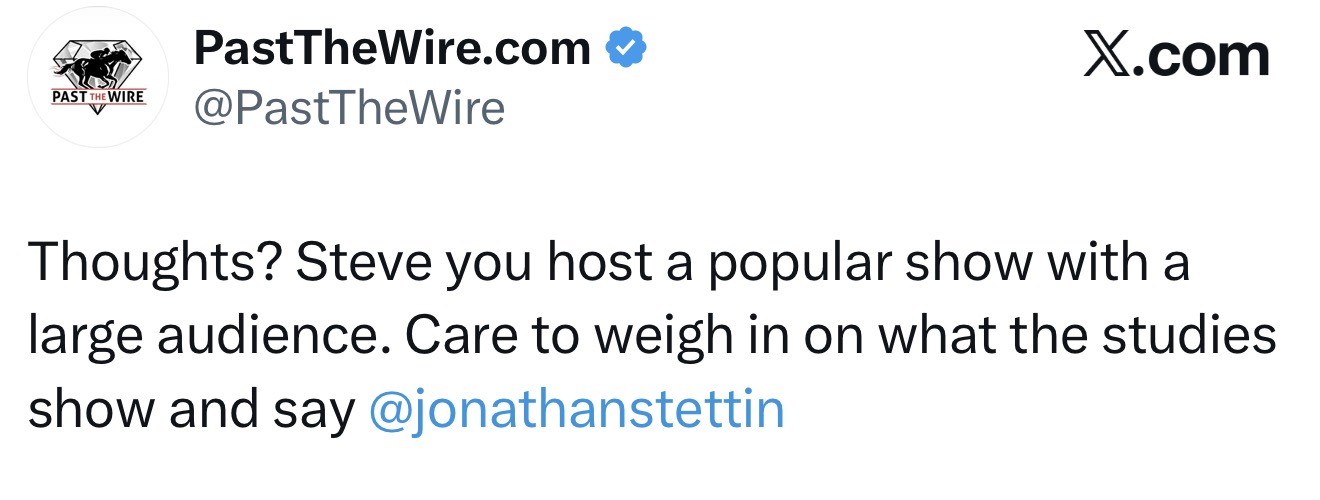
What can be observed not alleged, observed, is that the same platform that engages freely and warmly with congratulatory content, with praise for industry stakeholders, with the comfortable currency of insider relationships, had nothing to say when asked to engage with a legitimate, sourced, scientific question about the sport’s most significant recent integrity story.
The contrast between what platforms speak to and what they do not speak to is, in itself, information. Audiences are entitled to notice it.
What makes the observation particularly pointed is this: at least one highly respected figure in the sport, a member of the very audience the broadcaster had been publicly and effusively praising just hours before the question was posed appears to have wanted that question answered. The elite of this sport are not a monolith of comfortable silence. Some of them are watching what the independent press is doing. Some of them appear to believe the questions are legitimate.
The gatekeepers who decline to ask those questions are not, the evidence suggests, protecting their audiences. The audiences, in at least some cases, appear to want more than they are being given.
The Controlled Narrative and the Empty Chairs
This publication has spent considerable time and reporting examining what we have come to call the controlled narrative, the mechanism by which racing’s power structure manages information flow, frames public conversation, and determines which integrity questions receive sustained attention and which ones are quietly rerouted into jurisdictional gaps or allowed to expire through silence.
The Empty Chairs episode of Past The Wire TV examined the governance vacuum at the Jockey Club, the seats at racing’s most powerful table that go unfilled, the voices that go unasked, the accountability structures that exist on paper and nowhere else. The pattern documented there and the pattern documented in this story are not unrelated. They are expressions of the same institutional logic: control the narrative, protect the structure, and when a story arrives that threatens both, apply the appropriate response from the available toolkit.
When the story serves the narrative, when it points outward at an individual outsider, when it can be used to consolidate regulatory authority, when the outrage is politically useful, the toolkit produces volume. Sustained, organized, multi-platform volume.
When the story threatens the narrative, when it implicates commercially indispensable figures, when it arrives at a moment of existing institutional vulnerability, when the outrage would require the power structure to act against its own interests, the toolkit produces silence.
This publication cannot tell you with certainty that this is the calculation being made. What it can tell you is that this is the pattern in the documented record. The Medina Spirit noise. The Dutrow noise. The Navarro and Servis noise. The Ortiz silence. Laid side by side, they form a picture.
Zerubavel wrote that conspiracies of silence revolve around uncomfortable truths hidden in plain sight. He wrote that they are maintained not through coordination but through shared understanding of what cannot be said.
Whether that description fits what has happened here is a conclusion this publication will not draw on your behalf. The facts are on the record. The pattern is visible. The reader is fully capable of deciding what it means.
The Verdict the Science Already Rendered
Hawley’s 1993 research documented the rationalization architecture of cockfighting culture and predicted with precision the arguments that would be deployed in its defense. Lee and Quarles’ 2012 study measured the empathy deficit and identified what separates those who register an animal’s suffering from those who do not. Bandura’s 1999 framework named every mechanism of institutional moral disengagement that has been on display since November. Zerubavel identified the social architecture of collective silence in professional communities under pressure.
Four independent bodies of peer-reviewed science, spanning three decades, published before this story broke, described what this response would look like.
It looked exactly like that.
That is not opinion. It is a documented alignment between prediction and outcome. The science made the call. The industry confirmed it.
There are two ways to cover this sport. One way maintains access, protects relationships, and serves the commercial infrastructure that funds the broadcast and fills the press box. The other way serves the horses, the bettors, and the integrity of a game that has no future if the public cannot trust that the people responsible for protecting it are actually doing so.
Past The Wire has been on one of those paths since November 2025, when nobody else would touch this story. We are still on it.
Racing cannot afford to protect its stars at the expense of its soul indefinitely. The costs compound. The public notices. The handle numbers tell the story that the broadcasts won’t.
When someone shows you who they are, believe them.
Horse racing has been showing us for six months.
Academic Sources Referenced in This Piece and in The Psychology of Complicity:
Hawley, Fred. “The Moral and Conceptual Universe of Cockfighters: Symbolism and Rationalization.” Society & Animals, Vol. 1, No. 2. Louisiana State University, 1993.
Lee, Sherman A. and Quarles, Linsey. “Who Feels Sympathy for Roosters Used in Cockfighting?” Society & Animals, Vol. 20, No. 4. Christopher Newport University, 2012.
Bandura, Albert. “Moral Disengagement in the Perpetration of Inhumanities.” Personality and Social Psychology Review, Vol. 3, No. 3. Stanford University, 1999.
Zerubavel, Eviatar. “The Social Sound of Silence: Toward a Sociology of Denial.” In Shadows of War. Cambridge University Press, 2010.