

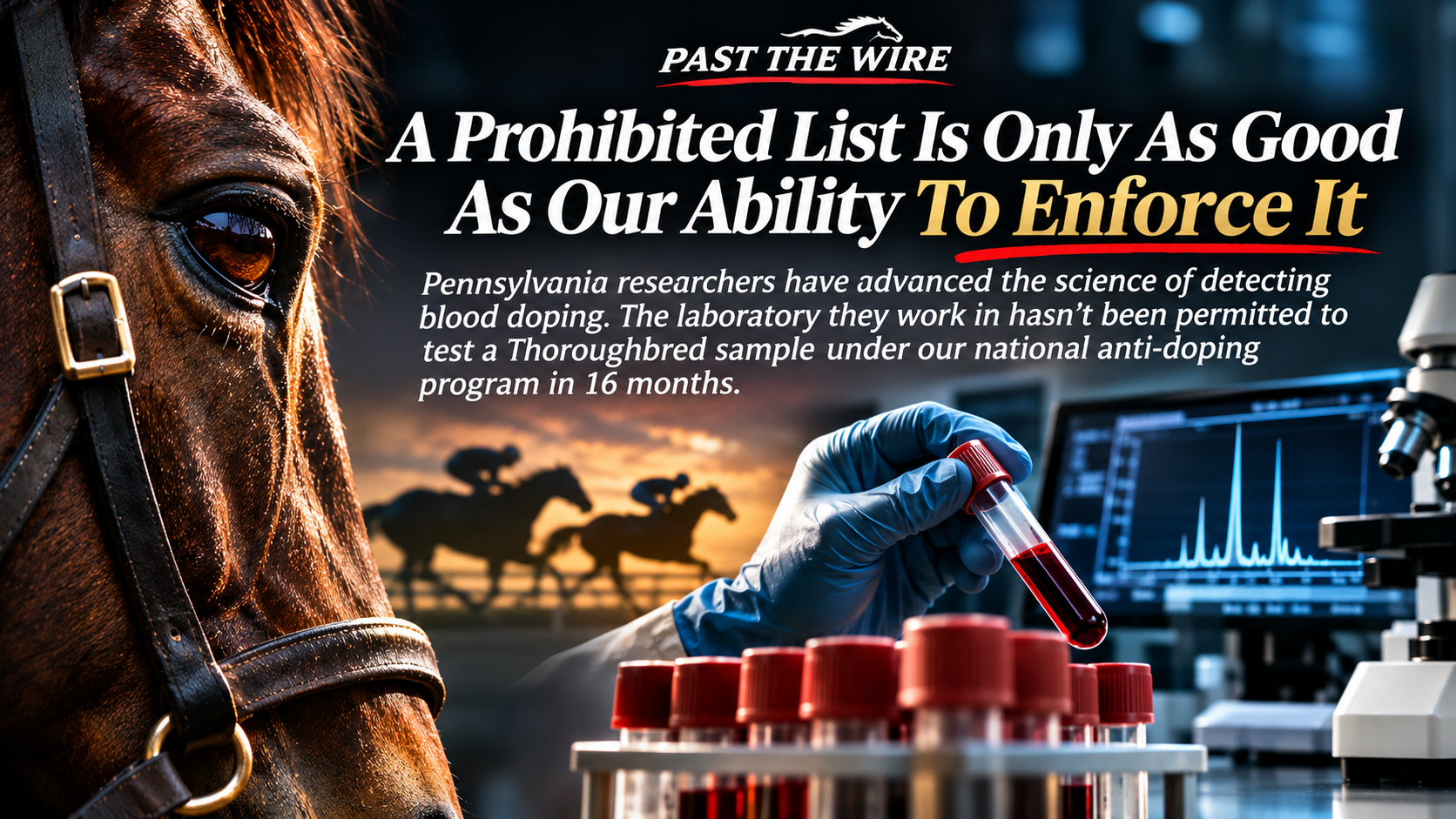

Pennsylvania researchers have advanced the science of detecting blood doping. The laboratory they work in hasn’t been permitted to test a Thoroughbred sample under our national anti-doping program in 16 months.
Horse racing has never had a shortage of rules prohibiting cheating. What we have had at times is a shortage of the ability to determine whether those rules are being broken, and perhaps even the desire to find out. There is a difference between prohibiting something and being able to detect it, and that distinction is worth exploring in light of some rather interesting research coming out of Pennsylvania.
Researchers at the University of Pennsylvania’s Pennsylvania Equine Toxicology and Research Laboratory (PETRL) have developed a method to detect and confirm the presence of 11 substances capable of manipulating the biological processes associated with red blood cell production. It is another advancement in the continuing battle against blood doping, and the scientists responsible deserve recognition for their work. There is, however, considerably more to this story than the development of a new drug test.
The laboratory where this research originated has been suspended from the Horseracing Integrity and Welfare Unit’s (HIWU) laboratory accreditation program since July of 2025. At the same Pennsylvania State Horse Racing Commission meeting on November 17, 2026, where the scientific advancement was discussed, officials also discussed the laboratory’s efforts to regain its accreditation. A reaccreditation audit was scheduled to begin the following day. “We’re hopeful for reaccreditation early in the first quarter of 2027,” said Eric Smith, the commission’s Thoroughbred bureau director.
The laboratory helping develop the science necessary to catch tomorrow’s cheaters has been suspended from testing Thoroughbred racing’s samples under our national anti-doping program for approximately 16 months. Pennsylvania’s Thoroughbred samples have been shipped to Industrial Laboratories in Colorado for that entire period, while PETRL has continued testing Standardbred samples, which fall under state rather than federal jurisdiction. There is some irony in that, particularly when you consider the history of horse racing in Pennsylvania. There are also some questions that warrant answers.
Most of us who have been around the racetrack for any length of time are familiar with EPO, or at least what it is intended to accomplish when administered to a racehorse. Erythropoietin is a hormone that stimulates red blood cell production. Increasing the number of red blood cells can increase the amount of oxygen carried to the muscles, potentially improving endurance and delaying fatigue. In a game where millions of dollars change hands over the difference between a nose and a head, the attraction to those inclined to cheat is not difficult to understand.
The substances targeted by the Pennsylvania researchers work somewhat differently. Rather than introducing EPO into the horse, these drugs can stimulate the horse’s own production of it by manipulating the body’s response to oxygen levels. They are known as hypoxia-inducible factor activating agents, or HIF activators. Some were developed for legitimate medical purposes in humans, particularly the treatment of anemia associated with kidney disease. As we have seen throughout the history of horse racing, what is developed for legitimate medical purposes does not necessarily remain confined to those purposes.
The science behind detecting these substances is considerably more complicated than the explanation of what they are intended to do. The Pennsylvania researchers have developed a method using liquid chromatography and high-resolution mass spectrometry, which, in layman’s terms, allows scientists to separate, identify and confirm the presence of specific chemical substances in blood plasma and urine, even at extremely low concentrations. In this case, concentrations measured in picograms per milliliter, which are fractions of a billionth of a gram.
Their research, published in the Journal of Chromatography A, demonstrated the ability to detect and confirm 11 targeted substances. The method was evaluated for accuracy, precision and specificity, and its applicability was demonstrated following the administration of one of the substances to a single research horse. It is worth noting that the paper appeared online in August of 2026, some three months before the Pennsylvania commission discussed it. What the research does not establish is how effective the method will be across thousands of samples collected under actual racing conditions, or how many horses, if any, are currently being administered these substances in American racing. The researchers themselves reported no evidence that these drugs are being used in racehorses.
Before we get too excited about what some might characterize as revolutionary science, we should look beyond our own borders. Researchers in Dubai published work on detecting this class of substances in Thoroughbreds in 2021, and separately validated a method for one of them that same year. A 2024 study established that one of these drugs could be detected in mane hair up to 166 days after the final dose. Japanese and Hong Kong laboratories have published their own work on detecting these substances in equine hair.
Human sport got there before any of us. The first athlete identified as having used one of these drugs was reported by a French anti-doping laboratory in 2016. The United States Anti-Doping Agency subsequently funded method development at accredited laboratories and began retesting stored samples. Racing’s own first brush with these drugs came in early 2020, when doping cases involving one of them, IOX-2, prompted laboratories to incorporate it into routine screening.
The Pennsylvania research advances the science, expands the range of substances that can be detected through a single method and provides additional tools for those charged with policing our sport. It did not invent the science, nor are we the first racing jurisdiction to recognize the threat. In fact, some of the international research predates the implementation of our national anti-doping program.
That brings us to the Horseracing Integrity and Safety Authority (HISA) and HIWU. HIF-activating agents were contemplated in HISA’s prohibited-substances framework from the outset of the program. IOX-2, one of the substances associated with stimulating the body’s own production of EPO, appeared on HISA’s banned list in material dated January of 2023, months before enforcement commenced. We are not talking about identifying a new threat and subsequently developing a rule to address it. We are talking about advancing our ability to detect substances that were already prohibited.
When we banned these substances, did we have the ability to reliably detect them, and was that ability consistent across the laboratories entrusted with enforcing our rules? The fact that comparable testing methods existed internationally does not establish that we were utilizing them here. Conversely, the publication of this new research does not establish that we weren’t. I would like to know where we stood when our national anti-doping program commenced in May of 2023, where we stand today, and whether this latest research is addressing a deficiency or simply improving upon capabilities we already possessed.
If you think that is an unreasonable question or one that casts unnecessary doubt on our testing procedures, I would suggest taking a look at HIWU’s and HISA’s own investigative report into the University of Kentucky Equine Analytical Chemistry Laboratory, released in September of 2024. You don’t have to take my word for it, nor do you have to rely on the suspicions of horseplayers who have watched more than their share of inexplicable performances over the years.
The report documented serious deficiencies at that laboratory. Among them were misrepresentations regarding testing capabilities for certain substances, including EPO, misrepresentations regarding whether certain analyses had actually been performed, and the failure to conduct required confirmatory testing on 91 samples whose initial screening indicated the potential presence of a prohibited substance. Those samples were reported as negative. The failures occurred at the direction of the laboratory’s then-director, who was subsequently removed from his position, and the matter was referred to federal law enforcement.
Read that carefully and consider its implications. We had suspicious samples reported as negative without the required confirmatory testing having been performed. We also had misrepresentations involving the ability to test for certain substances. These are not allegations from someone who lost a Pick 6 or a trainer who finished second to a horse they thought ran out of its skin. These are findings published by the organizations entrusted with the integrity of our national anti-doping program.
There is a further detail from that investigation worth sitting with. When HIWU reanalyzed those samples that still existed, it found two false negatives and two false positives. Both kinds of error were present in the same laboratory at the same time. Hold onto that, because we will come back to it.
In fairness to HISA and HIWU, their oversight uncovered those deficiencies. That is an argument in favor of national oversight and one I readily acknowledge. I am not so sure those deficiencies would have been identified, disclosed or addressed under some of the regulatory structures we operated under previously. Giving credit where it is due, however, does not preclude asking what happened before those deficiencies were discovered, what the consequences were, and what assurances we have that similar deficiencies do not exist elsewhere.
Pennsylvania brings another dimension to this discussion. Anyone who has played the horses professionally or seriously for any appreciable length of time is likely familiar with the reputation Parx has developed among a segment of the wagering public. Penn National has had its share of scrutiny as well. Reputations are not evidence, and suspicions are not convictions, but Pennsylvania’s history in this area is not confined to racetrack rumors or conversations among horseplayers.
In 2015, four veterinarians pleaded guilty in connection with a federal investigation into unlawful drug administration to racehorses at Penn National. According to the government, the veterinarians took drug orders from trainers, administered substances to horses within 24 hours of racing, backdated billing records to avoid detection and submitted false treatment reports to the Pennsylvania State Horse Racing Commission. Their cooperation was an essential term of their plea agreements, and prosecutors told the court the veterinarians had already identified the trainers involved. The investigation extended beyond veterinarians to trainers and racing personnel, and later produced the federal conviction of a Penn National trainer. These were federal criminal proceedings, not hearings before a racing commission over an overage of an otherwise permissible medication.
None of that establishes that the substances targeted by this latest research are being used at Parx, Penn National, Presque Isle Downs or anywhere else. It does establish that concerns about the integrity of racing in Pennsylvania have, on occasion, been more than justified. I would think the honest horsemen competing at those racetracks have as much interest in the effectiveness of our testing procedures as those of us wagering our money on their horses.
There is another aspect to the Pennsylvania laboratory’s history that should not be overlooked. In early 2025, concerns arose over its methodology for testing total carbon dioxide, commonly referred to as TCO2. HIWU directed the laboratory to change its methodology to bring it into alignment with the program’s other laboratories, and cases were withdrawn following concerns over testing inconsistencies. The scale of it deserves mention. Of the TCO2-related cases reported since HISA’s implementation, 11 of 14 involved horses that ran in Pennsylvania. HISA offered to return purse money, refund fines, have disqualifications removed from Equibase and strip penalty points from the records of affected trainers.
We should be equally concerned about a laboratory producing an erroneous positive as we are about one producing an erroneous negative. One potentially deprives an innocent trainer of their livelihood and reputation, while the other potentially allows someone who is cheating to continue doing so at the expense of everyone else. If we are going to talk about integrity, it has to apply to both sides of the equation. I have never subscribed to the theory that due process and the presumption of innocence are impediments to cleaning up our sport.
If anyone needs a reminder of what the other side of that equation costs, consider the case of Parx trainer Felissa Dunn. Charges against her were dropped after an internal investigation determined that one or more Pennsylvania State Horse Racing Commission investigators had made material misstatements of fact regarding syringes they claimed to have found in her barn. Her attorney, Drew Mollica, noted that she had never had a positive test in her entire career. She was facing what amounted to a career-ending sanction. The enforcement failure there did not involve a laboratory at all, and it ran in the opposite direction from the one most horseplayers worry about. Both directions are integrity problems.
In October of 2026, Penn Vet broke ground on a new state-funded laboratory facility, a $94 million, 63,000-square-foot building sponsored by the Pennsylvania Department of Agriculture, with construction expected to finish in 2028 and occupancy anticipated in 2029. In its announcement, the university described PETRL as the only laboratory in the United States accredited for gene-doping testing and the only domestic laboratory capable of confirming certain blood-doping agents, including EPO and darbepoetin. The university also noted that PETRL analyzes roughly 30,000 samples a year from Pennsylvania’s six racetracks, while operating out of leased space at West Chester University.
That is a rather significant distinction for a laboratory suspended from our national anti-doping program. Different accreditation programs and specialized testing arrangements may well explain how both things can be true. Nonetheless, if the university’s characterization of its capabilities is accurate, how has HIWU maintained equivalent blood-doping confirmation capabilities during the laboratory’s suspension? Are those samples being sent elsewhere, are other laboratories now capable of performing those analyses, or is there another arrangement we are unaware of? It is a fair question to put to both parties, and one I would expect each of them to have an answer for.
I don’t need to know when HIWU intends to test a particular horse, which horses it is targeting or the specifics of its investigative strategies. I recognize the legitimate need for confidentiality in policing the sport. I do not, however, believe that confidentiality should extend to whether we possess the scientific capabilities necessary to enforce the rules we have implemented. There is a considerable difference between educating those who cheat and assuring those who don’t that the system is capable of protecting them.
It should be said that the same confidentiality was invoked on this very subject. When Dr. Mary Robinson, who leads the Pennsylvania laboratory, was asked at the November commission meeting whether racing laboratories already test for these substances, she declined to answer specifically, explaining that laboratories keep their testing lists confidential. I understand the rationale. I would still note that the question of whether we can detect a banned substance is not the same question as when we intend to look for it.
I would also like to know whether samples collected in previous years have been preserved and whether they can be subjected to retrospective analysis as our detection capabilities improve. If we have developed the ability to identify substances we previously had difficulty detecting, there is potentially considerable value in looking at more than just the horses competing tomorrow. The international racing community has recognized the value of retrospective testing, as has human sport, and I would like to know to what extent we are in a position to take advantage of it. The Kentucky investigation offers a cautionary note on that front as well. Most of the 91 samples at issue had already been discarded under existing retention policies by the time anyone went looking for them.
The scientists in Pennsylvania deserve credit for their work. I hope their research proves as valuable in practical application as it appears to be in the laboratory. I also hope their laboratory successfully addresses whatever deficiencies resulted in its suspension and returns to the national testing program. There is no downside to having more qualified laboratories and better scientific capabilities available to those charged with protecting the integrity of horse racing.
What I am not prepared to do is confuse a scientific advancement with a regulatory accomplishment. We have not established that this new method is being utilized throughout our national testing program, that it will be, or that the capabilities it provides were previously unavailable to us. Those are important distinctions, particularly in an industry that has a tendency to announce progress before demonstrating it.
As a horseplayer, I am less interested in how many substances appear on a prohibited list than I am in how many of them we can reliably detect. I am less interested in how many samples are collected than I am in whether those samples are properly analyzed. I am considerably less interested in how many negative results we report than I am in what those negative results actually establish.
A prohibited-substances list is only as effective as our ability and willingness to enforce it. A negative test is only as meaningful as what was actually tested for, how it was tested for, and whether the laboratory was capable of finding it. We have already learned those lessons in American horse racing, and some of them at considerable expense to the credibility of our sport.
The larger question is not whether America can develop the technology to catch those who cheat. Our scientists have demonstrated that we can. The question is whether American horse racing has consistently deployed the technology it already has, and whether the science and the system are moving at the same pace. I think those of us who put our money through the windows, along with the horsemen who compete honestly and the horses who have no choice in any of this, are entitled to know.


Comments