


After Bloomberg quoted Lisa Lazarus and me on the Fair Hill Five, someone I respect in this industry , highly I might add, sent me Part 11 of the Thoroughbred Idea Foundation’s 2021 series, “Wagering Insecurity.” The point was simple. Lazarus is off base when she says HISA has no authority over wagering.
I’ll be honest. I had been working from the same assumption Lazarus states. HISA handles medication and safety, and wagering belongs to the states, the tracks and whoever they pay to watch the pools. But a good horseplayer tests his opinion before the gate opens, not after, so I went back to the statute and read it line by line.
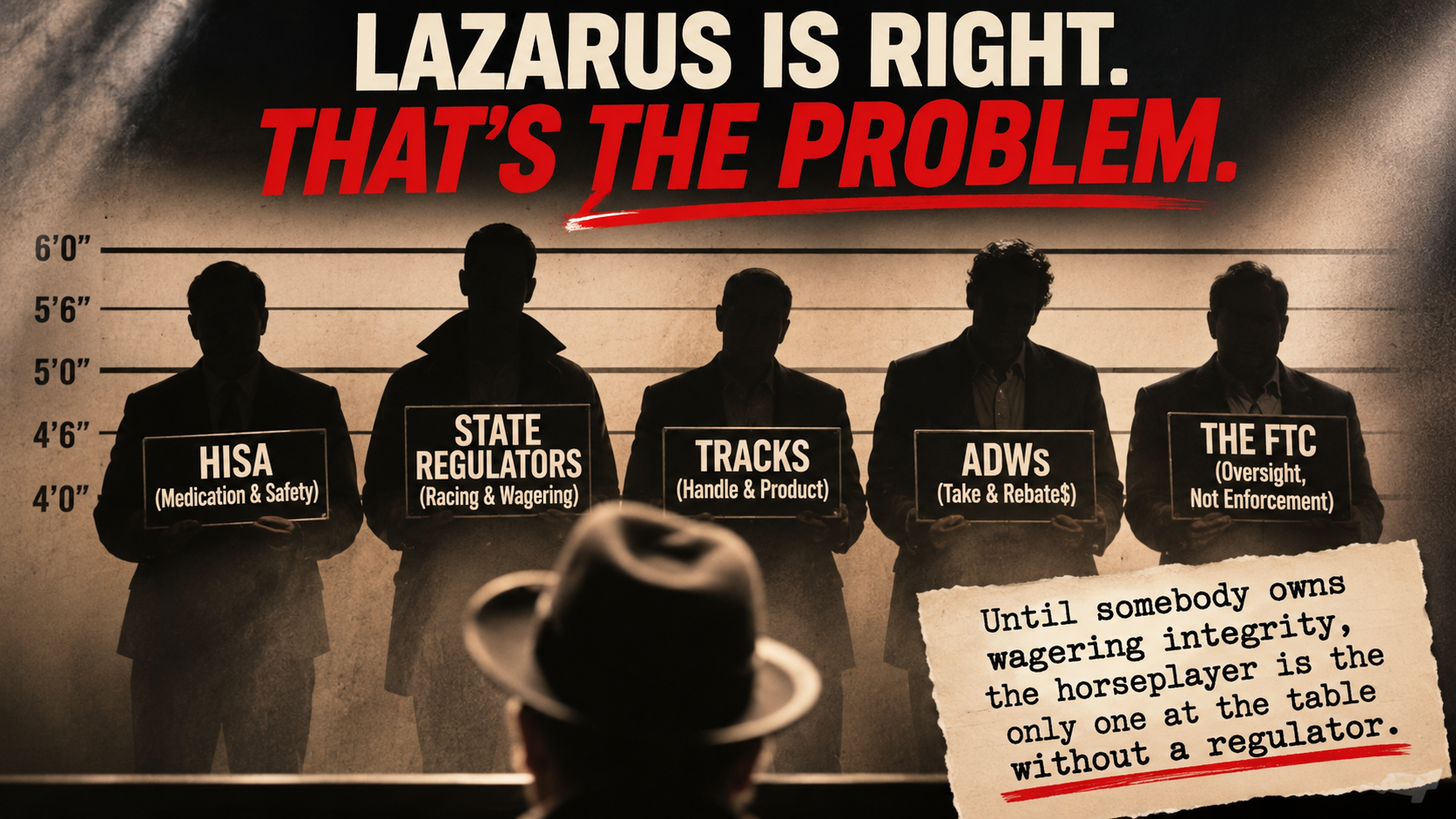
What I found is more interesting than either side’s sound bite. Lazarus is right on the law. That’s the problem.
This is my opinion, not a legal review. I’m a horseplayer and a columnist, not a lawyer. Not a journalist. I don’t have a GED but I do know how to read. The words in this statute aren’t difficult, and you don’t need a law degree to follow where they lead.
The Case for HISA as the Horseplayer’s Cop
Credit where it’s due. TIF’s argument isn’t built on air. Section 3054(a)(2) gives HISA “independent and exclusive national authority” over the safety, welfare and integrity of covered horses, covered persons and covered horseraces. Integrity is in the statute. It’s in HISA’s name.
TIF also nails the uncomfortable truth about where HISA’s power comes from. The federal hook is the bet. A covered horserace is defined by its tie to interstate commerce, including any Thoroughbred race that is the subject of interstate off-track or advance deposit wagers. Lazarus has said it herself for years. A track that doesn’t export its signal doesn’t fall under HISA. No simulcast, no HISA.
The Act even tells HISA, in building its safety program, to consider the IFHA’s International Agreement on Breeding, Racing, and Wagering. So the word isn’t foreign to this law. TIF looked at all of that in 2021 and said HISA should become a horseplayer’s best friend. I don’t disagree with the goal. In The Bet They Won’t Take, I argued that racing’s integrity problems are wagering problems first, because this is a state-sanctioned gambling business and always has been.
Where the Argument Pulls Up
Here’s the problem. Read the very next words of the clause TIF quotes. HISA’s exclusive authority also covers “all horseracing safety, performance, and anti-doping and medication control matters,” and everything Congress built underneath it is two programs. One is Anti-Doping and Medication Control. The other is Racetrack Safety. There is no third program, and there is no wagering program.
The investigative power is fenced the same way. Under Section 3054(h), HISA has subpoena and investigatory authority “with respect to civil violations committed under its jurisdiction.” HISA can investigate violations of HISA’s rules. It can’t open an investigation into a betting pool because the pool looks funny.
The best counter in the statute is Section 3054(c), which lets HISA adopt investigative powers “of the nature and scope exercised by State racing commissions.” State commissions do look at betting. But that clause serves HISA’s safety and medication programs, and the Act describes HISA’s authority over covered persons as safety, performance, and anti-doping and medication control authority. It’s a toolkit for those two programs, not a back door to the tote.
Then there’s the detail that settled it for me. The original 2020 law did mention wagering once in language with teeth. It let the FTC issue an emergency interim rule if needed to protect “the integrity of covered horseraces and wagering on those horseraces.” When Congress rewrote that subsection in its 2022 fix, the wagering language didn’t survive. That change matters, although deleting those words does not, by itself, settle every question about HISA’s authority over wagering-related conduct.
As for the FTC’s mission of protecting consumers, that’s the FTC’s mission. It doesn’t transfer to HISA by proximity. And to be fair to TIF, its piece never claimed it did. Read its last line: “It should do so.” That’s advocacy, and it’s a good argument for what the law ought to be. It isn’t proof of what the law is.
Zero Authority? Not Quite.
Now here’s where Lazarus gets a little too tidy. Responding to Churchill Downs’ letter to the FTC, she wrote that HISA’s congressional mandate doesn’t include the regulation of betting markets, and that HISA therefore has “zero authority over wagering activity.” On betting markets, she’s right. On wagering activity, look at HISA’s own docket.
HISA charged Marshall Gramm with fraud, alleging he used confidential horse health information from its portal for “potential wagering or claiming decisions.” HISA has also said it will seek restitution of what he made from handicapping contests, pari-mutuel wagering and claiming during that window. Gramm denies it, and I’ve written about the rush to hang him and about a sport wearing blinkers. But set guilt aside for a moment. Seeking those proceeds doesn’t make HISA a wagering regulator, but it does show how a violation of HISA’s rules can reach into wagering activity.
That isn’t hypocrisy. It’s the actual line, and it’s worth drawing precisely. HISA can’t regulate the pools, the tote, the ADWs or the betting shops in London. It can sanction a covered person whose violation of HISA’s rules touched a bet. As the Paulick Report put it, suspicious wagering can matter when it points to a violation within HISA’s jurisdiction. Fair Hill proves it. The betting patterns started the conversation, and HISA answered with out- of-competition testing, Vet’s List scratches and a provisional suspension of Angel Quiroz after albuterol positives.
Early on, Lazarus told reporters the horses had been tested and the tote system was being examined for suspicious betting. Weeks later it was zero authority over wagering. Both can be true, because using betting data as evidence isn’t the same as regulating betting. But horseplayers deserve that line explained in one consistent sentence, not two that sound like they’re arguing with each other. She’s drawn jurisdictional lines before and stood on them, as she did at HISA’s Town Hall. This one needs the same clarity.
The Gap Nobody Owns
So who does own wagering integrity? State racing commissions can pull betting data from the tracks they license, but whether they have the people to make sense of it is another question. The TRPB watches pools, but it’s a private bureau working for the tracks and regulators who pay it. The British bookmakers who took the Fair Hill money answer to their own regulators. Every one of them sees a slice. Nobody sees the whole board.
That’s what the Fair Hill Five really exposed, and it’s bigger than whether Lazarus or TIF has the better read. Racing built a national regulator because a horse’s medication rules shouldn’t change when it crosses a state line. Then it left the bet, the thing that makes this whole enterprise legal and pays for all of it, scattered among state commissions and a private bureau.
If the industry wants what TIF asked for five years ago, it won’t get there by pretending the statute already says so. There are two ways to get there. Congress can amend the Act and give someone, HISA or otherwise, clear national authority over wagering integrity. Or HISA can write narrow rules inside its own lane, like barring covered persons from betting against their own horses or from betting on confidential health data, and run them through the FTC. Either road draws a lawsuit, because this industry sues over everything. But one of them has to be taken, or the next Fair Hill ends the same way this one did: with everyone pointing down the hall.
When Churchill Downs asked the FTC to look at HISA, I wrote that nobody gets an exemption from scrutiny. The same goes here. Not HISA, not the commissions, not the tracks and ADWs that profit from the handle and leave the policing to someone else.
Shocked, Shocked
There’s a scene in Casablanca every horseplayer should know by heart. Captain Renault shuts down Rick’s, announcing he’s shocked to find gambling going on in there, just as the croupier hands him his winnings.
Racing has been playing that scene for decades. Everybody lives off the handle. Everybody is shocked when someone bets like they know something. And when the question becomes who’s supposed to be watching the money, everybody discovers it’s somebody else’s jurisdiction.
Lisa Lazarus read her statute correctly. TIF asked the right question five years ago. The law just never answered it.
Until somebody owns wagering integrity nationally, the horseplayer is the only one at the table without a regulator watching the whole game. Round up the usual suspects.

Comments