

By Jon Stettin | Past The Wire | November 17, 2026
I’m late to this one, and that’s fine. It is not the first time, it likely won’t be the last time. Dan Ross at Thoroughbred Daily News did the digging, and he deserves the credit. His investigation, The EQIAS Lab, The General Counsel and the Conflicts of Interest Concerns, laid out the relationships and the questions surrounding them. Andy Cohen followed with a column at Paulick Report, calling it an unforced error and a bad look. He’s right, but he stopped too soon. This isn’t really a story about one lawyer on one nonprofit board. It’s about a federal anti-doping program that built a process to police its labs but has yet to demonstrate that it holds itself to the same standard.
So let’s follow the paper and ask the questions nobody at HIWU seems to want to ask.
The lab with a past
To understand why this matters, start with the building.
The Equine Integrity and Anti-Doping Sciences Lab, EQIAS, sits in Lexington. It occupies the former University of Kentucky Equine Analytical Chemistry Laboratory facility. That’s the laboratory HISA and HIWU began investigating in March 2024. Investigations by HISA, HIWU and the university found, among other failures, positive tests misrepresented as negative. The university fired director Scott Stanley in September 2025.
That was one of the lowest points of HISA’s young life as a regulator. Positives were being called negatives at a laboratory participating in the federal program. If you were a horseman staring at a suspension, or a horseplayer who’d lost a photo to a horse that should never have been on the track, you had every right to wonder what else had slipped through.
The facility didn’t close. Its assets were sold, and a new operator took over. The personnel, management and operating arrangements changed. There is no evidence establishing that the misconduct uncovered under the previous laboratory management continued under EQIAS.
But who acquired the laboratory assets, and how the new operation was structured, is central to this story.
Follow the paper
SMRTL is the Sports Medicine Research and Testing Laboratory, a nonprofit run by Dr. Daniel Eichner. According to HIWU’s own closing book of evidence in the case against trainer Christopher Fung, as documented by Ross, Eichner acknowledged that the initial bid to buy the UK lab was “submitted by and awarded to SMRTL.” He also testified there was concern that SMRTL could lose its 501(c)(3) status if it bought and operated the lab itself.
The transaction ultimately went through a different entity, the Sports Drug Testing Laboratory, operating as Eagle Diagnostics, which runs EQIAS. SMRTL’s 2025 tax filing lists SMRTL as the sole owner of the Sports Drug Testing Laboratory. Eichner is president of both. When Ross called Eagle Diagnostics, SMRTL’s chief operating officer answered the phone.
Now look at what HIWU has said.
HIWU’s new general counsel, Janelle Winston, told TDN that “SMRTL had nothing to do with buying EQIAS.” A HIWU spokesperson told Cohen that SMRTL’s board “did not authorize or have a vote in” the acquisition. Maybe the board never formally voted. But HIWU’s own filing says the initial bid came from SMRTL and was awarded to SMRTL. The structure that followed addressed concerns about SMRTL’s tax exemption. Whether it also provided meaningful independence is another question.
In August 2025, EQIAS received probationary HEAL accreditation and began testing HIWU samples. HISA and HIWU have paid it approximately $1.6 million, according to figures they supplied to Ross.
The general counsel and the expert
Michelle Pujals became HIWU’s general counsel in July 2022 and also served on SMRTL’s board. Tax filings show SMRTL paid her $4,500 in 2025. Those filings also show Eichner received $581,028 in compensation that year plus a $41,086 bonus. His bonuses were subject to review by SMRTL’s board, which included Pujals.
Meanwhile, HIWU has used Eichner as an expert witness in approximately half a dozen anti-doping and medication cases. Ross reports that HIWU initially did not clearly disclose his ties to EQIAS. HIWU says it will continue using him.
Consider the relationships. HIWU’s top lawyer sat on the board responsible for reviewing the compensation of a man HIWU put on the stand against horsemen. His organization owns a laboratory HIWU accredited and pays. That laboratory operates in the facility where HIWU previously uncovered serious testing failures under different management.
HIWU says Pujals didn’t argue specific cases; she oversaw the legal department. Fair enough. But Winston acknowledged to Ross it was “possible” Pujals discussed specific cases and offered guidance to litigating attorneys. You can’t have it both ways. Either the general counsel was walled off from the cases, or she wasn’t. If safeguards existed, explain them.
This was not hidden
Here’s the part that bothers me most.
This didn’t surface last week. Fung’s lawyers were challenging Eichner’s impartiality in filings by October 2025. On January 22, 2026, trainer Phil Serpe’s lawyers raised the relationships involving Pujals, SMRTL, Eichner and EQIAS in a motion before the Federal Trade Commission, identifying Pujals by name.
On February 4, the FTC declined to consider the additional evidence because Serpe had not demonstrated sufficient grounds for failing to present it earlier. The commission did not decide whether the relationships constituted a conflict of interest.
Pujals remained at HIWU until June. HIWU says her retirement was planned since 2022 and had nothing to do with SMRTL. I’ll take them at their word on that. But that wasn’t the question. The question is what HIWU and HISA did between October 2025 and June 2026, once these relationships were being challenged in arbitration and before the FTC. What review took place, who conducted it, and where is the documentation?
HIWU announced Pujals’s retirement on June 17. Six days later, on June 23, HISA proposed updates to its laboratory rules, Rule Series 6000, including enhanced accreditation standards and expanded laboratory oversight. That rulemaking was already part of an ongoing review. The question is whether HISA considered strengthening its own conflict safeguards while strengthening laboratory oversight.
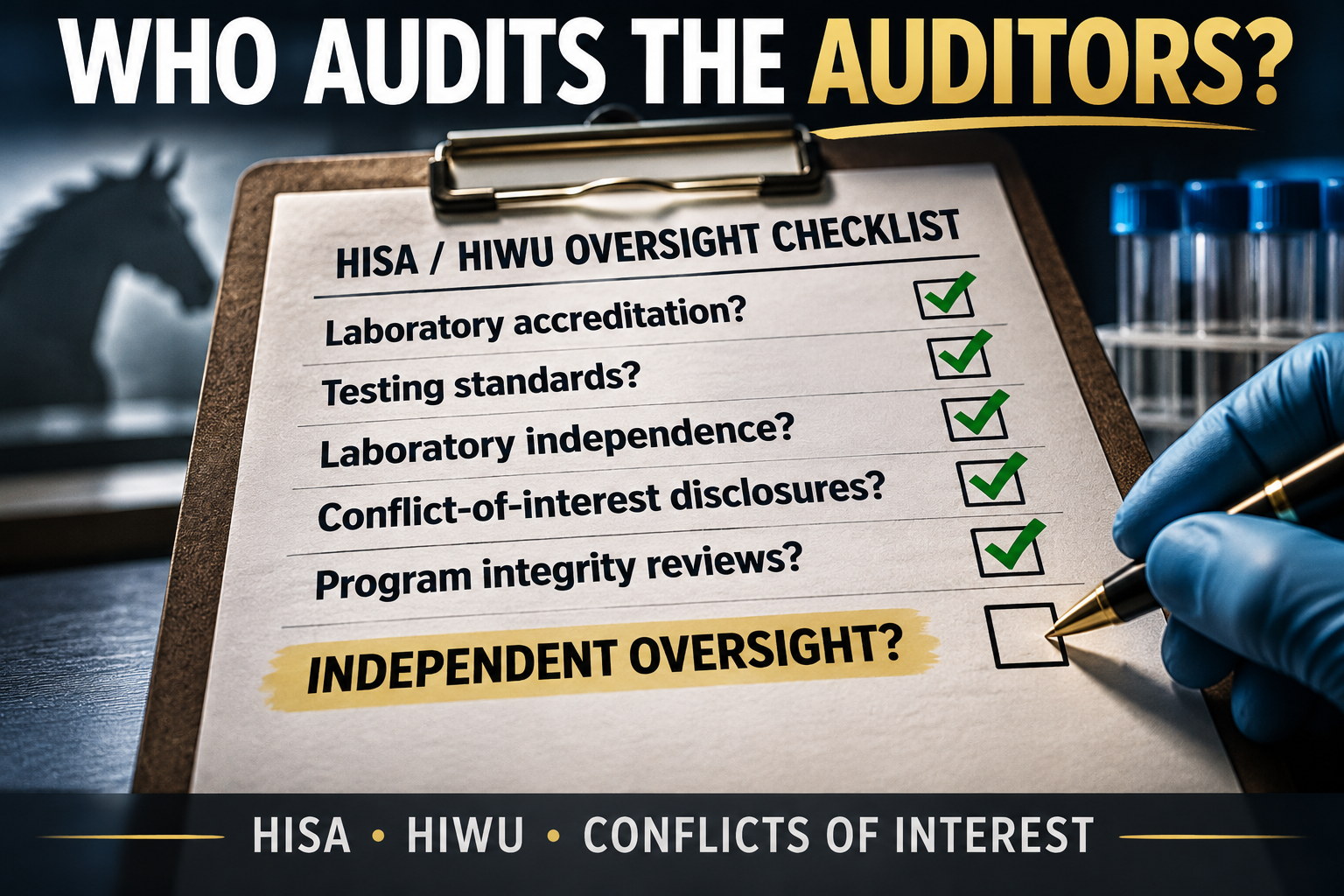
Who audits the auditors?
To be fair, HIWU has shown it will act against a laboratory. It suspended probationary accreditation for the Pennsylvania laboratory, PETRL, and for the Ohio Department of Agriculture laboratory. It promised to publicly disclose any effect on pending or resolved cases, as program rules require. That’s real, and it shows laboratory oversight isn’t just ceremony.
But it makes the gap more obvious. When a laboratory’s chemistry falls short, there’s a mechanism: review, suspension, corrective action, public disclosure. When the people running the program face questions about a potential conflict, what’s the mechanism? Who reviews it? Who decides? Who tells the horsemen whose cases might be affected?
Right now the public explanation amounts to HIWU reviewing the relationship and finding nothing. “There’s no there there,” Winston told Ross. Asked about an additional review, she said HIWU had “already determined that there wasn’t a conflict.”
That’s the problem in one sentence. The organization facing questions about a conflict decided there was no conflict. In this sport, we’d never accept that explanation from a trainer without examining the underlying facts.
Is there a legitimate explanation?
There is a case for HIWU, and it deserves a hearing.
The pool of qualified anti-doping laboratories and experts is small. The arbitrator in Fung’s case, Bernard Taylor, recognized that it isn’t uncommon for experts to testify for agencies with which their laboratories have relationships. He determined that potential bias affected the weight or credibility of testimony rather than its admissibility.
Someone had to take over the Kentucky laboratory after the Stanley mess, and relatively few organizations had the necessary expertise. HIWU says Pujals disclosed her board position before she was hired. The reporting has not established that any EQIAS test result was affected by these relationships.
I accept that those are legitimate considerations. I don’t believe they’re enough.
Disclosure is step one, not the finish line. HISA’s laboratory standards require administrative and operational independence from parties capable of exerting undue pressure. That requirement addresses laboratory independence and does not, by itself, establish that Pujals violated a rule governing HIWU personnel.
But the underlying principle matters. An ethics expert Ross spoke with, Matthew Altman, said standard practice would have been for Pujals to leave the SMRTL board, or at least recuse herself, once the purchase was under consideration. HIWU says it determined recusal was unnecessary.
That isn’t proof of a crime or even necessarily a specific rule violation. It is a judgment call. Based on the relationships and the explanations offered so far, I think it was the wrong one.
My read is that nobody necessarily fell asleep at the wheel. HIWU was built with expertise from the human-sports anti-doping world, where a limited pool of specialists creates overlapping professional relationships. Perhaps those relationships appeared ordinary to the people involved. Perhaps they evaluated the situation and genuinely believed there was no problem.
If so, that is precisely why the reasoning should be available for independent examination. Institutional familiarity can make a potential conflict seem less significant to insiders than it does to everyone else.
The question we asked Mike Repole
When I sat down with Mike Repole on November 4, I asked him which Mike shows up when Churchill Downs makes a call that’s good for its shareholders and bad for racing. He’s a Churchill shareholder, an owner-breeder, and the man who calls himself racing’s commissioner.
His answer was pure Repole. “The Mike that shows up is going to be the Mike from Queens,” he said. He told me he has already told Bill Carstanjen, in language I won’t print, when he thinks Churchill gets something wrong. Then he drew the line himself: “I’m not going to make that decision. I can’t.”
Later I asked him where an ordinary relationship becomes a real conflict in a sport this small. Brothers ride against each other. Partners, farms, families and trainers are tangled every which way. His answer was the cleanest definition I’ve heard from anyone in this business:
“When those relationships are ownership on a horse, that’s not a conflict. When those relationships are making decisions for the entire industry and have a chance to benefit a particular group, that’s a major conflict.”
Hold the Kentucky laboratory relationships up to that test. HIWU prosecutes drug cases for the whole industry. Its general counsel sat on the board of the nonprofit that owns a laboratory HIWU pays. That isn’t a piece of a horse. That’s the second category.
Repole gave me another example that fits almost too well. He was talking about Lexington law firms that represent several racing bodies at once. If the Mets and the Yankees were doing business, he said, “they couldn’t use the same attorney.” The lawyer would simply say, “I have a conflict.” That’s the sort of independence HIWU should have been especially careful to demonstrate.
He also told me about HISA’s own standard. According to Repole, when he offered to pay for an investigation, Lisa Lazarus told him HISA couldn’t accept money from anybody it regulates. She didn’t want it to look like a conflict if one of his horses ever tested positive. That’s the right instinct. It’s also the instinct HIWU should have applied when evaluating its own general counsel’s outside responsibilities.
I owe you my own words too. When Repole pointed out HISA and HIWU staff who came from The Jockey Club and its law firm, I said on air that it’s a small, niche industry and overlap comes with it. I also said it’s a concern that “needs clarification and more transparency.” I still believe both halves of that.
A small industry explains why roles overlap. It doesn’t excuse a regulator from managing them. And the standard for the regulator has to be higher than the standard for an owner. Repole risks his own money. HIWU makes decisions that can affect someone’s license, livelihood and reputation.
A small sport needs a simple standard: disclose, recuse, and watch the money. Disclose the relationship. Recuse where responsibilities or interests could compromise independent judgment. Watch where the money and the information flow.
HIWU says Pujals did the first and that the second wasn’t necessary. As for the third, the financial relationships are documented: a laboratory contract, an expert witness, and a compensation review structure involving a board that included the regulator’s top lawyer.
If HISA wants owners like Repole held to account for the hats they wear, and it should, it has to hold itself to account first.
What HISA should answer
I’ve generally given HISA the benefit of the doubt, and I’ll keep doing that. But benefit of the doubt isn’t a blank check, so here are the questions.
What written assessment did HISA and HIWU conduct when they considered Pujals’s SMRTL board position in connection with the EQIAS contract in 2025, and who approved the determination that no conflict existed?
Was anyone independent of HIWU, at HISA or elsewhere, asked to review whether Pujals should remain on the SMRTL board after the Kentucky laboratory acquisition?
Winston said SMRTL had nothing to do with buying EQIAS. HIWU’s own closing book of evidence identifies SMRTL as the successful initial bidder. How does HIWU reconcile those statements?
What safeguards governed Pujals’s involvement in legal department decisions concerning EQIAS samples or Eichner’s testimony, and how were those safeguards documented?
Will HISA, rather than HIWU alone, commission an independent review of conflict-of-interest policies across the program?
Will the laboratory rule updates be accompanied by a review of conflict standards for program personnel, not just laboratories?
How will HIWU respond when the next trainer facing a positive raises these relationships in a defense? The issue has already reached the FTC, and it can arise again.
The bottom line
HISA faces another potential Supreme Court showdown, and one of its strongest arguments has been that it brought competence to a sport that badly needed it. I’ve said before that the sport is better with HISA than without it. I still think so.
That’s exactly why this matters. A drug testing program depends on confidence in the integrity of its results and the independence of those who administer it. Horsemen whose cases involve EQIAS have a legitimate interest in understanding how these relationships were evaluated and managed.
HISA can answer that with a documented, independent review, or HIWU can keep saying there’s no there there.
In this game, appearance is reality. I’d rather see them fix it than explain it.
As Worm learned in Rounders, the problem isn’t always who’s dealing the cards. Sometimes it’s who’s watching the dealer.


Comments