

The Sport of Kings Is Being Taken to Court. This Time, the People Suing Are Not Going Away.
Horse racing has spent decades managing dissent the same way it manages everything else: quietly, internally, and with the implicit understanding that those who depend on the industry for their livelihoods do not sue the industry. You complained to the trade press. You voiced concern at a board meeting. You accepted the outcome, because the alternative was to become persona non grata in a sport governed by people who have long memories and short tolerances for accountability.
That era is ending.
At this moment, four separate legal challenges are bearing down on the institutions that have run this sport for generations. Two are active filed cases in federal and state court. Two are pending, threatened, or already reshaping the terrain without a single pleading yet filed. They are different in their origins, their targets, and their legal theories. What they share is something this sport has rarely seen: people who decided that the inside game was not working, that the polite conversation had run its course, and that the courtroom was the only room left where the rules apply equally to everyone.
Past The Wire has covered each of these threads in depth since they began. We have written about the CAW litigation from both the plaintiff and defense side, analyzed the specific legal architecture of the White Abarrio complaint, fact-checked the Jockey Club’s public response to Mike Repole’s governance campaign line by line against the actual 990 filings, and covered the Kalshi prediction market rulings since before the Third Circuit had weighed in. This is not a summary of what others have reported. This is where all four threads stand today, and what the picture looks like when you put them together.
I. DICKEY ET AL. v. THE STRONACH GROUP ET AL.
The CAW Case | Eastern District of New York | Active — Discovery Stayed
Ryan Dickey filed the original complaint in the Eastern District of New York in October 2025, alleging under the Racketeer Influenced and Corrupt Organizations Act that computer-assisted wagering platforms operated by The Stronach Group, Churchill Downs, NYRA, AmTote, United Tote, Racing and Gaming Services, and Elite Turf Club conspired with insider bettors to corrupt pari-mutuel pools at the expense of ordinary horseplayers. The First Amended Complaint, filed February 2026, expanded the action to seven named plaintiffs, seven proposed statewide subclasses, and ten state consumer protection claims layered on top of the original RICO theory.
We have written this case from both directions. In April 2026 we published our analysis of why the plaintiffs constructed the wrong lawsuit around the right problem, walking through the coordinated defense letters filed the same day by Wilson Sonsini for Stronach, AmTote, and Elite Turf Club; Greenberg Traurig for NYRA; Rivkin Radler for RGS; and Gibson Dunn for Churchill Downs and United Tote. The structural weaknesses in the plaintiffs’ RICO theory are real, and we said so plainly. We subsequently published a piece laying out the legitimate defenses available to the CAW side, because fairness demands both. The legal vulnerabilities run in both directions.
The procedural posture is this. In February 2026 Judge Joan Azrack stayed discovery with a single sentence, ‘Discovery is stayed until the Court directs otherwise,’ accompanied by no explanation. Defendants had sought the stay. Plaintiffs had argued in a January filing that the harms of CAW were beyond dispute and that they needed the archived pari-mutuel records to prove it. The stay denied them those records, at least for now, and the case sits in pre-motion posture awaiting rulings on the anticipated motions to dismiss.
Then came the moment that belongs in any account of this sport’s current accountability climate. On April 8, 2026, at an ARCI conference session explicitly titled ‘Consumer Confidence in a World of Computer-Assisted Wagering,‘ Scott Chaney, executive director of the California Horse Racing Board, told his audience that CAW is ‘not a problem to be solved or something that needs to be severely restricted or limited’ and that the approach was to figure out ‘what is the best long-term approach for the health of horse racing.’ We reported on those remarks the day they were made, and we reported something alongside them that Chaney could not have anticipated: his statement appeared as exhibit material in the federal litigation. The plaintiffs cited it as evidence.
We are not suggesting Chaney’s remarks were legally imprudent or constitute any admission on behalf of any party. We are noting that the executive director of the primary state regulator of CAW activity in California made a public statement characterizing CAW as categorically not a problem, in his official capacity, at the precise moment active federal litigation was arguing the opposite, and that characterization now exists in the public record alongside that litigation.
The executive director of California’s primary CAW regulator declared CAW ‘not a problem to be solved’ on the same day his name appeared as exhibit material in a federal racketeering case arguing the contrary.
Whether this case ultimately survives the motions to dismiss is a legal question with a genuinely uncertain answer. What is not uncertain is the broader point we have made since the original filing: if the case is dismissed, the industry cannot treat dismissal as vindication. The structural problem Dickey identified, even if his legal theory cannot survive Rule 9(b)’s particularity requirement, does not disappear because the complaint does. It was there before the lawsuit and it will be there after it.
II. BARBER AND C2 RACING STABLE v. BREEDERS’ CUP LIMITED ET AL.
The White Abarrio Case | Los Angeles Superior Court | Active — Filed April 2026
This is the most document-rich active litigation in racing right now, and it has become considerably more consequential than the original coverage of a disputed scratch suggests. What sits behind the complaint is not only a specific, sworn factual record sourced to the defendants’ own veterinary documentation. It is a legal trap the defendants constructed for themselves, and the trap has two doors, neither of which leads anywhere comfortable.
We wrote the definitive account of this case when the complaint was filed in April 2026, anchoring the piece to the fact that almost no one else emphasized: the Breeders’ Cup’s own published scratch deadline for Saturday championship races was 8:00 AM. White Abarrio had been examined every day for a week. He underwent an 18F NaF PET scan at the Breeders’ Cup’s own request. He passed a Sleip AI gait analysis the day before the race. He was cleared the morning of the race. He was already in the post parade with Irad Ortiz Jr. aboard when a veterinarian made a snap judgment and called the stewards. Post the 8:00 AM deadline. After a week of documentation that said the same thing every day.
The complaint’s central factual allegation is that the gait Dr. Brant Cassady, the Del Mar track veterinarian, flagged in the post parade as disqualifying was the same choppy gait White Abarrio has carried throughout his entire career. More specifically, the complaint alleges that Cassady himself had examined White Abarrio before the 2023 Breeders’ Cup Classic, noted that identical gait, and cleared the horse as racing sound. White Abarrio won that race. The complaint states it plainly: it was the same gait with which White Abarrio had already run in 24 races and won 10 of them.
The Illusion of Elite Oversight — and the Trap It Created
Here is where the piece gets structurally significant, and where we are going beyond what most coverage has noted.
The Breeders’ Cup, for events of its scale, assembles what it presents as an elite panel of international and out-of-state regulatory veterinarians to conduct the week-long, rigorous pre-race scrutiny that justifies its safety narrative. This is a marketing asset as much as a clinical one. The organization wants the public to understand that the best veterinary minds in the sport are examining these horses under conditions more sophisticated than any ordinary race meet. PET scans. AI-assisted gait analysis. Daily physical examinations. Seven days of documentation. It is the apparatus of elite oversight, and the Breeders’ Cup built it deliberately.
The legal vulnerability of that apparatus, now that an owner with the resources to pursue it has put it under oath, is this: under California Horse Racing Board rules and the California Business and Professions Code, any veterinarian conducting examinations, interpreting advanced diagnostics, making official declarations of soundness, or exercising any regulatory veterinary function on the backside of a California racetrack must hold a valid license to practice veterinary medicine in the State of California, or operate under a narrow and explicit regulatory exemption. The out-of-state experts the Breeders’ Cup brings in as advisors or inspectors occupy a legally ambiguous space the moment their observations, recommendations, or communications enter the chain of authority that produces a regulatory outcome. And a scratch is a regulatory outcome.
The complaint addresses this directly, and this language comes from the complaint itself, not from any secondary source. It alleges that Dr. Cassady ‘relied on text messages received from persons who: (a) had not examined White Abarrio in the lead up to the race; (b) should not have been present on the racetrack (as they lacked the necessary CHRB license); and (c) were not authorized to act in a veterinary role or provide any input or recommendations regarding scratches.’
Three independent violations, layered into a single sworn allegation. No prior examination. No California license. No authority to participate in scratch decisions under the governing regulatory structure. And the mechanism through which they allegedly exercised influence was not a formal recommendation entered into the official record. It was a text message.
The complaint alleges Cassady acted on texts from people who had no prior examination of the horse, no California license to be there, and no authority to weigh in on scratches. The Breeders’ Cup’s elite panel just became a legal liability.
The Bilateral Trap: There Is No Good Door
Watch what happens to the defendants’ position when they try to respond to this allegation. They face a bilateral trap with no exit that does not cost them something significant.
If they argue that the out-of-state veterinary panel was merely advisory and had no official role in the scratch decision, they have just conceded that a multi-million dollar regulatory determination, affecting a former Breeders’ Cup Classic winner, a horse that had been declared racing sound by every examination conducted over seven days, was made exclusively by one licensed California veterinarian on the basis of a visual impression that lasted, according to the complaint, only a few seconds. They have confirmed the snap judgment theory. They have confirmed that a week of clean scientific data was overridden in the post parade by a single pair of eyes. That is the worst version of the story for the institution, and they will have been the ones to tell it.
If, on the other hand, they acknowledge that the international veterinary panel played a substantive role in the scrutiny and in the decision-making that led to the scratch, they have opened a different and arguably more serious door: they permitted out-of-state, California-unlicensed individuals to exercise sovereign regulatory authority over a California-licensed stable operating at a California-licensed racetrack. That is not a policy disagreement. Under the California Business and Professions Code, practicing veterinary medicine without a license is a statutory violation. Influencing a regulatory scratch decision without the required California credential, if that is what the evidence shows, is not an informal procedural irregularity. It is the kind of finding that follows institutions.
The Breeders’ Cup cannot have it both ways. They built the elite panel for the marketing. They cannot dissolve its legal footprint when the marketing creates liability.
The Cassady Pivot — and What It Reveals
Notice the public narrative that took hold immediately after the scratch. Racing officials and stewards went out of their way, in the days following the card, to emphasize that the final call came from Dr. Cassady. That framing was not accidental. Cassady is the locally licensed, officially credentialed track veterinarian. If the decision can be pinned entirely to him, the Breeders’ Cup has regulatory insulation. The international panel disappears. The text messages disappear. The chain of influence disappears. What remains is a licensed California official making a judgment call, and judgment calls by licensed officials are defensible.
The complaint destroys that positioning. It alleges specifically that Cassady’s recommendation was shaped by communications from people who were not licensed to be in that chain of authority. The Cassady pivot was a defensive strategy, and the complaint anticipated it.
The Contractual Paradox and the Fee Structure
We wrote in our original piece about the contractual contradiction sitting at the center of this case and it bears restating here. The Breeders’ Cup pre-entry form states that fees are non-refundable except in the event of sickness or disability certified by the track or state veterinarian. The CHRB-issued certification of unsoundness that placed White Abarrio on the vet list is simultaneously the regulatory action the plaintiffs are contesting and the contractual mechanism that would normally unlock a fee refund. The certification cannot be both valid enough to justify retaining fees and legally actionable at the same time. The Breeders’ Cup’s fee structure was designed to insulate the organization from financial exposure in precisely this scenario. The lawsuit is forcing that insulation into court.
The Broader Pattern Nobody Explained
White Abarrio was not the only prominent horse scratched at the 2025 Breeders’ Cup under circumstances that produced no public explanation. Mystik Dan, the 2024 Kentucky Derby winner, was scratched by regulatory vets race morning. Blackout Time, Tamara, Sweet Azteca, and Coolmore’s Precise were also removed. Trainer Kenny McPeek stated publicly that neither of his two scratched horses had any history of unsoundness and that he had loaded them without a soundness concern. Not one of those scratches produced a public explanation from the Breeders’ Cup, the CHRB, or HISA. Not one.
The White Abarrio complaint also notes that the veterinary team did not consult Irad Ortiz Jr., the jockey who was aboard the horse in the post parade and who believed the gait was normal and the horse showed no problems during warmup. The attending veterinarian who examined White Abarrio immediately after the scratch, back at the barn, was stunned by what she found. Or rather, by what she did not find.
Mongolian Groom — The Origin of the Protocols Now Being Litigated
This context belongs in this story. Mongolian Groom’s catastrophic breakdown in the 2019 Breeders’ Cup Classic produced the Bramlage Report, which recommended that advanced diagnostic imaging become part of pre-race protocols for selected horses. The report specifically documented that veterinarians had observed short or choppy movement in Mongolian Groom in the weeks before the race. That documentation became the foundation for the PET scan protocol. The Bramlage Report’s language about choppy movement and the White Abarrio complaint’s language about a choppy gait occupy the same sentence in racing history, six years apart and on opposite sides of the same argument.
The protocols that cleared White Abarrio all week were born from Mongolian Groom’s death. The sport learned the lesson. Built the tools. Required the scans. Then a post-parade call overrode everything those tools produced. If that is what the evidence shows, it is not an irony. It is institutional amnesia with a $10 million price tag.
Where It Stands
Neither Breeders’ Cup Limited, the CHRB, nor Del Mar has offered any substantive public response to the allegations in the complaint. All three declined comment on pending litigation when the complaint was filed. No defense answer has surfaced publicly as of this publication. The case is in early posture. Discovery has not begun. What happens when it does is the question the industry should be thinking about, because what the plaintiffs are requesting is exactly what the Breeders’ Cup does not want produced: every internal communication between the veterinary team and the stewards, the text messages referenced in the complaint, Cassady’s examination records going back to the 2023 Classic, and the credentials and licensure status of every member of the veterinary apparatus that touched this horse.
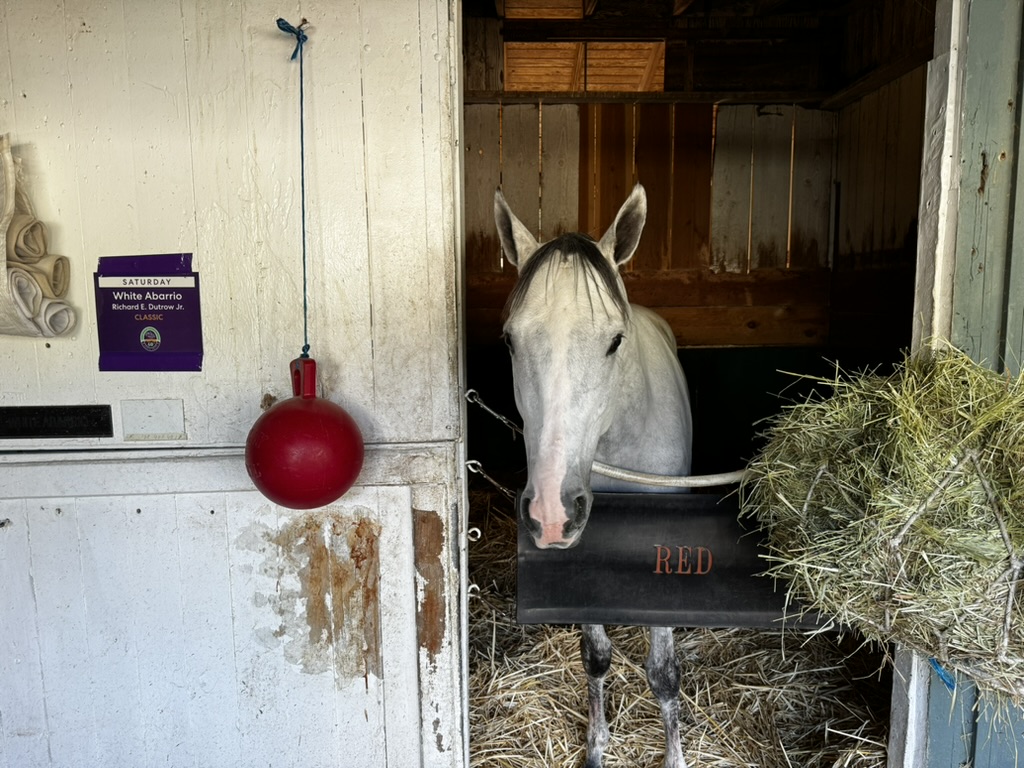
Since the scratch, White Abarrio has answered every question a racetrack can ask. He cleared the CHRB vet list after a single five-furlong work. He finished a game second in the 2026 Pegasus World Cup, five and a half lengths clear of third. He won the Oaklawn Handicap against the best older horses in training. The horse the post-parade veterinarian called unsound in his left front leg has performed like a champion in every appearance since. He literally beat the horse of the year. That is not a legal argument. But it is a fact, and in court, facts matter.
III. REPOLE v. THE JOCKEY CLUB ET AL.
The Governance Case | Threatened — Not Confirmed Filed as of Publication
Mike Repole has been conducting a public campaign against The Jockey Club and the governance architecture surrounding it since at least 2023. Past The Wire has covered that campaign in depth, including a line-by-line fact-check of the Jockey Club’s January 2026 public rebuttal, measured against the actual 990 filings and publicly available financial data. The conclusion of that fact-check was more nuanced than either side’s public posture, which is as it should be. Repole’s factual critique of the financial architecture is stronger than the Jockey Club’s dismissal acknowledges. The Jockey Club’s counterarguments on certain specific expenditure claims are also legitimate. The record is the record.
In January 2026 Repole announced he had been working since June 2025 on what he called a national lawsuit and had taken formal steps toward filing it. He named The Jockey Club, the Breeders’ Cup, the NTRA, and TOBA as entities that had been legally notified to preserve all documents, emails, and texts. He compared his strategy explicitly to Michael Jordan’s antitrust lawsuit against NASCAR, which reached a mid-trial settlement in December 2025, a settlement NASCAR agreed to because it did not want its internal governance documents in the public record. The comparison was not made casually. Repole understands exactly what discovery produces.
On the eve of the 2026 Kentucky Derby, Repole intensified the threat at Churchill Downs, telling media directly: ‘The lawsuit is going to happen. Michael Jordan sued NASCAR. That’s how NASCAR moved. I’m convinced the Jockey Club is not going to move until someone punches them in the face and that’s what the lawsuit is. The lawsuit is ready. I could have dropped it this week.’ He gave the organization one week after the Derby. That deadline has passed. As of publication, no lawsuit has been confirmed filed, and we are not going to pretend otherwise. Repole has set deadlines before.
What has changed since January, however, is the environment in which any such lawsuit would land. The CAW case is in federal court. The White Abarrio case is in California Superior Court. The prediction market architecture is being litigated in multiple circuits simultaneously. The bilateral-trap dynamic we described in the White Abarrio section applies here in a different form: if the Jockey Club engages seriously with Repole’s conditions, they implicitly validate the governance critique. If they stonewall until a complaint is filed, they hand the plaintiffs a discovery process they have already demonstrated they want to avoid. The Jordan-NASCAR comparison Repole has been making for months is no longer hypothetical. It is precedent from December 2025.
The antitrust theory believed to be at the heart of Repole’s threatened case targets the Jockey Club’s ownership of Equibase specifically, a for-profit data monopoly embedded inside a nonprofit governance structure that also controls breed registry, influences regulatory appointments, and interlocks with the boards of virtually every major organization in the sport simultaneously. Whether that structure is legally vulnerable to antitrust challenge is a genuine legal question. What is not a genuine question is whether the discovery process that would accompany such a lawsuit would produce documents the Jockey Club wants in the public record. The Stewards’ open letter in January called Repole’s allegations baseless and noted that he had admitted having no facts and that filing was his only way to find any. That framing may prove to be a gift to his attorneys. Discovery is exactly how you find facts.
The Jockey Club’s response to Repole’s May 2026 letter, agreeing to meet in Saratoga in early June with principals present, is a response worth acknowledging. A willingness to sit in a room is not reform, and we said so when it happened. But it is a change from the dismissive January posture, and pressure, legal and public both, appears to have produced it. At least on the surface. To date, we understand the meeting is not scheduled. We will report what comes out of Saratoga without assumption in either direction.
IV. KalshiEX LLC v. FLAHERTY — AND THE IHA WALL
The Prediction Market Cases | Third Circuit Ruled April 6, 2026 | Supreme Court Likely
This thread is different in kind from the others. It is not a lawsuit against racing. It is a lawsuit by a federally licensed prediction market operator against a state gaming regulator, and horse racing is not a party. Its implications for the sport’s structural position are more sweeping than all three other cases combined, and Past The Wire has been covering the terrain it crosses longer than virtually anyone in this industry.
We have written about exchange wagering and prediction markets as competitive alternatives to pari-mutuel since 2014. We covered Kentucky HB 904, the legislation that put the Jockey Club on notice regarding Thoroughbred registry governance while simultaneously attempting to prohibit licensed sports betting operators from affiliating with prediction market platforms. We covered the Third Circuit’s April 6 ruling the day it came down and reported its specific implications for HB 904’s Section 25, the provision whose legal foundation the ruling substantially undermines. We covered the DOJ and CFTC’s simultaneous complaints against multiple states in April, representing coordinated federal muscle in defense of CFTC exclusive jurisdiction. We covered the Arizona preliminary injunction and the developing circuit split. We are on record with this analysis before most of the industry’s trade press had caught up to the legal mechanics, because we have been watching this terrain for a decade.
On April 6, 2026, the United States Court of Appeals for the Third Circuit ruled 2-1 in KalshiEX LLC v. Flaherty, becoming the first federal appellate court to hold that the Commodity Exchange Act preempts state gambling laws as applied to sports-related event contracts traded on CFTC-licensed designated contract markets. New Jersey tried to enforce its gambling statutes against Kalshi. The Third Circuit said New Jersey does not have that authority. The Commodity Exchange Act does.
A circuit split is now developing rapidly. The Ninth Circuit heard consolidated oral arguments on April 16 in cases involving Kalshi, Robinhood, and Crypto.com against Nevada, where the district court below had ruled against all three platforms in direct conflict with the Third Circuit. If the Ninth Circuit affirms Nevada, the split is established and the Supreme Court’s hand is effectively forced. As of publication, prediction market traders are pricing a 64 percent probability that SCOTUS accepts a sports event contract case by end of 2026. The Fourth Circuit heard oral arguments in a Maryland case on May 7.
For horse racing specifically, the picture is more nuanced than a simple win or loss for either side, and the distinction matters enormously. We have been drawing it consistently while others conflate two separate legal arguments.
The Third Circuit ruling dismantles state-level containment strategies, including the framework underlying HB 904’s Section 25. It does not automatically dismantle racing’s Interstate Horseracing Act defense. The IHA is a separate federal statute, not a state gambling law, and it gives the racing industry rights over the commercial use of its racing data and events that exist independently of state gaming authority. When Churchill Downs told Polymarket to remove its Kentucky Derby contracts and Polymarket complied, that was the IHA doing exactly what it was designed to do. When Kalshi declined to offer Derby contracts at all, that was Kalshi reading the IHA correctly. Kalshi’s battles against Nevada and New Jersey are being won at the federal preemption level. The IHA operates on a different battlefield under a different federal statute. Those are not the same fight.
The governance class has been relying on ‘let the states handle it.’ The Third Circuit eliminated that option. The IHA wall still stands. But a wall requires someone willing to maintain it, and racing’s governance class has shown no appetite for engagement.
What the Third Circuit ruling does do is eliminate the ‘let the states handle it’ strategy the racing governance class has been quietly depending on. If prediction markets cannot be regulated at the state level, and the industry’s IHA moat has limits it has never tested in adversarial litigation, then the rational move is engagement with prediction market operators on terms racing controls, before courts or market forces define those terms for it. The industry has shown no appetite for that engagement. The governance class that built pari-mutuel primacy over half a century has treated every alternative wagering format as an existential threat rather than a potential revenue stream and audience expansion tool.
That posture has costs, and the Third Circuit just made one of them visible.
The Umbrella
These four cases did not emerge from a coordinated movement. A bettor in Colorado, horse owners in Los Angeles, a billionaire in New York, and a fintech company built their challenges independently, from their own grievances, with their own legal theories, against different institutions. But they arrived at the same moment, and they are pointing in the same direction.
Each one exists because the conventional alternative failed. Dickey tried betting. He stopped when he understood what he was betting against. The White Abarrio connections spent five months in good-faith private engagement before filing suit. Repole has been trying public pressure and social media and open letters since 2023. The prediction market operators tried working with state regulators and received enforcement actions for their trouble.
What they all share is a conclusion: the institution in question does not respond to internal pressure, public argument, or polite engagement. It responds to legal process. That is not a verdict on the merits of any individual case. It is a verdict on how these institutions have chosen to operate, and it was rendered by the people who tried the other options first.
The bilateral trap we described in detail in the White Abarrio section is, in a broader sense, the trap all four cases are building together. The governance class of this sport cannot simultaneously claim that its processes are rigorous and legitimate while refusing to let those processes be examined in a public forum where the rules of evidence apply. Either the Breeders’ Cup’s veterinary apparatus can withstand the scrutiny the White Abarrio lawsuit demands, or it cannot. Either the CAW ecosystem operates within the spirit of pari-mutuel wagering’s legal framework, or it does not. Either the Jockey Club’s governance structure serves the sport’s broad constituency, or it serves a narrower set of interests that discovery would make visible. Either prediction markets can be engaged as partners, or they will be absorbed as competitors. In each case, the institution has been given the opportunity to answer the question in a controlled environment. In each case, it chose not to.
Past The Wire has been asking these questions in print since before any of these lawsuits existed, because we believed, and still believe, that accountability journalism done without institutional entanglement is a more civilized tool than litigation. But journalism requires an audience willing to act on what it reads. Courts require compliance. There is a difference, and horse racing’s governance class has spent years demonstrating that it understands the difference perfectly well.
The times are changing. Whether the institutions that have governed this sport for generations have the capacity to change with them, or whether it will take a series of courtroom defeats and discovery-forced disclosures to produce the accountability that public argument could not, is the question the next eighteen months will begin to answer.
We will keep asking.
Times are changing:
Related coverage: Eight O’clock Was the Time