

How CDI and the KHRG Completed the Job Boxing Started
There was a time when the heavyweight championship of the world stopped everything.
Not just sports. Everything. You cleared your schedule. You found a television. If you couldn’t find one you found a radio, and you sat next to it like it was warm. Ali and Frazier. Foreman going down in Zaire. Tyson in his prime, three rounds and the arena already knew. These were not sporting events. They were national pauses. The kind of moment that finds its way into American memory without anyone deciding to put it there.
Today, most people cannot name the heavyweight champion of the world.
Not because the talent disappeared. Because the credibility did.
Too many belts. Too many sanctioning bodies that existed mainly to collect fees and manufacture champions. The best fighters stopped fighting the best fighters because the economics rewarded avoidance and the regulatory structure permitted it. Promoters became the story. Politics became visible. And fans, who are not stupid, quietly reclassified what they were watching. It was still athletic. It was still occasionally spectacular. But it was no longer the thing they’d stop everything for.
Boxing didn’t die. It just stopped mattering the way it once did.
Horse racing should be paying very close attention.
The Bet Nobody Wanted to Make
In January of this year, before the Ortiz story had broken into the national conversation, before USA Today had put it on its front page, before any of this year’s governance failures had finished accumulating, Past The Wire published a piece arguing that the Kentucky Derby was not untouchable. That the IndyCar parallels were real. That extraction was replacing cultivation at the top of American racing, and that fans who feel exploited eventually stop showing up not with a protest, but with a quiet decision to spend their Sunday afternoon somewhere else.
The piece was a warning.
It was also, it turns out, already too conservative.
Because what has unfolded since is not a sport flirting with the line. It is a sport that crossed it, looked back at the line, and decided not to walk back. The Kentucky Horse Racing and Gaming Corporation had seven specific questions about the most significant integrity matter racing has faced in years. They answered none of them. Churchill Downs Incorporated established through federal litigation that it possesses the private property authority to ban any licensee from its premises on integrity grounds alone, without waiting for regulatory action, without requiring a criminal conviction. They won that case. They built that tool. And then they watched two of the sport’s most prominent participants compete in the Kentucky Derby without a word.
In a gambling business, you would think they’d make better bets. JS
The Grade They Forgot to Defend
This is not the first time the question of the Kentucky Derby’s actual institutional integrity has been raised in these pages.
In February 2022, Past The Wire asked a question that made people uncomfortable precisely because the answer was uncomfortable: when Churchill Downs banned Bob Baffert’s horses from accumulating Kentucky Derby qualifying points, did the Derby technically cease to qualify as a Grade 1 race under the American Graded Stakes Committee’s own rules?
The TOBA language, consulted directly, was not ambiguous. A race is regarded as restricted and therefore ineligible for graded status if any of its conditions for entry would tend to exclude better horses while allowing participation by lesser horses. The rule does not ask why the exclusion exists. It measures the effect. And the effect, that year, was exactly what the rule describes: demonstrably better horses were excluded in favor of lesser ones.
Nobody wanted to hear it. The question was inconvenient. The TOBA secretary acknowledged, when pressed, that the scenario had not been anticipated when the rule was written. Which is a polite way of confirming the conflict was real.
Past The Wire was not granted media credentials to Churchill Downs that year. They resumed the following year. Draw your own conclusions about what the revocation was intended to accomplish, and what the resumption confirmed it was never about.
Here is why that matters now, four years later and in an entirely different context.
Churchill Downs used its private property rights to exclude Baffert. It then litigated that right to its conclusion in federal court and won. The precedent it established, that a private racing entity may act on integrity grounds alone, without regulatory approval, without a criminal conviction is now a matter of settled law.
They built the tool. They know it works. They chose not to use it.
The 2022 piece documented that CDI bends its own rules when it suits the moment. The 2026 situation documents the same instinct running in the opposite direction. In both cases, the integrity of the product was the cost. The only difference is that in 2022 they were at least pretending to protect something. This year, they didn’t bother with the pretense.
The Category Shift
Professional wrestling figured something out that its critics never gave it credit for.
When the WWF dropped the last thin pretense and acknowledged, in 1989, that professional wrestling was entertainment rather than athletic competition, it was not a surrender. It was a business decision. Vince McMahon understood that his audience already knew what they were watching. The spectacle, the worked outcomes, the predetermined storylines, the fans had long since made their peace with all of it. What they wanted was the show. McMahon gave them the show, built an empire around it, and never looked back.
Horse racing has arrived at a version of that same threshold, without any of the self-awareness that made wrestling’s transition survivable.
When fans begin to believe, not that they can prove it, but that they believe it in the way you believe something you’ve seen with your own eyes and been told to disregard, that outcomes are shaped by forces outside the race, that stars operate under different rules than everyone else, that the sanctioning apparatus exists primarily to manage appearances rather than enforce standards, a reclassification happens. It is not announced. It does not require a vote. It happens in the mind of each individual fan, quietly, the moment they decide the result doesn’t quite matter the way it used to.
Not literally fixed. But spiritually fixed.
That is the category horse racing is drifting into. Not the WWE, no one is booking the finishes in the paddock. But the audience relationship is beginning to resemble it. The suspension of disbelief that a legitimate sport requires from its fans is eroding. And the people doing the most to erode it are the ones whose job is to prevent exactly that.
What CDI and the KHRG Have Actually Accomplished
Churchill Downs Incorporated owns the Kentucky Derby. The brand. The property. The gate. They also own, through the litigation they chose to pursue, the clearest legal authority in American racing to act on integrity concerns without waiting for anyone’s permission.
The Kentucky Horse Racing and Gaming Corporation governs the Kentucky Derby. Not just any race but the race. The one that still pulls the casual fan back into the tent once a year. The one that briefly makes horse racing feel like what it once was. They also govern the pari-mutuel wagering markets in Kentucky. Their mandate is not incidentally about wagering integrity. It is centrally about it. The sport’s economic justification, its regulatory foundation, and its social contract with the public are all built on the premise that the wagering market is clean and the result means something.
What they have accomplished together, through inaction more than action, through the response that answered nothing and the silence that said everything, is the steady work of moving horse racing down the entertainment hierarchy.
Not to where it belongs.
To where their choices are sending it.
Pete Rozelle suspended Paul Hornung and Alex Karras in 1963 for a full season. No criminality. No fixed games. No corrupted outcomes. Association with gambling was sufficient, because Rozelle understood that the only way professional football could be hurt was through gambling, and he said so publicly and acted accordingly. His sport went on to become the dominant cultural institution in American athletics.
The commissioners who followed him applied the same standard, in different contexts, across six decades. The standard was never walked back. The sport was never downgraded into spectacle because the people running it refused to let the audience stop believing the result mattered.
Racing’s governing entities had that standard available to them. They had the regulatory framework. They had the legal precedent. They had the evidence. They had seven specific questions, none of which they chose to answer.
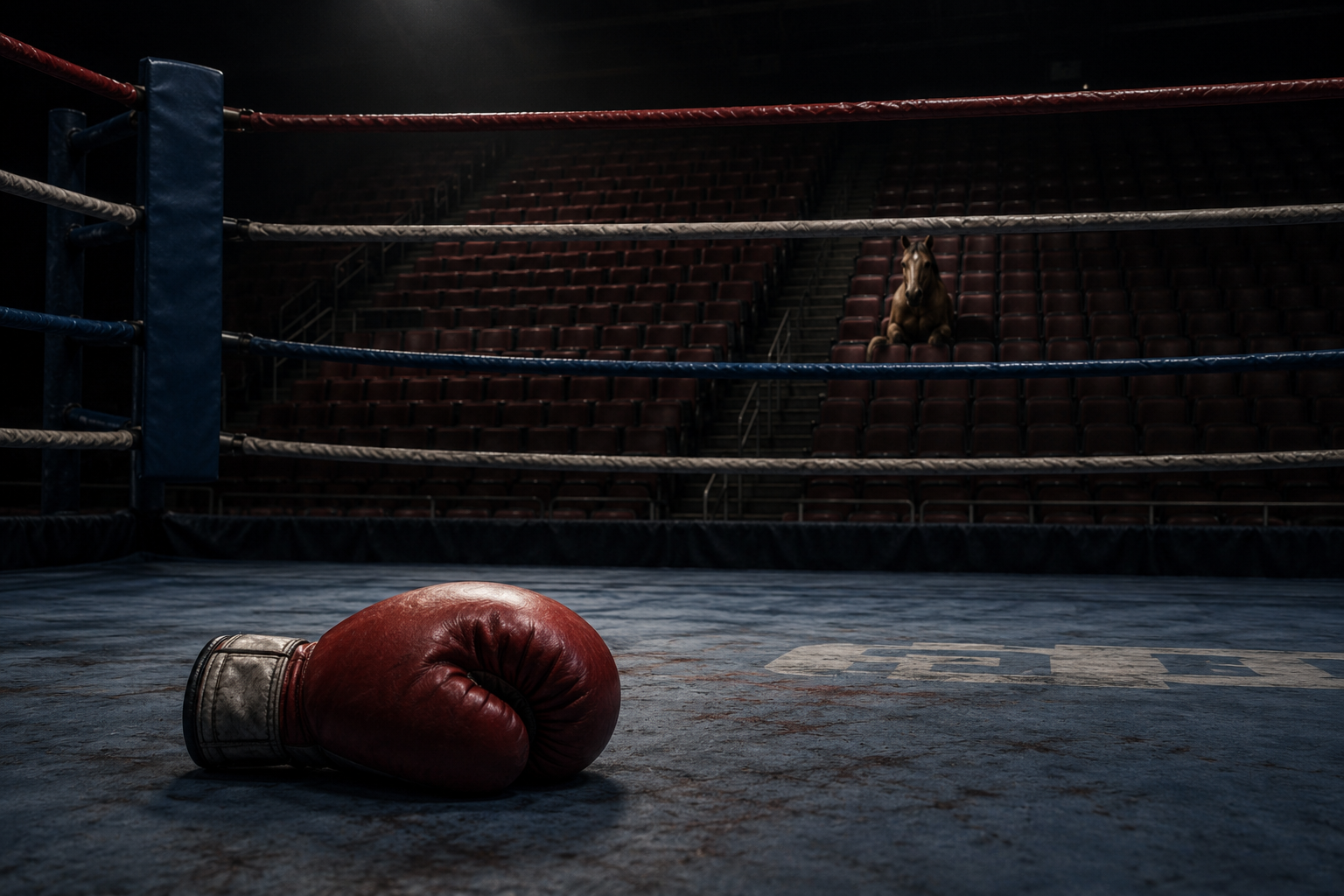
And they had, perhaps most poignantly, the example of what happens to a sport when the audience stops believing. It is right there in the record books, in the half-empty arenas, in the fact that most people today genuinely cannot name the heavyweight champion of the world.
They had all of that.
They still made the bad bet.
The Forethought Nobody Asked For
The pieces cited above, the 2022 Grade 1 question, the January 2026 warning about the Derby’s vulnerability, and the recent comparison of racing’s governance to the commissioners who actually governed were not written as a trilogy. They were written because the questions they raised were real, the documentation supported them, and the answers mattered regardless of whether anyone in a position of authority wanted to engage with them.
In retrospect they form something, whether anyone intended them to or not.
In 2022: the rules bend when it’s convenient, and the credential of the sport’s most famous race is not as bulletproof as its participants assume.
In January 2026: the trajectory is set, the comparisons to boxing are not hyperbole, and the people running this sport are making choices they will not be able to walk back.
In May 2026: the standard other sports upheld, and the one racing chose not to apply, and the public record of what that choice cost.
The throughline is not complicated. It is, in fact, the same line Roger Goodell drew in 2007 and again in 2022, the same one Rozelle drew in 1963, the same one anyone who has ever genuinely cared about the long-term viability of a sport understands instinctively.
If the audience stops believing the result matters, you no longer have a sport. You have an entertainment product. And entertainment products compete in a very crowded market against things that are considerably more entertaining than a two-minute horse race.
Past The Wire has been saying this for a while.
They should start paying attention.
They won’t is the play here.
Down Goes Racing….Down Goes Racing……Down Goes Racing
Related Coverage:
The Standard That Racing Forgot — pastthewire.com
Here Today, Maybe Not Tomorrow: Why The Kentucky Derby Is Not Untouchable — pastthewire.com
Is the Kentucky Derby a Grade 1 Race This Year pastthewire.com