


A Statement Arrives. The Questions Don’t.
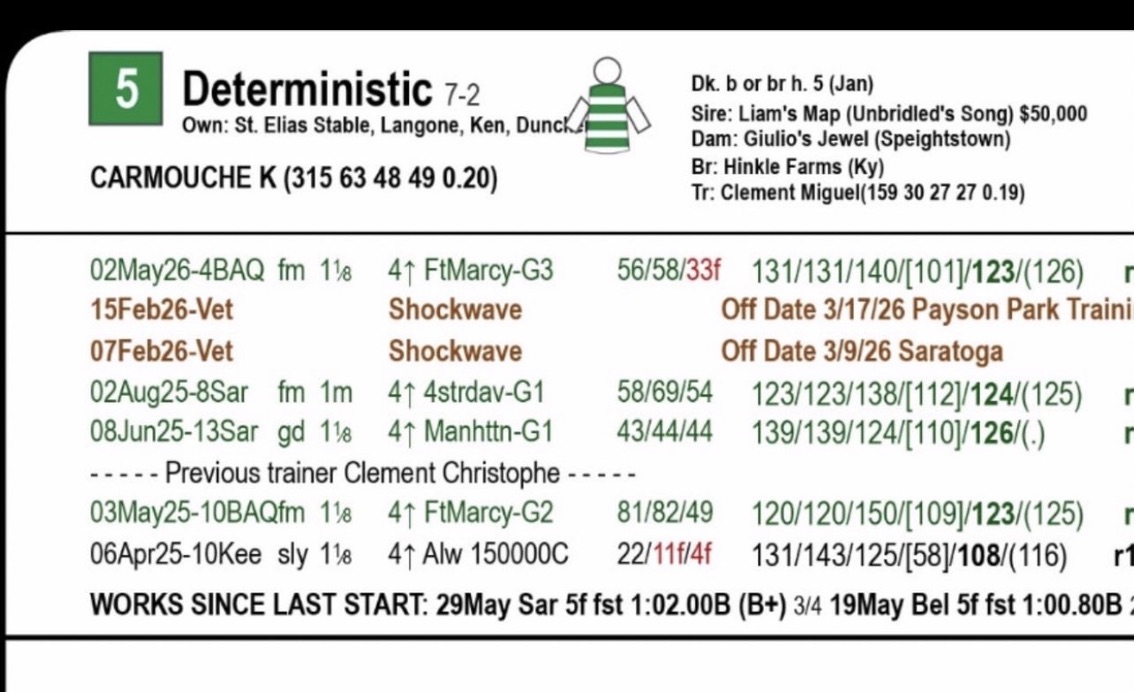
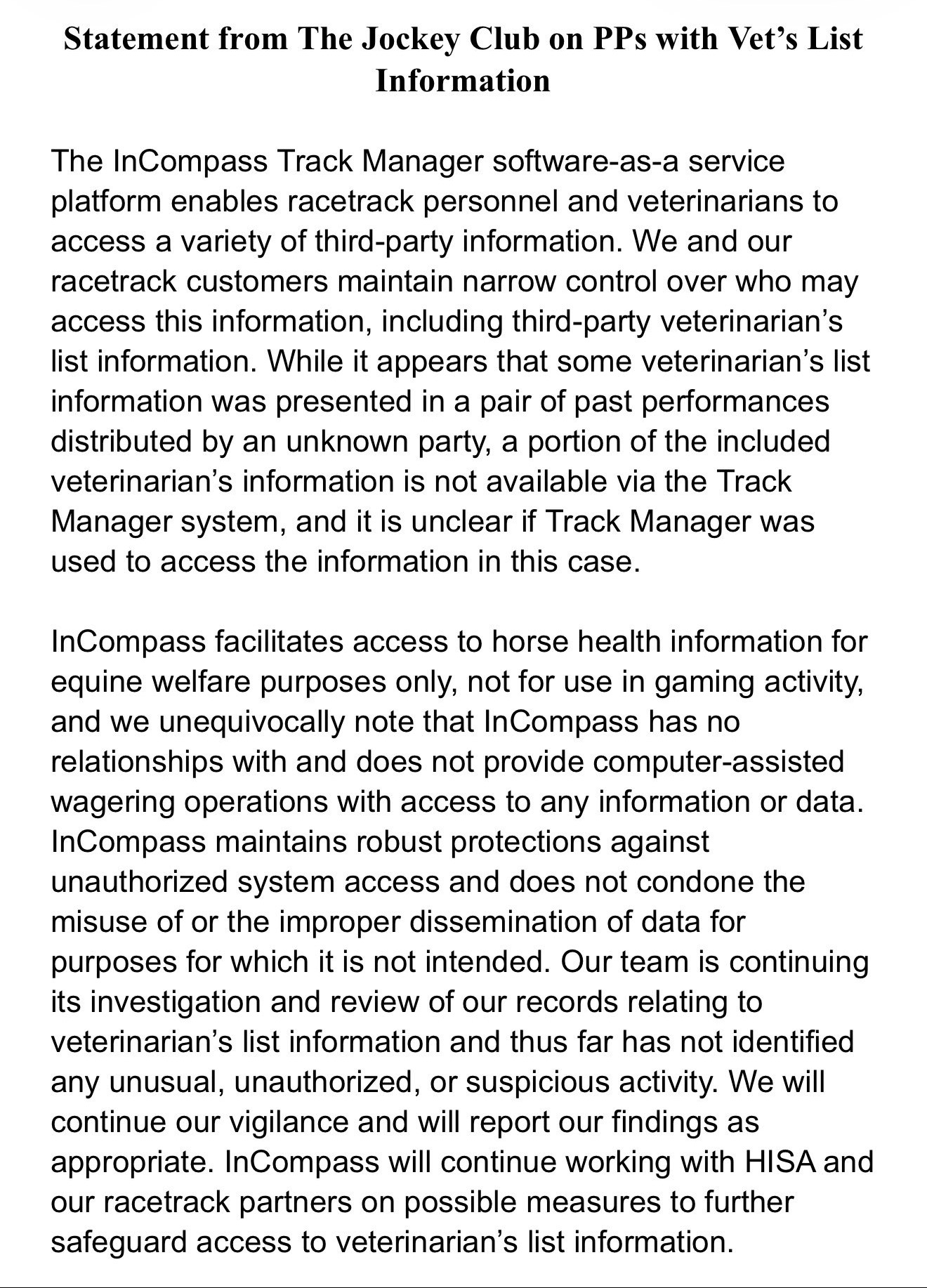
After days of silence silence Past The Wire noted directly in our last two pieces on this story, The Jockey Club has finally issued a public statement on the leaked custom past performances containing embedded veterinary treatment data. It did not come in response to Past The Wire’s formal written inquiry, submitted directly to both The Jockey Club’s communications office and InCompass/TJC Technology Services days ago. It came as a general public relations statement, released broadly, with no indication anyone at The Jockey Club intends to answer a single question Past The Wire actually asked.
That matters. There is a real difference between an institution choosing to speak and an institution choosing to answer. The Jockey Club did the first. They did not do the second. Let’s go through exactly what they said, what it confirms, what it carefully avoids, and what remains completely unaddressed.
What the Statement Confirms
For the first time, The Jockey Club has put a name to the system at the center of this story: InCompass Track Manager, described as a “software-as-a-service platform” that “enables racetrack personnel and veterinarians to access a variety of third-party information,” including what they call “third-party veterinarian’s list information.” That confirms the basic architecture this publication and others including Doug Salvatore’s detailed breakdown and the broader X racing community had already mapped out independently. Racetrack personnel and veterinarians have access to a centralized system carrying veterinary list data. That much is now on the record, directly from The Jockey Club itself.
They also state plainly, for the first time anywhere in this saga, that “InCompass facilitates access to horse health information for equine welfare purposes only, not for use in gaming activity,” and that InCompass has no relationships with and does not provide computer-assisted wagering operations access to any information or data. That is a specific, notable claim, made on the record, and it directly addresses the CAW speculation that has driven much of the public reaction to this story. It is now part of the record and Past The Wire will hold it there.
The Sentence Doing All the Work
Read this one carefully, because it is the most important sentence in the entire statement and it says considerably less than it appears to on first pass: “While it appears that some veterinarian’s list information was presented in a pair of past performances distributed by an unknown party, a portion of the included veterinarian’s information is not available via the Track Manager system, and it is unclear if Track Manager was used to access the information in this case.”
Compare that, directly, to how HISA CEO Lisa Lazarus addressed the same question in TDN’s Ask HISA column. Lazarus stated the screenshots “could not have come from the HISA Portal because some of the information is different from what is in the HISA Portal” a definitive statement of exclusion, based on specific discrepancies she was willing to point to.
The Jockey Club’s statement does not do that. It says some of the information in the leaked PPs doesn’t match what’s available through Track Manager, and therefore “it is unclear” whether Track Manager was used. That is not a denial. That is a hedge. The Jockey Club has not said their system was not the source. They have said they cannot determine whether it was. Those are very different claims, and the gap between them is exactly where a careful reader should be paying attention.
It is entirely possible that the discrepancy The Jockey Club is pointing to has an obvious explanation that has nothing to do with their system being innocent, additional data fields could have been merged in from elsewhere, exactly as Past The Wire’s investigative framework has laid out across our last two pieces. A custom PP product built on a skeleton with Ragozin figures, Beyer-type figures, and race shape numbers, into which veterinary data was imported, would naturally include “a portion of information not available via Track Manager” because the Track Manager data would only be one ingredient in a larger constructed document. The discrepancy The Jockey Club cites as grounds for uncertainty is fully consistent with the assembled-product theory this publication has been pursuing from the start. It does not clear InCompass. If anything, it fits.
“Has Not Identified Any Unusual, Unauthorized, or Suspicious Activity”
This is the sentence every organization issues in the first days of any data incident, and it should be read with the appropriate amount of skepticism that statement always deserves, not because The Jockey Club is necessarily being untruthful, but because an early internal system review finding nothing is a routine, almost universal first step, not a conclusion. It tells you a records and access log review has occurred. It does not tell you whether a deeper forensic investigation is underway, whether individual personnel have been interviewed, or whether the review has extended beyond automated log analysis to the kind of human investigation a matter like this actually requires.
HISA conducted its own review and reached a more confident, more specific conclusion about its own portal. The Jockey Club’s language is notably softer, and notably less specific, on the question of its own system.
What Past The Wire Asked — and What This Statement Does Not Answer
Past The Wire submitted eight specific, formal questions in writing to The Jockey Club and to InCompass/TJC Technology Services. This statement, released broadly rather than in direct response to any outlet’s inquiry, does not answer a single one of them. For the record, here is what remains completely unaddressed:
Who, specifically, can see veterinary list reasons within InCompass, not just eligibility status, but treatment details? The statement says access is “narrowly controlled” without specifying by whom, how many people, across how many jurisdictions, or under what criteria.
Can racing office staff see treatment details for horses at all jurisdictions, or only horses at their own track? Not addressed.
Are downloads, exports, or batch queries logged and audited? Not addressed. The statement references an internal review of “records relating to veterinarian’s list information,” which implies some logging exists, but provides no detail on what is actually tracked or how.
Are there API endpoints, and if so, who has access to them and what controls govern their use? Not addressed at all.
Has any authorized account shown abnormal access patterns? The statement says no “unusual, unauthorized, or suspicious activity” has been identified but this is a conclusion, not an answer to the underlying question of what monitoring exists to detect such activity in the first place.
Why does a racing office need to see treatment details at all, rather than simple eligibility status? This is the single most important structural question in this entire story, and it remains completely unaddressed. The Jockey Club had the opportunity to explain the operational necessity of this design choice and chose not to.
What do InCompass’s terms of service and user agreements specifically prohibit regarding the use, export, or commercial redistribution of accessed data? Past The Wire formally requested copies of these documents. They were not provided, referenced, or even acknowledged in this statement.
Is The Jockey Club considering architectural changes to restrict treatment-detail access for personnel whose function requires only eligibility status? The closest the statement comes is a vague closing line about working with HISA and racetrack partners “on possible measures to further safeguard access to veterinarian’s list information” language with no specifics, no timeline, and no commitment.
Where This Leaves the Story
The Jockey Club broke its silence. That is worth acknowledging plainly, and it is more than they had offered in the days since this story broke. But breaking silence with a carefully worded public relations statement, released broadly rather than in response to specific press inquiries, is not the same as transparency and it is a notably different standard than the one Lisa Lazarus has held herself to throughout this story. She has answered direct questions, by name, on the record, repeatedly. The Jockey Club has now spoken once, in general terms, without addressing a single specific question put to them in writing.
Past The Wire’s formal inquiry remains open. The questions above remain unanswered. We will continue to press for direct responses, and we will report them in full the moment they arrive exactly as we have committed to throughout this story. Until then, the most important sentence in this entire saga remains the one The Jockey Club chose not to address: why does a racing office need to know what treatment a horse received, when all it actually needs to know is whether that horse is eligible to run?
That question is still sitting there. Unanswered. Same as before this statement arrived.
Related Coverage: Upon Further Review
Hmmmmmmm…..