
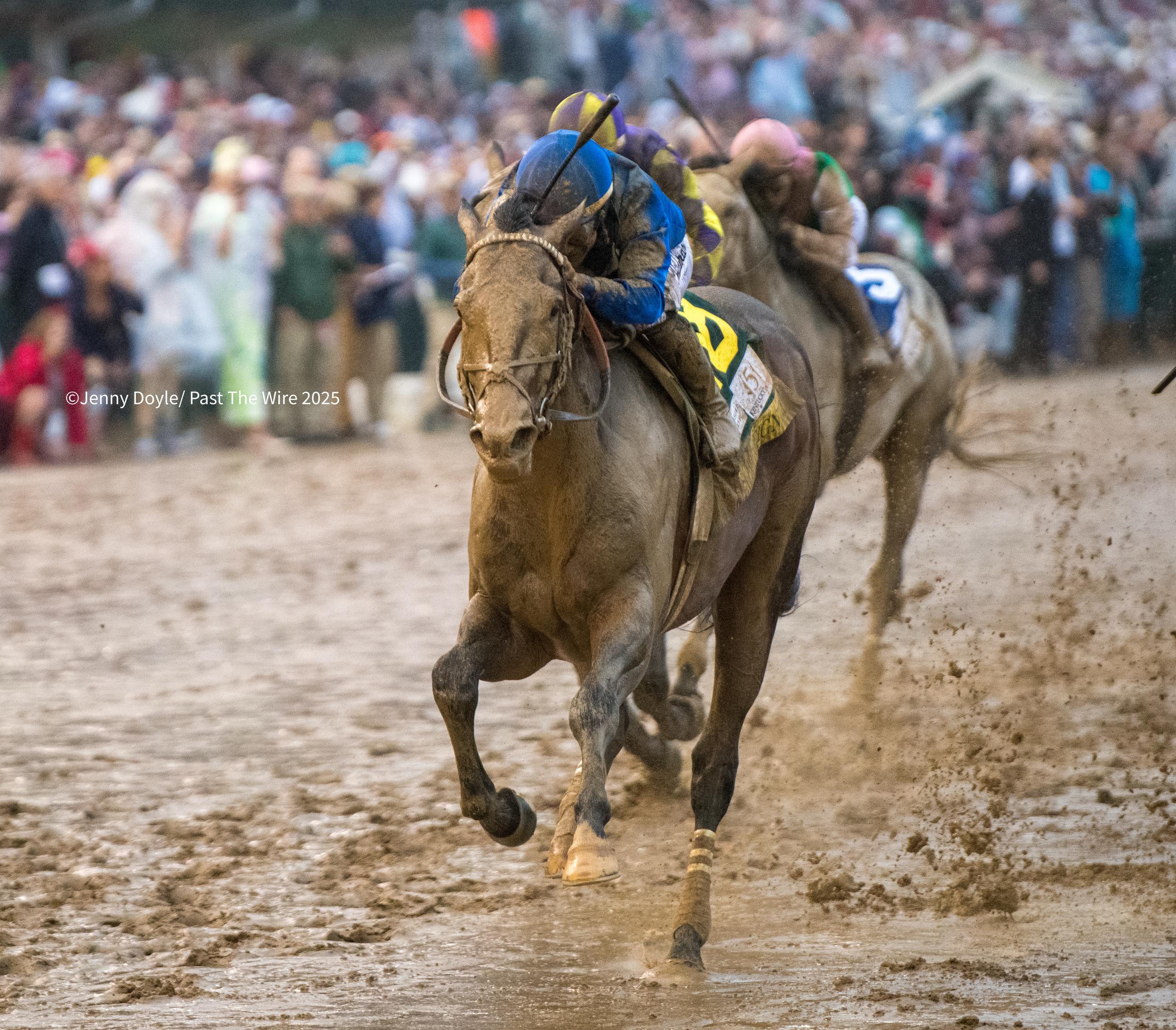

Final Gambit (pink cap) tries to catch Sovereignty but no one could. (Jenny Doyle/Past The Wire)
Jon Stettin
Someone once said, Oh the Humanity, I’m going with Oh the Absurdity.
Every time I go looking for a reason to believe the people running this sport are building something for the sport, they hand me the evidence to talk myself out of it. This is one of those times.
Greg Maffei and Danny Epstein announced the HRL, the Horse Racing League, on July 9. Ten teams. A live draft in November where each team buys eight horses outright. Ten horse fields. Points for finishing position stacking toward a season championship. More than ten million dollars in purses and prizes. Three stops only, Santa Anita, Gulfstream, and a finale at Keeneland, with talk of expanding to three more cities by 2029.
Read the founding roster before you read another word of the pitch because the roster is the pitch.
Godolphin, the largest racing operation on earth with more than 9,600 wins worldwide and six consecutive Eclipse Awards as North America’s outstanding owner. WinStar Farm, breeder of Triple Crown winner Justify and home to stallions like Constitution and Life Is Good. Vinnie Viola, founder of Virtu Financial and owner of the Florida Panthers. Gary Barber of Spyglass Media Group. Chris Pucillo of Solus Alternative Asset Management. The Financial Times reports Godolphin alone is investing six million dollars.
This was never a league searching for owners. This was owners searching for a league.
Maffei is not a mystery hire. He is the former CEO of Liberty Media, the executive who oversaw Formula One’s commercial transformation and remained in that role until the end of 2024. During that period, the Department of Justice opened an antitrust investigation into Liberty Media and Formula One following the rejection of Andretti Global’s bid to join the grid despite FIA approval and the backing of General Motors. Michael Andretti has publicly alleged that Greg Maffei looked him in the eye and told him he would do everything in his power to keep Andretti off the Formula One grid.
That is the man now telling horse racing his playbook is one of inclusion and growth. Watch the hands, not the mouth. In Formula One, the hands helped build a wall around the paddock. In the HRL, the hands have already decided who gets a franchise, and the list reads more like a Breeders’ Cup box than an open invitation.
Maffei’s own words make the target audience perfectly clear.
“Formula One demonstrated what can happen when you bring fans to a historic sport in a modern way through storytelling and social media. The HRL brings the excitement of teams to follow, dramatic rivalries, high stakes betting, and a championship that builds race by race.”
Notice what is doing the work in that statement. Storytelling. Rivalries. Championship. Nowhere in that quote is a horse. Nowhere do you see bettor.
Nowhere is the horseman standing in a shedrow at five in the morning. Nowhere is the trainer trying to keep a small stable alive. Nowhere is the owner with one claimer running for a modest purse at a county fair meet. The story is not about the horse. It is about the product.
Vinnie Viola followed the same script.
“Horse racing already commands one of the largest single day audiences in American sports. Investing in a team based concept designed to carry that momentum across a full season is what makes the HRL so exciting for us.”
Read it again.
He is not describing what it will do for the sport. He is describing what it will do for the momentum he is already sitting on.
Gary Barber may have been the most revealing of all.
“This is a rare opportunity to be a part of something from the ground up in a sport that I am incredibly passionate about.”
A rare opportunity. For him.
Then Everett Dobson, Chairman of The Jockey Club, arrived on cue to bless the entire project.
“We’re excited to see a new concept come to life in our sport, and we know this is the right leadership group to make it a success. We have a common goal to attract new fans and give longtime enthusiasts more exciting experiences. It’s a win for everyone in the industry.”
This is about as exciting to bettors, or gamblers, your actual customers, as that short but far too long lived roulette wager. That may have actually been better.
Everyone in the industry. Except the industry was never asked. Not the smaller breeders. Not the independent owners. Not the horsemen whose livelihoods exist outside Santa Anita, Gulfstream, and Keeneland. Not the outfits that are trying to survive instead of collecting Eclipse Awards.
Once again, the common goal appears to have been found among the sport’s largest and most influential ownership interests.
I have written about this institutional reflex all year. The same hands. The same handshake. The same circle. Only this time it is wrapped in the language of innovation instead of governance.
Danny Epstein, to his credit, was at least direct about what separates the HRL from previous attempts like the National Thoroughbred League. Speaking to BloodHorse, he explained that the teams actually own the horses instead of simply representing cities.
That honesty exposes something important.
The price of admission is not passion. It is not knowledge. It is not a lifetime spent in a barn. The price of admission is capital.
Buying eight racehorses outright is not democratizing ownership. It is narrowing it. Every major announcement reveals priorities.
The same week this release landed, the industry was still absorbing stories about a Breeders’ Cup Classic winner dying overseas. We are still confronting horses found in kill pens. We are still debating traceability from birth through retirement. We are still relying on an aftercare system that remains chronically underfunded and largely voluntary. Yet here we are celebrating more than ten million dollars in purses, prizes, hospitality, branding, and team competition.
Every major announcement reveals priorities. Formula One enriching existing team owners is one thing. Those owners are not breeding thousands of cars every year.
A Red Bull chassis does not end up in a slaughterhouse in Mexico when it stops winning. A horse does. That makes this comparison fundamentally different. Applying the Formula One franchise model to Thoroughbred racing without acknowledging the industry’s unique moral responsibilities is not innovation. It is imitation.
I wanted to find the version of this that is good for the sport. I looked. What I found instead was a closed shop with a velvet rope, an entry price measured in millions, a Jockey Club chairman applauding from the front row, and the same handful of people who already own the biggest operations in racing creating another layer at the top of a pyramid they already occupy.
If this had been announced honestly as an elite league for elite owners, I would have far less to say. My problem begins when every project built for the top of the pyramid is marketed as though it was built for everyone standing underneath it.
Horse racing does not need another exclusive club nearly as much as it needs someone willing to build the foundation.