

First The Triple Crown, Now The Belmont Stakes, The Former Test of Champions, Morto
I knew this was coming. I wanted to be wrong, but in my gut I could always sense I wasn’t.
Not yesterday, when Daily Racing Form reported that NYRA President and CEO Dave O’Rourke acknowledged reducing the Belmont Stakes permanently from a mile and a half to a mile and a quarter is now something that will be contemplated. I thought this was where we were headed when circumstances gave racing a convenient experiment with a shorter Belmont Stakes. Three years at Saratoga at a mile and a quarter showed everyone that the world would continue turning if the Test of the Champion wasn’t quite the same test anymore.
Now the experiment threatens to become the solution.
O’Rourke’s reasoning is revealing. He acknowledged that a mile and a half is traditional and the historic test of champions, but said it isn’t what people are breeding for and questioned how relevant the distance is to breeding today.
There it is.
We aren’t breeding horses for the Belmont Stakes anymore, so perhaps we should change the Belmont Stakes for the horses we’re breeding.
I think we have that exactly backwards.
There are plenty of things in American horse racing that are broken. Post times on major stakes races routinely collide when they could be staggered. Aftercare remains woefully inadequate relative to the money flowing through the sport. Thoroughbreds still wind up in the slaughter pipeline. Field sizes are shrinking. The foal crop has collapsed. Racetracks struggle to fill races and racing secretaries increasingly have to write condition books like Picasso painted pictures just to assemble competitive fields.
The Triple Crown isn’t one of the things that’s broken. The Kentucky Derby, Preakness Stakes and Belmont Stakes have survived precisely because they are difficult. They are not supposed to accommodate every horse. They are not supposed to be interchangeable races separated only by geography and purse money. They are three different tests compressed into a demanding period of a three-year-old’s life, and accomplishing all three is supposed to be exceptionally difficult.
That’s the point. The Belmont’s mile and a half isn’t an inconvenience attached to the race. It is part of the race’s identity. It is why Secretariat’s 31-length demolition remains one of the most extraordinary performances in the history of sport. It is why Affirmed had to withstand Alydar. It is why Easy Goer had to prove what he could do over twelve furlongs. It is why American Pharoah’s stretch run meant something entirely different after 37 years without a Triple Crown winner. You don’t preserve a test by making the test easier because fewer students are studying for it. And before racing accommodates modern breeding any further, perhaps it should look at what modern breeding has already helped produce.
In 1990, North America registered 44,143 Thoroughbred foals. By 2024, the number was approximately 17,900. The Jockey Club projected the 2026 crop at only 17,000. We’ve lost roughly 60 percent of the annual foal crop in a generation. That isn’t all. In 2000 there were 69,569 individual starters participating in 60,872 races and making 493,682 starts. In 2025 there were 42,674 starters, 33,410 races and 247,239 starts. In 25 years, the number of starts has essentially been cut in half. Average starts per runner declined from 7.10 to 5.79. Average field size fell from 8.11 to 7.40. Go back to 1990 and the average horse made 7.94 starts. Those numbers don’t prove breeding philosophy alone caused any of it. There are numerous economic, regulatory, ownership, training and demographic forces involved, and pretending otherwise would be intellectually dishonest. But they certainly raise a question worth asking.
If breeding increasingly for speed, precocity and commercial appeal has accompanied fewer foals, fewer runners, fewer starts and smaller fields, why would one of racing’s answers be to further accommodate that breeding model? For decades the commercial marketplace has increasingly rewarded the horse that looks fast early. Speed sells. Precocity sells. A two-year-old who flies through a furlong at a sale can become extraordinarily valuable before proving whether he can carry that speed around two turns, much less a mile and a half. I understand the economics. Breeders aren’t charities. Owners aren’t charities. Sales companies aren’t charities. People respond to financial incentives. But racing also creates those incentives. And if the sport continually moves its most important races toward the horse the commercial market already rewards, don’t be surprised when breeders produce more of exactly that horse.
That is where this becomes bigger than changing one race from twelve furlongs to ten. Breeding decisions don’t show up tomorrow afternoon. They compound across generations. Change what the sport rewards today and you may not understand the full consequences for ten or twenty years. We already have fewer horses. We already have fewer starts. We already have smaller fields. We already have difficulty filling races. Maybe encouraging an even greater emphasis on speed over stamina fixes that. Maybe. But I’d want considerably better evidence before betting the breed on it.
There is another piece of timing here that shouldn’t be ignored. NYRA and Churchill Downs just announced the new Thoroughbred Championship Series beginning in 2027, a six-race, five-month series with a $5 million championship bonus. It begins with the Kentucky Derby, includes the Belmont, Matt Winn, Jim Dandy and Travers, and concludes with a new championship race at Churchill Downs. The Preakness Stakes, the middle jewel of the Triple Crown, isn’t included. Now, one month later, we’re openly discussing changing the distance of the Belmont. Perhaps those are completely independent developments. Perhaps not.
But taken together they certainly tell us something about where powerful people in racing believe the three-year-old season should go. A Derby at a mile and a quarter. A Belmont potentially at a mile and a quarter. Then a manufactured points series extending through September while the Preakness sits outside of it. At some point modernization stops complementing history and starts replacing it. There is an irony here that is almost impossible to miss. The reconstructed Belmont Park has a 1 1/2-mile main track, and according to DRF, the clubhouse turn was specifically widened so that mile-and-a-quarter races could be conducted more fairly than at the old Belmont, where the ten-furlong starting gate had to be placed on an angle. So racing is returning to a magnificent, rebuilt Belmont Park capable of staging the Test of the Champion at its historic distance and simultaneously considering whether the Test of the Champion should remain the Test of the Champion. That would be funny if it weren’t so perfectly racing.
There is nothing inherently wrong with creating new championships. There is nothing wrong with trying to keep the best three-year-olds racing against one another throughout the summer. Actually, that’s a worthy objective. Too many good horses avoid one another, and anything that creates meaningful competition instead of carefully managed campaigns deserves consideration. But create something new without destroying something old that still works.
Horse racing is different from almost every other major sport because history isn’t merely part of its marketing. History is part of the competition itself. The Derby is still the Derby. The Travers is still the Travers. Saratoga is Saratoga. The Triple Crown connects horses separated by generations because they were asked essentially the same impossible question. Can you win the Derby? Can you come back and win the Preakness? And then, when you’ve already done both, can you go farther than almost any American dirt horse will ever be asked to go at three-years old and win the Belmont Stakes at a mile and a half?
Secretariat answered it.
Seattle Slew answered it.
Affirmed answered it.
American Pharoah answered it.
Justify answered it. More before those as well.
The answer is supposed to be hard. I understand why breeders would prefer a mile and a quarter. I understand why trainers might prefer it. I understand why owners might prefer it. It probably produces a larger field and makes the race accessible to more horses. Those are arguments for another mile-and-a-quarter race. Wait a minute, we have one, The Travers which carries enough weight on its own to be relevant. They aren’t necessarily arguments for changing the Belmont Stakes.
Racing has spent decades responding to immediate problems with solutions whose long-term consequences weren’t always considered. Fewer horses? Write different races. Horses race less? Adjust the schedule. Trainers don’t want twelve furlongs? Shorten the race. Breeders aren’t producing stamina? Stop demanding stamina. Eventually you have to ask where that road ends. If nobody breeds for twelve furlongs because there aren’t important twelve-furlong dirt races, and we eliminate the most important twelve-furlong dirt race because nobody breeds for twelve furlongs, we haven’t identified a problem. We’ve created a self-fulfilling prophecy.
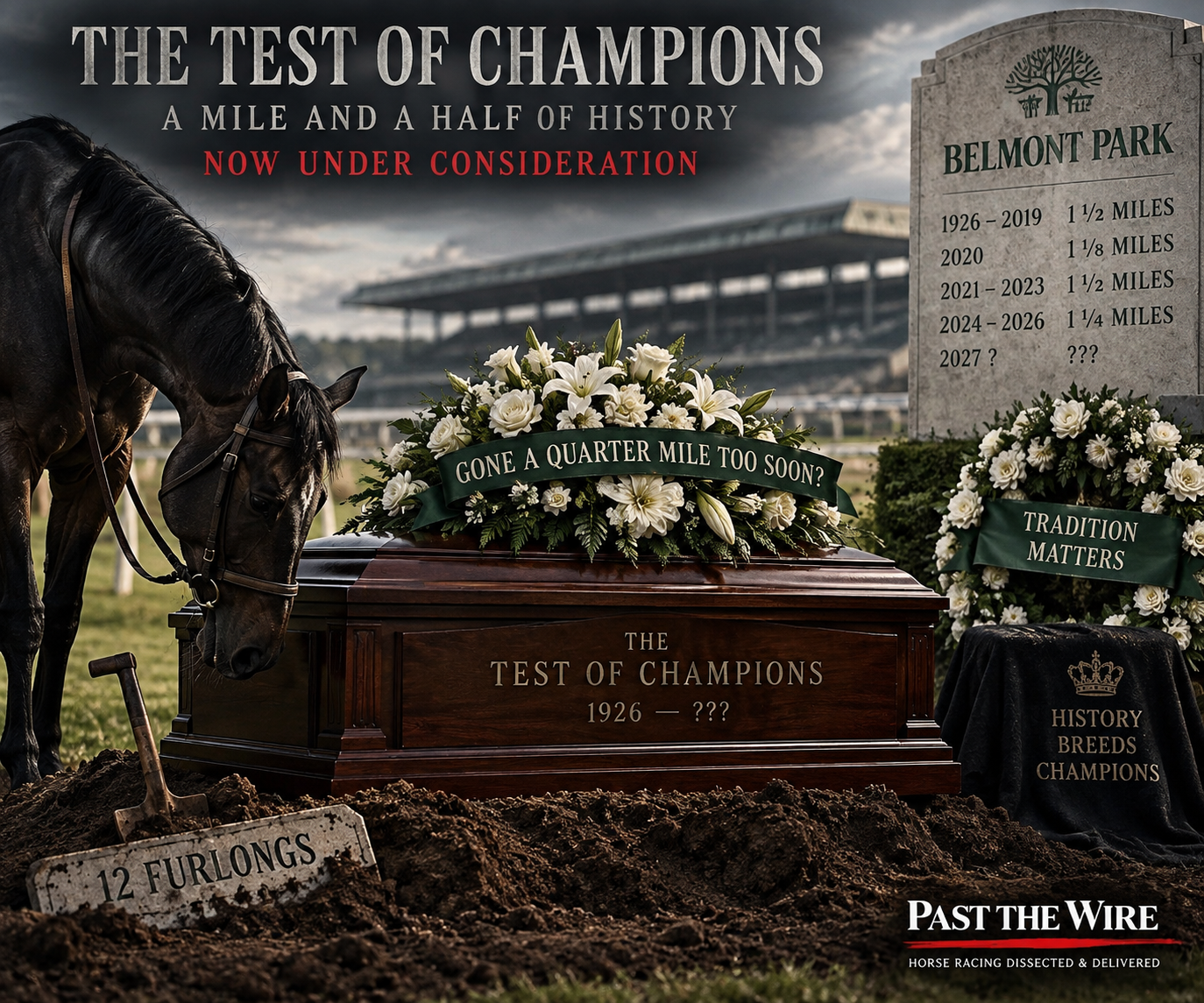
From 1926 through 2019, for 94 consecutive runnings, the Belmont Stakes was contested at a mile and a half, even when it was displaced to Aqueduct for five years while Belmont Park was rebuilt. Only the extraordinary COVID restructuring of 2020 broke that streak. It returned to twelve furlongs from 2021 through 2023 before the current temporary move to Saratoga shortened it to a mile and a quarter. The differences are what make champions.
If anything, American racing needs to start asking whether the direction of the last several decades is sustainable before accelerating farther down the same road. A shrinking foal crop cannot indefinitely support a racing calendar built for a much larger population. Horses making fewer starts cannot indefinitely support the same number of racing opportunities. Smaller fields aren’t good for wagering. And a breed increasingly rewarded for doing less, sooner and shorter shouldn’t automatically dictate that racing’s historic tests become less demanding too.
There are problems worth modernizing. Coordinate the damn post times. Make meaningful aftercare an industry obligation instead of a slogan. Stop the slaughter pipeline. Figure out why we’re producing fewer horses and why the ones we produce race less. Build racing schedules that produce competitive fields instead of forcing racing secretaries to perform magic every morning. There is plenty of work available.
Leave the mile and a half Belmont Stakes alone. Some things survive for a century because nobody has figured out how to improve them. And some things are difficult because they’re supposed to be. The Belmont Stakes is both.
If we finally kill the Test of Champions, at least we’ll know who gets the broom.
Ciao Ciao: RIP