

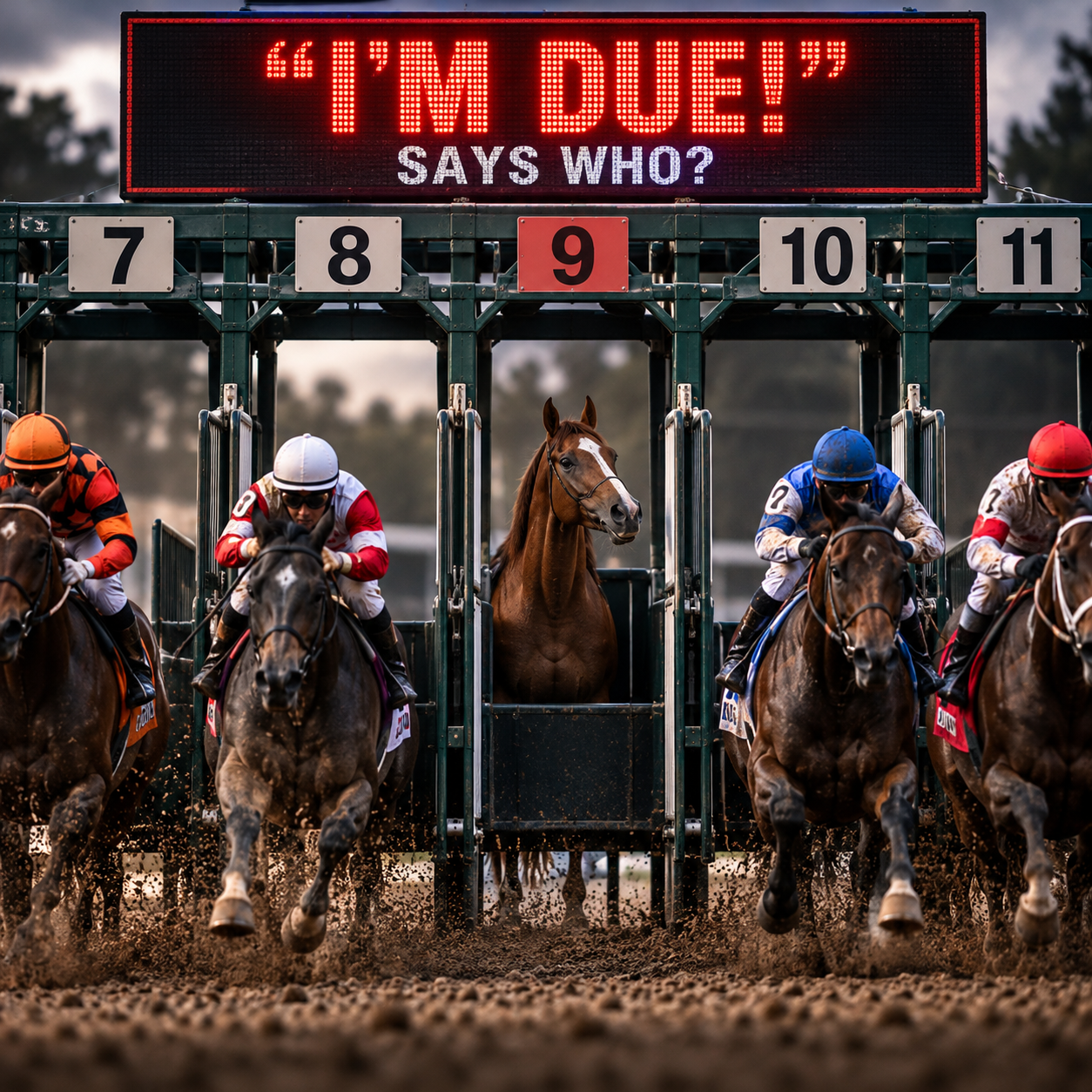

Walk through any simulcast room and you will hear it before the first race goes off. “That post hasn’t won all meet. It’s due.” “He’s 0-for-30, he’s gotta hit one soon.” “Third straight second. Today’s the day.”
It sounds like common sense. It sounds like the law of averages. Every time something fails to happen, it feels like it moves one step closer to happening.
It doesn’t. And the horseplayer who understands why has an edge on everyone in the room still waiting for the gate to pay them back.
The Gate Has No Memory
The mathematicians have a name for the “due” theory. They call it the gambler’s fallacy. The most famous case came at the Monte Carlo Casino in 1913, when black hit 26 times in a row on a roulette wheel. Gamblers lost a fortune piling onto red because red was “due.” It wasn’t. The wheel didn’t know what it had done the spin before.
Neither does the starting gate. Post 2 doesn’t know it has been shut out all meet. A trainer’s 0-for-30 doesn’t put a winner in the barn. Each race is decided by the horses in it, not by the ghosts of the races before it.
So what about the law of averages? It’s real, but almost everyone has it backwards. It doesn’t work by catching up. It works by drowning out.
Flip a fair coin and get ten straight heads. Now flip it 1,000 more times. You would expect those next 1,000 flips to produce roughly 500 heads and 500 tails. Your overall percentage moves closer to 50% because those first ten flips become a smaller part of the total. Tails never had to make up for anything.
There is one part of the “due” instinct that holds water. If you give something enough chances, it becomes increasingly likely to happen at least once. A post with a genuine 8% chance of winning each race has approximately a 98.5% chance of producing at least one winner over its next 50 starts, assuming those chances remain constant and the results are independent. That’s extremely likely, but it isn’t guaranteed. More importantly, it doesn’t make that post any more likely to win today’s race. Mixing those two things up is how people go broke waiting on a streak to end.
Post 17: Not Due, Not Cursed
Every spring the same story makes the rounds. Post 17 has never won the Kentucky Derby. Through 2025 it was 0-for-46, the only post in Derby history with nothing in the win column. Sandman drew it in 2025. This year Further Ado slid into it after Silent Tactic scratched. Neither won. Golden Tempo did, at 25-1.
Half the room says 17 is cursed. The other half says it has to be getting close. Both are wrong.
Run the numbers. In a 19- or 20-horse Derby field, any one post would have approximately a 5% chance of winning if all horses and posts were equal. Over 46 starts, that works out to roughly two or three expected winners. The chance of getting zero by pure luck is approximately 9%. That’s unusual, but hardly impossible. And when you’re looking at as many as 20 different posts, finding one with an unusually long losing streak shouldn’t come as a great surprise. Of course, not every Derby had the same field size or starting configuration, so this is an illustration of probability, not a precise historical model.
Now ask the question that separates handicapping from superstition: is there a reason? Look at the neighbors. Sovereignty won last year from post 16. Post 18 has produced two winners, the last being Country House in 2019. There is no obvious reason stall 17, simply because it carries that number, should be substantially worse than the stalls on either side of it.
There is another factor that can’t be ignored. Churchill Downs introduced a new, single 20-stall starting gate for the Kentucky Derby in 2020, replacing the old arrangement that required an auxiliary gate and left a gap between posts 14 and 15. That matters. We are comparing statistics compiled under two different starting configurations. Anyone treating decades of post-position results as though the conditions never changed is ignoring a rather important variable. The numbers may be accurate. What they tell us about today’s race is another question entirely.
Post 17 isn’t due and it isn’t cursed. Its winless record became a legend because people love a good streak, especially one that seems to defy explanation.
The Rail: A Real Bias, With a Reason
The rail is a different animal. On paper, it doesn’t even look bad. Since the starting gate came to the Derby in 1930, post 1 is 8-for-96, an 8.3% win rate. That’s above the roughly 5% baseline of a full 20-horse field, although that comparison itself is imperfect because Derby field sizes have varied.
But look at when those wins came. War Admiral, Citation and the rest of them won from the rail in an era of smaller fields. The last one to do it was Ferdinand in 1986, with Shoemaker on him. Forty years and counting.
This time there is a reason. With 20 horses breaking and all of them angling toward the first turn, the rail horse can find himself with nowhere to go. He breaks with a fence on one side and a wall of horses closing on the other. That’s a physical problem, and one that can become more pronounced as fields get bigger. The old wins described a different race, and the newer starting gate is another reason not to treat every historical result as though it occurred under identical conditions.
That’s what a real bias looks like. A mechanism you can explain, and a pattern worth examining as the conditions change.
Then came 2026. Renegade, the favorite, drew the rail. Plenty of people threw him out for that alone. He ran second, beaten only by the winner. A real bias is a tax on a horse’s chances, not a wall. It belongs in the price you’re willing to take. It doesn’t give you permission to stop handicapping.
The Same Trap, Every Day at Saratoga
You don’t need the Derby to see this. Here are the outside posts from the Saratoga meet, main-track routes at a mile and longer:
| Post | Wins | Starts | Win rate |
|---|---|---|---|
| 7 | 3 | 54 | 5.6% |
| 8 | 2 | 21 | 9.5% |
| 9 | 0 | 9 | 0% |
| 10 | 1 | 6 | 16.7% |
| 11 | 0 | 1 | 0% |
Source: NYRA official Saratoga winning post positions. These figures cover main-track routes of a mile and longer, not exclusively races from the Wilson Chute.
Post 9 is winless in nine starts. Post 10 won one of six. Does that make 10 a great post and 9 a bad one? No. Does it make 9 due? Also no.
In a 10-horse field, each post would have a 10% chance of winning if every horse had an equal chance. Over nine starts, that’s less than one expected winner. Under those assumptions, going 0-for-9 happens about 39% of the time. That’s hardly remarkable. Post 10’s one win in six is the same story in reverse. One race changes the whole number.
There’s a second problem, and it’s the one most people miss. Posts 9 and 10 only exist in big fields. Post 2 runs in virtually every race, including the five-horse fields where each horse would have a 20% chance if all were equal. Comparing a raw win rate for post 2 against post 10 is comparing apples to watermelons.
The Derby has the same issue. The official numbers note that inside posts pile up higher percentages partly because not every Derby had a full field. Post 20 actually shows the best historical win rate of any post, at 10.5%. That’s two winners in a small sample. Nobody serious thinks the far outside is automatically the best seat in the house.
The first adjustment is simple. Don’t just count wins. Count wins against what was expected. As a neutral starting point, every post represented in a six-horse field gets one-sixth of an expected win. Every post in a 12-horse field gets one-twelfth. Add them up for a post, then compare that total to the wins it actually produced. A post with four wins against 2.5 expected is outperforming that baseline. A post with zero wins against 0.9 expected isn’t telling you much yet.
Of course, that assumes all horses are equal, and any horseplayer knows better. The sharper version uses each horse’s actual estimated probability of winning, with the closing odds serving as one available benchmark. That way a post isn’t credited because good horses happened to draw it, or blamed because longshots did. And even the odds aren’t gospel. The public can be wrong. That’s the whole reason we handicap.
The Only Question That Matters
Nothing at the racetrack is ever due. Not a post, not a trainer, not a jockey, not a horse who keeps running second. The race in front of you doesn’t owe you anything for the ones that came before it.
But a streak isn’t meaningless either. Sometimes it’s noise, like a post that hasn’t won despite having reasonable chances. Sometimes it’s a signal, like a physical disadvantage that becomes more significant under certain conditions. And sometimes a losing streak is evidence that our original estimate of a horse’s, trainer’s, or post position’s chances was wrong in the first place.
The player who wins long term isn’t the one asking whether something is due. He’s asking whether the streak means something. Is there a reason behind it? Is the sample big enough to trust? Have the conditions changed? Has the public already priced it in, or overreacted to it?
That last one is where the money is. When the crowd tosses a horse for a post that’s really just an unlucky number, that horse may go off at a price he shouldn’t. That’s not a curse. That’s an overlay.
Related on Past The Wire
- When the Chart Becomes the Argument: a rate without context is a number in search of a narrative.
- Saratoga Today 2021, Day 16: The Bounce: why so many people get the bounce theory wrong.
- Kentucky Derby 2025 Post Position Reactions: the draw breakdown, including Citizen Bull and the rail.
- 147th Kentucky Derby Post Positions and What Connections Had to Say



Comments