

Churchill Downs Just Bought the Preakness. That Should Concern Everyone.
This morning, Churchill Downs Incorporated announced it has entered into a definitive agreement to acquire the intellectual property rights to the Preakness Stakes and Black-Eyed Susan Stakes from 1/ST Maryland LLC, an affiliate of Belinda Stronach’s 1/ST Racing — for $85 million. The deal is expected to close after the running of the 2026 Preakness.
Ray Paulick called it huge. He’s right. But not for all the reasons being celebrated this morning.
Before we get to the substance, let’s note something that’s already circulating on social media this morning: the story leaked before the announcement. Deals of this complexity, $85 million acquisitions involving IP rights, licensing agreements, state regulatory relationships, and television contract implications do not get conceived and executed overnight. There were negotiations. There were lawyers. There were term sheets and board approvals and conversations that went on for weeks or months before today’s press release. Someone knew. And as Horse Racing Nation journalist Ed DeRosa pointedly observed this morning, there’s no way Churchill Downs wasn’t involved in those discussions. So the first question worth asking isn’t what this deal means. It’s how long CDI has been quietly positioning for it and what else may have been negotiated while the industry’s attention was elsewhere.
Now to what it means.
Churchill Downs, a publicly traded gaming conglomerate now owns the intellectual property to two of the three legs of the American Triple Crown. They own the Kentucky Derby. They own the Preakness. The Belmont, by virtue of its association with NYRA, remains the only jewel not in their hands. For now.
Bill Carstanjen called it consistent with CDI’s strategy of investing in “premier Thoroughbred racing assets with long-term growth potential.” An interesting comment from the head of the organization that is known for closing racetracks. Translation: this is a commercial play, not a stewardship decision. And the racing industry, which still likes to tell itself it operates in the public trust, should be asking hard questions about what that means.
I’ve covered consolidation of power in this industry. The warning signs are always the same. When one entity controls the IP, the schedule, the television rights, and the wagering infrastructure for marquee events, everyone else becomes a tenant. That’s not hyperbole, that’s the business model.
Here’s what people seem to be forgetting this morning. In 2020, when COVID forced a rescheduling of the entire Triple Crown calendar, Churchill Downs moved the Kentucky Derby to September and as I understand it without meaningful consultation with the other Triple Crown tracks. The result was a fractured, incoherent Triple Crown sequence in which the Belmont ran first, in June, and the Preakness ran last, in October. It was a logistical disaster for horsemen, bettors, and fans and it happened because CDI answered to their shareholders first and the sport second. They are publicly traded and this is what they’re supposed to do.
Now they own the Preakness IP too. Paulick raises the question of whether this opens the door to additional time between the Derby and the Preakness. Maybe. But the more important question is: who gets consulted when CDI decides? The State of Maryland gets an annual licensing fee and the right to conduct the race. That’s it. The power to define what the Preakness is, commercially and culturally, now belongs to Louisville.
And then there’s the matter of prediction markets and this is where precision matters.
CDI has been extraordinarily aggressive in asserting IP-based wagering control, and that posture is directly relevant to the ongoing national debate around prediction markets, Kentucky HB 904, and the Third Circuit’s KalshiEX ruling. CEO Bill Carstanjen has cited the Interstate Horse Racing Act as a federal umbrella statute that he argues gives CDI intellectual property rights in their content and has stated that any platform, including prediction markets, needs their expressed consent to take wagers on their races. He has said prediction markets aren’t part of wagering on horse racing and he doesn’t expect that to change any time in the future.
CDI’s position is clear. But it is an assertion, not a settled legal verdict. The question of whether the Interstate Horse Racing Act actually forecloses prediction market operators, who argue they operate under CFTC federal commodity regulation, not state gambling law has not been fully litigated. Kalshi has steered clear of horse racing contracts, but that’s a strategic choice, not a legal concession. The Third Circuit’s ruling in KalshiEX and the CFTC’s current posture under this administration leave genuine ambiguity about where those jurisdictional lines ultimately fall.
What today’s acquisition does is extend CDI’s asserted control, whatever its ultimate legal weight over a second Triple Crown race. It means that any prediction market operator who decides to test that theory now has to do it against Churchill Downs twice, with Churchill Downs’ resources, on IP that Churchill Downs owns outright. That doesn’t resolve the legal question. It just makes the battlefield larger and the adversary better armed. For anyone who believes prediction markets represent the future of sports wagering, that’s not a minor development.
The National Thoroughbred Racing Association has already publicly warned that prediction markets should not offer bets on the Kentucky Derby or any other horse races, arguing such activity would violate federal law. CDI’s acquisition of the Preakness IP hands that argument additional institutional weight whether or not it ultimately prevails in court. A sharp play.
The irony here is thick. CDI helped create HISA. They backed the push for a national regulatory authority. And then they wound up in a fee dispute with that same authority, with the threat of blocked interstate wagering hanging over Churchill Downs itself during Derby week. One hand built the cage. The other hand is now rattling its door.
Meanwhile, 1/ST Racing is selling arguably its most valuable asset for cash. The Stronach family’s grip on American racing has been loosening for years through litigation, management upheaval, and now what appears to be a straightforward capital extraction. The CAW litigation is still unresolved. Pimlico is in the middle of a redevelopment process. The timing of this sale and the apparent need to generate $85 million in liquidity raises questions as much as answers.
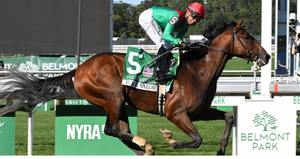
As for the Belmont and NYRA: watch this space. The Belmont Stakes is in the middle of its own identity moment. The old grandstand was demolished and the new Belmont Park, a $455 million rebuild funded by a New York State loan is not scheduled to fully open until September 2026. The race itself has been displaced to Saratoga for back-to-back runnings while construction continued. The third jewel of the Triple Crown has been running in a temporary home, at a shorter distance, while its permanent address is rebuilt from the ground up. That’s not a footnote, that’s the state of the Triple Crown’s third leg right now.
So consider where we actually are. The Preakness IP just changed hands. Pimlico is mid-renovation. The Belmont has been racing at Saratoga and won’t return to a finished facility until the fall. All three legs of the Triple Crown are simultaneously in states of flux and CDI made this move in the middle of all of it, after a story leaked that suggests the positioning has been underway for some time. You don’t need to call that opportunistic. The timing speaks for itself.
If CDI now controls the first two legs commercially, the pressure on the Belmont and on NYRA to align or negotiate will be real and immediate. That’s not a prediction. That’s how leverage works.
Racing has spent decades trying to tell the public it’s a sport first and a business second. Churchill Downs has never pretended otherwise, and I respect the honesty. But the rest of the industry, the horsemen, the smaller tracks, the state regulators, the fans who show up on a Tuesday afternoon in April because they love this sport deserves to understand what concentrated commercial control of the Triple Crown actually means.
Two legs of the crown. One corporation. $85 million.
That’s not stewardship. That’s ownership.
And in this industry, those two things are not the same.
A little Lord Acton maybe……