
Horses Need Help Today, Aftercare is Not a Success, There is Nothing to Celebrate Here
“When you celebrate an epic fail while the horses still suffer, the performance becomes more offensive than the failure itself.” JS
The Post
The Jockey Club posted it proudly on X. Thoroughbred Aftercare Alliance has granted more than $40.74 million to accredited aftercare organizations since 2012, helping 20,000 Thoroughbreds coming off the track. Currently 86 organizations with approximately 175 facilities. A photograph of a horse silhouetted against a sunset. Applause emoji implied.
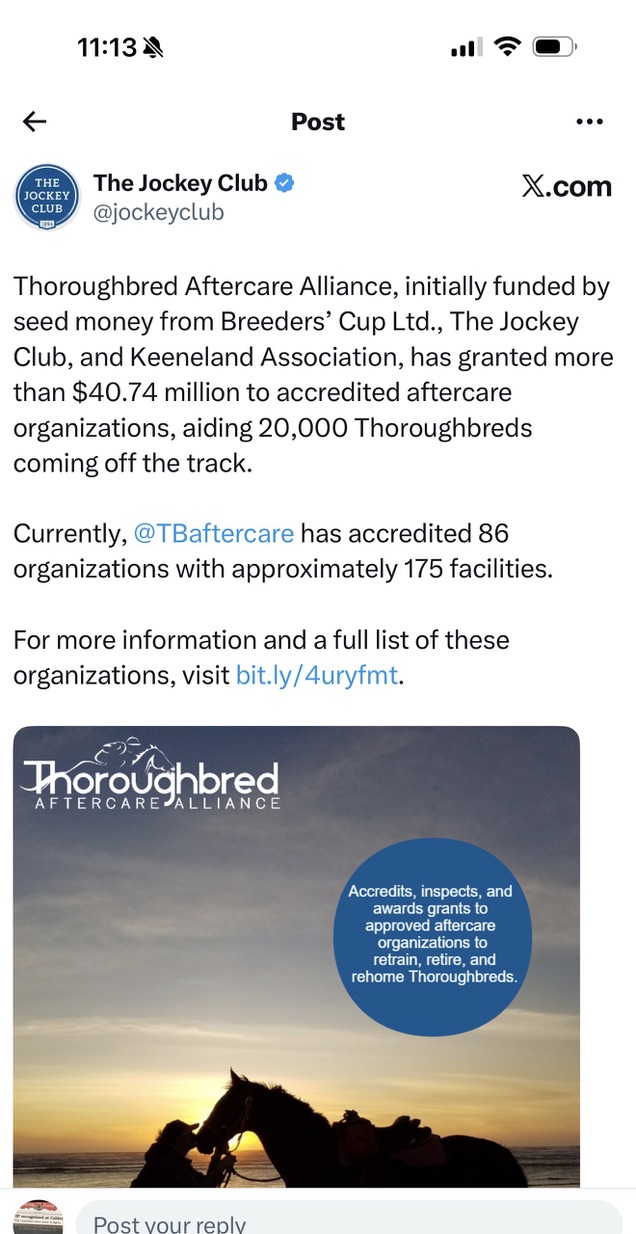
Read it again. Thirteen years. $40.74 million. Eighty-six organizations. One hundred seventy-five facilities. And a founding trio that includes The Jockey Club itself, Breeders’ Cup Limited, and Keeneland Association — the three most powerful institutions in American Thoroughbred racing — collectively holding nearly $200 million in net assets while tooting their own horns over a cumulative aftercare spend that works out to roughly $3.1 million a year.
The horses can’t read the tweet. The rescues begging for operating funds know exactly what it represents. The rest of us should, too.
The $2.5 Million That Isn’t Theirs
For 2026, The Jockey Club’s chair Everett Dobson announced that TJC is contributing $2.5 million to aftercare — “funding driven in part by registry transactions and proceeds from our commercial companies.”
“Driven in part by registry transactions.” That language is doing heavy lifting. Here is what it actually means: starting January 1, 2013, The Jockey Club raised fees by $25 for nearly all registry-related transactions, including foal registration, and directed those proceeds to the TAA. The breeders pay the fees. TJC collects them. TJC routes them to TAA and calls it a contribution.
Reilly McDonald made this point explicitly in a February 2026 letter published by TDN: TJC’s $2.5 million figure is misleading without clarification, because a meaningful portion of that funding is generated through breeder-paid registry transaction fees — “effectively a pass-through mechanism. In other words, it is not ‘The Jockey Club’ alone funding aftercare through The Jockey Club. It is actually the breeders.”
The Jockey Club is a fee-collection vehicle presenting itself as more of a a philanthropist. That is the entire story.
What the Numbers Actually Say
$40.74 million over 13 years. That is approximately $3.1 million per year, on average. The 2024 Keeneland September Yearling Sale, one auction, 12 days, grossed $427.8 million. The all-time record. Under the TAA’s contribution formula, buyers and consignors each contribute 0.05% of their transactions, with sales companies matching. Do that math on $427.8 million and you get roughly $428,000 from that single sale, barely 14% of one year’s average TAA grant pool.
The TAA’s own 990 filing shows total revenue of $5.86 million in 2024, a banner year. Of that, 80% goes to grants, per the TAA’s published allocation. That’s $4.68 million split among 86 organizations. Average grant: approximately $54,400 per organization annually. For a full year of aftercare operations, that number covers one horse’s basic annual care expenses at most facilities and not much else.
Meanwhile, the foal crop entering the system in 2023 was approximately 17,200 horses. Industry estimates put annual retirements from racing at 10,000 to 20,000 Thoroughbreds per year. The TAA’s cumulative 20,000 horses helped over 13 years represents, at best, a small fraction of the animals that have passed through the pipeline since 2012.
The industry celebrates the numerator. Nobody discusses the denominator.
The Cushion They’re Sitting On
Public filings tell a straightforward story. Breeders’ Cup Limited, one of the TAA’s three seed funders and perpetual co-celebrants of the TAA’s existence carries net assets of $101.1 million, according to its most recent Form 990. Total assets: $123.7 million. Fleming’s compensation: $767,483. Keitt’s: $479,326.
The Jockey Club, TJC, the registry, the institution that frames its fee-collection mechanism as charitable giving carries net assets of $78.1 million, with $81.1 million in total assets. James Gagliano’s compensation: north of $958,000.
Combined: nearly $179 million in net assets between the two organizations most prominently associated with racing’s welfare narrative. Against that, the TAA’s $5.86 million in annual revenue looks like what it is, a rounding error dressed up as a mission statement.
To be precise: nobody is accusing anyone of a crime. These are nonprofits operating within the law. The question is not legality. The question is proportion, and the question is honesty. When institutions with $179 million in reserves celebrate a $3.1 million annual average spend on aftercare as evidence of their commitment to the horses, something has gone wrong in the accounting not the financial accounting, but the moral one.
The Hierarchy of Concerns
In the same weeks that The Jockey Club posted its welfare self-congratulation, the sport’s racing media apparatus was largely silent on the fact that Irad and Jose Ortiz whose family has been documented by USA Today and, originally, by Past The Wire, in November 2025, to have participated in cockfighting finished 1-2 in the Kentucky Derby. The front-page USA Today story that confirmed PTW’s original reporting? Quiet across the industry’s major platforms. Not a concern. Not a moment worth interrogating.
Paco Lopez won the Preakness Stakes. A feel-good story. It was presented as one. What received considerably less prominent treatment: the circumstances around whether a suspension that could have affected his Preakness eligibility was appropriately processed and timed. The industry moved on.
This is the pattern. When the optics are good a cumulative dollar figure, a sunset photograph of a horse, a jockey’s fairy-tale Preakness victory — the machinery of racing media amplifies without scrutiny. When the optics are uncomfortable cockfighting, suspension timing, the actual mechanics of who funds what and how much the machinery goes quiet.
The horses in the aftercare pipeline aren’t a press release. They are animals requiring daily care, feeding, veterinary attention, and facility overhead that $54,400 per organization per year does not meaningfully address. The people running those organizations the ones not getting $767,000 compensation packages know this. They live it. I ask this question, who is doing more for the industry?
What Proportional Commitment Would Actually Look Like
The new expanded TAA funding structure mandatory 0.1% from buyers and consignors at Keeneland, Fasig-Tipton, and OBS, plus stallion contributions is projected to generate $4.4 million annually from sales alone, and $2.2 million from stallion farms. That is real progress in structure. It is not progress in proportion. It is not the Mike Repole proposal which to my understanding would up in a garbage pail on Park Ave.
Apply 1%, not 0.1%, but 1% of the 2024 Keeneland September gross to aftercare and you get $4.28 million from that one sale. Apply it across the full U.S. sales calendar and you transform the funding picture entirely. Nobody is proposing 1%. Nobody in the room where these decisions are made has any financial incentive to propose it. Terry Finlay of West Point Thoroughbreds has said, come with suggestions and ideas, are you paying attention Terry?
The Commonwealth of Kentucky allocated $250,000 annually to the TAA under House Bill 8, money that, it should be noted, flows from racino subsidies rather than general revenue. Against Kentucky’s conservative estimated $40 million in stallion-season tax revenue alone, $250,000 is 0.625%. That is the value the state places on cleaning up the back end of an industry it actively subsidizes at the front.
The industry talks about a “foal-to-forever” mindset. The math doesn’t support the mindset. It supports a minimum viable welfare gesture sufficient to deflect criticism, executed through mechanisms that allow the institutions with the deepest pockets to present other people’s money as their own generosity.
The Bottom Line
The TAA does real work. The people running accredited aftercare organizations do heroic work, often with inadequate resources and without compensation packages that approach six figures. None of this analysis is directed at them. I disagree with the censorship the TAA imposes on grant recipients, but that is something I have discussed in the past and likely will again in the future.
It is directed at the institutional performance of welfare commitment, the tweet, the press release, the cumulative dollar figure stripped of context, the careful construction of a narrative in which the most powerful and most financially secure organizations in American racing present themselves as the solution to a problem that their own structural priorities helped create and continue to perpetuate.
$40.74 million over 13 years. $427.8 million from one auction in 12 days. $179 million in combined net assets. $54,400 average annual grant per aftercare organization.
You do the math. The horses already have.
The Horse of a Different Color, or the X Post of a different color:
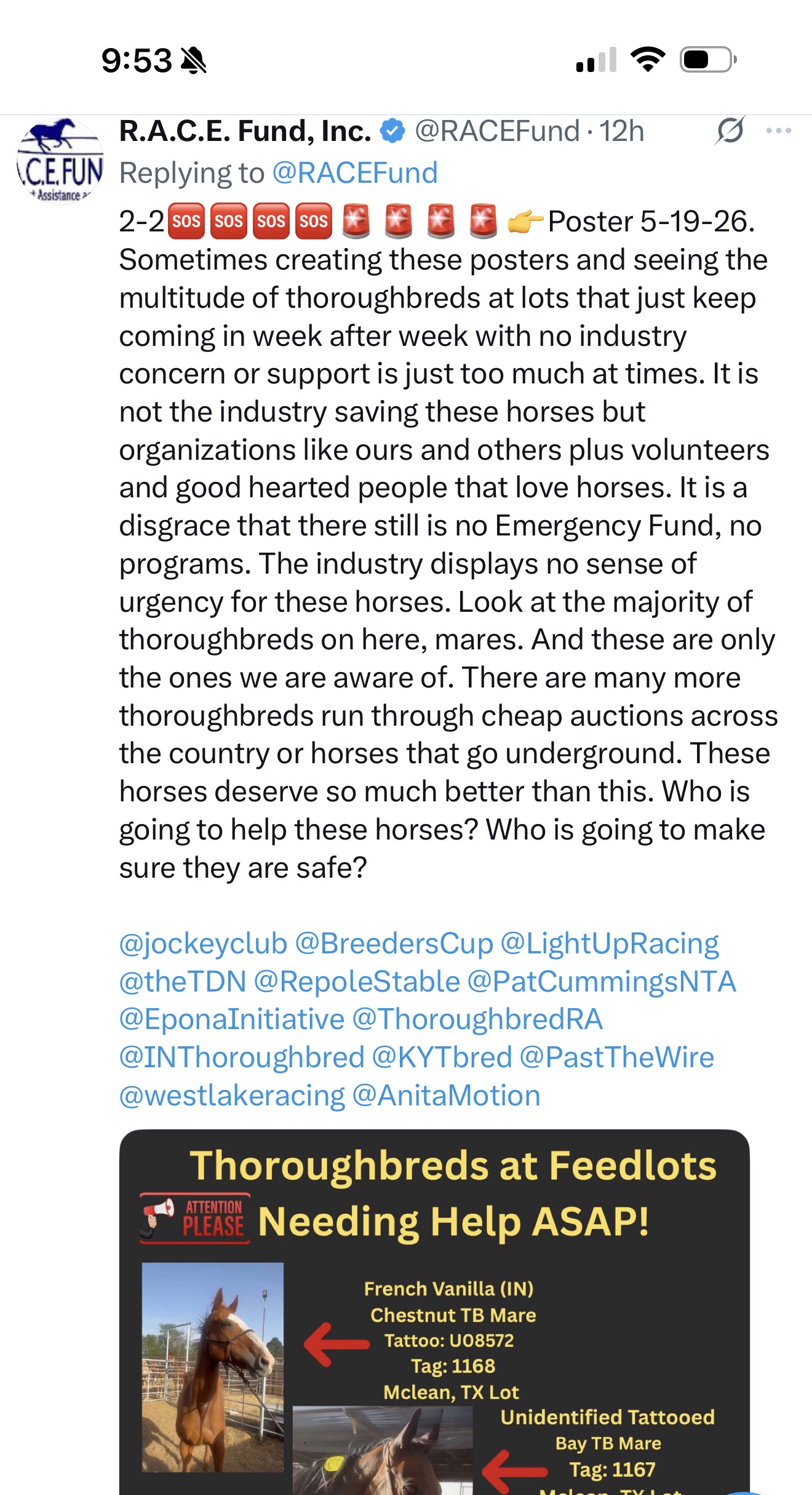
Don’t Bullshit Me: