
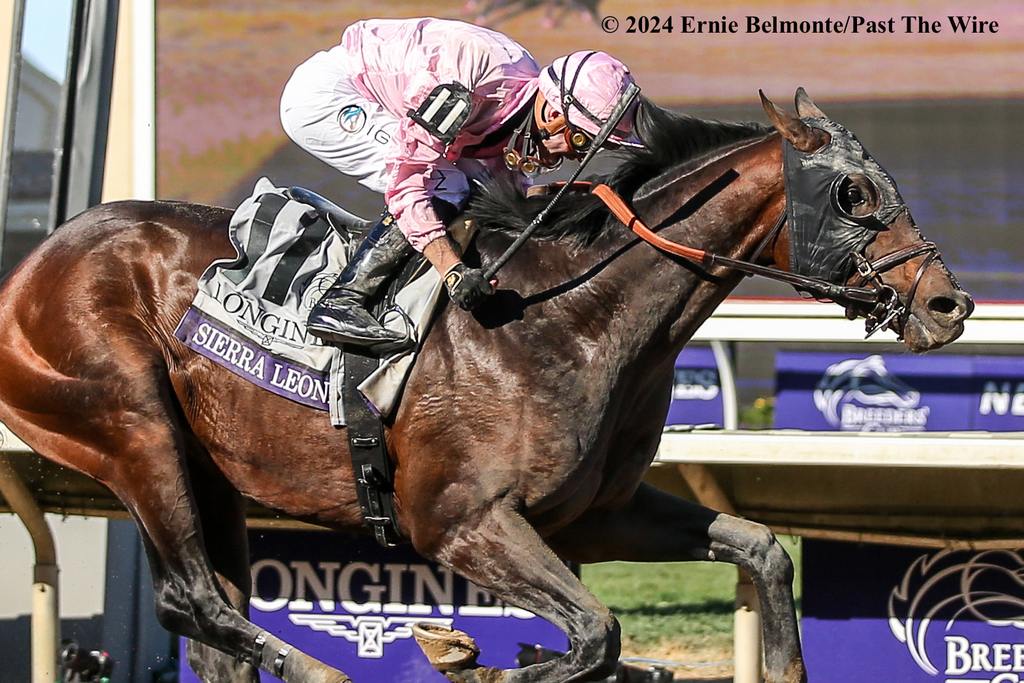

Sierra Leone defends his 2024 victory in the Breeders’ Cup Classic. (Ernie Belmonte/Past The Wire)
Rabbits on the Racetrack: The Unsung Pace Makers of the Game
By John Stettin
People love to talk about “pace makes the race,” but few take that phrase to its logical conclusion. If pace truly dictates outcomes, then why would anyone clutch their pearls at the mere use of a “rabbit”, the horse entered to ensure a fair, honest tempo for their stablemate? The truth is, rabbits have been part of racing’s DNA longer than most handicappers have been alive, even on dirt tracks in the U.S., where pace is king and energy distribution is everything.
Let’s get something straight right from the gate: using a rabbit isn’t unfair, it’s strategy. It’s no different than setting a screen in basketball or sending a fullback to open a lane or a wide receiver who is not getting a look from the QB sprinting down the sideline in full flight and focus. You’re using your stable’s assets to maximize your chance of winning, and last time I checked, that’s the entire point of competition.
The Buckpasser–Dr. Fager Rivalry and the Rabbits that Turned the Tables
Few races in American history capture the essence of pace manipulation like the 1967 Woodward, when Buckpasser, Dr. Fager and Damascus met in what became known as the Race of the Century. Dr. Fager, the freakishly fast front-running machine trained by John Nerud, could drown a field in his wake if left alone. Buckpasser and Damascus were at their best with something to run at. Let Dr. Fager control the race, and it might be over before the real running began.
So two rabbits went into the gate with him. Great Power was entered for Buckpasser. Hedevar was entered for Damascus. Their purpose was obvious: make Dr. Fager run early, force him to expend his greatest weapon before the stretch, and give the two closers a fair target.
Hedevar did the damage, pressing Dr. Fager through brutal opening fractions. The strategy worked. Damascus swept past to win by ten lengths, while Buckpasser caught Dr. Fager late for second by half a length. Two of the greatest horses ever to look through a bridle finished in front of Dr. Fager that afternoon, but neither gets the same race without the pace being created for them.
The rabbits did not produce a false result. They ensured that Dr. Fager could not produce one by controlling the race on his own terms. That was not unfair. It was strategy, and it turned one of racing’s greatest confrontations into a war of attrition.
John Nerud himself, never one to mince words, once said, “You can’t fight pace. A horse only has so many moves in him.” That’s the essence of why rabbits exist.
They don’t create false results; they prevent false ones.
From Saint Liam to Sierra Leone — The Modern Rabbit
The rabbit isn’t exactly a relic, it’s alive and well in the modern game, if you know where to look. Rick Dutrow, never shy about playing the game the way it’s meant to be played, famously used a rabbit for Saint Liam, his hard-knocking Grade 1 dirt star and Breeders’ Cup Classic winner. Saint Liam was at his best when the tempo was fast enough to soften up the early gas and let him pounce turning for home. Rick understood that, and he made sure the Woodward would unfold on his terms and different than the Whitney. He had to beat front running Commentator with arguably the better horse. Commentator had a tactical advantage in the Whitney and he won. In the Woodward Dutrow erased that and Saint Liam won. That was tactics, and smart ones at that.
Fast-forward to the present day, and we’ve seen a similar concept with Contrary Thinking being used to set the table for Sierra Leone, the deep-closing colt who seems vulnerable to a slow pace. Sierra Leone’s late run is a weapon, but only if there’s enough pace to attack. Contrary Thinking’s role was to guarantee that honest tempo, ensuring the real running came when it mattered most not in a crawl-then-sprint setup that would neutralize Sierra Leone’s strengths. Unfortunately, but through no fault of the “rabbit” we didn’t see the true results. Everyone who saw the Jockey Club Gold Cup witnessed the bumper car chain reaction that left Irad Ortiz unseated from Mindframe. Racing accidents happen, riders react suddenly and without advance warning, horses react faster, and all who watch opine. It is one of the many possible occurrences in a horse race.
Both Dutrow and Chad Brown understood the same truth: a rabbit doesn’t rig the race, it restores balance. It forces the field to play fair, and gives the true closer a chance to show what he’s got when the running gets serious.
Where Rabbits Still Run
You don’t see rabbits as often these days in the U.S., but in Europe and the Middle East, they’re still part of the playbook. Coolmore, Godolphin, and Juddmonte have all used pacemakers in big turf races to set the table for their headliners. In America, it’s rarer, but it happens, it’s usually in graded stakes where one stable has both a confirmed front-runner and a closer. Churchill Downs, Belmont Park, and Saratoga have all seen their share of strategic pace setups — though trainers tend to be more subtle now, calling it “a horse that just likes to be forwardly placed.” Right. Sure.
The Fairness Factor
Critics will say it’s unsporting. That it’s “gaming the system.” But ask any horseman worth a damn, and they’ll tell you there’s nothing unsporting about creating a legitimate pace. In fact, it’s the opposite. A slow, uncontested lead can turn a Grade 1 into a merry-go-round. When closers are forced to make up six, eight, ten lengths into soft fractions, that’s not talent deciding the outcome — that’s circumstance. I think we see it way too often especially in turf races here in the states. I have yet to meet an owner, trainer or bettor who likes losing under those circumstances.
The rabbit levels the field. It ensures the race is won on merit, not luck of the trip. It’s not about hurting anyone; it’s about making sure the better horse — the one with the truer turn of foot — gets a fair shot. Put em in the gate, let the best horse win.
As the great trainer Charlie Whittingham once quipped when asked about using one, “If you’ve got two in there, might as well use one of them smart.”
Final Furlong
In a sport obsessed with optics and too often detached from its own history, let alone customer, the rabbit remains one of the most misunderstood tools in the trainer’s arsenal. It’s not dirty, it’s not unsafe, and it’s certainly not unfair. It’s tactical. It’s chess, not checkers.
And if we’re being honest the sport could use a little more tactical thinking these days. A well-placed rabbit doesn’t taint the race; it makes the race. Because when pace makes the race, so does the horse brave enough to set it.
Contrary Thinking is among the pre-entries for the Breeders’ Cup Classic. The race promises to be one of the best renewals we’ve seen. Chad Brown has chosen to let his horses do the talking on the racetrack. Mike Repole, who plays the game as good or better than many has been more vocal even expressing his displeasure with “the rabbit” on social media and somewhat calling out Chad for the tactics. Personally I think it’s fun and adds to the intrigue of the race which by the way is far from a two horse affair. Mike has Fierceness and Mindframe. Both are live as is Sierra Leone but they are not the only ones. This brings us to the “other issue” in having multiple horses from the same stable. I don’t hear Chad complaining if one of Mike’s horses is out of gas his rider might keep his horse bottled up. This is all part of racing and why there are a million ways to lose a race but only one to win it. You have to wind up first. Let’s all enjoy this one and may the best horse win. Safe trips to all!