

Get your reservation for our annual Kentucky Derby seminar now! Details Here
A convicted trainer. An unapproved designer drug. An untouched gene pool. And The Jockey Club’s silence.
Let me tell you something I have said before and that this industry has chosen not to say at all. In my view, Maximum Security should never have been allowed to breed. I will say it plainly and I will defend it with facts, because in this business plainly stated facts that make powerful people uncomfortable have a way of disappearing into the noise.
This is not about punishing the Wests, who by every account available were themselves deceived by Jason Servis. Gary and Mary West bred the horse, raced him with genuine passion, and when the truth emerged, they did the right thing. They supported Saudi Cup disqualification. They released Servis. They were, by the evidence on the record, victims. This is not about them. This is about something larger, something structural, something that The Jockey Club — whose entire stated reason for existing is the protection of the Thoroughbred breed — should have addressed and did not.
An Unknown Drug and an Unasked Question
Let us lay out what is documented, not alleged, documented, in federal court filings, guilty pleas, and sentencing transcripts.
Jason Servis, for years one of the top trainers in the country by win percentage, pleaded guilty in December 2022 to felony charges of misbranding and adulterating a chemical substance and a misdemeanor of misbranding and adulterating SGF-1000. Federal prosecutors told the court that Servis administered SGF-1000 to virtually all of the racehorses under his control. The government’s own language. Virtually all.
SGF-1000 was not some gray-area therapeutic. It was compounded and manufactured in unregistered facilities. It was specifically promoted as being undetectable by racing regulators — the entire sales pitch was that the tests would not catch it. The drug purported to be a vasodilator capable of promoting stamina, endurance, and lower heart rates. It was not approved by the Food and Drug Administration. And according to prosecutors, those who marketed it did not fully understand what it was beyond the fact that it worked and the testers could not find it. That is not a therapeutic drug with an inadvertent overage. That is a designed instrument of fraud.
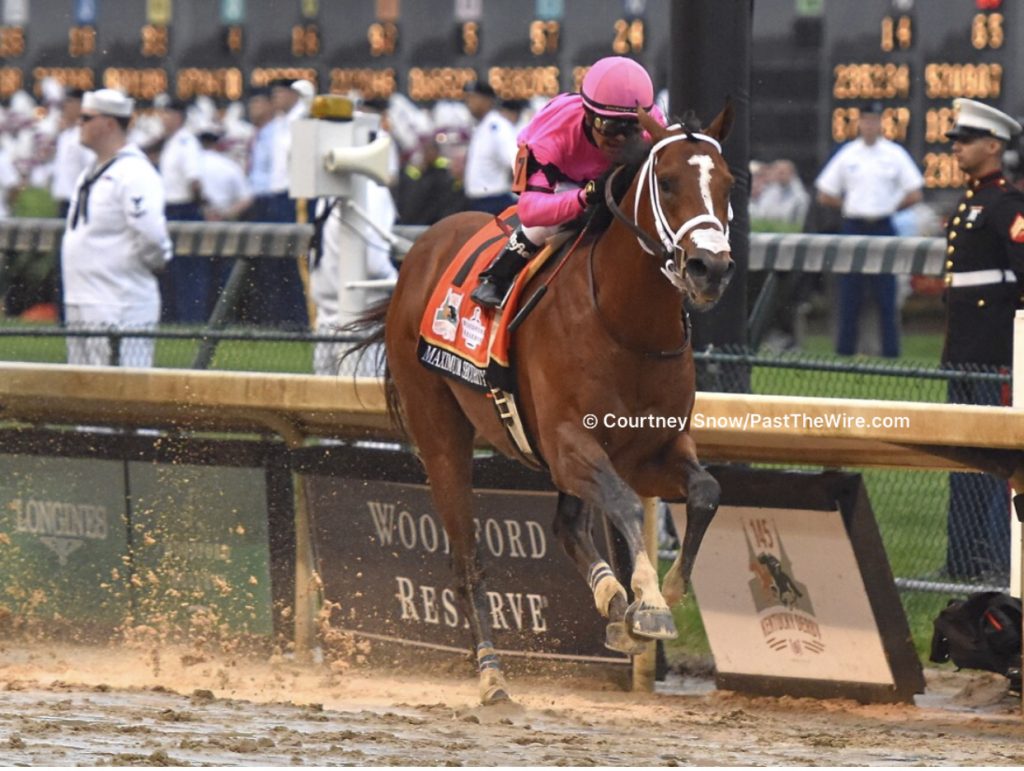
Among the horses in Servis’s barn to receive SGF-1000: Maximum Security. The original federal indictment, filed March 2020, specifically named the horse. Servis, in his guilty plea, admitted that Maximum Security had been administered SGF-1000. The sentencing judge quoted directly from wiretaps showing that Servis directed his people to keep Maximum Security on the clenbuterol sourced from fellow convicted trainer Jorge Navarro, who was sent to federal prison. Servis himself received a sentence of four years.
Here is what makes the breeding question not merely ethical but scientifically urgent: nobody knows what SGF-1000 did to the horses who received it. That is not hyperbole. Federal prosecutors explicitly stated that even those who manufactured and sold the drug did not fully understand its mechanism or long-term effects. It was designed to be undetectable. It was used on a racehorse that went from a $16,000 maiden claimer in December 2018 to the winner of a $20 million international race in February 2020. The trajectory was extraordinary by any measure. Whether that trajectory reflected natural talent, exceptional training, the drug, or some combination of all three is a question science cannot yet fully answer, because the scientific record on SGF-1000’s effects on equine physiology is effectively blank.
That should matter enormously to anyone who claims to care about the Thoroughbred gene pool.
What The Jockey Club Did — and Didn’t Do
The Jockey Club, founded in 1894, describes its mission as the improvement of Thoroughbred breeding and racing, and positions itself as the keeper of the American Stud Book. In May 2020, the same month Servis was under federal indictment, The Jockey Club finalized a rule limiting stallion books to 140 mares per year for horses foaled in 2020 or later, citing as justification the need to preserve the health of the Thoroughbred breed. The stewards wrote that the rule reflects The Jockey Club’s goal to preserve the health of the Thoroughbred breed for the long term.
That same Jockey Club had no rule, no provision, no mechanism, no public discussion about what to do when a horse whose entire career was tainted by an unapproved, undetectable, FDA-violating designer drug was prepared to enter the breeding shed. None. The stud book rules, as published, contain requirements about genetic typing, parentage verification, and registration eligibility. They contain nothing about whether a horse whose trainer pleaded guilty to administering an unknown performance-enhancing compound to virtually all horses in his care, including that specific horse, should be permitted to pass whatever SGF-1000 may or may not have done to his biology into the bloodlines of the Thoroughbred breed.
Maximum Security entered stud at Coolmore’s Ashford Stud in Kentucky for the 2021 breeding season at a fee of $20,000. He has since completed multiple seasons. His first foals are now racing. As Coolmore itself noted in late 2024, he had an impressive winner at Saint-Cloud in France from his first European runners. Breeders are sending quality mares to a stallion whose competitive career was conducted, in part, under the influence of a drug whose effects on equine genetics are unknown.
Let me be precise about what I am saying and what I am not saying. I am not saying Maximum Security’s foals will be defective. I am not saying SGF-1000 causes genetic damage. The science does not exist to say either of those things. What I am saying is that the science does not exist to say the opposite, either, and that is the entire problem. When you introduce an unknown compound of unknown mechanism and unknown long-term effects into the body of a stallion and then allow that stallion to enter one of the world’s most consequential breed registries, you are not making an informed decision. You are making a commercial one and hoping the biology cooperates.
Breeding decisions carry generational consequences. Bloodlines in the Thoroughbred are extraordinarily narrow. The Jockey Club’s own research, cited when it promulgated the mare cap rule, documented that 97 percent of all registered Thoroughbreds carry Northern Dancer in their pedigree, and that inbreeding coefficients have been rising for decades. The gene pool is already under concentration pressure. Adding stallions whose pharmacological history is a documented blank page into that equation is not a small decision.
The industry’s reflex will be to say this is unfair to the owners. I disagree, and not just because the Wests themselves were deceived. Unfair is a negotiable concept when weighed against the integrity of a closed breed registry. If The Jockey Club can limit mares bred per stallion to 140 in the name of genetic diversity, it can certainly ask whether a horse whose competitive performance was chemically assisted by an unapproved substance of unknown composition should be eligible to serve in that registry at all. The capacity to ask the question existed. The will to ask it did not.
The Institution That Never Asked
There is another question I want to put on the table, and I will frame it as a question because the documentary record I have reviewed does not answer it. At the time Maximum Security entered stud, who among The Jockey Club’s board of stewards, officers, or affiliated members held breeding partnerships, stallion shares, or commercial relationships with Coolmore, with Ashford Stud, or with the West breeding operation? The question is not an accusation. It is the kind of conflict-of-interest inquiry that any responsible governing body should be able to answer publicly and on the record, particularly when a decision of this magnitude, allowing a horse with this specific history into the American Stud Book as a breeding stallion, was either actively made or simply never discussed.
The Saudi Cup outcome gives us the clearest possible measurement of the stakes. Saudi officials withheld the winning purse of $10 million for over four years while they conducted their own investigation. Their stewards’ report found that Servis had administered prohibited substances contrary to the entry conditions of the race, that there were suspicious administrations in the weeks before the race, and that there was a significant level of underreporting on medical declaration forms. The Saudi Jockey Club, a foreign racing authority, took this seriously enough to conduct a multi-year inquiry, hold hearings, and ultimately disqualify the horse and redistribute the purse in August 2024. The American Stud Book’s keeper apparently never considered whether the same set of facts warranted any inquiry into the horse’s breeding eligibility at all.
To be clear about what was available and when: Servis was federally indicted in March 2020. Maximum Security entered stud for the 2021 breeding season. The indictment was public. The specific naming of Maximum Security in the federal charging documents was public. The Jockey Club had all of this information when it registered the horse as a breeding stallion and issued service certificates for his first book of mares. The decision to proceed was not made in ignorance. It was made in silence.
That silence is the story. Not the Wests. Not Coolmore, which operates a legitimate commercial breeding enterprise and purchased its interest in Maximum Security’s racing and breeding rights before the full picture became clear. The story is the institution that calls itself the guardian of the breed, that issues press releases about its commitment to the long-term health of the Thoroughbred, that caps mare books in the name of genetic diversity, and that apparently never once asked whether a horse doped with an FDA-unapproved, undetectable, compounded designer drug of unknown genetic consequence should be permitted to contribute to the bloodlines it claims to protect.
I said this years ago in a different context and without the full factual record now available from federal court proceedings. I will say it again now, on the record, with that record fully established.
If The Jockey Club’s mission means anything beyond a press release, someone there needs to explain, publicly and in detail, why this question was never asked. Or if it was asked, what the answer was and who decided it.
The breed deserves at least that much.
A final thought. Anyone familiar with how federal criminal investigations actually work knows two things: the FBI almost always knows more than it says, and consistently knows less than it should. That gap, between what was shared, with whom, and when is rarely as tidy as the official version. Who knows what Maximum Security may have been given and what long term effects it can have? Nobody is talking and now nobody is asking. And yet, through all that uncertainty, all that gray area, they still want to sell you the same line—it’s all about the horse. No, Maximum Security is not the only one.
The Roman poet Juvenal asked it two thousand years ago and nobody has answered it satisfactorily since: Quis custodiet ipsos custodes? Who watches the watchmen? The Jockey Club watches the breed. The breed deserves to know who is watching the Jockey Club.
Can you hear that?